
Organ Recital

The climb up the hill to Bradlow Knoll is without doubt an accurate indicator of the ageing process – calves are sorer, backs stiffer, breathing shallower and heart more flabbergasted than ever. Why are you doing this? it shouts. Sit down on the grass and breath slowly, you’re no spring chicken, or mountain goat. A bit more respect if you want me to go on pumping as I have these last 71 years! The problem is that one gets easily sidetracked if talking to one’s organs, and the heart is always the one that complains about things. I find conversations with my brain a lot more rewarding, my liver is slightly anxious and prone to melancholy, my lungs are no-nonsense and direct and perhaps lacking in humour. The stomach (my third favourite organ) is emotional but also stoical.

Anyway, half way up the hill, a moment to catch one’s breath was necessary, and as it was early in the morning on the first day of the new year, the fields and woods were very quiet, so that when a raven croaked overhead and landed about 20 yards away from the hedge I was sitting by, it was unaware of me (despite my pink jumper) and I could watch its corvine hopping from one patch to another, on the lookout for grubs, beetles or whatever. They are among the smartest of birds, with intelligence comparable to that of apes, and experiments have shown they are able to problem solve, use tools, plan ahead and even hold a grudge – a bit like us, in other words.

They are surprisingly large birds – the closest most people get to one is in the Tower of London where they are kept because it is said that the kingdom and the Tower will fall if the six resident ravens ever leave the fortress. These are fed twice a day by a Raven Master and dine on a special diet of mice, chicks, rats and assorted raw meats. As a special treat, they are given biscuits soaked in blood. But this one on Bradlow Hill had to work for its food, tugging and pecking between the tussocks of grass. Unfortunately, my mobile pinged as a message came through and the bird looked up and immediately flapped off towards the wood. The message was from the electricity company encouraging me to have a smart meter put in.

The rest of the journey to the top was uneventful, with the reward of sitting on CJ’s bench and soaking in the view with its manmade patchwork of fields and meadows in the distance, and with the time to consider the subtle differences in the shades of green available to walkers in the countryside – all presumably dependent on the type of grass or crop growing, chlorophyll concentrations, soil conditions, moisture levels, or fatigue or eye strain after spending too much time looking at screens (after which everything seems to have a green tint to it).

All of which brings us to ceramics and the use of green. At Peter Arscott Ceramics (PAC) the colour is rarely used by itself and seems to only work well in conjunction with another colour alongside. As you know from previous blogs, having green alongside red is very vibrant because they are complementary, or opposites on the chromatic wheel (as are blue and orange, yellow and violet). The greens we use are eider green, chromium oxide, chartreuse green and goosander green, usually combined with off red or brown stains, as in the image above, or next to a red that has been mixed with tin oxide to reduce any sharp contrast, as in the image below…….

…. or else the green itself is mixed with a little black to reduce its vibrancy, as in the image below ….

….or the overall red is no longer doing battle with the green because the green in question pulls towards yellow, as with the chartreuse green polka dots in the image below.

As with all colours, green has many associations, from nature and the environment, growth and renewal, health and healing and lots more. But let’s keep a sensible balance here and also acknowledge envy and jealousy, sickness, parrots, slime, and leprechauns. And that the former flag of Libya (1977–2011) was the only flag in the world with a single colour (green) and no design or details.

I’ve digressed. Back to ceramics: greenware is unfired clay. It’s the state in which the piece you have thrown or slab-rolled into shape sits under wraps while it dries. I use large plastic bags over them to slow down the drying process – too quick and the clay will crack. And thinner parts dry faster than thicker ones, so sometimes one has to spray with water to help the whole piece dry as uniformly as possible. This is one of the many reasons ceramicists get nervous before opening up the kiln after a firing and end up having angry conversations with their spleens when things go wrong, as in the image below.

Another kiln katastrophe
Interestingly, greenware is also the term for software distributed under the condition that the user does something to help the environment. The author expects the user to do something “green”. For example: planting a tree, eating more vegetables, or quitting smoking.

Holey vase – this one came out intact
Quitting smoking? That sounds like a New Year’s resolution, though it turns out that of the 40% or so making resolutions every year, only 25% remain committed after a month. Worse still, less than 10% end up accomplishing them at all. Most of us actually throw in the towel in the first few weeks of January. As a result, the second Friday in January is now often called Quitters’ Day.

Kinglet vase
Nonetheless, the team at PAC (Ziggy, Spyro, Shimpo and Yours Truly) have together decided that we will:
Embrace our flaws and imperfections
Book a night under the stars
Surround ourselves with positive influences
Let go of grudges and practice forgiveness (Shimpo)
Resolve conflicts calmly and openly
Not talk when mouth full of spiders (Ziggy)
Learn a musical instrument
Trim nose and ear hair (Spyro)
Reports on progress will be made publicly in future blogs.

small black and white construct
We hope you have a happy 2026, and that it is everything you want it to be.


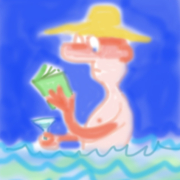


Happy New Year Peter
Amused to hear that you have a hierarchy of favourite organs – surely your eyes must be #1?
All best wishes, Steve
How do you know, dear Steve? I can think of one piece of me that I value above all others (I suppose a brain is an organ?)
Best
P
Never get tired of the view from Bradlow Knoll
It’s the reward for climbing up to it, and it’s getting more challenging every time – we’ll go up to it next time you’re here.
I need to ask you Peter, who Ziggy, Styro, and Shimpo are, do they help in your ceramic studio …( ☺️ )….. Green is lovely and a tricky colour for me to mix effectively. Lovely artwork and Happy New Yea.
Spyro is St Spyridon, patron saint of potters, who is in charge of Marketing at PAC. Shimpo is the busiest of the team because he is a pug mill and compresses all the unused clay into usable cylinder shapes, and Ziggy is in charge of keeping the fly population under control (usually during the Summer months) – he is a spider.
See you around. P
Happy New Year Peter!
The hierarchy of organs reminds me of the character in Woody Allan’s film Annie Hall.
Indeed, though I think it might be the film where he wakes after been put “on ice” for 200 years and is told that his brain was removed for inspection before being put back in, to which he protests: “but that’s my second favourite organ!”
Dear Peter, Thanks v much for your inspiring blog.
Sorry but one item I won’t be able to achieve.
Now that I’m over the flue come for that Panetone.[not pantone]
All best wishes to all (Ziggy, Spyro, Shimpo and Yours Truly) and Viv.
Will come over and we can discuss issues of world-wide importance
P