Posts

Organ Recital

The climb up the hill to Bradlow Knoll is without doubt an accurate indicator of the ageing process – calves are sorer, backs stiffer, breathing shallower and heart more flabbergasted than ever. Why are you doing this? it shouts. Sit down on the grass and breath slowly, you’re no spring chicken, or mountain goat. A bit more respect if you want me to go on pumping as I have these last 71 years! The problem is that one gets easily sidetracked if talking to one’s organs, and the heart is always the one that complains about things. I find conversations with my brain a lot more rewarding, my liver is slightly anxious and prone to melancholy, my lungs are no-nonsense and direct and perhaps lacking in humour. The stomach (my third favourite organ) is emotional but also stoical.

Anyway, half way up the hill, a moment to catch one’s breath was necessary, and as it was early in the morning on the first day of the new year, the fields and woods were very quiet, so that when a raven croaked overhead and landed about 20 yards away from the hedge I was sitting by, it was unaware of me (despite my pink jumper) and I could watch its corvine hopping from one patch to another, on the lookout for grubs, beetles or whatever. They are among the smartest of birds, with intelligence comparable to that of apes, and experiments have shown they are able to problem solve, use tools, plan ahead and even hold a grudge – a bit like us, in other words.

They are surprisingly large birds – the closest most people get to one is in the Tower of London where they are kept because it is said that the kingdom and the Tower will fall if the six resident ravens ever leave the fortress. These are fed twice a day by a Raven Master and dine on a special diet of mice, chicks, rats and assorted raw meats. As a special treat, they are given biscuits soaked in blood. But this one on Bradlow Hill had to work for its food, tugging and pecking between the tussocks of grass. Unfortunately, my mobile pinged as a message came through and the bird looked up and immediately flapped off towards the wood. The message was from the electricity company encouraging me to have a smart meter put in.

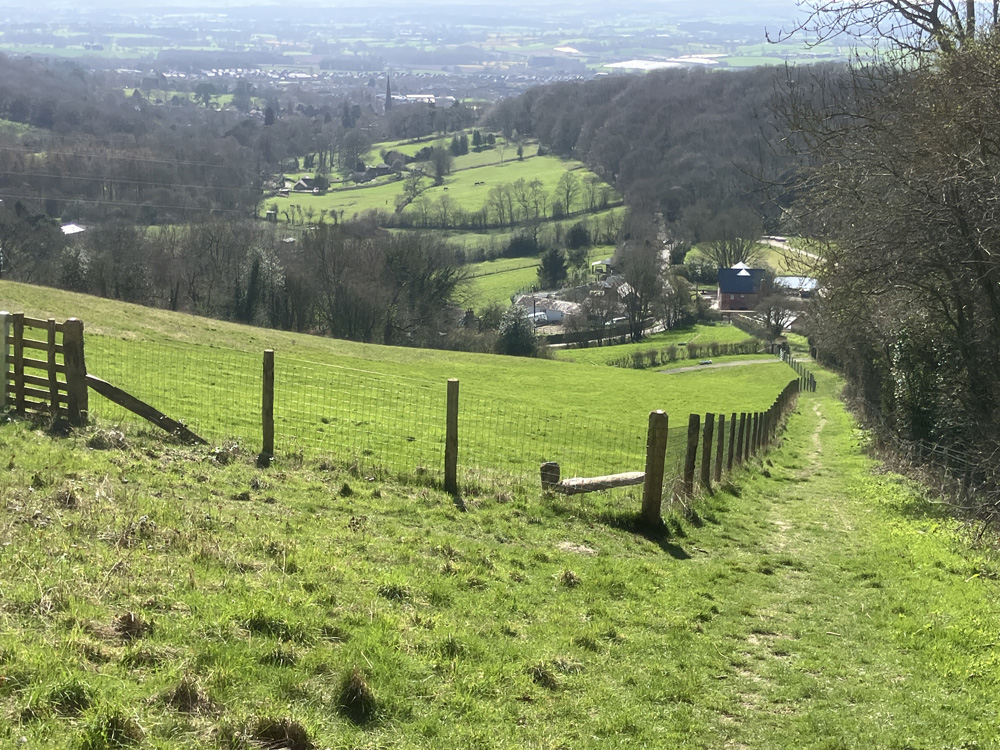
The rest of the journey to the top was uneventful, with the reward of sitting on CJ’s bench and soaking in the view with its manmade patchwork of fields and meadows in the distance, and with the time to consider the subtle differences in the shades of green available to walkers in the countryside – all presumably dependent on the type of grass or crop growing, chlorophyll concentrations, soil conditions, moisture levels, or fatigue or eye strain after spending too much time looking at screens (after which everything seems to have a green tint to it).

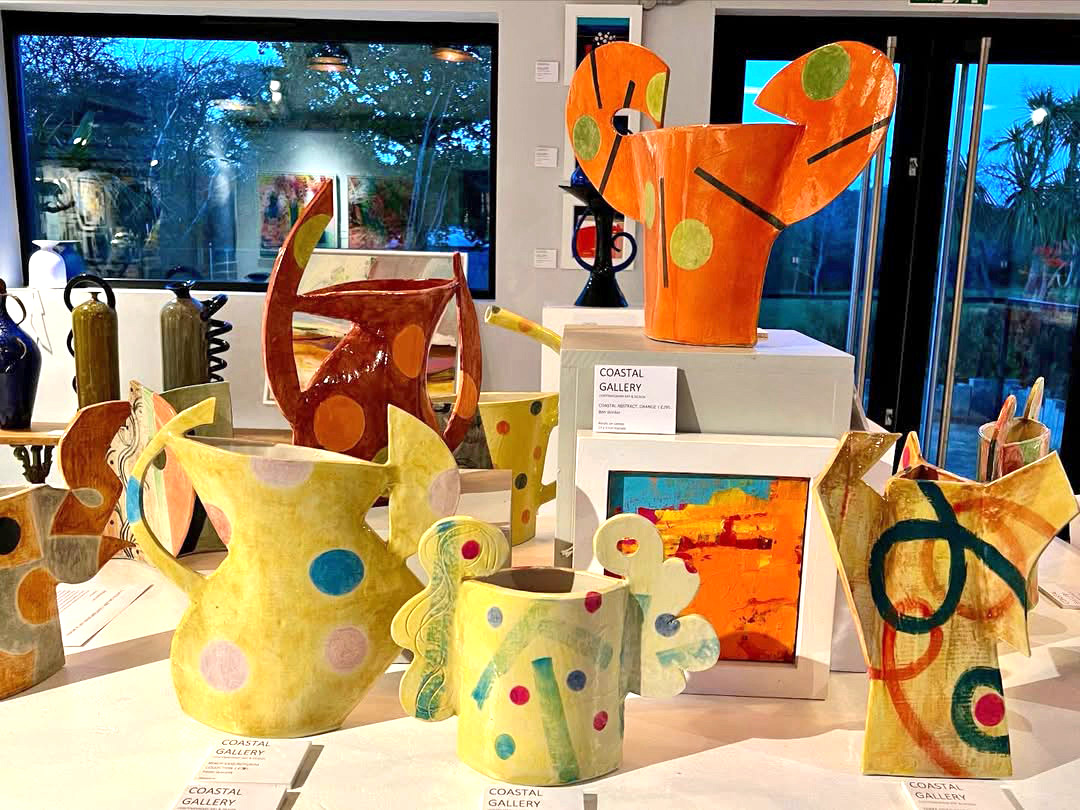
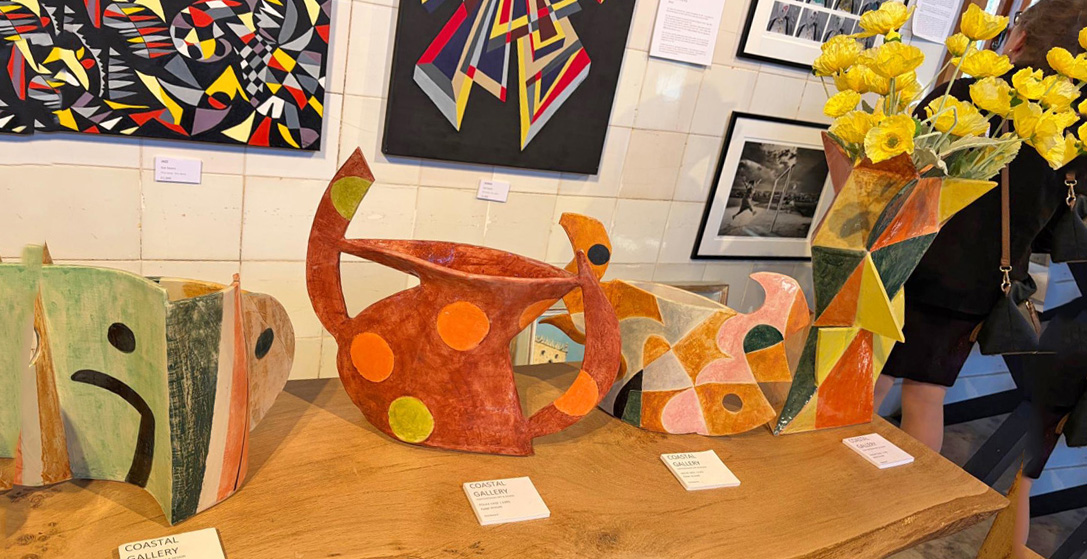
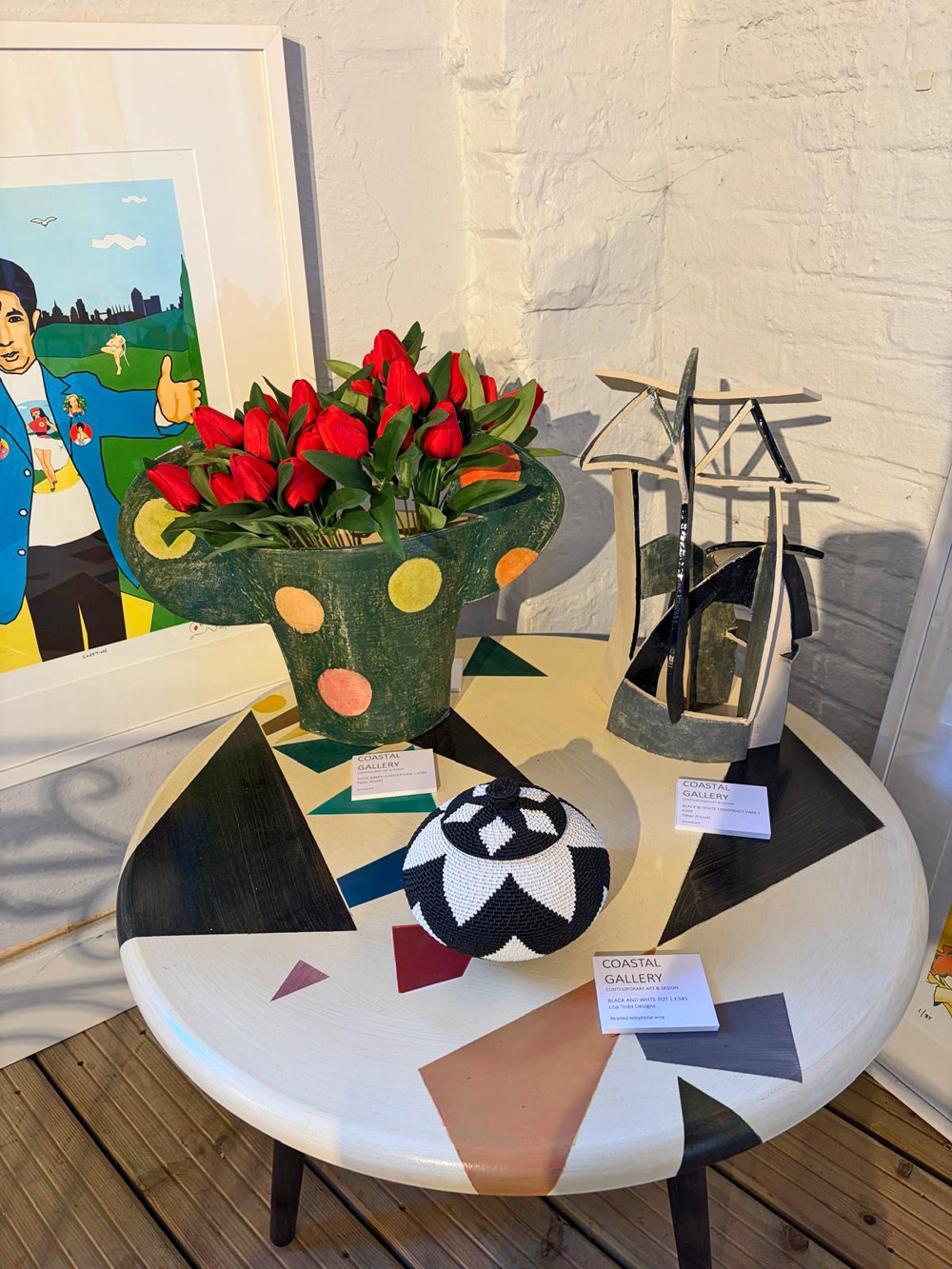
All of which brings us to ceramics and the use of green. At Peter Arscott Ceramics (PAC) the colour is rarely used by itself and seems to only work well in conjunction with another colour alongside. As you know from previous blogs, having green alongside red is very vibrant because they are complementary, or opposites on the chromatic wheel (as are blue and orange, yellow and violet). The greens we use are eider green, chromium oxide, chartreuse green and goosander green, usually combined with off red or brown stains, as in the image above, or next to a red that has been mixed with tin oxide to reduce any sharp contrast, as in the image below…….

…. or else the green itself is mixed with a little black to reduce its vibrancy, as in the image below ….

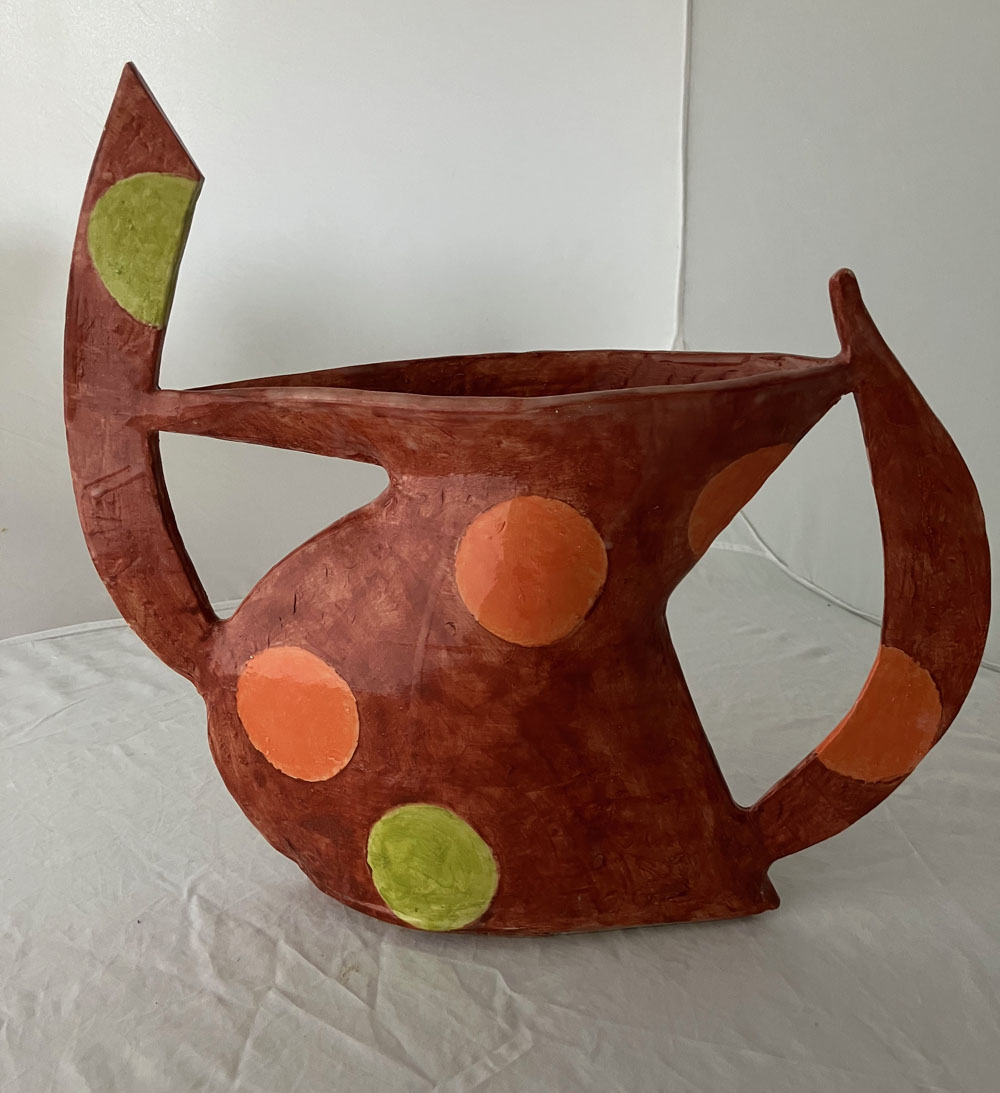
….or the overall red is no longer doing battle with the green because the green in question pulls towards yellow, as with the chartreuse green polka dots in the image below.

As with all colours, green has many associations, from nature and the environment, growth and renewal, health and healing and lots more. But let’s keep a sensible balance here and also acknowledge envy and jealousy, sickness, parrots, slime, and leprechauns. And that the former flag of Libya (1977–2011) was the only flag in the world with a single colour (green) and no design or details.

I’ve digressed. Back to ceramics: greenware is unfired clay. It’s the state in which the piece you have thrown or slab-rolled into shape sits under wraps while it dries. I use large plastic bags over them to slow down the drying process – too quick and the clay will crack. And thinner parts dry faster than thicker ones, so sometimes one has to spray with water to help the whole piece dry as uniformly as possible. This is one of the many reasons ceramicists get nervous before opening up the kiln after a firing and end up having angry conversations with their spleens when things go wrong, as in the image below.

Another kiln katastrophe

Interestingly, greenware is also the term for software distributed under the condition that the user does something to help the environment. The author expects the user to do something “green”. For example: planting a tree, eating more vegetables, or quitting smoking.

ceramic vase with decorative holes

Holey vase – this one came out intact

Quitting smoking? That sounds like a New Year’s resolution, though it turns out that of the 40% or so making resolutions every year, only 25% remain committed after a month. Worse still, less than 10% end up accomplishing them at all. Most of us actually throw in the towel in the first few weeks of January. As a result, the second Friday in January is now often called Quitters’ Day.

Kinglet vase

Nonetheless, the team at PAC (Ziggy, Spyro, Shimpo and Yours Truly) have together decided that we will:

Embrace our flaws and imperfections

Book a night under the stars

Surround ourselves with positive influences

Let go of grudges and practice forgiveness (Shimpo)

Resolve conflicts calmly and openly

Not talk when mouth full of spiders (Ziggy)

Learn a musical instrument

Trim nose and ear hair (Spyro)

Reports on progress will be made publicly in future blogs.

small black and white construct

We hope you have a happy 2026, and that it is everything you want it to be.

In praise of tweeting

View from Bradlow Hill, with the town of Ledbury in the distance

View from Bradlow Hill

It struck me while I was walking up Bradlow Hill and into Frith Wood that though I meet people walking in the opposite direction, that is, coming towards me, I wonder if they meet people other than me. Because most people will sensibly choose the way that offers least effort, the one with a slow ascent into the woods and then the downhill walk along Bradlow Hill – I think I’m one of the few who do it the hard way, and that subsequently people get to see my face hoving into view more than others.

A carpet of bluebells amongst the trees in Frith Wood.

Bluebells in the Frith

The reason I do it is for the reward of the view after the exercise, and as an indicator of how the ageing process is coming along. Legs get heavier with age. One of the walkers I met in the wood was a lady from Winchester who used to live in Malvern, but who comes to the Frith once a month to walk and relax. She said it uncluttered her mind and helped her relax – the quiet, the bluebells (see above), the birdsong and the relative wildness (compared to Winchester). Blackbirds, blue tits, black caps, chiff chaffs, a song thrush and a pheasant all contributed to calming the mind on this occasion. Birdsong should certainly be prescribed by doctors to treat mental health conditions, such as certain types of anxiety. Perhaps not the pheasant, they make strange metallic calls – the Pavarottis of the bird world they’re not.

Recently on BBC Radio 4 there was an intriguing programme by Sacha Dench on the plight of one of the world’s most persecuted birds, the vulture. However misunderstood they are (and they are), they shouldn’t be included in the doctors’ prescription: they make raspy, hissing sounds while feeding and fighting, along with grunting noises that can sound like hungry pigs or dogs barking in the distance. Luckily there aren’t any in Frith Wood or the Ledbury area.

Greater Stitchwort – Frith Wood is full of them.

Last week in Wales, on a family visit, I heard a Grasshopper Warbler for the first time. Its high, grasshopper-like song is usually what gives it away. Even when you hear one it can be difficult to locate it because of the way it throws its song. My daughter could hear it clearly, but it took me a while to catch the sound – it turns out that as we get older the first part of the hearing to deteriorate is the exact pitch the grasshopper warbler sings at. Sad to think most of us will stop hearing them at some stage in our lives, so I’m glad it happened. It’s a Red List species, and thus very rare. Click here to see a picture of one.

Cooee vase. Nothing to do with birds.

Here at Peter Arscott Ceramics we have sometimes been asked about birds and ceramics. Specifically, does bird poop affect outdoor ceramics, like birdbaths, for example. The answer is no, the vitrification of the glaze firing protects the ceramic from the acidity of the bird droppings. Research by PCA reveals that birds don’t have the same level of control over their sphincter muscles as humans or other mammals. This means they can’t hold their waste, leading to seemingly random pooping. These are the sort of facts you learn in this blog.

Stoneware vase with upturned handles looking like spindly arms. Painted orange with big green dots.

Polka dot vase

Whilst we’re on the subject, pooping while in flight is a way for birds to lighten their load and conserve energy, especially for longer flights. And they often have preferred areas for pooping, such as where they spend time or find food. They might poop on a garden bench, or near their nest, or, of course, on your head or your car, which is why it’s good there are no vultures in Ledbury.

green, ochre and grey striped vase with skewed handles

Verde vase

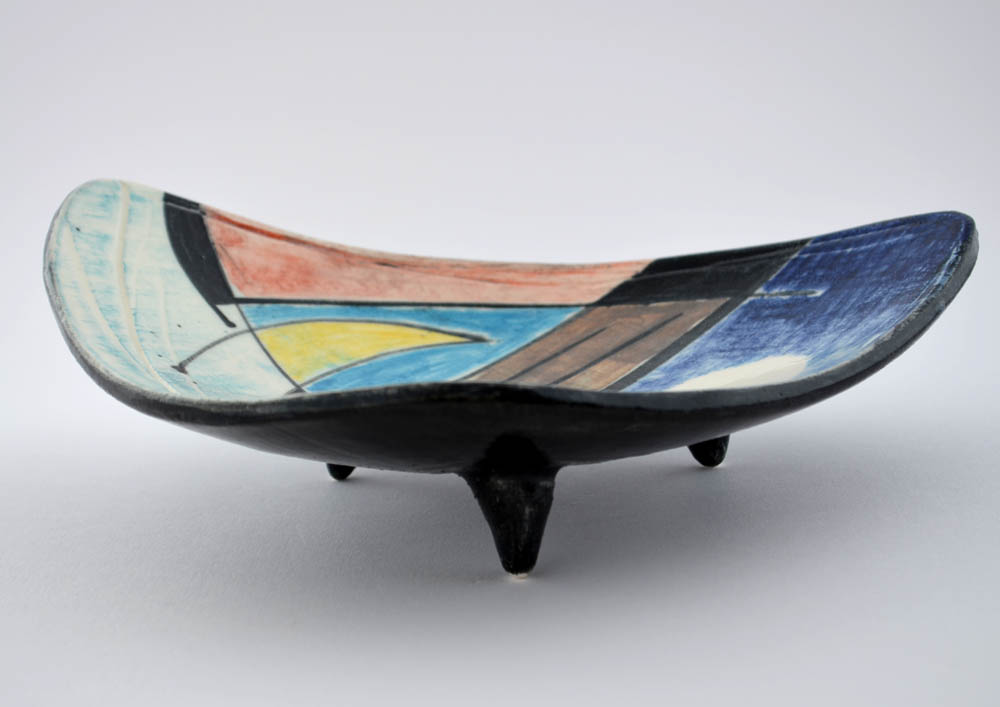
Pablo Picasso used birds in his work, from the early paintings of pigeons roosting which can be seen at the Picasso Museum in Barcelona, to the famous dove of peace drawing. He also used them in his ceramics, both sculpturally and as motifs, as on this earthenware dish from the 1950s.

Limited edition of Picasso plate with white adobe bird painted on black background.

Picasso bird

And thus, we finally come to ceramics (“About time”, says Spiro. “And why did you have to mention bird poop?”).

Architectural ceramic piece made up of horizontal and vertical slabs

Construct 1.

PAC’s creative juices are flowing in all directions. Although we are still in love with the basic idea of the vessel, or vase, as the basis for most work, the lure of the sculptural possibilities in ceramics often takes us down different paths. Using grogged stoneware clay, which lends itself to modelling, this large structural piece took shape after careful and deliberate work with weight and balance – remember that once in the kiln and at a temperature of 1200℃, a clay piece can easily flop about and collapse, depending on weight distribution.

Big Hugging vase

On the other hand, and as a contrast (in character it is almost the opposite of the previous piece), this next one (above) was made in one session with no preparation or planning, and turned out in the shape it did, still retaining some practical use – you could possibly wash a small baby in it –  but definitely pulling towards appearance for its own sake.

Swirl vase

We’ve been producing “spontaneous” ceramics for a while – it’s not something new that PAC has stumbled on. The Swirl vase (above) came out of the studio in 2017. The Tutti Frutti jug (below) is from 2018.

Tutti Frutti jug

Going back to the subject of birdsong and tranquility (not again!), the edge of the Frith was flecked with the white bloom of the hawthorn. Its flowers, typically white or pink, bloom in spring, often around May, giving rise to the name “Mayflower”, but its antispasmodic and nerving actions make it suitable for anxiety or nervous tension – it is also sacred to the fairies and is therefore considered unlucky to bring indoors.

image of hawthorn tree in full bloom in May

Mayflower

We do keep a bird indoors in the studio. He is Murphy the Mallard and he’s always quacking jokes: Two vultures were eating a dead comedian. One looks to the other and says, “Does this taste funny to you?”

Ceramic mallard duck made by a child

Murphy says bye


Many Vast Elephants Make Jam Sandwiches Under No Pressure

I wonder of any of you have been craning your necks up at the night sky recently. There’s been an alignment of planets visible to the naked eye and Venus has been the most spectacular and can still be seen as a bright ‘star’ in the early evening, if you look to the west. Its position in the sky is bringing it closer to the Sun as March rolls on, so only a few days left to see it. Mercury, Mars, Jupiter, Neptune, Uranus and Saturn are the other ones vying for your attention, but time is running out and it won’t happen again till 2040.

Photo: Petr Novák, Wikipedia

Venus, named after the Roman Goddess of Beauty, presumably because it’s so bright, brought to my undisciplined and ruminating mind the sadly armless Venus de Milo, the venus flytrap, Venus in Blue Jeans, Men Are from Mars, Women are from Venus, and finally the Venus of Dolni Věstonice (though I did have to come home and check on the spelling). You may have heard of her – the oldest known ceramic in the world, discovered in Czechoslovakia. A clay sculpture figure of a female, which has been dated to 29,000 – 25,000 BC.

Diligent vase

To think we’ve gone from using ceramic for this primitive (but powerful) figurine of a Mother Goddess to making objects as diverse as spark plugs, fibre optics, artificial joints, space shuttle tiles, oven tops, self-lubricating bearings, body armour, and skis. Human progress (?) as measured by clay. By the way, I did not know that enough ceramic tiles are produced each year to pave a path 300-ft. wide around the world. The things you learn.

Green striped vase

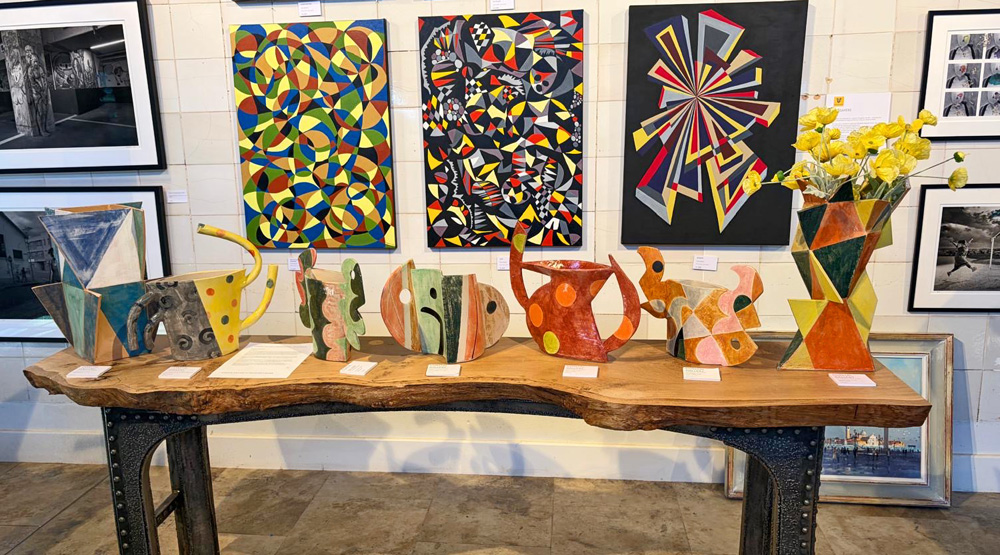
Despite the multiple and varied uses clay can be put to, I instinctively feel that it’s at its best when it is made into a vessel, when it draws the human hand to pick it up, weigh it, feel its surface, fill it with water, and the human eye to admire its shape and colours. Like, for example, Peter Arscott Ceramic (PAC) pieces, new images of which I’ve scattered within this blog.

Lime Welcome vase. Cecilia Colman Gallery

Let me just say that PAC ceramics are well-priced and affordable to those of you who appreciate uniqueness and quality. A PAC vase is not as expensive as a small bowl known as the Chicken Cup from the Ming Dynasty: it was sold in Hong Kong in 2015 for $ 36 million. A rooster, a chicken and a chick are depicted on it, thus its nickname.

Torero vase. Palais des Vaches, Exbury

After patting me on the shoulder for finally getting around to mentioning my vases, Spiro, being Greek, and being Patron Saint of potters, is telling me that the word “ceramics” is traced back to the term keramos, meaning potter’s clay or pottery. I reciprocate etymologically by telling him about my “claggy” walk up to Bradlow Knoll (Spiro does not walk), and that the word is from the Middle English claggen, probably of Scandinavian origin; akin to Danish klagge sticky mud, akin to Old English clǣg clay.

Autumn vase. Cecilia Colman gallery

And indeed, it was claggy, not slippery but viscous and adhesive underfoot, and the weather warm with hazy sunshine, so that by the time I reached CJ’s bench I was hot and bothered. There’s more construction work going on in the nearest adjacent fields, mainly barns, fencing and access tracks, but if you look into the distance around and beyond Ledbury, the reflected gleam of plastic sheeting is more obvious, as soft fruit farming gets into gear for the season, and with the addition of hundreds of houses being built, the town is slowly creeping further into the countryside.

Orange juggler vase

There’s a balance to be struck between the idea of preserving what’s valuable and catering to the needs of a society. Things shouldn’t be preserved for the sake of it: if there’s a housing need then houses must be built. If farming land can be used more efficiently by applying new approaches, why not? And after all, the British countryside is essentially man made and shaped. But we ought to keep an eye-out. Don’t forget what happened to the River Wye – an example of a catastrophic imbalance because a check was not kept on the huge growth of chicken farms.

Pink Green vase. Cecilia Colman Gallery

But back to ceramics, and away from chicken poo. The Palais des Vaches in Exbury has received a new batch of PAC ceramics, as has the Cecilia Colman Gallery in London.

St Sebastian vase. Palais des Vaches.

Exbury is in the New Forest not far from the coast, opposite the Isle of Wight. This part of England is unlike any other: open heathland, wild and intriguing. After delivery, I took a wrong turn and ended up asking the only local in the vicinity for help, but any offer was unforthcoming as he continued chewing grass in the rain and looking rather wary.

Unforthcoming

On the other hand, St John’s Wood in London, where the Cecilia Colman gallery is, belongs to another world: Regent’s Park, Lord’s Cricket Ground, elegant shops and restaurants.

Cecilia Colman Gallery

You may have gathered that the title of this blog is a mnemonic for memorizing the order of the planets, starting with the one nearest the Sun: Mercury, Venus, Earth, Mars, Jupiter, Saturn, Uranus, Neptune, Pluto.


And finally some good advice from an old Congolese saying: If you are asked to join a parade, don’t march behind the elephants.


Capriccio

Ceramics is more than just playing with mud, as has been discussed on this site before. It ranges from the functional and commercial to the personal and expressive, from pieces that demand no attention because they exist to hold a pile of sandwiches to pots that require effort from the viewer as you move around the object, examining details and angles that provide an emotional connection with the maker.

Tabu teapot by Angus Suttie at the Sunday Painter gallery

In London recently, and on a visit to The Sunday Painter gallery, the work of Angus Suttie (1946 – 1993) was on display. His approach was described as “tapping the subconscious to see what happens”, and he turned out work that is humorous, direct and engaged. Strong vertical or horizontal shapes, with twisted forms, holes and conduits, piled-up different forms from smaller parts, playful and probably unplanned from the start, they are “awkward and beautiful” as he himself described the work. The exhibition is on until 26th October – click here for the link, if you’re anywhere near the South Lambeth Rd, drop in.

Red and Green dancing vase – Peter Arscott Ceramics

That element of play is important. Starting out without a clear plan or design in mind can lead to all sorts of interesting outcomes, specially with hand-building when you can cut the clay and shape it as you build your piece. At Peter Arscott Ceramics the vessel is still king, and is the basis for all work, but sometimes functionality is not obvious, or, rather, not relevant, as the personality of the piece takes shape – often in a whimsical direction.

Poseur vase

“Whimsical” is such a strange-sounding word. “Whimsical derives from whim-wham, a noun from the early 16th century that originally referred to an ornamental object or trinket. Later whim-wham, with its fun sound, came to refer to a fantastic notion or odd fancy” (Merriam-Webster dictionary). So that explains it: whimsical, quirky, capricious.

Lone goat

There is nothing capricious about setting off to walk up to Bradlow Knoll – it is a serious undertaking for two-legged beings of a certain age whose gamboling days are long behind them. However, this latest walk led to an encounter which put a spring in the step, as the recent fencing layout on the hill was eventually explained by the number of goats grazing. As all walkers know “When setting out upon an important journey, it’s good luck to meet a goat.”

Apologies for my lexicographical meanderings – it’s probably a phase. There are two theories as to how the word “capricious” is derived.  It comes via French from the Italian word capriccio, which originally referred not to a sudden desire but to a sudden shiver of fear. It probably comes from the Italian capo, meaning “head,” and riccio, the word for “hedgehog” – anyone who shuddered in fear was said to have a “hedgehog head,” meaning that the person’s hair stood on end like the spines of a hedgehog.

Capriccio vase, or St Sebastian vase.

My preferred theory is the possible link to Italian word “capra”, meaning “goat,” because of the animal’s perceived whimsical nature. Anyway, they are sociable animals, intelligent and curious, and, thanks to them, coffee was first discovered when Ethiopian goat herders noticed the animals acting energetically after nibbling coffee beans, though I prefer the version where the abbot of a monastery full of lazy monks saw the effect on his goats and fed the beans to his brethren.

Cockerel vase

St Spyridon, patron saint of potters and former goat herd, known by the PAC team in the studio simply as Spiro (in charge of Marketing) is keen that we know that goats are one of the cleanest animals, though they dislike water and would rather leap over streams and puddles than step in them. They also use the sneeze sound to warn each other of danger. Fact: the pharaoh Cephranes thought that so much of his goats that he had 2,234 buried with him. Spiro also says that goat yoghurt is the best – that’s all he eats.

Autumnal vase

As you can see from the image at the start of this blog, the view from Bradlow Knoll in early October gives every appearance that summer is still with us. The only tree that is turning autumnal is the horse chestnut, and there are not many in the neighbourhood: ash, hawthorn, hazel, blackthorn, sycamore and apple are more common in Herefordshire. This time of year is all about apples and cider-making, and in the cluster of villages around Much Marcle, the Big Apple Harvest festival takes place on 12th and 13thOctober. You can visit the local orchards, see, hear and smell cider and perry being made and taste and buy many different varieties of apples, local ciders, perries and apple juices. Click here.

Michaelmas daisies

Michaelmas daisies are all out now. They are a sure sign of Autumn and are so called because they reach their peak on or around the 29 September, Michaelmas Day, or The Feast of Michael and All Angels, signifying the end of the harvest, the start of autumn and the beginning of the shorter days.

A couple invited the local vicar for Sunday dinner. While they were in the kitchen preparing the meal, the minister asked their son what they were having.
“Goat,” the little boy replied.
“Goat?” replied the vicar, “Are you sure about that?”
“Yes,” said the youngster. “I heard Dad say to Mom, ‘Today is just as good as any to have the old goat for dinner.’

All the King’s horses

This is going to be a very equine blog. As one gets older, the more challenging the climb up Bradlow Hill becomes, and the more one wishes for a horse. The weather was breezy, and there was a lot of Red Campion about in the wood, having taken over from the Bluebells – the moment when both overlap would have been a month ago: a sea of blue and pink.

Red Campion

Recently I took up the birthday gift by my children of a riding lesson in the Western style, not far from Ledbury, in a place called Ullingswick. It was more fun than expected, given that the last time I sat on an animal was in 1967, and the tolerance of April (my horse) was impressive, as is the fact that I did not fall off. The Western style encourages the rider and horse to become one, with the former using his or her body to guide the horse, who responds to pressure from a knee or a shift in weight.

April carrying a sack of potatoes

April had all the qualities of a ceramicist: patience, perseverance, stoicism, and equanimity (a habit of mind that is only rarely disturbed under great strain). If she had fingers rather than hooves, she would make a good potter.

Juggler vase at Cecilia Colman Gallery

Earlier in the week I was in St John’s Wood to deliver some ceramics to the Cecilia Colman Gallery, which you may remember from a previous blog, has been operating for forty-five years. It’s an established star in the ceramics firmament.

Streaky bacon

Regent’s Park and Zoo are nearby, lots of shops, but also some fine residential buildings built in the late 19th century Streaky Bacon style, or ‘Constructional Polychromy’ – alternating bands of brick and marble, which was popular with British architects. I mention architecture in order to show you a recent piece from the kiln called Construct. There is an affinity between ceramicists and architects in that both vessels and buildings are ways of filling space (discuss).

Construct

I was a little early, so I went to a café. A morning coffee isn’t always accompanied by the unexpected thrill of a seemingly endless column of beautiful chestnut horses clip-clopping their way past the large windows of a London café on its way to Regent’s Park. There must have been over forty, twenty riderless, that passed by with an air of disdainful boredom, as if the gawping pedestrians confirmed all their prejudices about two-legged beings.

All the King’s horses

The barista confirmed that this was a regular occurrence. Based in St Johns Wood, the King’s Troop Royal Horse Artillery is responsible for firing royal and ceremonial salutes as part of the sovereign’s birthday parade in April, the state opening of parliament, state visits and Remembrance Day. The barista was a talented joker. When I said I thought they were beautiful thoroughbreds, he told me he had once I put a bet on a horse that had excellent breeding, and that after it left the starting gate, it stopped and closed it behind him.

Red ochre vase at the Cecilia Colman Gallery

Unable to get horses out of my mind, I inevitably resorted to finding out a bit more about them. So, did you know that horses can sleep both lying down and standing up, thanks to a special locking system in their legs? You’ll like this: when foals are born their hooves are covered with soft tissue which stops their mothers’ birth canal and uterus from being damaged – they are called fairy slippers.

Cuckoo spit

Horses produce 10 gallons of saliva a day – saliva has very important functions because it wets feed material and begins to break it down. It also has an important buffering effect in the stomach, reducing acidity. Since we are talking of these matters, above is a picture I took in Bradlow Knoll of some Cockoo Spit, which has nothing to do with horses’ saliva.  Inside each mass of cuckoo spit is a juvenile yellow-green froghopper.

The adult froghoppers or spittlebugs  are 6mm long and bright green, with large eyes and a blunt-shaped head, but they’re rarely seen because they hop away on their strong back legs at the first sign of danger. We all know people like that – excepting the “bright green” bit, I assume.

Tall pink ochre vase at Cecilia Colman gallery

With the excuse that a froghopper looks like a plump cricket, here in St John’s Wood is the home of the sport. Lord’s  has been  the birthplace of cricket since 1787, but looking at the grounds from outside one has to admit that they’ve moved on with the times, and their roofscape is nice mixture of the old and the new. They say that if cricket wasn’t so difficult to understand, most of its obsessives and followers might never have bothered with it at all. Here are some of the fielding positions players take up: Deep point, Backward point, Deep backward point, Short third, Deep third, Short leg, Square leg, Deep square leg, Backward square leg, Long leg, Short fine leg, Deep fine leg, etc.

Lord’s cricket ground

Most people have some sort of obsession, major or minor, though cricket is not one shared by the team here at Peter Arscott Ceramics (PAC). Spiro (Marketing) has a passion for goat yoghurt, Ziggy (fly-catching) is forever pondering the significance of  Proust’s “A la Recherche du temps Perdu” and Shinto (the pugmill) goes on and on about sushi. In my case it’s Picasso’s Demoiselles d’Avignon that has always bothered me – it’s the elbow sticking out at the top, centre, of the painting, which the vase below always reminds me of.

Demoiselles vase at the Cecilia Colman Gallery

Les Demoiselles d”Avignon by Pablo Picasso

A horse walks into a bar. “Hey,” says the barman. “Yes please,” says the horse.

Sign in Frith Wood

Potter Pete’s foggy day

The view down to Ledbury

This time I groped my way up Bradlow Hill – forget the mud, the rain and the general swampy state of the countryside at present – this was different because I could not see anything in front of me. Fog shrouded everything, as you can see from the picture of the “view” above.

entrance to Frith Wood

Faced with the entrance into Frith Wood, I chickened out of groping any further and blindly banging my head on tree trunks, so turned back and walked along Green Lane in Dog Hill Wood until I reached Ledbury, an easy flat route into town, and the original pack horse trail connecting Worcester to Hereford. There are fragments of  yellowish sandstone on and around the path, formed millennia ago by sand brought by nearby rivers which settled around the tide line in layers (as it does in beaches today) when this area was a coastal stretch.

Green Lane

A great deal of Queen Anne’s Lace and alkanet, unfairly deemed a weed by gardeners, grew along the path, which was, of course, slimy with mud and is specially tricky as it leads downhill into town, but once you are near St Michael’s parish church you are safely back on dry and even surface.

alkanet

A useful angel to have on your side, St Michael the Archangel, patron saint of grocers, soldiers, doctors, mariners, paratroopers and police, and conqueror of Satan.

St Michael’s

Satan is so often depicted as a monstruous three-headed entity, or as a horned beast, half human half goat, or as a squirming dragon, but I believe he is the personification of mud. I promise that this is the last blog where I complain about mud – after all, I am a potter, and it is my source material. By the way, never buy a wig from the Devil, there will be Hell toupee.

And what about ceramics? Well, I have little to show you right now, as the big pieces I am now making take such a long time to dry before they can go into the kiln for bisque firing – and it is no good speeding up the drying process as this will cause the more exposed parts of a piece to dry more quickly that the body, thus creating tension leading to cracks. So, it is always wise to wrap the pieces in plastic to encourage uniform drying, and not to, say, expose it to the sun.

However, here is another experimental piece, not the usual vessel, more an architectural exercise. To remind yourselves of  PAC’s vessel-based work, do visit the website: https://www.peterarscott.co.uk

If you would like to read something that combines waitresses, xenophobia, the Pope and a café, here is a link to a short story of mine called Mysteron (2600 words) on Fiction on the Web. Please read it if you’re in the mood, if it is unread, then it does not exist. Click here.

stumped

On my way up to Bradlow Hill I walked past the tree stumps along Knapp Lane. The trees had been felled as they were a potential danger to traffic. I noticed that each stump had a ring of blue studs inserted evenly around the inside of the edges. What is this? One of you out there will know – please tell us.

Queen Anne’s lace

We often hear mist and fog mentioned alongside each other, but the difference is a simple matter of how far you can see through it. If you can see more than 1,000 metres it’s called mist, but if it is thicker and the visibility drops below 1,000 metres it’s called fog.

What’s a bigamist?

It’s what Italians call a thick fog.

April showers bring more than flowers.

The art of walking on sludge requires you to walk bow-legged and on bent knees, leaning forward if going uphill, so that by the time you reach CJ’s bench at the top of Bradlow Hill your thighs ache like a ballerina’s after five consecutive performances of Swan Lake.  By the way, someone has left a nice pair of gloves that are now wedged between the slats waiting for their owner.

England’s sewage system

The rain has been relentless in this part of the world, making the ground as soft as chocolate fondant, delaying planting and seeding by farmers, flooding many areas, reducing oxygen in the soil (think of the poor worms) and forcing water companies to allow sewage into the rivers – this last revolting image the direct result of the privatisation of water and the neglect of any control over “market forces” in the guise of hedge funds. The result is priority for shareholders’ dividends over proper investment in upgrading an outdated system that can no longer cope with the zillion turds we produce daily. Enough moaning.

Bluebells in Frith Wood

Despite the muddy pathway into Frith wood, I ventured in, knowing that you would want proof that at least some things are still as they should be. What with Ukraine, Gaza, climate change, polarized politics, and all the rest of the present gloom fest, it’s good to know that the bluebells are with us, and the wood anemones.

Anemones

On my way out of the woods I passed by a large patch of forget-me-nots. The Greek name Myosotis is a combination of “mus” and “otis” and means “mouse ear”, referring to the shape of the leaves. I’m posting the image because they are beautiful delicate blue flowers with a yellow eye and grey-green velvety leaves, and they are vibrant, heart-warming and make one smile – a reminder of a friend who is no longer with us.

Ceramics: the good news is that the new kiln is now up and running, and a first batch of vases has been glaze-fired successfully.

Big Yoohoo vase just out of the new kiln

The kiln is a Rohde front-loader called Helmut – very efficient and accurate, with a good work ethic.

Introducing Helmut.

He is extremely heavy and here I must give thanks to Steve whose knowledge of cantilevered engineering worked a treat when we moved H into position. He deserves a medal and should any of you be interested in acquiring or finding out about medals of the Great War then Steve, professional military history researcher that he is, is your man. Click here to visit his sight. So far, Helmut seems to get along with the rest of the team – it’s all change here with the introduction of Shinto the Pugmill too.

Thelonious undone.

Spiro and Ziggy are very sad that Thelonious (the old pugmill) is no longer here, and were upset to see him being loaded onto the back of a lorry by a forklift truck to be taken to the (gulp) scrapyard.

Spiro and Ziggy making a scene

It seems that nobody wants anything requiring three-phase power. If anybody is looking for an inverter designed to drive a three-phase induction motor, please get in touch – this one is an IMO iDrive2 XKL.

While writing this blog, news arrived from local MP Jesse Norman that the government has published the River Wye action plan, with up to £35 million in new funding, setting out a wide range of measures to address phosphate pollution and other environmental impacts on the Wye. It has also appointed a new River Champion for the river. All this could lead to a properly funded single collective long-term effort bringing all groups together. That’s a good result and, who knows, it may even be the first step towards the eventual re-nationalization of water.

Back to ceramics.

Stockpiling at PAC.

Here is an architectural piece made from left-overs from the slab roller. It would look better if it were 10ft high.

And before I finally abandon the issue of what can be found bobbing on the surface of our rivers:

  • What is brown and sticky?
  • A stick.

Have a good Spring.

Anatomy of a fall

The view from Bradlow Knoll at 10 am New Year’s Day

Pottery is just an excuse to play with mud. The material used is really nothing more than soil clay that has been mined. Mud is wet soil. Roll a ball of moist sediment into a thin string – if you can, it’s clay. It’s generally accepted now that playing with mud allows children to connect with the natural world around them, and helps develop tactile skills, boosts creativity and imagination. And it’s fun and therapeutic. And I think this applies to adults too. Using your hands to shape clay into a vessel is an ancient practice that is fulfilling, and whole cultures are identified by their pottery, after all it is one of the oldest and most widespread of artforms. Pots say a lot about people.

New Year’s Day, old moon.

But as you well know, when it’s been raining a lot in the countryside, mud becomes an enemy not a friend, and you have to take it into account when you go for a walk, specially up and down a hill like Bradlow Knoll. In the early morning of the first day of the New Year, the sky was clear after the rainfall of a few days – weighing the pros and cons, and mindful of my duty to my faithful blog readers and seeing a pale waning moon beckoning in a blue sky, I decided the omens were good for a climb up the hill and a first photo of this year’s view.

Walk in the woods vase

However, the problem with walking on claggy mud is that you have to keep your eyes on your feet the whole time. One small lapse of concentration and can send your legs into the air, so you try to step on the least wet bits along the edge of the path, head down and unable to appreciate the surrounding landscape. Which is tiring and frustrating, specially deep into Frith Wood where the dark tree cover keeps everything as damp as possible, though there was a wintry sun low in the sky that you could glimpse through the trees.

I was not really enjoying my New Year’s walk. The mud was not fun and therapeutic, though maybe the worms were enjoying it; in one acre of lands there can be more than a million worms, so I imagined them partying underfoot. There is a stretch towards the end of the walk that is surrounded on both sides by brambles so it’s difficult to use the drier edges of the path. It was here that my concentration strayed because the birdsong was so unexpected and loud. I was trying to identify all the various songs (mainly blackbird, robin and bluetit) when it happened.

Some doctors  believe that one of the biggest benefits of mud baths is that they can provide stress relief. Sitting in warm, soft mud can relax the muscles and soothe the mind. They are also thought to relieve stress, joint pain, rheumatoid arthritis and certain skin ailments. Some people use mud baths simply to chill out. What I found myself in face down was not a warm bath of mud but an unrelaxing cold and slimy one that did nothing for my self-esteem.

It was a slow-motion experience in three stages. First the right foot slid backwards, and I thought I’d land on my right knee (no big deal, I thought, just a muddy knee). Second, because it was slightly downhill, my upper body was leaning forward enough to propel me further, so I stuck out my right hand to stop things getting any worse (no big deal, just a muddy hand, as well as knee). Third, my right hand made contact with the mud and slid forward all the way until the whole right side of my body lay obligingly in the quagmire. This happened in less than a second, but it felt very gradual – it’s amazing what your brain can be doing in such a short time: surprise (this cannot be happening!), anger (I showered and put on clean clothes an hour ago in honour of this New Year, and now look!), indignity (God, I hope nobody’s looking!), curiosity (all the birds have suddenly stopped singing, are they having a quiet laugh? Do birds laugh? I must find out), and finally disappointment and petulance (I was being so careful all the way, it’s just not fair).

I met two dog walkers further on, at a fork in their path, and wondered whether they’d heard my expletives. They looked vaguely concerned at my state, and I had two choices: either I let them go along my path to see if they too slipped in the mud or I recommended the alternative path ahead of them. The Devil in me lost and I told them how to best avoid my fate – it was my first good deed of the year. By the time I got home the sun was out again low in the sky and cast a long shadow, reminding me that we’ve already had our shortest day (22 Dec), and that seemed to put things in proportion, so I blamed my shoes, which have no grip and are inappropriate for walks.

guilty shoes

Somewhere in the Frith Wood is the mud imprint of yours truly. It will last until the next rainfall, then dissolve back to its natural muddiness. Mud is the stuff of creation, used to create Adam, so how come it’s used to tarnish people? Mud is thrown at people in accusation, a name is dragged through it, anything dark and confusing is clear as mud, a person who resists change is a stick in the mud. But we potters know better, which is why I hold nothing against it, other than, occasionally, my body.

architectural pieces drying.

And ceramics? (It’s about time you mentioned them, says Spiro). Well, yes, the new kiln is yet to be connected, so I have been making pieces that have not been bisque fired and sit around waiting in the studio, like the ones in the image above, and the set of Yoohoo vases below.

Yoohoo vases waiting for a bisque firing

Also waiting for kiln connection and bisque firing are various figures and pieces made by visitors to the studio. The lynx pictured is a favourite.

Lynx by Lisa Dearling

And finally, and given that these blogs always seem to refer to woods and trees: a man walks into Frith Wood and tries to cut down a talking tree. “You can’t cut me down,” the tree exclaims, “I’m a talking tree!” The man responds, “You may be a talking tree, but you will dialogue.”

Goodbye 2023

Possibly because it was a cold, grey, miserable day, my walk up Bradlow Hill and into Frith Wood was a lonely one. Not a single walker passed by, nor did I even see a squirrel, and there was no birdsong, except for the distant cawing of the resident raven. It was an unusually silent trudge along the woodland track, the whole atmosphere was brooding, possibly reinforced by the inactivity in the ceramics studio due to delays in connecting the new kiln – creative juices with no outlet can make a person very gloomy – and by the realization that the familiar whiff in our sitting room indicates a dead rat in the skirting boards. The smell is faint now, but building up to its peak for Christmas day.

Crouch vase at Cecilia Colman Gallery, London

Feeling uninspired, I turned a rock over with my foot to find what I expected to see: bugs scuttling away, mainly woodlice. “Aha!” I thought to myself, “here are the true companions of my walk today.” Just because they are not visible and make no sound does not mean they should not be respected as denizens of the wood, as much as the charismatic squirrels, foxes and birds, who have not bothered to make their presence felt; lethargic, pampered and entitled as they lie in their nests, dreys, lairs and setts for the day.

In praise of the woodlouse, the species is found across the UK in almost any habitat. They are flat, oval and grey with a thick exoskeleton and have seven body segments, each with a pair of legs. They are actually crustaceans, related to shrimps and crabs. Like their aquatic relatives they easily dry out, which is why they hide away in cool, damp places during the day and come out at night. To recycle copper in their diet (as their blood is copper based like all marine crustaceans) they eat their own poo, but they also munch away at decaying wood, leaf litter, fungi, fruit, dead animals, as well as other animals’ poo. By the way, eating your own poo is not recommended – do not do it at home.

Granny grunter

If you collect a few woodlice and keep them in a jar, try sniffing it after a while. They excrete ammonia through their exoskeletons, so it’s unpleasant, which is why they are called ‘stinky pigs’ in parts of the UK. They are also known as ‘chiggy pig’ (Devon), ‘gramersow’ (Cornwall), ‘sow bug’ and ‘woodpig’.

Flower vase at Cecilia Colman Gallery

They have 250 recorded names in the UK, including Billy Baker, Monkey pea, Parson’s pig, Cheese log, Daddy granfer, Granny grunter, Damper, Slate cutter, Hardy back, Penny sow, Cheesy bug and Nut bug. Probably names given by children, who are after all the ones closest to these things that crawl around on the ground, it’s children who find them under stones and under sticks, and who play with them.

Segment vase at Cecilia Colman Gallery, London

One insect I did not see was the mythical caterpillar, a beast so rare that only my granddaughter knows about it. It is half caterpillar and half cat – notice the sharp claws at the end of its many feet, the long tail and the feline head.

Cat/erpillar. Erin Arscott Richards

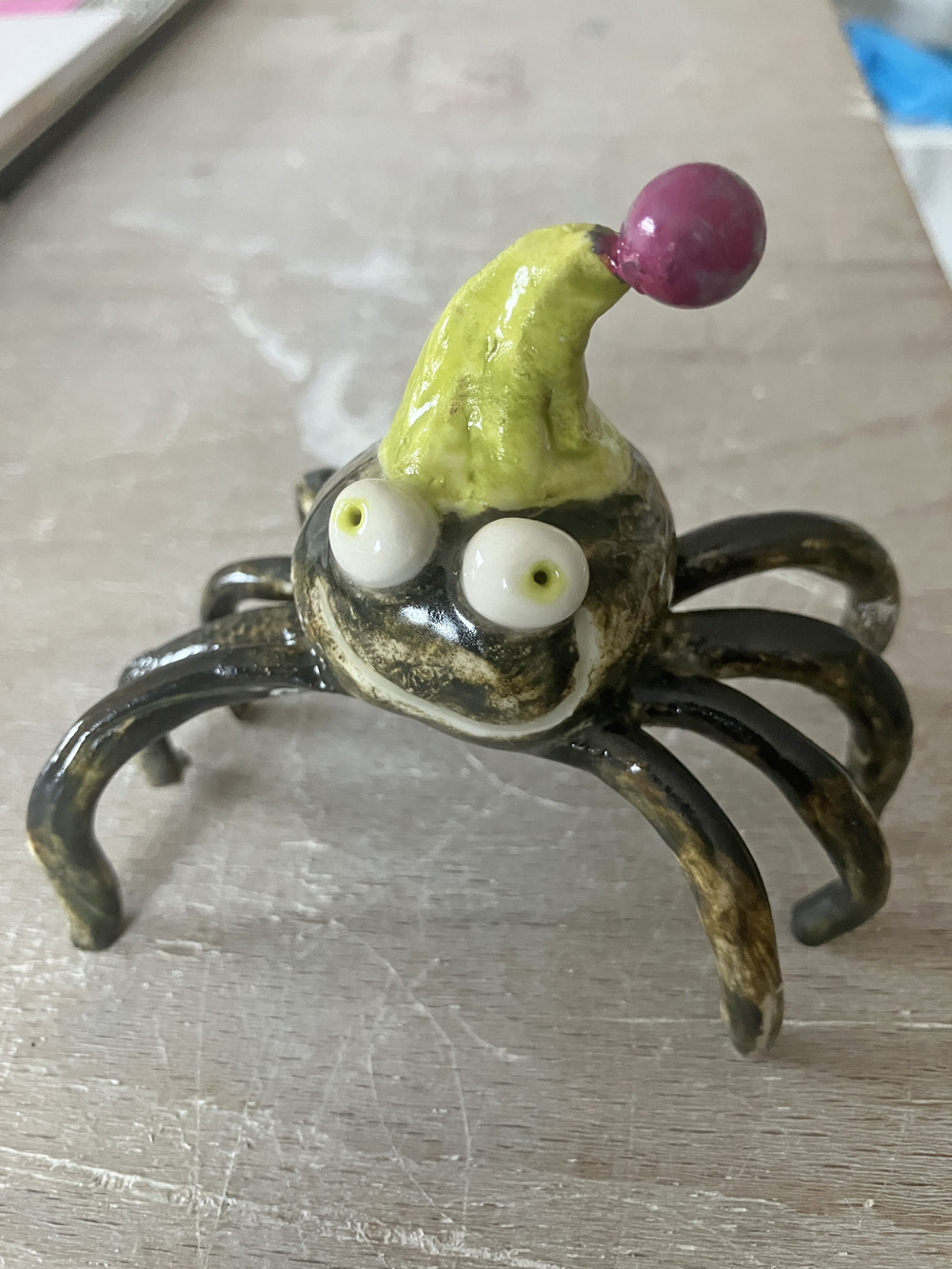
In an effort to be as fair as possible about bugs in general, I include images of two studio residents, a spider and a slug. Both are ceramic portraits, the spider a very accurate one of Ziggy, who as regular readers of this blog know, is in charge of fly-catching in the studio.

Ceramic portrait of Ziggy

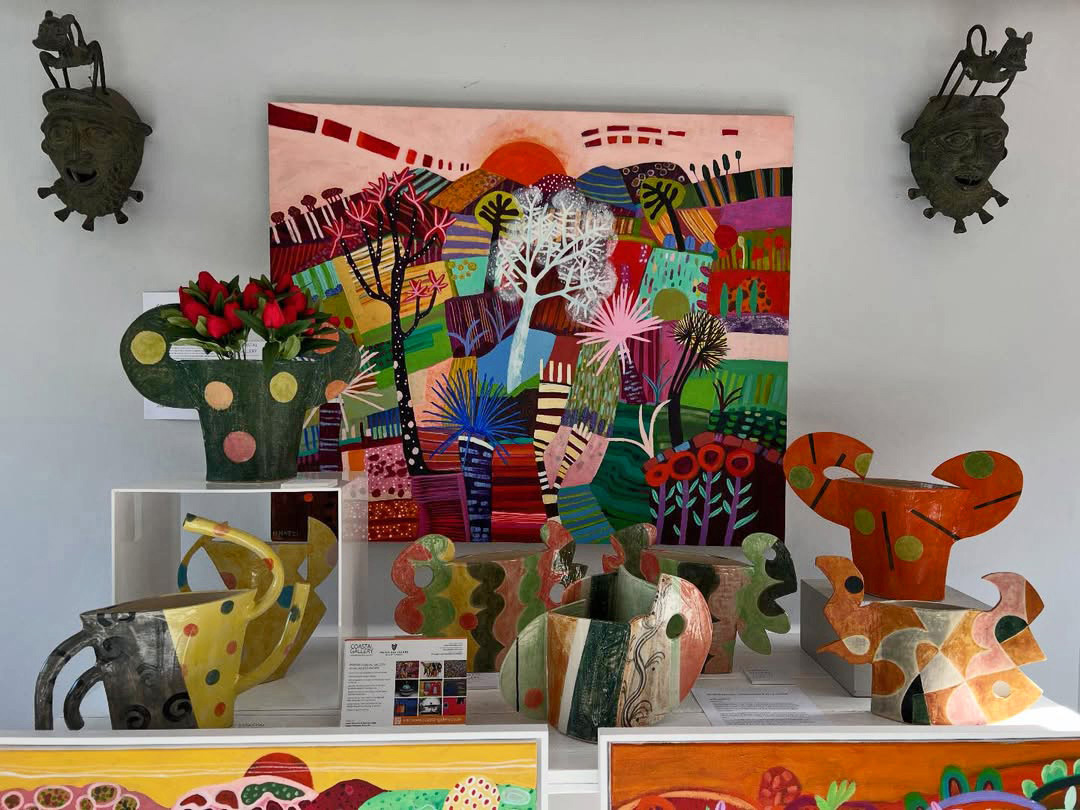
Vases have been made in the studio, but they are not even bisque fired yet, until the new kiln is set up. Until then, pieces are available at various outlets, the most recent delivery being at the Cecilia Colman Gallery in London, where you can see the ceramics displayed here on the blog (At last, says Spiro, at least a gesture towards marketing).

Sam Slug

We wish you all a happy Christmas and a prosperous 2024. Here’s hoping it’s a better year for humanity than ’23. Celebrate properly, don’t waste time making mulled wine and other aberrations, go for the classic Dry Martini: Put your martini glass in the freezer, pour a good gin into a shaker, add a drop of Dry Vermouth (only a drop!) and put it in the freezer. After at least 3 hours you can take it out and pour it into the frozen glass and add an olive. The first sip is the best, hold it by the stem so your fingers won’t warm it up. Here endeth the lesson.

Blue dot vase at Cecilia Colman Gallery

A man and his pet slug walk into a bar. They start drinking beer, then as the night goes on they move to cocktails, and then to brandy.  Finally, the bartender says: “Last orders.” So, the man says, “One more for me… and one more for my slug.” The bartender sets them up and they gulp them down. Suddenly the slug falls over dead. The man puts on his coat and starts to leave. The bartender says angrily: “Hey, you can’t just leave that lyin’ there.” The man replies: “That’s not a lion, that’s a slug.

Cheers, and a Happy 2024

Marmite explained

The view from CJ’s bench on Bradlow Knoll was appropriate for the day, after all it was St Leger’s, the day of the famous horse race (Saturday 16th September) established by Colonel Barry Saint Leger in 1776 and named for him in 1778. An event for three-year-old colts and fillies, it is run annually at Doncaster, Yorkshire. The winner this year was Continuous, the last horse was Alexandroupolis. They say that Winter comes in on the tail of the last St. Leger horse, but global warming may have done for this old adage.

the last horse at the St Leger

The view was grey, misty and damp, and the leaves on the trees have yet to start turning, but the faint mulchy whiff of tired greenery was hinting at Autumn. Somebody had obviously felt the cold recently as they had left traces of a firepit in front of CJ’s bench. Or perhaps it was an impromptu BBQ. Whoever it was had also forgotten his or her disposable vape – I wonder if CJ would’ve approved of the cherry flavour.

BBQ

Given the weather, I don’t believe that a bonfire would have spread and caused a conflagration in Frith Wood. Apart from a few hot days earlier in the week, it’s been mild. Unhappily that’s not been the story in Greece or Libya, or even Canada, and tramping through the cool damp wood seemed so far removed from those weather extremes. However, even in this neck of the woods, manmade calamity lurks in the shape of the River Wye and its slow poisoning by nutrients leaching from livestock manure (about 70%) and sewage treatment works (20%). Most of the agricultural phosphate pollution is from intensive poultry production (from “What’s polluting the Wye?” – Herefordshire Wildlife Trust blog).

Wye pooper

In order to counter any black outlook that may be developing here, may we urge you to join the fight to save the river by subscribing or following Save the Wye on Facebook, Instagram and Twitter. Here is the link: https://savethewye.org/what-can-you-do-to-help/

Large black and white scrawl vase

Spiro is shouting in my ear that this blog is about marketing ceramics. I have pointed out to him that having unwittingly introduced the word “black” in the context of global warming, I will now exploit its presence in the blog in as measured and respectful a way possible, and with none of the in-your-face cynicism that he always advocates.

Black and white juggler vase at there Palais des Vaches

It is hard to believe Spiro is a 3rd century Bishop of Trimythous, as well as the patron saint of potters, and frankly I am not entirely convinced by his marketing skills. Last month he joined the Ledbury Bank Holiday Carnival Parade saying it was an opportunity to sell pots to the hundreds of Ledburians lining the High Street and was deeply insulted by the pennies people were throwing into the pots he held out, unaware that this the traditional way the parade gathers income for local charities. I had to drag him away when he started berating them in his local Archaic Greek dialect, much to everyone’s amusement who thought this was part of a comedy act.

Poseur vase (Vulcan clay)

Ahem, there is an exhibition at the Palais des Vaches Gallery in Exbury from 29th September, and the theme is “Black & White”. In response to this challenge, Peter Arscott Ceramics (PAC) have made a number of pieces for the show, some are black and white glazed stoneware, and some are made from a dark clay called Vulcan stoneware which comes out of the kiln in a rich dark chocolaty black if left unglazed.

My oh my vase (Palais des caches)

One piece in particular cannot be explained, and for some reason is called Buffoon Vase and wears a top in the shape of Napoleon’s hat. It looks even more inexplicable if you remove the top and insert a flower in it (it can only take one flower, and no water, as it has a leaky bottom). It’s a “marmite” piece – some people will simply like it without having to understand its impractical character, others will just think it’s strange.

Buffoon vase

For those of you unfamiliar with marmite, it is a dark brown yeast extract spread, much liked by half the UK population, and much disliked by the other half. It is used as a metaphor for something that is an acquired taste, or something that divides opinion, like, say, Elon Musk or Nigel Farage or morris dancing.

Buffoon vase with flower

In a neat bringing-together of various themes in this blog (fish, ceramics, rivers), a recent visit to Wales included a fly-fishing lesson with Mr Jones on the banks of the beautiful Dyfi river (unpolluted and very clean, thus salmon and sea trout are happy to swim in it).

Fly-fishing lessons on the Dyfi

The result was a brown trout fished from a smaller river nearby, which was cooked and served to fourteen people on a PAC dish. Thank you Mr J.

Sacrifishal?

A man walks into a fish and chip shop with a happy trout under his arm.
“Excuse me, do you sell fish cakes?” he asks.
The owner replies, “Yes, of course we do”
“Great” the man responds, smiling at his trout, “It’s his birthday.”

With apologies for that old chestnut, farewell and goodbye.

Unhappy trout