Posts

Marmite explained

The view from CJ’s bench on Bradlow Knoll was appropriate for the day, after all it was St Leger’s, the day of the famous horse race (Saturday 16th September) established by Colonel Barry Saint Leger in 1776 and named for him in 1778. An event for three-year-old colts and fillies, it is run annually at Doncaster, Yorkshire. The winner this year was Continuous, the last horse was Alexandroupolis. They say that Winter comes in on the tail of the last St. Leger horse, but global warming may have done for this old adage.

the last horse at the St Leger

The view was grey, misty and damp, and the leaves on the trees have yet to start turning, but the faint mulchy whiff of tired greenery was hinting at Autumn. Somebody had obviously felt the cold recently as they had left traces of a firepit in front of CJ’s bench. Or perhaps it was an impromptu BBQ. Whoever it was had also forgotten his or her disposable vape – I wonder if CJ would’ve approved of the cherry flavour.

BBQ

Given the weather, I don’t believe that a bonfire would have spread and caused a conflagration in Frith Wood. Apart from a few hot days earlier in the week, it’s been mild. Unhappily that’s not been the story in Greece or Libya, or even Canada, and tramping through the cool damp wood seemed so far removed from those weather extremes. However, even in this neck of the woods, manmade calamity lurks in the shape of the River Wye and its slow poisoning by nutrients leaching from livestock manure (about 70%) and sewage treatment works (20%). Most of the agricultural phosphate pollution is from intensive poultry production (from “What’s polluting the Wye?” – Herefordshire Wildlife Trust blog).

Wye pooper

In order to counter any black outlook that may be developing here, may we urge you to join the fight to save the river by subscribing or following Save the Wye on Facebook, Instagram and Twitter. Here is the link: https://savethewye.org/what-can-you-do-to-help/

Large black and white scrawl vase

Spiro is shouting in my ear that this blog is about marketing ceramics. I have pointed out to him that having unwittingly introduced the word “black” in the context of global warming, I will now exploit its presence in the blog in as measured and respectful a way possible, and with none of the in-your-face cynicism that he always advocates.

Black and white juggler vase at there Palais des Vaches

It is hard to believe Spiro is a 3rd century Bishop of Trimythous, as well as the patron saint of potters, and frankly I am not entirely convinced by his marketing skills. Last month he joined the Ledbury Bank Holiday Carnival Parade saying it was an opportunity to sell pots to the hundreds of Ledburians lining the High Street and was deeply insulted by the pennies people were throwing into the pots he held out, unaware that this the traditional way the parade gathers income for local charities. I had to drag him away when he started berating them in his local Archaic Greek dialect, much to everyone’s amusement who thought this was part of a comedy act.

Poseur vase (Vulcan clay)

Ahem, there is an exhibition at the Palais des Vaches Gallery in Exbury from 29th September, and the theme is “Black & White”. In response to this challenge, Peter Arscott Ceramics (PAC) have made a number of pieces for the show, some are black and white glazed stoneware, and some are made from a dark clay called Vulcan stoneware which comes out of the kiln in a rich dark chocolaty black if left unglazed.

My oh my vase (Palais des caches)

One piece in particular cannot be explained, and for some reason is called Buffoon Vase and wears a top in the shape of Napoleon’s hat. It looks even more inexplicable if you remove the top and insert a flower in it (it can only take one flower, and no water, as it has a leaky bottom). It’s a “marmite” piece – some people will simply like it without having to understand its impractical character, others will just think it’s strange.

Buffoon vase

For those of you unfamiliar with marmite, it is a dark brown yeast extract spread, much liked by half the UK population, and much disliked by the other half. It is used as a metaphor for something that is an acquired taste, or something that divides opinion, like, say, Elon Musk or Nigel Farage or morris dancing.

Buffoon vase with flower

In a neat bringing-together of various themes in this blog (fish, ceramics, rivers), a recent visit to Wales included a fly-fishing lesson with Mr Jones on the banks of the beautiful Dyfi river (unpolluted and very clean, thus salmon and sea trout are happy to swim in it).

Fly-fishing lessons on the Dyfi

The result was a brown trout fished from a smaller river nearby, which was cooked and served to fourteen people on a PAC dish. Thank you Mr J.

Sacrifishal?

A man walks into a fish and chip shop with a happy trout under his arm.
“Excuse me, do you sell fish cakes?” he asks.
The owner replies, “Yes, of course we do”
“Great” the man responds, smiling at his trout, “It’s his birthday.”

With apologies for that old chestnut, farewell and goodbye.

Unhappy trout

Potters and solitude

The view from Bradlow Knoll

Trudging up Bradlow Hill I noticed that the mayflower was in full bloom. What we call “mayflower” is actually hawthorn, a pagan symbol of fertility with ancient associations with May Day, and its blossoming marks the point at which spring turns into summer. This was a cheering thought, as a large vase destined for a gallery had cracked in the kiln the day before and one’s mind needed some distraction.

Mayflower

In the studio, the radio is always on, in part to accompany the ongoing work and to fend off any feelings of aloneness, though there is nothing wrong with a bit of solitude when making vases. As regular readers of this blog know, my team consists of Ziggy (a spider), Thelonious (a pugmill) and Saint Spyridon, (third century Bishop of Trimythous in charge of marketing) – all of them, possibly, not real.

Leaf vase

An important factor in converting aloneness into solitude is that it is voluntary, instead of imposed. As such, it becomes a creative and productive state. It helps concentration, but sometimes it can get to people. For example, a researcher at a station in Antarctica stabbed a colleague (non-fatally), though this may have happened because the victim was giving away the endings of books the attacker was reading.

Antartica. Photo Giuseppe Zibardi

This information is being given out freely by Peter Arscott Ceramics (PAC) because only the other day, seated alone at the workspace and eating a banana, a small unhappy voice was heard in the studio. Looking down at the banana in hand I noticed that it was looking up at me. Don’t tell me that’s not the saddest little world-weary face you’ve seen in a while.

Unhappy

“You shouldn’t be eating me, you know.”

“Is that why you look so sad?”

“No. It’s just that the monoculture production methods used to grow us can destroy entire ecosystems.  I bet you didn’t realize that the banana industry consumes more agrochemicals than any other in the world, except cotton.’

“Well I never.”

“And the low prices paid by supermarkets and the cost cutting by fruit companies as they relocate in search of cheaper labour, and the harsh conditions in plantations…’

“Oh, I’m sorry to hear that.”

“Yes, and none of the other fruit in the fruit bowl talk to me.”

Wormery

Despite feelings of guilt, I finished off the banana, then chopped up the skin and fed it to the inhabitants of the PAC wormery alongside the studio. At least they don’t talk to me, and the skin was put to good use.

Green wobble vase

Back on Bradlow Hill, my mind filled with images of cracked pots, Puritans on the Mayflower, talking bananas and Antarctic research stations, these gradually faded away as the birdsong in the wood took over. I recorded some for you – the loudest is probably a robin, some blackbirds and a chiff chaff, as well as a distant ambulance on its way to Worcester Hospital. You’ll need full volume to get all that.

Click here: birdsong

The bluebells were past their pomp, but the stitchwort was flecking the undergrowth with white, and there was a lot of campion in the hedgerows.

Stitchwort

In parts of Africa the campion is used by Xhosa diviners: the roots are ground, mixed with water, and beaten to a froth, which is consumed by novice diviners during the full moon to influence their dreams.

Campion

Given that this type of campion cannot be found in Herefordshire, PAC recommends buying a good bottle of Ribera del Duero instead. The better the wine, the sweeter the dream. Perhaps the resulting pot, a very impractical and possibly useless wine decanter, is the result.

Droop decanter

Still on the subject of wine, over-consumption of the grape, even if it’s the Queen of Grapes, Tempranillo, can lead to moments of euphoria to be followed the next day by terrible remorse and anguish. In an unusual attempt at public information and to highlight the issue of the seductive lure of alcohol and its consequences, PAC would like to introduce the following piece:

Saturday night, Sunday morning vase

Psychoceramics is the study of crackpot ideas about human behaviour – get it? “Crack pots”?  (Also, Psycho Ceramics were a range of novelty ceramics made by US-based Kreiss company and manufactured in Japan between the 1960s and 1970s). However, PAC would like to associate the word with the more subtle art of depicting the mind or mental processes – psykho, (Greek) meaning “the soul, mind, spirit, or invisible animating entity which occupies the physical body”. PAC would like to think that the above is an example of psychoceramics, as is the next one:

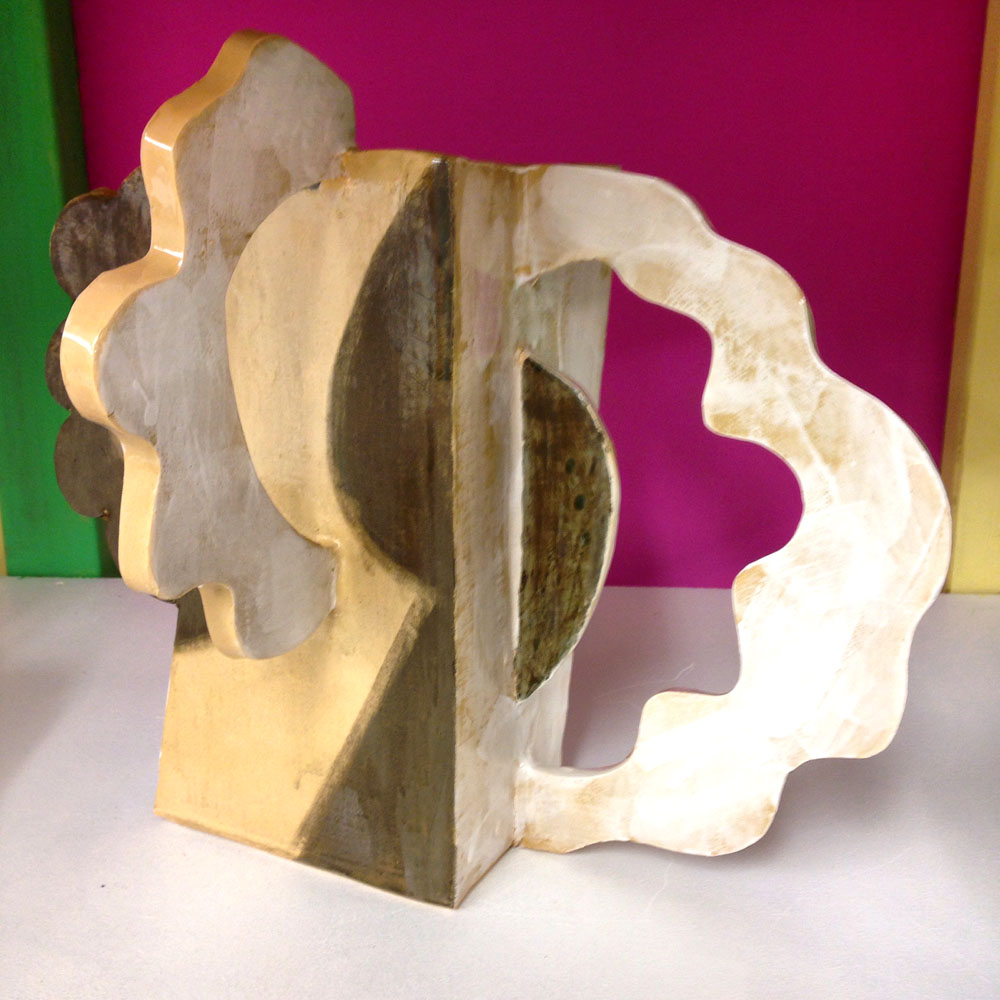
Why? Perhaps because it is a “personality”. Whereas other pieces may highlight a particular colour to effect, or hint at landscape, or get across the idea of spring, or even jazz music, others have their own particular and less easily described temperament which is a bit more than just the sum of its shape, colours and brushstrokes. For example, we like the following piece because it’s a gentle play on a grid and geometrical shapes – it’s attractive enough, but what it offers is essentially decorative:

What do you think, dear reader? Is PAC barking up the wrong tree? Is it all too subjective for a theory? Have we been talking to fruit too often? Can bananas ever look happy? Did you know that the Latin name for banana is musa sapientum, which translates as fruit of the wise men? Please send us your thoughts.

psychoceramic or articeramic?

Clay is good for you

view of ledbury from Bradlow Knoll
May Hill on the horizon

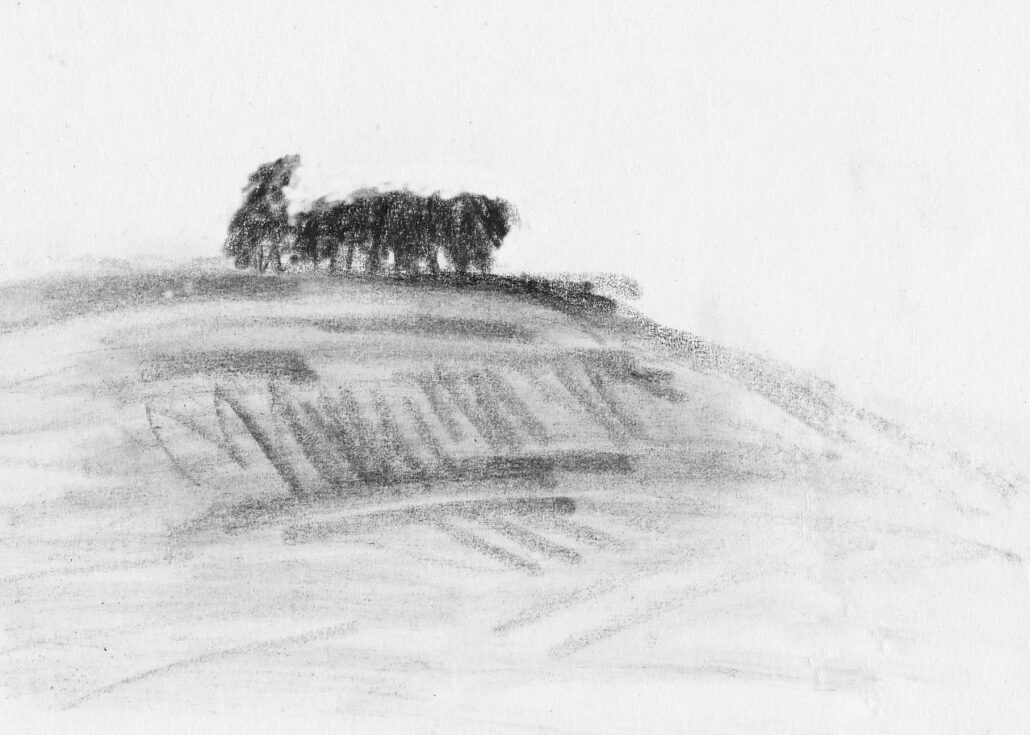
You can see May Hill on the horizon when you stand on Bradlow Knoll and look down towards Ledbury and the Cotswolds beyond. In the image you can see it slightly to the left of centre, with its distinctive clump of pines standing out from this distance like a pimple, It is where Edward Thomas wrote his poem Words, not long before Ledbury-born John Masefield referred to the outline of the pines in his Everlasting Mercy:

I’ve marked the May Hill ploughman stay

Here on his hill, day after day

Driving his team against the sky

charcoal drawing of Mayhill in Glouycestershire
Mayhill ploughman (imagined)

I don’t know about Masefield, but Thomas was certainly a great walker and I often wonder if he ever took this path. If he did, I’m sure he took it in his stride.  I am not a hypochondriac but every time I climb the hill to Bradlow Knoll to reward myself with the view of Ledbury I seem to need a longer break to recover my breath and my heart thumps away even more in protest at what I am making it do. A few days ago I sat by the top gate gasping away and thinking of how complex the machinery of our body is, and how all our bits and pieces are connected, rather like an engine – you know, the lungs draw in air and deliver oxygen to our blood, the blood circulates thanks to the heart pumping away, the kidneys clean the blood of toxins, and so on. I thought that if my body were an engine then it would be a second hand and slightly rusty ford escort given to early morning ignition problems and always needing an oil change.

image of small toy car
ol’ engine

And sometimes I feel like some ol’ engine, gone and lost my driving wheel, as Tom Rush sang all those years ago, but really it is an excuse to give you a link to the great song if you click here.

cool, dank and very quiet

And where is this going, and where is the connection to ceramics? I do not know yet, but nevertheless, and in the meantime, let me continue with our bodies, their complex needs and some of the problems to which they give rise: ulcers, sore throats, haemorrhoids, high blood pressure, allergies, for example. Well, having got my breath back, I turned away from the panorama at my feet and entered Frith Wood – cool, dank and very quiet – and came across a lot of these small mauve plants growing low to the ground. Self-heal, heal-all, slough-heal and woundwort are all common names for prunella vulgaris, and it is said to help cure all the above, as well as burns, insect bites and herpes.

prunella vulgaris

It is mainly used for sore throats, even severe ones like quinsy, which is an abscess of the tonsils. It is good as a hot tea at the beginning stages of a cold with sore throat. Apparently, self-heal tastes slightly bitter and slightly sweet with a hint of rosemary.

Are ceramics as good for you as prunella vulgaris? Well, potters are the only people, other than children, who play with mud, a base material that is malleable, sensuous and expressive, and, as a result, I reckon the feel-good factor plays a part in reducing stress. Making a clay pot and drinking a self-heal tea is a perfect combination that will lead to improving your quality of life.

dish with knife and fork with lump of clay in middle to illustrate geophagia
geophagia

Now, do not get confused and start putting clay in your mouth instead of the tea. Pregnant women sometimes crave dirt, clay or charcoal if their bodies are deficient in key minerals but geophagia, as it is called, is best avoided.

Ruby my dear – irrelevant, but I wanted some colour

Clay comes in many varieties for the potter. The type one uses depends on the firing temperature, and mine is high so I use stoneware, and because I am a slab potter, I need a certain robust quality which grog provides, tiny pieces of malachite or firesand or chamotte, which has a high percentage of alumina. Anyway, it may taste OK  but I do not even take furtive licks. Quartz, feldspar, mica and kaolinite are other minerals you may find in stoneware. Since I fire my pieces at 1275°, they are vitrified and entirely food safe once glazed, and you can then lick them without harm.

meandering tree design / Coastal Gallery

All this walking in the wood seems to have somehow crept into the vases, a fusion of Paul Klee and a meandering rambling design. This one above can be seen at the Coastal Gallery in Lymington. Click here.

do not lick

By way of contrast, there is ragwort. I came across this clump in a clearing near the edge of the wood. Ragwort is a tall erect plant bearing large flat-topped clusters of yellow daisy-like flowers. Do not lick them! Cattle and horses are particularly susceptible to its poisoning.

A type of ragwort was introduced into the UK from the slopes of Mount Etna around 1690 via the Oxford Botanic Garden where, following many years of cultivation, it  ‘escaped’ and could be found growing in the masonry of Oxford colleges and walls. During the Industrial Revolution, Oxford became a thriving railway centre and Oxford ragwort found a new habitat in the clinker beds of the railway lines that fanned out of Oxford to all parts of the country. The clinker providing the plant with a replica of the lava-soils of its native home in Sicily and, to be fair, it should not be confused with the common ragwort. I do not know which type the Frith Wood ragwort is. Perhaps Bridget of Malvern or another of you botanical savants could tell me.

stinking Bob

Please forgive my botanical meanderings. I just love the names. Herb-Robert is a quick growing plant with explosive seed pods which if allowed to flower, will spread rapidly over a wide area. Also known as red robin, death come quickly, storksbill, fox geranium, stinking Bob, squinter-pip, crow’s foot. Fabulous names.

Autumn cocktail

There was a lot of bramble about, just beginning to flower, so the blackberries will be out by September. To look forward to this I suggest a Bramble cocktail, to be made when the hedgerows are groaning with ripe fruit.  Start by squashing six  blackberries in a sturdy glass. Add 50ml of good gin, 25ml lemon juice, 25ml sugar syrup (you can just dissolve some sugar in water) and fill the glass two thirds with crushed ice. Mix with a long-handled spoon. Top with more crushed ice, a blackberry and a paper straw.

three legged bowl at Bevere Gallery. Click here

I always try to say no to gin – but it’s 42.5% stronger than me.

landscape vase

Free ceramic pieces

Hello all. Those of you who live near the studio can help yourselves to a ceramic piece if you are passing by the house. As you can see from the view from The Homend, all you have to do is climb four steps and take a vase or bowl. They are all rejects – some have hairline cracks, others are wonky , some cannot stand up straight and some are plug ugly. They are all frost proof and can be used in the garden.

Address: Oakland House, The Homend, Ledbury HR8 1AP. There will be a donation yoghurt pot – all proceeds will go to CUP Ceramic Community in Hereford

help yourself

The winner of the three legged bowl (see previous blog) identified three birds correctly: great tit, blue tit, cock pheasant. The fourth was a black cap. The winner is a Mr A.Lloyd of London. Well done.

ankle-deep in bluebells (Part 2)

Frith Wood

I apologize for this second blog in one month but, you see, I never know how many people read this, so, when somebody actually makes contact (info@peterarscott.co.uk) I am taken by surprise. Anna got in touch after the last one; she is a potter in Manchester who lives in a small flat in the city and she liked all the references to the countryside, mainly because, for her, the outdoors are inaccessible at the moment and she enjoyed the pictures of Frith Wood and even found my comments acceptable, and not at all flippant. She wants more. So, Anna, this is for you.

Queen Anne’s lace or Cow Parsley?

The first thing to point out on your way up the road towards the gate that leads to the steep meadow up to Bradlow Knoll is the appearance in just a few days of Queen Anne’s lace and Cow Parsley growing along the verges. The former is said to have been named after Queen Anne, who was an expert lace maker. When she pricked herself with a needle, a single drop of blood fell from her finger onto the lace, leaving the dark purple floret found in the flower’s centre. Its root is edible when young and similar to a carrot, but it is easily confused with Poison Hemlock, which is deadly, so best not to bother eating it. Stick to your local supermarket.

effort rewarded

Since the last visit to the wood, Bradlow Hill has become even steeper. This means that before you can turn to look down at the view of Ledbury at your feet (the reward for all your uphill effort), you have to sit amongst the sheep and their calling cards and take deep mouthfuls of air. Never do lungs seem more like bellows than when you need air, and never have they been more appreciated than in these Covid times. They are fabulous organs and have climbed the rankings in the “Favourite Organ” league to overtake kidneys, spleen and bladder. The appendix, surely, is bottom of the league. By the way, the other reason for contacting me is to challenge any drivel I come up with. Is the appendix an organ? There is a comment box at the bottom of the page if you want to avoid emailing me.

mayflower

From the top of the hill, with the gate that leads into the wood at your back, the view is now speckled with white as the hawthorn hedges start to show off their mayflower bloom. A frequent shrub for hedgerows in this country as it is an effective barrier against livestock, in this case sheep, thanks to its twisted, thorny branches. The Bradlow sheep were unbothered by this and were using its shade to take a nap in or for scratching their posteriors.

the laid-back denizens of Bradlow
a sea of stitchwort

I could tell something had changed from the last visit. When I entered the cool dark of the wood and allowed my eyes to get used to the gloom it was obvious that the bluebells were in decline. Instead of the profusion of blue, a newer carpet of colour had taken over: white stitchwort taking in the light through the thinly leaved canopy of the woodland. It was once used as a herbal remedy for a stitch (the pain sometimes felt in the side during exercise), hence the name ‘stitchwort’. Also known as “Star-of-Bethlehem” and “daddy’s-shirt-buttons“. Do not pick them – if you pick greater stitchwort, you will cause a thunderstorm. I shall return to them next month when their seed capsules ripen and start making popping sounds. They could be mistaken foe wood anemones, a mistake I made, but I was steered away gently by Bridget of Malvern – for which many thanks. Misinforming Anna of Manchester is not what I want.

birdies in Frith Wood

Deep in the woods the birds were singing away as they do. I stopped and recorded a minute’s worth for you. If you can identify correctly three of the birds (there are in fact four) and send me your answer in an email (see above), the first correct answer will get a prize. You may have to turn up the volume. Sadly, Mr W.B. cannot take part, being our go-to expert who officially identified the birdies. Ladies and gentlemen, this three legged stoneware bowl shall be sent to the winner. Hand painted and glazed, part of the Hudson series, slightly retro, in a good way, American abstract expressionist in character. 23 x 23 x 8 cms (0.75 g). Normally retails at £60. How can you resist the challenge?

win this fab three legged bowl

The Yellow Archangel is another plant that comes into bloom as the Bluebells are fading, it probably gets its name from its virtue of not stinging, despite being part of the dead-nettle family. Here’s a picture of some amongst the few Bluebells left. Is that single pink flower a Herb Robert?

Yellow Archangel

Further and deeper into the wood a yew tree leans into the path. These old trees can live for centuries and often harbour badger setts among its roots. The badger, “that most ancient Briton of English beasts” (Edward Thomas), is not seen very often – it is nocturnal and secretive, often associated with The Wind in the Willows in his dressing gown and slippers, but by others, including some friends, blamed for many criminal acts in gardens.

only yew

One friend is surprised that after years of country-dwelling we haven’t learned that every act of seemingly pointless rural vandalism is always caused by badgers. Furthermore, and to counter the “cuddly” view of badgers, another friend quotes Beatrix Potter from The Tale of Mr Tod:

rural thug

” . . . Tommy Brock was a short bristly fat waddling person with a grin; he grinned all over his face.  He was not nice in his habits.  He ate wasps nests and frogs and worms; and he waddled about by moonlight, digging things up.  His clothes were very dirty; and as he slept in the daytime, he always went to bed in his boots.  And the bed which he went to bed in, was generally Mr Tod’s.”

I’m not sure how bucolic I’ve been, but I hope you enjoyed it, Anna. I even squeezed in a ceramics reference, which is, after all, the point of this blog. Lastly (and here I am blowing my own trumpet, I know),  if you are in the mood and like short stories, let me introduce you to The Common. It is a literary organization whose mission is to deepen our individual and collective sense of place. Based at Amherst College, it aims to serve as a vibrant common space for the global exchange of ideas and experiences and publishes works that embody particular times and places. It has published one of my short stories. Please click here if you would like to read it: Malus

malus

Thank you, keep well, and keep off the Hemlock.

A policeman saw a man driving around with a van full of badgers. He pulls the man over and says… “You can’t drive around with badgers in this town! Take them to the zoo immediately.” The man says “OK”… and drives away. The next day, the officer sees the man still driving around with the van full of badgers, and they’re all wearing straw hats. He pulls him over and demands… “I thought I told you to take these badgers to the zoo yesterday?” The man replies… “I did . . . today I’m taking them to the beach!”