Posts

Organ Recital

The climb up the hill to Bradlow Knoll is without doubt an accurate indicator of the ageing process – calves are sorer, backs stiffer, breathing shallower and heart more flabbergasted than ever. Why are you doing this? it shouts. Sit down on the grass and breath slowly, you’re no spring chicken, or mountain goat. A bit more respect if you want me to go on pumping as I have these last 71 years! The problem is that one gets easily sidetracked if talking to one’s organs, and the heart is always the one that complains about things. I find conversations with my brain a lot more rewarding, my liver is slightly anxious and prone to melancholy, my lungs are no-nonsense and direct and perhaps lacking in humour. The stomach (my third favourite organ) is emotional but also stoical.

Anyway, half way up the hill, a moment to catch one’s breath was necessary, and as it was early in the morning on the first day of the new year, the fields and woods were very quiet, so that when a raven croaked overhead and landed about 20 yards away from the hedge I was sitting by, it was unaware of me (despite my pink jumper) and I could watch its corvine hopping from one patch to another, on the lookout for grubs, beetles or whatever. They are among the smartest of birds, with intelligence comparable to that of apes, and experiments have shown they are able to problem solve, use tools, plan ahead and even hold a grudge – a bit like us, in other words.

They are surprisingly large birds – the closest most people get to one is in the Tower of London where they are kept because it is said that the kingdom and the Tower will fall if the six resident ravens ever leave the fortress. These are fed twice a day by a Raven Master and dine on a special diet of mice, chicks, rats and assorted raw meats. As a special treat, they are given biscuits soaked in blood. But this one on Bradlow Hill had to work for its food, tugging and pecking between the tussocks of grass. Unfortunately, my mobile pinged as a message came through and the bird looked up and immediately flapped off towards the wood. The message was from the electricity company encouraging me to have a smart meter put in.

The rest of the journey to the top was uneventful, with the reward of sitting on CJ’s bench and soaking in the view with its manmade patchwork of fields and meadows in the distance, and with the time to consider the subtle differences in the shades of green available to walkers in the countryside – all presumably dependent on the type of grass or crop growing, chlorophyll concentrations, soil conditions, moisture levels, or fatigue or eye strain after spending too much time looking at screens (after which everything seems to have a green tint to it).

All of which brings us to ceramics and the use of green. At Peter Arscott Ceramics (PAC) the colour is rarely used by itself and seems to only work well in conjunction with another colour alongside. As you know from previous blogs, having green alongside red is very vibrant because they are complementary, or opposites on the chromatic wheel (as are blue and orange, yellow and violet). The greens we use are eider green, chromium oxide, chartreuse green and goosander green, usually combined with off red or brown stains, as in the image above, or next to a red that has been mixed with tin oxide to reduce any sharp contrast, as in the image below…….

…. or else the green itself is mixed with a little black to reduce its vibrancy, as in the image below ….

….or the overall red is no longer doing battle with the green because the green in question pulls towards yellow, as with the chartreuse green polka dots in the image below.

As with all colours, green has many associations, from nature and the environment, growth and renewal, health and healing and lots more. But let’s keep a sensible balance here and also acknowledge envy and jealousy, sickness, parrots, slime, and leprechauns. And that the former flag of Libya (1977–2011) was the only flag in the world with a single colour (green) and no design or details.

I’ve digressed. Back to ceramics: greenware is unfired clay. It’s the state in which the piece you have thrown or slab-rolled into shape sits under wraps while it dries. I use large plastic bags over them to slow down the drying process – too quick and the clay will crack. And thinner parts dry faster than thicker ones, so sometimes one has to spray with water to help the whole piece dry as uniformly as possible. This is one of the many reasons ceramicists get nervous before opening up the kiln after a firing and end up having angry conversations with their spleens when things go wrong, as in the image below.

Another kiln katastrophe

Interestingly, greenware is also the term for software distributed under the condition that the user does something to help the environment. The author expects the user to do something “green”. For example: planting a tree, eating more vegetables, or quitting smoking.

ceramic vase with decorative holes

Holey vase – this one came out intact

Quitting smoking? That sounds like a New Year’s resolution, though it turns out that of the 40% or so making resolutions every year, only 25% remain committed after a month. Worse still, less than 10% end up accomplishing them at all. Most of us actually throw in the towel in the first few weeks of January. As a result, the second Friday in January is now often called Quitters’ Day.

Kinglet vase

Nonetheless, the team at PAC (Ziggy, Spyro, Shimpo and Yours Truly) have together decided that we will:

Embrace our flaws and imperfections

Book a night under the stars

Surround ourselves with positive influences

Let go of grudges and practice forgiveness (Shimpo)

Resolve conflicts calmly and openly

Not talk when mouth full of spiders (Ziggy)

Learn a musical instrument

Trim nose and ear hair (Spyro)

Reports on progress will be made publicly in future blogs.

small black and white construct

We hope you have a happy 2026, and that it is everything you want it to be.

In praise of tweeting

View from Bradlow Hill, with the town of Ledbury in the distance

View from Bradlow Hill

It struck me while I was walking up Bradlow Hill and into Frith Wood that though I meet people walking in the opposite direction, that is, coming towards me, I wonder if they meet people other than me. Because most people will sensibly choose the way that offers least effort, the one with a slow ascent into the woods and then the downhill walk along Bradlow Hill – I think I’m one of the few who do it the hard way, and that subsequently people get to see my face hoving into view more than others.

A carpet of bluebells amongst the trees in Frith Wood.

Bluebells in the Frith

The reason I do it is for the reward of the view after the exercise, and as an indicator of how the ageing process is coming along. Legs get heavier with age. One of the walkers I met in the wood was a lady from Winchester who used to live in Malvern, but who comes to the Frith once a month to walk and relax. She said it uncluttered her mind and helped her relax – the quiet, the bluebells (see above), the birdsong and the relative wildness (compared to Winchester). Blackbirds, blue tits, black caps, chiff chaffs, a song thrush and a pheasant all contributed to calming the mind on this occasion. Birdsong should certainly be prescribed by doctors to treat mental health conditions, such as certain types of anxiety. Perhaps not the pheasant, they make strange metallic calls – the Pavarottis of the bird world they’re not.

Recently on BBC Radio 4 there was an intriguing programme by Sacha Dench on the plight of one of the world’s most persecuted birds, the vulture. However misunderstood they are (and they are), they shouldn’t be included in the doctors’ prescription: they make raspy, hissing sounds while feeding and fighting, along with grunting noises that can sound like hungry pigs or dogs barking in the distance. Luckily there aren’t any in Frith Wood or the Ledbury area.

Greater Stitchwort – Frith Wood is full of them.

Last week in Wales, on a family visit, I heard a Grasshopper Warbler for the first time. Its high, grasshopper-like song is usually what gives it away. Even when you hear one it can be difficult to locate it because of the way it throws its song. My daughter could hear it clearly, but it took me a while to catch the sound – it turns out that as we get older the first part of the hearing to deteriorate is the exact pitch the grasshopper warbler sings at. Sad to think most of us will stop hearing them at some stage in our lives, so I’m glad it happened. It’s a Red List species, and thus very rare. Click here to see a picture of one.

Cooee vase. Nothing to do with birds.

Here at Peter Arscott Ceramics we have sometimes been asked about birds and ceramics. Specifically, does bird poop affect outdoor ceramics, like birdbaths, for example. The answer is no, the vitrification of the glaze firing protects the ceramic from the acidity of the bird droppings. Research by PCA reveals that birds don’t have the same level of control over their sphincter muscles as humans or other mammals. This means they can’t hold their waste, leading to seemingly random pooping. These are the sort of facts you learn in this blog.

Stoneware vase with upturned handles looking like spindly arms. Painted orange with big green dots.

Polka dot vase

Whilst we’re on the subject, pooping while in flight is a way for birds to lighten their load and conserve energy, especially for longer flights. And they often have preferred areas for pooping, such as where they spend time or find food. They might poop on a garden bench, or near their nest, or, of course, on your head or your car, which is why it’s good there are no vultures in Ledbury.

green, ochre and grey striped vase with skewed handles

Verde vase

Pablo Picasso used birds in his work, from the early paintings of pigeons roosting which can be seen at the Picasso Museum in Barcelona, to the famous dove of peace drawing. He also used them in his ceramics, both sculpturally and as motifs, as on this earthenware dish from the 1950s.

Limited edition of Picasso plate with white adobe bird painted on black background.

Picasso bird

And thus, we finally come to ceramics (“About time”, says Spiro. “And why did you have to mention bird poop?”).

Architectural ceramic piece made up of horizontal and vertical slabs

Construct 1.

PAC’s creative juices are flowing in all directions. Although we are still in love with the basic idea of the vessel, or vase, as the basis for most work, the lure of the sculptural possibilities in ceramics often takes us down different paths. Using grogged stoneware clay, which lends itself to modelling, this large structural piece took shape after careful and deliberate work with weight and balance – remember that once in the kiln and at a temperature of 1200℃, a clay piece can easily flop about and collapse, depending on weight distribution.

Big Hugging vase

On the other hand, and as a contrast (in character it is almost the opposite of the previous piece), this next one (above) was made in one session with no preparation or planning, and turned out in the shape it did, still retaining some practical use – you could possibly wash a small baby in it –  but definitely pulling towards appearance for its own sake.

Swirl vase

We’ve been producing “spontaneous” ceramics for a while – it’s not something new that PAC has stumbled on. The Swirl vase (above) came out of the studio in 2017. The Tutti Frutti jug (below) is from 2018.

Tutti Frutti jug

Going back to the subject of birdsong and tranquility (not again!), the edge of the Frith was flecked with the white bloom of the hawthorn. Its flowers, typically white or pink, bloom in spring, often around May, giving rise to the name “Mayflower”, but its antispasmodic and nerving actions make it suitable for anxiety or nervous tension – it is also sacred to the fairies and is therefore considered unlucky to bring indoors.

image of hawthorn tree in full bloom in May

Mayflower

We do keep a bird indoors in the studio. He is Murphy the Mallard and he’s always quacking jokes: Two vultures were eating a dead comedian. One looks to the other and says, “Does this taste funny to you?”

Ceramic mallard duck made by a child

Murphy says bye


Many Vast Elephants Make Jam Sandwiches Under No Pressure

I wonder of any of you have been craning your necks up at the night sky recently. There’s been an alignment of planets visible to the naked eye and Venus has been the most spectacular and can still be seen as a bright ‘star’ in the early evening, if you look to the west. Its position in the sky is bringing it closer to the Sun as March rolls on, so only a few days left to see it. Mercury, Mars, Jupiter, Neptune, Uranus and Saturn are the other ones vying for your attention, but time is running out and it won’t happen again till 2040.

Photo: Petr Novák, Wikipedia

Venus, named after the Roman Goddess of Beauty, presumably because it’s so bright, brought to my undisciplined and ruminating mind the sadly armless Venus de Milo, the venus flytrap, Venus in Blue Jeans, Men Are from Mars, Women are from Venus, and finally the Venus of Dolni Věstonice (though I did have to come home and check on the spelling). You may have heard of her – the oldest known ceramic in the world, discovered in Czechoslovakia. A clay sculpture figure of a female, which has been dated to 29,000 – 25,000 BC.

Diligent vase

To think we’ve gone from using ceramic for this primitive (but powerful) figurine of a Mother Goddess to making objects as diverse as spark plugs, fibre optics, artificial joints, space shuttle tiles, oven tops, self-lubricating bearings, body armour, and skis. Human progress (?) as measured by clay. By the way, I did not know that enough ceramic tiles are produced each year to pave a path 300-ft. wide around the world. The things you learn.

Green striped vase

Despite the multiple and varied uses clay can be put to, I instinctively feel that it’s at its best when it is made into a vessel, when it draws the human hand to pick it up, weigh it, feel its surface, fill it with water, and the human eye to admire its shape and colours. Like, for example, Peter Arscott Ceramic (PAC) pieces, new images of which I’ve scattered within this blog.

Lime Welcome vase. Cecilia Colman Gallery

Let me just say that PAC ceramics are well-priced and affordable to those of you who appreciate uniqueness and quality. A PAC vase is not as expensive as a small bowl known as the Chicken Cup from the Ming Dynasty: it was sold in Hong Kong in 2015 for $ 36 million. A rooster, a chicken and a chick are depicted on it, thus its nickname.

Torero vase. Palais des Vaches, Exbury

After patting me on the shoulder for finally getting around to mentioning my vases, Spiro, being Greek, and being Patron Saint of potters, is telling me that the word “ceramics” is traced back to the term keramos, meaning potter’s clay or pottery. I reciprocate etymologically by telling him about my “claggy” walk up to Bradlow Knoll (Spiro does not walk), and that the word is from the Middle English claggen, probably of Scandinavian origin; akin to Danish klagge sticky mud, akin to Old English clǣg clay.

Autumn vase. Cecilia Colman gallery

And indeed, it was claggy, not slippery but viscous and adhesive underfoot, and the weather warm with hazy sunshine, so that by the time I reached CJ’s bench I was hot and bothered. There’s more construction work going on in the nearest adjacent fields, mainly barns, fencing and access tracks, but if you look into the distance around and beyond Ledbury, the reflected gleam of plastic sheeting is more obvious, as soft fruit farming gets into gear for the season, and with the addition of hundreds of houses being built, the town is slowly creeping further into the countryside.

Orange juggler vase

There’s a balance to be struck between the idea of preserving what’s valuable and catering to the needs of a society. Things shouldn’t be preserved for the sake of it: if there’s a housing need then houses must be built. If farming land can be used more efficiently by applying new approaches, why not? And after all, the British countryside is essentially man made and shaped. But we ought to keep an eye-out. Don’t forget what happened to the River Wye – an example of a catastrophic imbalance because a check was not kept on the huge growth of chicken farms.

Pink Green vase. Cecilia Colman Gallery

But back to ceramics, and away from chicken poo. The Palais des Vaches in Exbury has received a new batch of PAC ceramics, as has the Cecilia Colman Gallery in London.

St Sebastian vase. Palais des Vaches.

Exbury is in the New Forest not far from the coast, opposite the Isle of Wight. This part of England is unlike any other: open heathland, wild and intriguing. After delivery, I took a wrong turn and ended up asking the only local in the vicinity for help, but any offer was unforthcoming as he continued chewing grass in the rain and looking rather wary.

Unforthcoming

On the other hand, St John’s Wood in London, where the Cecilia Colman gallery is, belongs to another world: Regent’s Park, Lord’s Cricket Ground, elegant shops and restaurants.

Cecilia Colman Gallery

You may have gathered that the title of this blog is a mnemonic for memorizing the order of the planets, starting with the one nearest the Sun: Mercury, Venus, Earth, Mars, Jupiter, Saturn, Uranus, Neptune, Pluto.


And finally some good advice from an old Congolese saying: If you are asked to join a parade, don’t march behind the elephants.


Potter Pete’s foggy day

The view down to Ledbury

This time I groped my way up Bradlow Hill – forget the mud, the rain and the general swampy state of the countryside at present – this was different because I could not see anything in front of me. Fog shrouded everything, as you can see from the picture of the “view” above.

entrance to Frith Wood

Faced with the entrance into Frith Wood, I chickened out of groping any further and blindly banging my head on tree trunks, so turned back and walked along Green Lane in Dog Hill Wood until I reached Ledbury, an easy flat route into town, and the original pack horse trail connecting Worcester to Hereford. There are fragments of  yellowish sandstone on and around the path, formed millennia ago by sand brought by nearby rivers which settled around the tide line in layers (as it does in beaches today) when this area was a coastal stretch.

Green Lane

A great deal of Queen Anne’s Lace and alkanet, unfairly deemed a weed by gardeners, grew along the path, which was, of course, slimy with mud and is specially tricky as it leads downhill into town, but once you are near St Michael’s parish church you are safely back on dry and even surface.

alkanet

A useful angel to have on your side, St Michael the Archangel, patron saint of grocers, soldiers, doctors, mariners, paratroopers and police, and conqueror of Satan.

St Michael’s

Satan is so often depicted as a monstruous three-headed entity, or as a horned beast, half human half goat, or as a squirming dragon, but I believe he is the personification of mud. I promise that this is the last blog where I complain about mud – after all, I am a potter, and it is my source material. By the way, never buy a wig from the Devil, there will be Hell toupee.

And what about ceramics? Well, I have little to show you right now, as the big pieces I am now making take such a long time to dry before they can go into the kiln for bisque firing – and it is no good speeding up the drying process as this will cause the more exposed parts of a piece to dry more quickly that the body, thus creating tension leading to cracks. So, it is always wise to wrap the pieces in plastic to encourage uniform drying, and not to, say, expose it to the sun.

However, here is another experimental piece, not the usual vessel, more an architectural exercise. To remind yourselves of  PAC’s vessel-based work, do visit the website: https://www.peterarscott.co.uk

If you would like to read something that combines waitresses, xenophobia, the Pope and a café, here is a link to a short story of mine called Mysteron (2600 words) on Fiction on the Web. Please read it if you’re in the mood, if it is unread, then it does not exist. Click here.

stumped

On my way up to Bradlow Hill I walked past the tree stumps along Knapp Lane. The trees had been felled as they were a potential danger to traffic. I noticed that each stump had a ring of blue studs inserted evenly around the inside of the edges. What is this? One of you out there will know – please tell us.

Queen Anne’s lace

We often hear mist and fog mentioned alongside each other, but the difference is a simple matter of how far you can see through it. If you can see more than 1,000 metres it’s called mist, but if it is thicker and the visibility drops below 1,000 metres it’s called fog.

What’s a bigamist?

It’s what Italians call a thick fog.

April showers bring more than flowers.

The art of walking on sludge requires you to walk bow-legged and on bent knees, leaning forward if going uphill, so that by the time you reach CJ’s bench at the top of Bradlow Hill your thighs ache like a ballerina’s after five consecutive performances of Swan Lake.  By the way, someone has left a nice pair of gloves that are now wedged between the slats waiting for their owner.

England’s sewage system

The rain has been relentless in this part of the world, making the ground as soft as chocolate fondant, delaying planting and seeding by farmers, flooding many areas, reducing oxygen in the soil (think of the poor worms) and forcing water companies to allow sewage into the rivers – this last revolting image the direct result of the privatisation of water and the neglect of any control over “market forces” in the guise of hedge funds. The result is priority for shareholders’ dividends over proper investment in upgrading an outdated system that can no longer cope with the zillion turds we produce daily. Enough moaning.

Bluebells in Frith Wood

Despite the muddy pathway into Frith wood, I ventured in, knowing that you would want proof that at least some things are still as they should be. What with Ukraine, Gaza, climate change, polarized politics, and all the rest of the present gloom fest, it’s good to know that the bluebells are with us, and the wood anemones.

Anemones

On my way out of the woods I passed by a large patch of forget-me-nots. The Greek name Myosotis is a combination of “mus” and “otis” and means “mouse ear”, referring to the shape of the leaves. I’m posting the image because they are beautiful delicate blue flowers with a yellow eye and grey-green velvety leaves, and they are vibrant, heart-warming and make one smile – a reminder of a friend who is no longer with us.

Ceramics: the good news is that the new kiln is now up and running, and a first batch of vases has been glaze-fired successfully.

Big Yoohoo vase just out of the new kiln

The kiln is a Rohde front-loader called Helmut – very efficient and accurate, with a good work ethic.

Introducing Helmut.

He is extremely heavy and here I must give thanks to Steve whose knowledge of cantilevered engineering worked a treat when we moved H into position. He deserves a medal and should any of you be interested in acquiring or finding out about medals of the Great War then Steve, professional military history researcher that he is, is your man. Click here to visit his sight. So far, Helmut seems to get along with the rest of the team – it’s all change here with the introduction of Shinto the Pugmill too.

Thelonious undone.

Spiro and Ziggy are very sad that Thelonious (the old pugmill) is no longer here, and were upset to see him being loaded onto the back of a lorry by a forklift truck to be taken to the (gulp) scrapyard.

Spiro and Ziggy making a scene

It seems that nobody wants anything requiring three-phase power. If anybody is looking for an inverter designed to drive a three-phase induction motor, please get in touch – this one is an IMO iDrive2 XKL.

While writing this blog, news arrived from local MP Jesse Norman that the government has published the River Wye action plan, with up to £35 million in new funding, setting out a wide range of measures to address phosphate pollution and other environmental impacts on the Wye. It has also appointed a new River Champion for the river. All this could lead to a properly funded single collective long-term effort bringing all groups together. That’s a good result and, who knows, it may even be the first step towards the eventual re-nationalization of water.

Back to ceramics.

Stockpiling at PAC.

Here is an architectural piece made from left-overs from the slab roller. It would look better if it were 10ft high.

And before I finally abandon the issue of what can be found bobbing on the surface of our rivers:

  • What is brown and sticky?
  • A stick.

Have a good Spring.

Anatomy of a fall

The view from Bradlow Knoll at 10 am New Year’s Day

Pottery is just an excuse to play with mud. The material used is really nothing more than soil clay that has been mined. Mud is wet soil. Roll a ball of moist sediment into a thin string – if you can, it’s clay. It’s generally accepted now that playing with mud allows children to connect with the natural world around them, and helps develop tactile skills, boosts creativity and imagination. And it’s fun and therapeutic. And I think this applies to adults too. Using your hands to shape clay into a vessel is an ancient practice that is fulfilling, and whole cultures are identified by their pottery, after all it is one of the oldest and most widespread of artforms. Pots say a lot about people.

New Year’s Day, old moon.

But as you well know, when it’s been raining a lot in the countryside, mud becomes an enemy not a friend, and you have to take it into account when you go for a walk, specially up and down a hill like Bradlow Knoll. In the early morning of the first day of the New Year, the sky was clear after the rainfall of a few days – weighing the pros and cons, and mindful of my duty to my faithful blog readers and seeing a pale waning moon beckoning in a blue sky, I decided the omens were good for a climb up the hill and a first photo of this year’s view.

Walk in the woods vase

However, the problem with walking on claggy mud is that you have to keep your eyes on your feet the whole time. One small lapse of concentration and can send your legs into the air, so you try to step on the least wet bits along the edge of the path, head down and unable to appreciate the surrounding landscape. Which is tiring and frustrating, specially deep into Frith Wood where the dark tree cover keeps everything as damp as possible, though there was a wintry sun low in the sky that you could glimpse through the trees.

I was not really enjoying my New Year’s walk. The mud was not fun and therapeutic, though maybe the worms were enjoying it; in one acre of lands there can be more than a million worms, so I imagined them partying underfoot. There is a stretch towards the end of the walk that is surrounded on both sides by brambles so it’s difficult to use the drier edges of the path. It was here that my concentration strayed because the birdsong was so unexpected and loud. I was trying to identify all the various songs (mainly blackbird, robin and bluetit) when it happened.

Some doctors  believe that one of the biggest benefits of mud baths is that they can provide stress relief. Sitting in warm, soft mud can relax the muscles and soothe the mind. They are also thought to relieve stress, joint pain, rheumatoid arthritis and certain skin ailments. Some people use mud baths simply to chill out. What I found myself in face down was not a warm bath of mud but an unrelaxing cold and slimy one that did nothing for my self-esteem.

It was a slow-motion experience in three stages. First the right foot slid backwards, and I thought I’d land on my right knee (no big deal, I thought, just a muddy knee). Second, because it was slightly downhill, my upper body was leaning forward enough to propel me further, so I stuck out my right hand to stop things getting any worse (no big deal, just a muddy hand, as well as knee). Third, my right hand made contact with the mud and slid forward all the way until the whole right side of my body lay obligingly in the quagmire. This happened in less than a second, but it felt very gradual – it’s amazing what your brain can be doing in such a short time: surprise (this cannot be happening!), anger (I showered and put on clean clothes an hour ago in honour of this New Year, and now look!), indignity (God, I hope nobody’s looking!), curiosity (all the birds have suddenly stopped singing, are they having a quiet laugh? Do birds laugh? I must find out), and finally disappointment and petulance (I was being so careful all the way, it’s just not fair).

I met two dog walkers further on, at a fork in their path, and wondered whether they’d heard my expletives. They looked vaguely concerned at my state, and I had two choices: either I let them go along my path to see if they too slipped in the mud or I recommended the alternative path ahead of them. The Devil in me lost and I told them how to best avoid my fate – it was my first good deed of the year. By the time I got home the sun was out again low in the sky and cast a long shadow, reminding me that we’ve already had our shortest day (22 Dec), and that seemed to put things in proportion, so I blamed my shoes, which have no grip and are inappropriate for walks.

guilty shoes

Somewhere in the Frith Wood is the mud imprint of yours truly. It will last until the next rainfall, then dissolve back to its natural muddiness. Mud is the stuff of creation, used to create Adam, so how come it’s used to tarnish people? Mud is thrown at people in accusation, a name is dragged through it, anything dark and confusing is clear as mud, a person who resists change is a stick in the mud. But we potters know better, which is why I hold nothing against it, other than, occasionally, my body.

architectural pieces drying.

And ceramics? (It’s about time you mentioned them, says Spiro). Well, yes, the new kiln is yet to be connected, so I have been making pieces that have not been bisque fired and sit around waiting in the studio, like the ones in the image above, and the set of Yoohoo vases below.

Yoohoo vases waiting for a bisque firing

Also waiting for kiln connection and bisque firing are various figures and pieces made by visitors to the studio. The lynx pictured is a favourite.

Lynx by Lisa Dearling

And finally, and given that these blogs always seem to refer to woods and trees: a man walks into Frith Wood and tries to cut down a talking tree. “You can’t cut me down,” the tree exclaims, “I’m a talking tree!” The man responds, “You may be a talking tree, but you will dialogue.”

Want to know what Nasocarpia is?

November view

Sometimes, when having to make a great physical effort, it helps to have a mantra echoing in your head. Rutile is a good word to pronounce, like, say, elbow or helicopter. The sort of word that comes into your head for no apparent reason when you’re trudging up Bradlow Hill. Anything to take your mind off the increasingly challenging gradient and the pain in your lungs.

Shallow roots

When I finally made it into Frith Wood I saw a fallen tree. I was surprised at how shallow its roots seemed. I suspected that this is due to the trees being tightly packed in a small area and thus competing for light by concentrating on shooting up as high as possible and not wasting time with root depth. But a little research showed that when life gets tough, the roots take the easy option, staying close to the surface and spreading out a long way from the tree. A common misconception is that the root system is a mirror image of the trunk and branches. It turns out a tree’s root system is surprisingly shallow, dominated by long, lateral roots spreading out close to the soil surface and outwards and beyond the branch spread. So, trees are much like us – given to taking the easy option.

Oyster mushroom

The trunks of older trees were hosts to all sorts of fungi, and here’s an image of an oyster mushroom. Mushrooms do not have roots; they have mycelium— a root system that is a mass of filaments called hyphae. I expect you know that. These web-like structures spread into the substrate the fungus is growing on – wood, soil, dead squirrels or compost, and the purpose of the mycelium is to find food sources and collect nutrients for the final creation of its bloom or flower: the mushroom.

Large rutile serving dish (50 cms diam)

There was a reason for the word rutile popping into my head during the hill climb. Rutile (its name is derived from the Latin rutilus meaning “shining, golden-red”) is an oxide mineral composed of titanium dioxide which produces many surprising effects in glazes during cooling in the kiln and is used to enhance the surface character of ceramics.

Rutile spot vase

In other words, you do not know exactly what you’re going to get when you open the kiln, specially if you pour an iron oxide glaze over a bisque surface that has been painted with rutile – it’s all in the lap of the God of Pottery, Khnum, who was depicted by the ancient Egyptians with a ram’s head. He was the creator of the bodies of human children which he made at a potter’s wheel, from clay, and placed in their mothers’ womb. His title was the “Divine Potter”.

Small rutile signal vase

Back to the subject of roots and uprooting, it’s sad saying goodbye to an old friend, specially one that has worked hard in the studio over the years, but the advantages of the new style of pugmill outweigh Thelonious’s steady workhorse qualities and he is shortly going to make way for his replacement.

Thelonious – uprooted

Needless to say, it was difficult breaking the news to him and he is refusing to speak to me (as are Ziggy and Spiro) and goes around the studio with a deeply hurt look. “You’re certainly no Divine Potter”, I heard him mutter under his breath. The indignity of being sold on Ebay was also mentioned. Even the promise of a farewell party has been shrugged off with a sigh, despite the complexities involved in finding exactly the right delicacies for my strange little team: goat yoghurt, spiders and engine oil. I suspect Shimpo, the new pugmill, will be just as fastidious and will only contemplate cheeseburgers (he was born in the USA).

Shimpo – the Jimmy Cagney of pugmills

And cheeseburgers were part of the reason I drove all the way to Stoke-on-Trent, cradle of pottery in the UK. I was there to inspect and then buy Shimpo and bring him back, with the reward of a cheeseburger at one of the motorway service stations on the way back. Somehow, they taste better in a car park when you’re sitting in the car listening to the radio – there’s something vaguely illicit about it if you are not a regular burger eater.

Large rutile planter

I shall miss Thelonious and his whimsical nature. Shimpo, I can tell, is more the James Cagney of pugmills – robust, stocky, slightly aggressive, and “no nonsense”.  He just wants to get down to work, with no pussy-footing – I just hope he gets along with the others.

And finally, a plea to you all. Just as a burger is nothing unless it is eaten, a ceramic cup meaningless unless drunk from, or a song unless heard, so a story unless somebody reads it. If you have ten minutes to spare (and the inclination) please read my short story published online.

Illustrator: Evgenia Barsheva

 It is called A Summary of A Brief History of Nasocarpia, the links with Grietta Ingar and the epidemic of 2049. It is published by Lazuli Literary Group who promote otherworld realism: a genre that represents the known, often mundane world in an elevated or defamiliarizing way through the use of linguistic craft, innovative language, or experimental structure. CLICK HERE.

Someone to watch over me


Do you ever get that feeling that someone is behind you, staring? A sort of ghostly or alien presence nearby, that you slowly become aware of and makes the hairs on the back of your neck stand up and your spine tingle? This happens at the studio very now and then, and probably as a result of the loneliness of the long-distance potter (see blog May), but more likely the result of having a ceramic custodian placed in the workshop high on a shelf, and then forgetting that it is there.

Norma

Our custodian is called Norma. She is imperiously “above it all”, dispassionate and detached, somewhat poker-faced, but commanding and reassuring as she protects the studio from any malevolent spirits. She is not a conversationalist. St Spyridon, or Spiro as we call him, the patron saint of potters, is no good at warding off the malignant because he is too busy with the marketing, and in any case considers such practices as beneath his dignity. However, unlike Norma, he does like to chat.

Frank

It’s natural to assume someone behind us is staring, but I think that feeling we get is a self-fulfilling because when we turn around, our action makes the other person look at us, and when they meet our eyes, they give us the impression that they’ve been staring the whole time. Norma – she is inscrutably mute and thus easily forgotten, until, for no particular reason, you become aware of her presence.

Hugo

In the garden, once Spring arrives and everything starts growing and covering every inch of space with leaves, blossom, buds, stalks, and branches, you forget what was standing visibly throughout the bare Winter months. Indulging in a bit of pruning, you uncover a patch that reveals an old garden sentinel that stares back at you – something familiar that takes you by surprise. In this case Hugo and Frank, who are stylised skulls made as part of a mural commissioned years ago and who were rejected on account of flaws detected – cracks, I think. They still look at one forlornly, even accusingly.

Forsaken

In fact, the garden is full of forsaken ceramics. They peek out at me or make sarcastic comments as I go by: “Call yourself a potter? Didn’t you know that stoneware contains (among other silicates) feldspar, and that this majestic mineral is by far the most abundant in the Earth’s crust, making up about 50% of all rocks? I contain eternity, I’m as old as the planet, and yet…and yet…you cast me out and abandon me in this squalor, surrounded by weeds, mud and (ugh) ants that crawl over me. Have you no respect?

Forlorn

Tables, on the other hand, being made of wood, suffer from no illusions and stand squarely on the earth’s surface, four-legged and robust, and in the case of these two that are now at the Palais des Vaches, looking quite elegant. Their hand-painted tops are varnished with a heat-resistant resin, so that hot cups of tea or coffee can be placed on them directly without the need for a coaster. Their tapering “sputnik” legs give them a fifties look.

Fifties vibe – handmade table at the Palais des Vaches

These tables are not for the outdoors, but for the house. And in the house, we have another sentinel that watches over us. He is tucked up in a corner of the kitchen ceiling and has been there uncomplaining for over thirty years, though he has been with the family for forty.  Three-fingered and four-toed, he is made of plaster and is named Garrel because the kids could not pronounce the word “gargoyle”, though strictly speaking gargoyles are meant to stand on roofs and act as waterspouts, as well as warding off evil spirits.

Garrel

Derivation of the word “gargoyle”? From Middle English: from Old French gargouille ‘throat’, also ‘gargoyle’ (because of the water passing through the throat and mouth of the figure); related to Greek gargarizein ‘to gargle’ (imitating the sounds made in the throat).

Jug vase

Spiro says that’s enough wittering on my part and reminds me that this is a ceramics blog, not some etymology lesson, and that I should at least show something recently made. So here it is – above is a large stoneware vase that looks like a jug from a certain angle. And here’s another table…

Do you want to listen to the incomparable Ella Fitzgerald singing Gershwin’s “Someone to watch over me“? Click here.

There’s a somebody I’m longin’ to seeI hope that he turns out to beSomeone who’ll watch over me

Sorry, I couldn’t resist this one:

A man goes into a bar with his small pet newt called Tiny. “A pint for me and a half for Tiny, please,” he says to the landlord.
The landlord asks, “Why do you name him Tiny?”
The man replies, “Because he’s my newt.”

My conversation with Eric

Vell Mill meadow near Dymock

This is the time of the wild daffodils, and one of the best surviving wild daffodil meadows in the UK is the Vell Mill meadow, where thousands of people used to visit during the spring – traveling up from London on the train to pick the flowers to take back and sell. They’d load them on the train known as the Daffodil Express.

from Bradlow Knoll

It is an easy and unchallenging walk along the Poets Path – a reminder of the area’s connections with Robert Frost, Edward Thomas and others poets, who used to walk “ankle-deep in daffodils”. And it’s not as challenging as climbing up to Bradlow Knoll, which was achieved for your benefit, and despite the treacherous mud, the strange ominous gunshots and creaking joints. As you can see from the photo, it’s still looking wintry.

Interior vase at the Palais des Vaches gallery, Exbury, Nr Southampton

This blog exists primarily to promote Peter Arscott Ceramics, but regular readers are well aware of my tendency to talk with spiders (Ziggy), with pug mills (Thelonious) and with a long-dead Bishop of Trimythous and Patron Saint of potters, Saint Spyridon (known as Spiro), who is in charge of marketing.  So you won’t be surprised about my conversation with Eric, a rat.

Eric

As I looked out of the studio window last week, I caught sight of a tail disappearing behind the compost. Some of you have already been introduced to Eric (see blog of Spring last year), and he has been a constant affront and aggravation since. His life was saved by a poet then, but by now I had had enough. I borrowed a humane rat trap and smeared a biscuit with peanut butter. Next day I had him at last in my power, though he seemed quite self-possessed given the situation.

Yoohoo vase at Palais des Vaches, Exbury, nr Southampton

‘So, what are you going to do? Shoot me? Drown me?”

“No, no drowning. You rats can hold your breath underwater for three minutes – so it would be prolonged and cruel. Did you know there are other species of rat that can swim for over a mile? So those stories about rats popping up in the toilet are not urban myths – you lot will easily make your way up a drainpipe and bite people’s bums for a laugh.”

“Drainpipes are cleaner than swimming in your rivers. You won’t see me anywhere near the River Wye – it’s like doing the breast stroke in treacle. Disgusting.  And I”m a rat!”, he said rather affectedly.

Good time vase at the Palais des Vaches, Exbury, nr Southampton

Touché. Anyway, I’m taking you over two miles away and releasing you.”

“Oh? May I draw your attention to the Universities Federation for Animal Welfare document whose guiding principles in the humane control of rats and mice cover the welfare of trapped rodents and points out the relevance of the Animal Welfare Act 2006. If you will permit me to quote from the document, (and here he cleared his throat): Release of an animal elsewhere is not necessarily a humane thing to do – translocated animals may fail to adapt to or integrate into new territory and may suffer and die as a result (Mason and Littin, 2003)”.

“What are my alternatives? If I leave you at home, you just breed like…rats. Apparently, just one of your lady rats produces six litters a year consisting of up to 12 ratlets. And you reach sexual maturity after 4-5 weeks, meaning that a population can swell from two rats to around 1,250 in one year, with the potential to grow exponentially. I daren’t think how many of you there are living by the compost.”

“So what difference will getting rid of yours truly make? I’m just one little rat.”

“Yes, but I’ve been after you for a long time. You are the one who flaunts himself in front of the kitchen window, metaphorically cocking a snoop at me, provoking me. And now I’ve got you, thanks to peanut butter.”

Eric’s downfall – crunchy peanut butter on a Hovis biscuit

“Yes, that was delicious, I admit. Will you let me take some when you “release” me? It’ll tide me over until I settle down and get used to eating whatever it is that’s available in the countryside. What do you suggest?”

“ Nuts, berries, wild vegetables, snails, birds’ eggs. It’s a very healthy diet. You have to work hard – it’s not the easy living of feeding off my compost and garbage. And you’ll have to watch out for traffic and cows.”

a cow

“What are cows?”

“Oh dear. You are going to have a hard time, aren’t you. They are large, domesticated, cloven-hooved herbivores. “Vache” is French for cow, you know, and it so happens that I am exhibiting some of my stoneware vases at the Palais des Vaches, a fine gallery in Exbury, near Southampton.”

Here I will stop talking to Eric and tell readers that included in the pieces on show is a new piece which refers to Betty Woodman, one of the great ceramicists whose approach to making pots was always an inspiration to someone who enjoys painting as much as shaping clay. Click here to visit her site.

Betty vase. Palais des Vaches, Exbury, Nr Southampton

To get back to Eric – I did take him 2 miles away in the car and released him in a very inviting meadow with lots of hedgerows and trees. He took with him some peanut butter on a Hovis biscuit, and, as an extra measure and gesture of goodwill, I gave him 50p. I have not seen him since but if any of you see him hitchhiking in the Ledbury area, you are NOT to give him a lift.

River Wye. Photo by Claire Ward

On a less whimsical note, concerned as Eric by the state our main river and its slow poisoning, the whole PAC team has joined the Save the Wye campaign. The Environment Agency says the main excess nutrient that is causing concern is phosphate and that more than 60 per cent of the phosphate in the Wye catchment, which causes harmful “blooms” of algae, comes from poultry and other livestock manure washing into the river during rainfall. This accounts for approximately 72-74% of phosphates entering rivers, turning them into pea soup.

Peggy Sue, pooping polluter

The situation is compounded by discharges from sewage treatment works, which are regulated through Environmental Permits, accounting for approximately 21-23% of phosphates entering rivers. #SaveTheWye is an umbrella campaign to support and build the network of organisations and individuals working to protect and restore the health of the River Wye and its tributaries, for the benefit of both wildlife and people: https://linktr.ee/savethewye

The display at the Palais

Goodbye from Eric

September meander

Exbury Gardens

There is a hint of autumn in the air, but only a hint. Looking down on Ledbury from Bradlow Knoll, the view still offers the usual subtle variation of greens with only a tinge of autumnal orange, though large spiders have started to move into the house and studio, always an indication of colder days ahead, and much to the annoyance of Ziggy, whose insecurities make him prey to anxiety and aggression at the sight of anything he sees as competition in his role as the studio’s “Flycatcher-in-chief”.

Autumn leaf zephyr vase @ Palais des Vaches

Flies are also on the move come autumn. They choose to fly high before the weather gets too cold and enter attics and lofts for the winter. No matter how well the space is sealed, they somehow manage to get in, so that when you visit the loft in spring the whole place is buzzing with blowflies trying to find a way out, presumably having bred throughout Winter. So, all power to the spider, and to anything else that eats them, like fish. Yes, fish, specially trout, are partial to fly, as is the chub – all this came to mind after a walk along the River Leadon.

River Leadon – Chub don’t mind mud

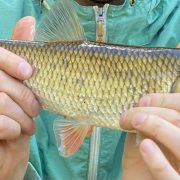
The sad state of the river was highlighted in a blog last September (click here), so it merited another visit. It is good to report an obvious improvement, not least because fish are back, including chub, which can sometimes be seen swimming near the surface of rivers and streams, often in large shoals. One was caught, and then returned – a good indication of better water quality, though there are two outlets pouring into the river that seem to contain some oily substance.  As they grow, chub become aggressive predators, eating fish, frogs and even small mammals. Hard to believe when you look at the little chap in the photo.

the predatory chub

He or she must be one of the 90,000 roach, chub, and dace fish that have been added to replace those killed by pollution in 2016, when 100 tonnes of digestate were pumped onto a field and flowed into the Preston Brook, which in turn flows into the river Leadon, and more than 15,200 fish were killed in what was described as “one of the worst watercourse pollution incidents in Herefordshire in recent memory”. The new fish were all hatched and reared at the Environment Agency’s national fish farm at Calverton in Nottinghamshire, which is funded by the proceeds of fishing rod licence sales.

Autumn swirl charger @ Palais des Vaches

There are almost 1500 river systems, comprising over 200,000 km of watercourses in the UK but, in a global context, our rivers are mere streams – being characteristically short, shallow and subject to considerable man-made disturbance, as we know from recent news about water companies releasing sewage and other waste whenever the system is deluged after rainfall (Rain? In the UK? Get away and stap me vitals!).

Autumn vase @ Palais des Vaches

One of these rivers is the Beaulieu River in the New Forest, which rises near Lyndhurst and flows into the Solent, passing through the beautiful gardens at Exbury. More than 100 years in the making, these gardens, designed and curated by the Rothschild family, have a spectacular collection of landscaped woodland, herbaceous, contemporary, formal and wildflower gardens.

Autumn Reds vase

Now, dear reader, as you probably know, a “meander” is a small winding river or stream, and, as a verb, can be used to describe a winding or intricate course suggestive of aimless wandering. Which is what I have done in order to get to this point. The Exbury estate, through which the river passes, also has the Palais des Vaches gallery, a former milking shed now transformed into a strikingly handsome gallery and show area. No thumb-twiddlers, the Rothschilds planned and rebuilt it during the Covid lockdown, and it now has had a further extension added.

interior of the Palais

Autumn Glory is the title of the show opening on Saturday 24th September, and Peter Arscott Ceramics is exhibiting there along with painters, sculptors and textile artists.

Peter Arscott ceramics on show

Possibly as a result of the long hot summer we have had, the apple harvest is early this year in Herefordshire. This means friends and neighbours will be desperately going round offering large bags to anybody they meet, in the hope that this will help with the glut. Other than freezing them, drying them, turning them into puree, or using them to throw at squirrels, any interesting and creative ideas that deal with large supplies of apples will be welcome.  Even leaving them on the garden wall for commuters to take before getting to the station makes few inroads.

In keeping with the tenor of this blog, here is a verse from Rupert Brooke’s “Heaven”:

Fish (fly-replete, in depth of June,
Dawdling away their wat’ry noon)
Ponder deep wisdom, dark or clear,
Each secret fishy hope or fear.
Fish say, they have their Stream and Pond;
But is there anything Beyond?….

You can read the rest by clicking here.