yes, you could win a belatrova ceramic

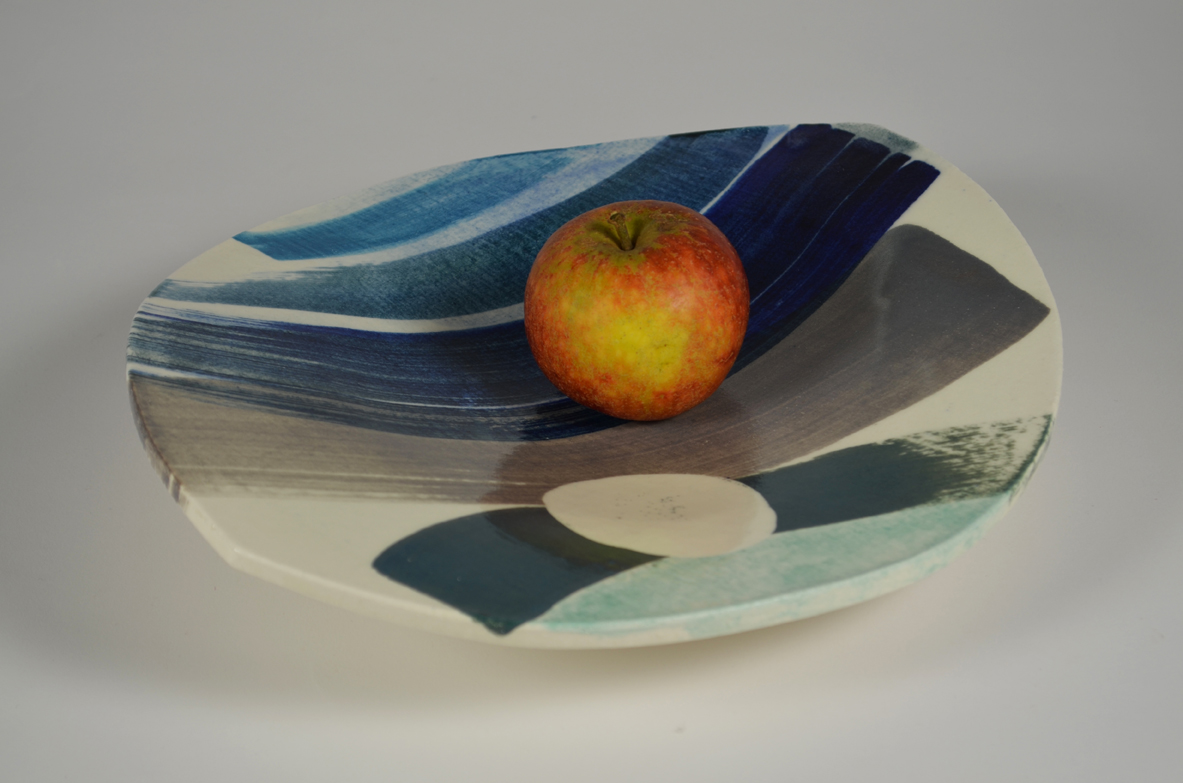
Please have a long look at this close-up of one of our dishes. Allow the colours and shapes to simmer and bubble away in your mind, and then come up with a name for that range. Anything permitted, barring whatever might get us sued.

close up of ceramic platter

name it and win it

Either go to our website and send us an email via contact page or simply add a comment on the blog. If you are successful, not only will the name be forever associated with this particular belatrova style, but you may win a prize: the very ceramic you see in the picture.

The result will be democratically decided (ie much discussed and argued over) by the team on Friday 1st November at No 9 Bankside at 5pm, and announced officially in the next blog.

close up of Valencia range

Valencia

We all know that belatrova makes unique hand-made and painted tables and ceramics. The variety of one-off designs is apparent when you walk into our workshop in Ledbury. Within the multiplicity of colours, brushstrokes and shapes there are a few discernable themes or ranges; one example being the mellow ochre look produced by mixing a little red iron oxide in the glaze into which the painted dish or bowl is dipped before firing. What to call this range? The team scratched its chin and mused one late Friday afternoon as it unwound with a Dry Martini (see blog May, Relocation). Names are important, after all, and after a great deal of discussion we decided that the range in question would be given the name of Valencia. There is something of coastal Mediterranean Spain in the tones.

 Inspired, the team went on to name three other ranges or “looks”. Here they are:

close-up of Manhattan range of ceramics

Manhattan

close-up of brushstroke blues range

Brushstroke Blues

close-up of allegro range

Allegro

We think highly of you and expect to receive some poetic and/or pithy ideas, so please give it a go. There’s a whole lot of biscuited bowls and dishes just waiting for the belatrova touch.

piles of biscuited bowls at belatrova

ready and waiting

Introducing Thelonius

image of belatrova products

slab pot and tables at the Courtyard

Before introducing you to Thelonius, belatrova would like to invite you to the Hereford Contemporary Craft Fair. Please come and see us and the work of 59 other selected makers of contemporary craft exhibiting over three days at The Courtyard (Hereford), where you can commission a piece of original work or buy direct from makers. It is open 10am to 6pm Friday 15th and Saturday 16th, 10am to 5pm on Sunday 17th November. The Courtyard has full disabled access and a café and restaurant that serve excellent locally sourced food and drink. Entry is £4 (free access for carers) and visitors can win a belatrova piece by just entering the daily Prize Draw at our stand by simply leaving their names and email addresses.

drawing of muscular right arm

belatrova’s mighty pugging arm

the arm used for lifting dry martinis

belatrova’s other arm

Now, Mrs belatrova has recently remarked on the amazing muscularity of Mr belatrova’s  right arm, and the strange contrast it offers when seen alongside his other rather weedier left one. This can be easily explained. It is the result of being right handed and having to thump the daylight out of lumps of recycled clay in order to “pre-process” it to get it to a smooth consistency before it can be used again.

In order to correct this imbalance, and to stop belatrova looking like a gangster with a bulging holster under his jacket, a decision was taken to invite a new member to the team who would take on the sole task of pugging.

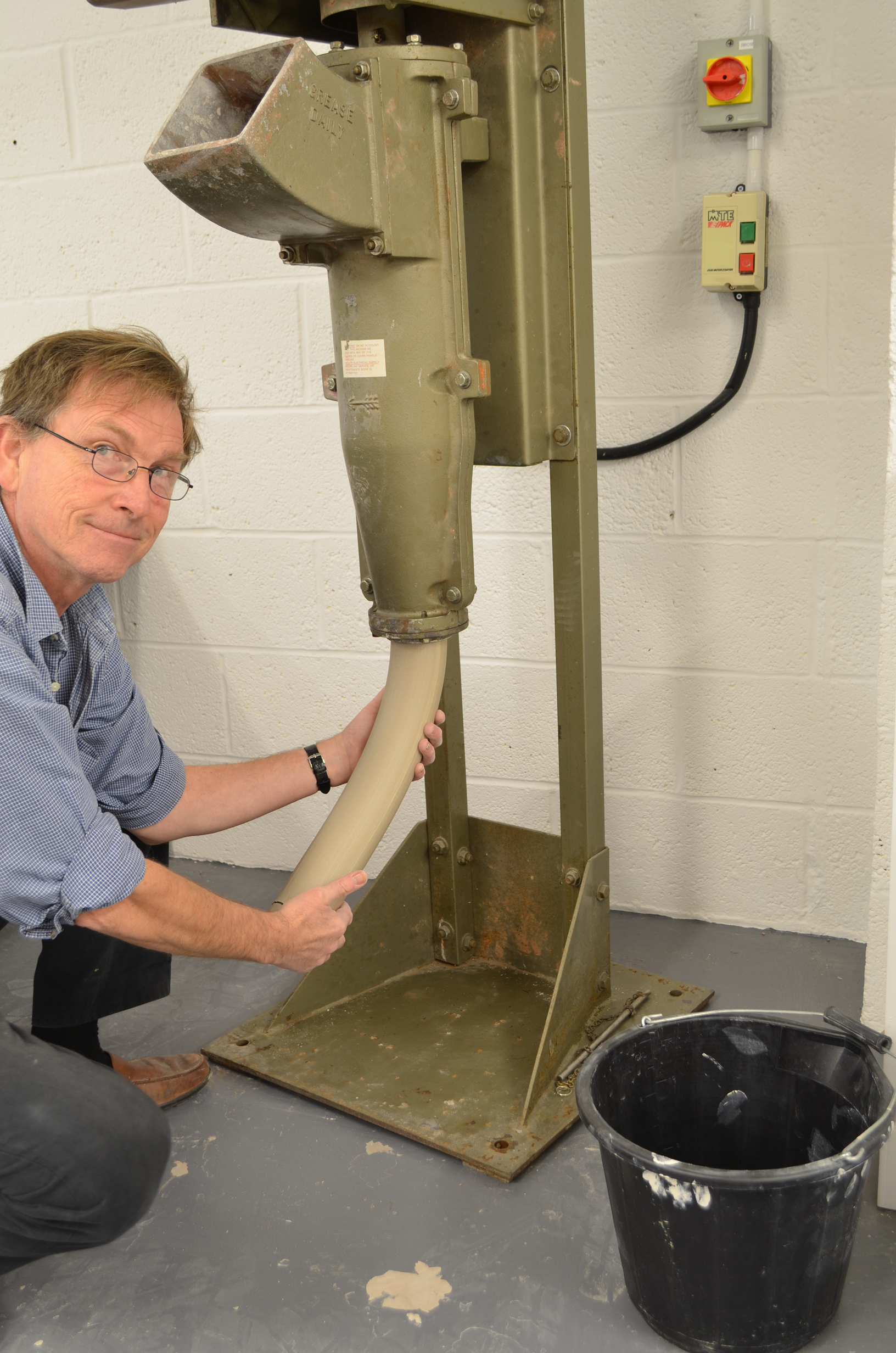
image of pugmill

Thelonius’ first day at No 9

Allow us to introduce Thelonius Pugmill; he’s from Essex and has until now spent his working life at a school in Colchester.

A pugmill is like a large mincer or sausage machine with knives on the screw fan principle that cut and knead the recycled clay, pressing it out of a smaller aperture (3″), smooth and even in texture, and ready to be used.

Most pug mills require you to process the clay to get it to a relatively tight range of consistency before going in. Dry clay has to be soaked in a bucket and wet clay kept wrapped in a plastic bag so that it is just right for the mill. The clay is squeezed out in long tube shapes called “slugs”, which are carefully stacked and wrapped in plastic until required.

The following images will give you an idea of how it all works:

ready for pugging

a lump of clay

clay in a bucket

clay soaking

image of clay going into pugmill

the clay is fed to Thelonius

image of pugmill lever being used to squeeze clay

squeezing the clay through

image of clay slug coming out of pugmill

Thelonius makes his first slug

image of two clay slugs or tubes from the pugmill

voilá, two lovely slugs, ready for use

image of pugmill with Peter Arscott and Staurt Houghton

the team

If you want to follow belatrova’s progress via Facebook or the blog, and unless you have already done so, just click the tag at the bottom right of your screen that says “follow” and you will get notifications everytime the blog is updated with news. We will be opening at No 9 for Christmas – details in the next blog.

You were only waiting for this moment to arrive…

image of blackbird perched on edge of ceramic birbath by belatrova

blackbird’s first bath

We told you in our last blog that we’d show you evidence of belatrova’s first birdbath being used, preferably by birds. So here it is: a local male blackbird is its first customer, having a break from pulling worms and pecking at insects and berries at the bottom of hedgerows. Apparently, they use vibration to attract worms to the surface. The males are all black and the females all brown except for the yellow-orange eye ring and beak.


Blackbirds are one of the commonest birds in Britain and there are thought to be over four million breeding pairs. It sings from a perch and its song is rich, varied and flute-like. Their calls are loud and varied. The warning call is given with flicking wings and tail and sounds a little like “chook”, and the alarm call is a loud rattle. Click this link and hear its song. Click this and you can hear Blackbird sung by Paul McCartney.

During the winter, blackbirds can often be heard quietly “singing to themselves” within undergrowth, this is called sub-song. When the breeding season is over, the male blackbird will stop singing and will not be heard properly again until February. They are not the world’s greatest nest builders and their attempts often end in failure through inexperienced birds deserting the nest, cold weather and predation by cats, crows and birds of prey. In fact, it is estimated that as many as 9 out of 10 nesting attempts end in failure.

child's drawing of dead bird

dead bird

So, enough ornithology from belatrova; after all, we are all about finely painted tables and beautiful ceramics. And ceramics can be used in so many ways, not only as bowls, dishes and birdbaths but also as commemorative objects … which brings us back to blackbirds.


Many years ago when Mr and Mrs belatrova were bringing up their own fledglings they were one day faced with a dilemma all parents have to deal with. Having rescued a young blackbird from the jaws of a cat, belatrova Jnr kept it overnight in a box with some water and worms she had dug up in the garden. When bleary-eyed Mr and Mrs b. awoke the next day they were confronted by their daughter who, perplexed, asked what it meant if a bird lay on its back with its legs in the air. And so Life and Death had to be explained. An important event worthy of commemoration – thus the ceramic plate.

image of ceramic platter with dead blackbird

explaining the big issue


belatrova, as ever in an expansive mood, and wanting to reward its sophisticated supporters, is giving you a taste of Summer, not by making a commemorative bowl but by inviting you to relax for eight minutes as you watch our video of bees working on a lavender bush. Watch each stalk sway as a bee lands on it, ease your mind into a restful trance and unclutter your head.


image od strawberries ina belatrova bowl with a glass of chilled Vermouth

strawberries and a cold glass of Vermouth


Then we suggest you buy some strawberries and pour yourself a glass of Dry Vermouth with ice and a slice of orange.

belatrova birdland

With Spring approaching and the dawn chorus getting earlier and louder, belatrova, lying in bed and thinking belatrovian thoughts, has started to wonder about birds and what they get up to throughout the day. On the way down to the workshop along the disused railway line that is now a cycle path the birds one usually sees are blackbirds, dunnocks, robins and sparrows, as well as the rooks high above in their nests cawing and talking to each other.

rook nests high above in trees

rookery

If there is a puddle it will often have a bird splashing around in it. Why do they do that? Probably because it helps them to keep their feathers in good condition. After bathing some birds protect their feathers using special waterproof oil that comes out of a gland under their tail. And presumably, during the summer, bathing in water also helps the bird to keep cool. In dry area birds will bathe in sand in order to remove lice and other organisms that gather in their feathers. This also helps to remove old feathers so that new ones can grow.

However, belatrova suspects that they also simply enjoy it. With that in mind, we decided to make our first birdbath.

image of molded platter for birdbath about to be turned over

about to turn the clay over


We mixed porcelain with a little red iron oxide – Thelonius was not best pleased at this messing up of his internal workings – and molded and coiled it into a large platter over which we attached a shallower one, leaving a gap of about 1 1/2 inches between both surfaces and so ensuring an extra robustness for the outdoors. It took about a week to dry, after which we fired it very slowly to 1275 degrees in the kiln. It was a long firing and we were all a little apprehensive when the time came to open the kiln. Would it be cracked? Would it be in pieces? Will it be twisted out of shape? belatrova now understands why all potters are so calm and measured when so much of their work is in the lap of the gods.


We decided the base would be of oak. Oak wood is strong, hard and very resistant to moisture and the elements. Builders and carpenters prefer it for building support beams and foundations of buildings because of its durability. The assortment and complexity of patterns on the wood give it an appearance other hardwoods can’t match, displaying prominent rings, vertical stripes, wavy figures, intermittent flecks, ray-like projections or any combination of these patterns. It is also resistant to fungal and insect attack.

stacks of wood at Whitney Sawmills

Whitney sawmills

Where to get the finest piece of cut oak? An hour’s drive from belatrova, in the English/Welsh border country near Hay-on-Wye, are the Whitney Sawmills – founded by Will Bullough thirty years ago. It is committed to replanting trees as they are felled. In addition, Will himself has planted a sixty-acre wood of mixed native hardwood at the site. But the main point is that one gets a quality product and a personal approach that is professional and caring; there is very little that Will does not know about wood.


two blocks of oak tio be used as bases for birdbath

two oak blocks await inspection


We drove to collect our oak, two pieces had been cut for us, and started sanding them as soon as we arrived back at the workshop.

image of oak base being sanded

sanding the oak


After the lengthy firing we allowed the birdbath to cool down and took it to the garden where we attached it securely to its base after we had placed the oak on a concrete foundation as a safety measure. A beautiful sixtieth birthday present surprise for a certain person, though, so far, reports state that the birds are eyeing it with suspicion. They’ll get the idea, and as evidence we’ll post a photo of a bird splashing around in it in the next blog.

image of birdbath in garden

the birdbath

dripping

flooded field in Herefordshire

barley underwater

Water, water everywhere – in cellars, in fields with crops, on roads, flooding whole areas like never before, forcing people out of their homes along the Thames and in Somerset and the South West of Britain. Above is a picture of a local field in Herefordshire; you can usually see the winter barley growing but now it is a lake. Yes, it has been wet outside, relentlessly wet and grey and dreary, with dark overcast skies, buckets of rain and gale force winds, which altogether, with the short winter days, has led belatrova to experience more difficulty rising in the morning when it is still dark outside.

chocolate cake

not good

This mental state has also been accompanied by an inexplicable craving for more carbohydrate-rich foods, possibly leading to weight gain. Cake, pizza, roast potato, waffle, pasta, jam, and, er, dried fruit and pickles, we know not why, but we do know that weather affects our mood and our digestion. However, cake bad, fresh fish good – so here’s a picture of both.

gilt headed bream on a ceramic platter

fresh fish on belatrova platter good

Being of a generally sunny disposition we at the workshop buzz along busily despite the sound of falling rain overhead, and one of us even nipped into Wales for a break; a case of “out of the frying pan into the fire” since the land was even wetter there, though on the way back it stopped raining and a scattering of snow made an appearance, transforming the landscape in a subtle way.

tree lined hill side in Wales

Welsh hillside with a hint of snow

Still, the temptation to jet off to hotter places will be resisted, and any holidays

sketch of couple sunbathing

sun worship

won’t take place till later in the year. In any case, the accompanying drawing is a reminder of what happens if you cannot control your winter craving for carbohydrates and decide to sunbathe in a foreign clime.

On the way to Stoke on Trent to buy more clay we drove uphill towards Malvern and for the first time in a long time saw a parting of the clouds and a sign from heaven. Everything’s going to be alright.

rainbow over Great Malvern

on the road to Malvern

Whistle while you work

Being a naturally harmonious workplace, belatrova’s workshop is a temple of productivity and foot-tapping enjoyment. Yes, music wafts through our workspace every day, and is shared by all – no headphones or earplugs to be seen. We know that those who listen to music complete their tasks more quickly and came up with better ideas than those who don’t, because, as we all know, music improves our mood.

image of dopamine

dopamine

We went online to see what explanations there may be and found out that in biological terms, melodious sounds help encourage the release of dopamine in the reward area of the brain. Dopamine functions as a neurotransmitter—a chemical released by nerve cells to send signals to other nerve cells. The brain includes several distinct dopamine systems, one of which plays a major role in reward-motivated behavior. Every type of reward that has been studied increases the level of dopamine in the brain: music, chocolate, sunshine, massages, coffee.

When glazing is the priority and we want our dopamines stroked in the best manner, the BrushstrokeBlues range benefits from the cool tonal subtlety of Miles Davis trumpet. The best-selling Jazz album of all time is Kind of Blue“, and it is played at No9 Bankside at least once a week; it slows down the pulse rate and the brushstrokes flow.

brushstroke blues range

brushstroke blues

ceramics in manhattan range

manhattan range

The Manhattan range belongs to the pugmill’s namesake Thelonius Monk, whose improvisations are full of dissonances and melodic surprises, and strange but wonderful gaps or hesitations. Try listening to “Round Midnight” or “Ruby, my dear” if you haven’t already.

And the Allegro range goes so well with the sensual playing Stan Getz’s saxophone and Astrud Gilberto‘s bossa nova voice (you know, “Girl from Ipanema“, “Fly me to the Moon“, “Corcovado“).

allegro range of ceramics

allegro

Which leaves us with the Valencia series. Warm, full of light…it’s samba and rumba – Peregoyo y su Combo Vacana floats our boat, but any Latin American dance music seems right.

valencia range

valencia

So far there is general consensus with the music played, and others that get a look-in are Ella Fitzgerald, Duke Ellington, Steely Dan, David Bowie, John Surman, Oscar Peterson, with only some ructions reserved for the occasional playing of Tom Waites (“Rain Dogs”).

We even have fabulous supporters and clients of belatrova who give us recordings they have made; one fine person even left us five CDs of Miles Davis late recordings. If he is reading this we would like to say “thanks” and tell him that “Aura” is growing on us.

By the way, even if you are a small business, if music is ever played on your premises for customers or staff, through radio, TV, CD, MP3 this is considered a “public performance”. A music licence grants you permission to do this, and the fees generated ensure that songwriters, composers and music publishers are paid when their music is used.

Goodbye for now.

predictions

We wish you all a happy 2014.

comic strip character by Paul arscott

troll

During a coffee break we were talking about how we will be seen in a hundred years’ time. Will the people of 2114 look at us and think  “… hmmm Britain’s got talent, Great British Bake-off, twerking, tweeting, trolling, drones…? What was all that about?”

Or will they be rubbing their chins, impressed by the years’ innovations: wearable computers, developments in biometrics, 3D-printed organs, crowd sourced business. Or maybe 2014 sees the return of abstract art, but made by women artists, or the rise of digital surrealism, or the rise of the comic, or the beginning of a return to connoisseurship and the appreciation of the individually crafted. Who knows? We don’t, but with the centenary commemoration of the First World War about to dominate the press and media, belatrova wanted to see what was happening culturally back then, we wanted to see what the “future” was like one hundred years ago.

For example:

Cubist picture of Horta, by Picasso

Picasso, 1909

Grand Central Station in New York

In Grand Central Station I sat down and wept

German expressionist image by Kirchner

Combat – agonies of love, Kirchner, 1915

Vortcist painting by Bomberg

The Mud Bath, Bomberg 1914

Gaudi’s art nouveau Casa Mila in Barcelona is finished (see blog June 2013), Die Brucke and German Expressionism comes to the fore, Art Deco in France starts to emerge, Picasso develops Cubism, Grand Central Station in New York opens to the public, the Vorticist movement takes shape in Britain,  and airships (or Zeppelins) were new.

And one hundred years ago the Arts and Crafts Movement was flourishing, and had been since 1880, inspired by John Ruskin and William Morris.  It emerged in Britain but was quickly taken up and adapted in America and Europe.

Arts & Craft mug by Finch

mug by Alfred William Finch 1900

They promoted a revival of traditional handicrafts and the introduction of better design in everyday and domestic objects. Individuals in small workshops to large manufacturers created the work.

And they all reached a wider audience thanks to shops such as Liberty’s and  Heal’s selling their goods.

Liberty's in London

Liberty’s

Heal's in London

Heal’s

belatrova  has a gut feeling that the era of the individually hand-crafted is coming around once again.

Geometrical painting by Malevich

Suprematist painting by Malevich

Here is one of our recent Manhattan slab pots, with just a hint of Kasimir Malevich about it, though strictly speaking the  Russian founder of Suprematist painting did not start the movement until 1915.

Slab pot made by belatrova with geometric patterns painted on

Manhattan slab pot by belatrova

here’s to christmas, to winter, and to tapetum lucidum,

plant pot in belatrova cobalt ceramic slab pot

the belatrova Christmas tree

Winter is drawing in and the days are getting shorter, Christmas is around the corner, and belatrova is already thinking about 2014 and what it will bring. New colours, newer shapes and sizes of tables and bowls, and who knows what else, though one element will always be a constant at No9, and that is the oxide that produces the colour we most associate with intelligence and trust, serenity, logic, reflection and calm.

Which colour do we think of when winter is upon us? Which is the one that will calm the mind and bring serenity? It is the colour of clear communication, the colour of the mind, essentially soothing, the one we most commonly associate with harmony, faithfulness, and confidence.

the colour blue

blue

It is the world’s favourite colour. But it was not always so: in Europe the colour blue grew in prestige and popularity only because of the veneration of the Virgin Mary and a change in the colours used to depict her clothing. Earlier, her robes had usually been painted in blacks and greys but after the 12th century they began to be painted a rich blue, usually made with a new pigment imported from Asia; ultramarine. So that is how blue became associated with holiness and virtue.

And long before belatrova came into existence, Chinese artisans, in about the 9th century, abandoned the traditional recipes they had been using and began to use cobalt blue, made with cobalt salts of alumina, to manufacture fine blue and white porcelain.

These ceramics were shaped, dried, the paint applied with a brush, covered with a clear glaze, then fired at a high temperature. Centuries later, this was exported in large quantities to Europe where it inspired a whole style of art, called Chinoiserie, though European artisans only succeeded in emulating their Chinese counterparts in the 18th century after a missionary brought the secret back from China.

scooped bowl by belatrova

belatrova scooped bowl made with cobalt and other oxides

For all the associations those in Europe attach to blue, in other cultures it can have other associations. In Mexico, Iran and Korea it is the colour of mourning, in the Middle East it is associated with protection, and in the East it is generally linked to immortality, life and femininity.

And just think how artists have used it down the centuries. Look at Vincent Van Gogh’s Starry Night Over the Rhone (1888) and see how the colour is used to create a mood. That cobalt blue sky and sea, and the touches of yellow/orange (cobalt’s opposite), are what create everything depicted – an immersion in blue.

painting by Vincent Van Gogh of night panorama over the Rhone river

Starry night over the Rhone by Vincent Van G

So all this is a roundabout way of saying to all of you: “see you next year, enjoy the winter, have a happy Christmas.” We will raise our Dry Martinis to you and dream up new things for your delectation – belatrova knows that even arctic reindeers’ eyes change colour over the course of the seasons (from amber to blue), so we may surprise you in 2014, though cobalt blue will always be there in some guise or another.

pug mill with Santa Claus hat

Thelonius says “Happy Christmas”

the great Paul Klee’s never ending reach

a line of hand painted belatrova tables

belatrova conga at the Open Day

So many of you came to our Open Days on Saturday 30th November and Sunday 1st December, that we ran out of coffee, white wine and mince pies.  Although Unit 9 Bankside is a workshop, please feel free to drop by at any time, though a ‘phone call beforehand is a good idea, just in case.

two lines of belatrova coffee tables

belatrova squad

Those of you who came were able to see the exhibition of table  paintings which we set up just for the two days, and this proved very popular. These tabletops are all hand painted, each one a painting in acrylic and then varnished over with a heat resistant lacquer.

With a big space dedicated to the tables only, most viewers took their own time to look at each individual piece and enjoyed the experience of a gallery-like atmosphere and the pleasure of looking down at paintings and walking around them. Try it at home, it’s so much more comfortable than looking up at paintings on walls. And you can put hot mugs of tea on them too.

One or two of you, having been to the Paul Klee exhibition at the Tate Modern, noted a connection between his painting and some of the tables. Well spotted. Klee is a particular hero of belatrova’s and every now and again surfaces in our work. Here are some Klee-like examples:

belatrova paul klee table painting

paul klee table

klee reference on belatrova table

a bit more klee

The Klee exhibition is one of the best to be held anywhere, and even if you are not familiar with his work, belatrova recommends a visit (we’ve been twice already); he was innovative and always trying out new ways to make marks on a surface, and, seventy three years after his death, you can see how much he has influenced artists.

belatrova is not sure that Klee ever made any ceramics, but had he done so the results would have been as engaging as Picasso’s, though gentler. Here are two we made earlier with P.K. in mind:

two pots in the Klee style

two Klee pots by belatrova

belatrova’s “Christmas Weekend”

display of ceramics at Hereford Contemporary Craft Fair

belatrova at the Contemporary Craft Fair

The Contemporary Craft Fair drew in large crowds throughout the weekend of 16th and 17th November and we were very pleased to meet so many of you at The Courtyard. Just about everyone we spoke to agreed that the standard of the exhibitors was of the highest order, attracting both the general public as well as galleries and the trade.

display of belatrova's Valencia range

valencia range display

Many of you left us your names and emails to enter the daily prize draw, and there were three winners who have now all received their three legged bowls. Congratulations to Tony, Cathy and Martin.

a visitor at the Hereford Contemporary Craft Fair speaking to a member of belatrova

feedback

The feedback received was very positive, with the Brushstroke Blues and the Valencia ranges proving the most popular. There were so many enquiries about techniques, dimensions, colours and commissions that we decided to invite you all to come and see things for yourselves at the workshop at No 9 Bankside in Ledbury, when we will be open to the public from 10 to 6 on Saturday 30th November and Sunday 1st December. Perfect timing for those who want to buy that singular Christmas present, or order a pair of table lamps for the house or just spend £15 on a small but perfectly formed three legged bowl which has room for only two olives.

two olives in a belatrova bowl

olives for two

banana in small bowl

tiny bowl, big banana

keys in small belatrova bowl

perfect for keys

Directions: follow the pink h Art signs off Lower Road or New Street into Little Marcle Road and onto the Bankside Industrial Estate. The postcode is HR8 2DR for those of you who use Sat Nav. There is parking available, and mince pies and wine – and you can meet Thelonius too.

image of belatrova pug mill

Thelonius says “hi”