belatrova’s Tales of the Alhambra

view of Granada from Sacromonte hill

Granada and the Alhambra from the Sacromonte

belatrova has often been drawn to Granada (blog August 2014) in the foothills of the Sierra Nevada, and specially to the Alhambra, the great sprawling hilltop fortress encompassing royal palaces from the Nasrid dynasty, as well as the fountains and orchards of the Generalife gardens.

looking down from the Alcazar

view of the city from the fortress

It first became a palace in the 14th century under Yusuf 1, Sultan of Granada, in the years when southern Spain was in the hands of various Moorish dynasties. It is a spellbinding place, all ceramic tiles, wood and plaster – Islamic art at its peak.

view of Granada through Alhambra Palace window

cool inside, hot out

It stands on its hill overlooking the city and from the cool darkened interiors you can see Granada below, through ornate lattice windows, sweltering in the white light of day. It is an indoor coolness reinforced by the tile work along its walls, the lightness of the intricate plaster ceilings, the presence of water in the courtyards and the calm the architecture seems to bestow on its surroundings.

slender pillars of Alhambra

tree-like

Part of its magic is the way you are constantly made aware of nature, specifically of light and water, no matter where you are standing within the palace; either because you are catching glimpses of the exterior, the patios, the views, the distant trees, the reflecting pools, or because your eyes are absorbing the gentle reflections from the chest-high ceramic surround and the extraordinary organic plasterwork of the domed ceilings and the tree-like colonnades of random columns (they are not, of course, they artfully appear to be scattered).

[one_half]

plasterwork of dome ceiling at the Alhambra

intricate and sublime

[/one_half]

[one_half_last]

more plasterwork in the Alhambra

delicate and voluptious

[/one_half_last]

The adjacent Generalife gardens also manage to maintain this fine balance of nature and architecture; no matter that you are outdoors, trees and hedges enclose you, lines of slender pillars appear and lead you into the welcoming shade of a domed space filled with mosaics. Birdsong and the sound of trickling water are all around you, and from certain vantage points, distant views of the Sierra Nevada, still snow capped, remind you of Washington Irving’s Tales of the Alhambra and the story of how muleteers used to bring ice down to the city in great blocks.

[one_half]

view of Sierra Nevada

distant snow-capped Sierra Nevada

[/one_half]

[one_half_last]

pool in Generalife gardens

toe-dipping allure of the Generalife

[/one_half_last]

Water is an essential ingredient in this manmade landscape, an important factor in the life of a culture shaped in the desserts of North Africa and so its presence is everywhere, even flowing in the stone balustrade that leads down a flight of steps to the gardens, and which allows a descending courtier or Sultan to dip his fingers in it.

[one_fourth]

stone balustrade with water running down the middle

finger-dipping stone balustrade

[/one_fourth]

[one_fourth]

ceramic toiles and plasterwork on wall of the Alhambra

ceramic and plaster

[/one_fourth]

[one_fourth]

intricate plasterwork

laberynthine plasterwork

[/one_fourth]

[one_fourth_last]

tiles on wall at the Alhambra

tiled wall

[/one_fourth_last]

Granada itself is a wonderful blend of medieval streets winding up to the Albaicín, gothic and baroque churches, a commanding cathedral, noisy squares filled with cafes and restaurants, fabulous ice cream parlours, incredibly helpful taxi drivers, shops brimming with blue and white ceramics, and one bar in particular that serves ice cold beer in freezing earthenware vessels (an idea germinating in belatrova’s collective mind – could this be applied to a Dry Martini?).

[one_third]

cold beer in earthenware mug

ice cold in Granada

[/one_third]

[one_third]

close-up of magnolia flower in Generalife

magnolia

[/one_third]

[one_third_last]

sandalled foot resting on table

belatrova resting

[/one_third_last]

The visit coincided with Granada’s Corpus Christi festival – a five day period of celebrations and religious processions. In the Plaza Bib Rambla families roamed around the square sipping drinks and watching a puppet show with their children, their young daughters dressed head to toe in their flamenco outfits.

[one_half]

fountain of the courtyard of the lions

the courtyard of the lions

[/one_half]

[one_half_last]

passion flower

passion flower in the Albaicín

[/one_half_last]

It was an inspirational visit, and made us want to get back to our ceramics, our birdbaths, but mostly to our tiled tables which we will be launching as part of the Bankside Studios Summer Open Weekend on Saturday 11th and Sunday 12th July. Please pay us a visit, and you will also get to see the work of six other makers. Hasta la vista.

open studio

The Ashes, Wimbledon – and our Open Workshop Weekend!

IMGP5629If the spectacle of the Ashes is not for you, nor the thrills from Centre Court of Federer versus Djokovic and you are looking for something else to do this weekend, then you will be very welcome at our Open Workshop on Saturday 11th and Sunday 12th July from 10.00am to 5.00pm!

We can’t promise you a Joe Root cover drive or Federer cross-court backhand, but you never know, we may have something else that catches your eye from our collection or from those of our neighbouring makers at Bankside Studios – including Stuart Houghton, Fleen Doran, Wendy Houghton, JapanGarden, Dave Preston, and Nicky Arscott (Painter).

…and who wants cricket or tennis if you can have….noughts and crosses!

tweet of the month

greenfinch

greenfinch looking for a bath

Imagine you are a garden bird. It is hot, the sun is shining, worms have been eaten and you need a drink. Perched on the very top of your favourite tree, probably a Lawson cypress, you have been singing away the early morning and your throat is dry (perhaps you are a greenfinch whose song is a prolonged nasal “tswe-e-e” in the breeding season, and you are exhausted). Looking down on what the neighbouring gardens have to offer, you see no puddles because of the heat, but you spot some inviting birdbaths. Alas, on closer inspection they are either too deep for your little pink legs or full of green slime because the bowl is porous and harbours algae.

ceramic birdbath

belatrova birdbath

Happily, you are attracted to a particular birdbath – a fine ceramic bowl with an attractive turquoise glaze, standing on a reassuringly solid piece of oak. The bowl tapers to a depth of three inches in the middle, and the glaze ensures there is little algae, if any. Perfect. You have a quick look at the bottom of the bowl: of course, the “b” of belatrova is embedded in the ceramic – no wonder it such a fine piece. No deeper than three inches at the center and even shallower at the edge, so that a greenfinch can ease its way in. Many birdbaths are just not shallow enough.

Some people put rocks in theirs to raise the bottom, but it will require more work to keep the water clean.

drawing of evil cat

bad cat

As a greenfinch you will know where a birdbath should be located. Not where cats can hide. Cats like to lie in wait beneath shrubbery and then jump on the birds when they’re wet and can’t fly well. Consider putting your birdbath at least five feet from such hiding places. Give the birds a chance to see the cat approaching. There should also be an escape route. The ideal location is under some branches that hang down within two or three feet of the bath. A wet bird can flutter a few feet up to the safety of the leaves.

[one_third]

shoebill bird

you don’t want shoebills in your birdbath

[/one_third]

[two_third_last]

A birdbath on a pedestal makes it easy to see from the house, easy to clean, and somewhat safer from predators. If you locate your bath on the ground, it is important for the birds to have overhanging branches to fly to. And place it within reach of a hose – make your birdbath easy to clean and refill. But locate your birdbath away from the feeding area, because seeds and droppings will dirty the water quickly. Change the water every few days, or even every day in hot weather.

[/two_third_last]

[one_third]

ceramic birdbath on oak plinth

perfect birdbath

[/one_third]

[two_third_last]

Don’t forget to place the birdbath where you can see it from indoors, from your desk, dining room, or the kitchen sink. Then you can enjoy the sight of a blackbird or sparrow splashing away – well, wouldn’t you want to clean your feathers and remove any parasites? it can brighten up your day.

[/two_third_last]

blackbird perched on rim of birdbath bowl

blackbird about to have a dip

belatrova’s favourite tweets (just click the bird):

blackbird

thrush

goldfinch

Ah, birdsong; nothing purer or more natural…. even Cathy Berberian knows there’s one roulade she can’t sing. (Steely Dan – Your Gold Teeth)

tweet, tweet

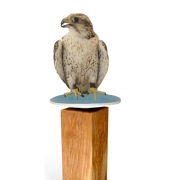
eagle superimposed on belatrova birdbath

beat the heat

landscape of Andalusia

Driving through Andalusia’s spectacular landscape last week, belatrova’s workshop and its kilns came to mind. It was a heat so fierce that, when getting out of the air-conditioned car, it felt you were being hit by a freight train. However, previous visits show that it is possible to adapt and deal with the problem by drinking large amounts of cold water and beer, slowing the pace down, and not doing much between 3pm and 7pm.

feet up with landscape beyond

belatrovians will have noticed that our blogs are often about Spain; we keep going back and discovering new places unvisited before, and it is a big country. This time the trip concentrated on Sevilla and Cadiz, with a lot of places in between. And it was hot – 41 ° centrigrade is fine for lizards (of which there were many) but it is a challenge to pale pink people from Albion, specially in the decision-making department.

beach in Cadiz

It turns out that when the temperature is unusually hot (or cold) we use energy in the form of glucose to maintain a steady temperature in our body, so our internal thermostat allows us to shiver and sweat, correcting for excessive heat or cold. Keeping the body cool seems to require more energy than warming it up and so uses up the resource that would otherwise be used for mental processes.

In other words, we are less likely to make good or complex decisions if we are struggling in the heat. In fact we are likely to just take the easy option that requires no effort. Thus, why climb a hill to visit the village church and admire its ornate Baroque carvings when you are standing right next to a cool and shady terraced bar serving cold Cruzcampo, and why bother putting factor 10 sun block cream on after a swim on the beach at Cadiz when you know you are going back into the water in ten minutes. Result: beery headaches and sun burnt shoulders.

map of journey

Sevilla is a beautiful city on the banks of the Guadalquivir River. Its pace is stately and entirely in keeping with the weather, its narrow streets dark and inviting, its monumental Gothic cathedral balanced by the sheer grace of the Giralda tower, its Maria Luisa Park a Moorish paradisical garden laid out for the Exhibition of 1929. But the highlight was the Alcazar built primarily in the 1300s – a wonderful Mudejar (post Moorish) palace that is a subtle intricacy of ceramic and wood. And belatrova really likes ceramic and wood, as you know from our Granada trip.

ceramic art in Alcazar in Seville

porch of Alcazar


image of underside of Alcazar dome

porch of Alcazar


The next stop was in the Grazalema range of hills and mountains to the south of Sevilla. In the Alcornocales area (it is a type of cork tree) the view was dramatic, the water from the lake down below changing colour from morning to night and the blue sky above visited by griffon vultures and Bonelli’s eagles for whom even a belatrova birdbath would be too small.

evening sun in cork forest

The wildlife seen included deer, woodpeckers, giant crickets, cobalt blue centipedes, scream-inducing hornets, gekkos, large moths and other unidentified creatures only briefly sighted as they scurried from under your bed or out of your shoes. Here are some pictures we took.

green cricket

praying mantis


centipede

image of eagle in Andalusia


We visited towns perched on hills and ravines (Arcos de la Frontera) or cradled in hot valleys (Ubrique) or with its own cooler microclimate where the rare Pinsapo pine tree thrives (Grazalema). We dropped in on Jerez de la Frontera and drank manzanilla from Sanlucar (the less well-known sherry rival). The founding Moors named the town Xeres, by the way, and so we inherited the pronunciation of “sherry” from them.

view from Grazalema road

And finally Cadiz, the oldest continuously inhabited city in western Europe, founded by the Phoenicians, who called it Gadir, and birthplace of notables such as the composer Manuel de Falla, the guitarist Paco de Lucia and the poet Rafael Alberti.

cathedral in Cadiz, Spain

We coincided with the celebrations of the Virgen del Rosario, whose effigy stopped a tsunami from the Lisbon earthquake causing any destruction of that part of the city. Her very heavy statue and float are carried by twenty men along the streets of the neighbourhood for three hours before she is taken back to the church of Santo Domingo. Here is a short video of the procession. Click here to see it.

It was belatrova’s first visit to Cadiz, and we cannot recommend it too highly. If ever you go there get in touch and we will tell you where to have the best breakfast in Andalusia.

So, it is back to the heat of the kiln at No 9. We are making ceramics and tables to show visitors during hArt Open Studios from 12 – 20 September – put it in your diary, though we will send a reminder. eagle superimposed on belatrova birdbath


Michaelmas daisies

vulcanology

horse's tail

winter rushes in

There is a saying that “winter comes in on the tail of the last horse home in the St Leger”, one of the oldest classic horse races and held at Doncaster every September.

horse head in stone Parthenon

exhausted horse at the British Museum

On the other hand, we at belatrova would like to banish any winter blues by pointing out that the Romans believed the month of September was looked after by the god Vulcan, so they associated it with fires and volcanic eruptions.

Much as belatrova does, except that we associate the whole year with fire because of our kilns, and with volcanic eruptions because of certain people’s reactions on opening the kilns. Yes, Vulcan presides over No 9 Bankside, reminding us so only a few weeks ago when a large coiled bowl in the Brushstroke Blues style, destined for a BBC programme, exploded in kiln 2.

Michaelmas daisies

September’s flower

Oh, the rage! And then the stoical acceptance. And then the need to soothe the fevered brow. Where better than in a quiet garden at this time of year: cyclamen, daisies, apples and pears, and that flower of the month of September – the Aster, whose name means “star” in ancient Greek and includes the Michaelmas daisy which grows all over the county of Herefordshire. We thought you would like to see them, so here is a snap.

Calm is essential at the workshop, specially at this time of the year because September also means hArt – the Herefordshire Art Week from 12th to 20th, to which you are most welcome. Do come and see us, we are open from 10 to 5 everyday throughout. All three kilns are busy pumping out heat like small volcanoes in readiness for the first day (Saturday), and we shall be exhibiting new birdbaths, lamps and tables.

lounge of Feathers Hotel , Ledbury

inside the Feathers with belatrova

We suggest you make a day of it by visiting other venues open for the week; there are twelve in Ledbury alone, and a total of over ninety countywide. Among the places you could stop at for lunch or supper is the Feathers Hotel, where you could rest in one of their comfortable sofas by the light of a belatrova table lamp, commissioned by the hotel only recently.
ceramic scoop bowl

Come and see us.


pathway in the woods

the belatrova look

pathway in the woods

the way to work

This is a photograph of one of the paths that lead us to work at No9 Bankside. As you can imagine, the colours and environment change considerably throughout the year, and even the birds sound different – hardly a tweet in January but a choir in May. The walk is soothing and helps focus ones thoughts, and amidst the usual deliberations (Is the universe finite or infinite? Are there female leprechauns? Why do old men have hairs in their nostrils? How much deeper would the oceans be without sponges?), what came into mind recently was “How to explain the belatrova look?”


Mid century modern? Vintage 50s? Contemporary retro? Retro contemporary? Not really. It’s just that the belatrova team like bright, bold colours and satisfying forms – it’s age and experience that allow any maker and designer to judge with confidence the fashions and periods she or he has lived through, and to come up with something that looks both familiar and refreshingly new. That’s belatrova.

medieval image of blacksmith

our neighbouring metal worker, on a good day

Add to this a contemporary rural community that provides know-how and support when dealing with different materials and processes – somehow our neighbours, a metal worker, a maker of Japanese screens, a textile artist and a ceramic sculptor, have some intangible influence on things – and if you add the fact that the three business partners are a potter, a painter and a pianist, you have a recipe for a unique creative business.

underside of coffee table

sputnik

What we are saying is that belatrova combines an awareness of contemporary style with the influence from childhoods spent in the era of sputnik legs, Mondrian geometry, rounded shapes and coffee tables, in other words the late fifties and early sixties (yes, last century) – but also bringing a contemporary artist’s touch to domestic design and introducing both fun and fine art painting into the home.

And so, not that you need reminding, distinctive hand made, hand glazed ceramic coasters, lamps, bowls, and large standing pots, contemporary designer coffee tables, and ceramic birdbaths on beautiful oak plinths make up the range of stunning products from belatrova. Here are a few images to whet your appetites:

handpainted coffee tabletop

durden

platter

platter

As most of you know, everything is made at our workshop in Ledbury, Herefordshire, which you are very welcome to visit; just give us a ring on 01531 634082 in case we are out delivering, or on an emergency expedition to buy olives for our Martinis. Warning: the picture below is not of a Martini, but an experiment involving apple juice and gin and other (secret) ingredients.

And by the way, a potter, a painter and a pianist deal respectively with mud, paint and ivory, so we thought at first we would find a name for our enterprise by making an attractive anagram of the three words. Luckily we went for “belatrova” – the only anagrams we came up with were “mad vino purity”, “via nudity romp” and “armpit undo ivy”.

belatrova sign

a bat lover

Toodle pip.


another close-up of mural

Muralista

complete head-on view of mural

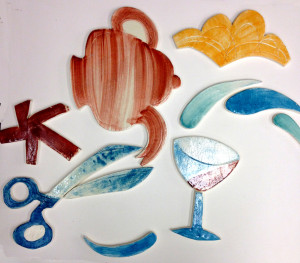
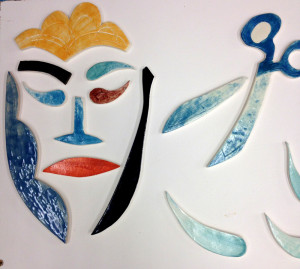
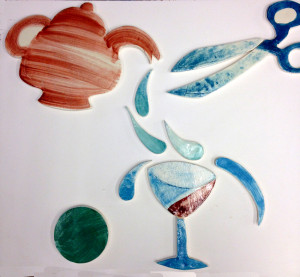
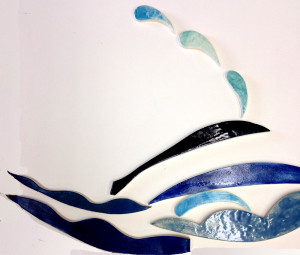
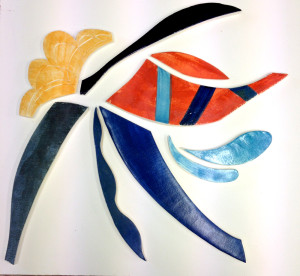
Adaptable as ever, belatrova, as well as designing and making handmade ceramic birdbaths, lamps, bowls and tables, has developed another skill that uses clay to great effect – we also make ceramic murals. A mural, from the Latin murus meaning wall, is any piece of artwork applied directly on a wall, ceiling or other large permanent surface.
view of ceramic mural lo<a href=

This particular mural uses the idea of “juggling” as its departure point; the house in Spain for which it was commissioned is named after an area of southern India, and it is a word that in Spanish is associated with jugglers and juggling. A happy convergence of imagery to get the ball rolling, and which can be seen in the final design with the still central figure at the bottom from which two circular movements flow, one counter clockwise, the other clockwise, co
ntaining the various elements and shapes which are being “juggled” – all presided over by the sun at the very top. Some of the shapes are purely abstract to accentuate the flowing lines, other more recognizable things are there because they are right (even if ultimately inexplicable to most people- cacti, skulls, vases and jugs, ashtrays?).

another close-up of mural


ceramic cactus

The rectangle of space within which the piece was designed measures 2300mm x 3126mm, and each piece is made from grogged stoneware, a clay that contains tiny fragments of molochite to strengthen the material when it has to be shaped and cut, slab rolled and then biscuited to 1000°, after which, as a lot of you may remember from previous blogs, the surfaces are painted with oxides and stains, dipped in a transparent glaze and then fired to 1275° in the belatrova kiln.

view of ceramic mural from ground floor
The challenge was always to produce shapes that stayed flat and did not crack, and there were five “skulls” made before the sixth and final one that you see in the images. Here is a picture of skull No 4, already biscuited, with a fine crack going from eye to jaw. It makes quite a good cheese board, specially when you need to hurry guests away from the table.

close-up of cracked ceramic piece

ceramic skull as cheese board

We were very pleased with the way the two flying legs turned out, considering their awkward shape and length. The belatrova team member who modeled for them wishes to remain anonymous, but we think he has a future with Tommy Hilfiger or Adidas.

ceramic legs in mural

The other challenge facing belatrova was the height of the scaffolding, about three metres off the ground, but, thankfully, any vertigo was kept at bay by our perfect hosts who supplied belatrova with a steady source of cold Spanish beer sothat in the end any lingering acrophobia was gently dispelled.

scaffolding

The first step upon arrival was to measure out the rectangle above the doorway in the hall and then to stick templates of the ceramic pieces (which had previously been cut out in card) onto the wall. When, after a great deal of tweaking, the templates were all blue-tacked in their place, a pencil mark was drawn around the contours and the card templates removed to allow the actual ceramic shapes to be bonded to the wall in their correct positions.

carboard templates of ceramic shapes for mural

Murals do vary from simple tiled works to huge installations by contemporary ceramic artists; depending on context, they can enhance large or small spaces, but belatrova thinks ceramic murals are the perfect solution for those who enjoy sculpture but have no space, or for those who have a large space that needs to resonate more with its surroundings. Murals fulfill the same function as a picture while often being much more dynamic and three-dimensional.

stylized ceramic skull

The technique of slab-rolling and shaping, which was used for this mural, is one also applied to most of belatrova’s production, and if any of you have not already seen our video showing how it is done, please click here.

Lastly, please remember that we have two pre-Christmas Open Weekends: 28 and 29 November, and 6 and 7 December, when we will be open from 10am to 5pm. Do drop in.

ceramic mural

weekend openings, many visitors

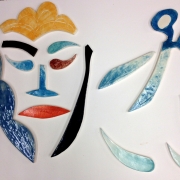
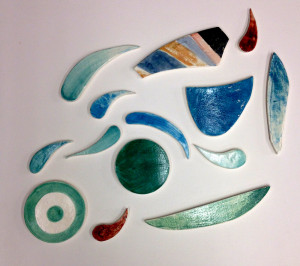
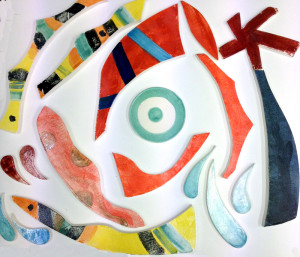
A big thank you to all our visitors who dropped by these last two weekends – it is always good to see new faces as well as the regular ones. Many of you took part in our “mini mural” competition which used an assortment of glazed ceramic pieces to very individual effect. And do they say something about the individual, we wonder?  And here are the best ones (as judged by Thelonius):

Hmmm. Very difficult to choose a winner. Turquoise (or anything with blues and greens) is a favourite of the judge’s (who is given to pondering about life), and he says it denotes  an ability to create emotional balance in your life, to express your hopes and dreams no matter how idealistic they may be and to make your own way in the world under your own terms, so he is awarding  a prize each to Alicia and to Lily.


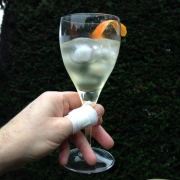
glass of Orange Blossom

all fingers and thumbs

glass of Orange Blossom

Orange Blossom cheer

It was Sir Isaac Newton who stated that, in the absence of any other proof, the thumb alone convinced him of God’s existence. And belatrova, stoically recovering from an injured left thumb after an unfortunate encounter with a kiln door, could not help but think of the usefulness of those five appendages that grow out of each hand – our fingers, or, strictly, our digits, if we include the thumb.

It turns out that our fingertips possess a high concentration of receptors, which means that they are highly sensitive to moisture, pressure, texture and temperature. Fingers are capable of feeling the tiniest, almost invisible, wrinkles on what appears to be a smooth surface, an extraordinary level of sensitivity. Thus we use our fingers as sensory probes to find out about the objects we bump into or are puzzled by, and so they are prone to getting hurt – they get burnt, cut, scratched, squashed and scraped. In belatrova’s case it was an injury due not to sensory probing but to simply forgetting where his thumb was as the kiln lid was being closed.

When not getting them injured, we at belatrova tend to use our fingers to poke clay to see how moist it is, or to smooth down the surface of a bowl before biscuiting, or to trim and cut around a shape, or to test how hot a piece is in the kiln (even if the meter indicates 90 degrees), or to brush on an oxide colour or to sandpaper the oak plinth of a birdbath.

mandarins in bowl

mandarins look better on ceramic

What would we do without our fingers. Think of all the finger gestures we rely on: thumbs up, the OK sign, the V for victory sign, the middle finger sign. And pointing is so useful, and counting, and playing the piano. What about the index to your mouth for “silence”, and snapping your fingers, or just picking your nose? The list is endless.

“…Even now that sweet memory lingers
I was playing my guitar
Lying underneath the stars
Just thanking the Lord
For my fingers
For my fingers” Paul Simon

And you need your fingers to make cocktails. As is customary at Christmas, we like to offer our supporters and friends a new cocktail that has been tried and tested on volunteers at the belatrova workshop. We have shown you how to make the perfect Dry Martini, and a delicious Black Velvet, now we would like you to try an Orange Blossom.

Use a large snifter or brandy glass, or balloon glass.

Fill it with ice – perhaps three generous cubes

shake two drops of Orange Bitters into it (this you can buy online or at some shops now). Do not allow more than two drops – these things really matter.

A small splash of Elderflower Cordial

Fill two thirds of the way up with cold Prosecco (it must be cold)

Curl a thin sliver of orange peel onto the rim

Stir

Drink

ceramic costers

star coasters

We at belatrova wish you all the very best for 2016, and we hope you have a Happy Christmas. As some of you know, we are always in and out of our workshop at No 9, so if any of you want to pay us a visit it is a good idea to give us a call first on 01531 634082, otherwise you can always contact us via our website: www.peterarscott.co.uk/dev or you can have a look at our ETSY site, or even our Pinterest boards.

Cheers! Salut! Salud! Santé! Prost! Salute!

pug mill

Thelonius says “Happy Christmas”


Over the moon, on the crest of a wave.


close-up of table top by belatrova

moon power

Gazing at the Full Moon last night belatrova was filled by the wonder of the night sky. Somebody told us it was a Wolf Moon, and it turns out that full moon names reflect the goings on of that time of year, and this one is so called by American Indians because it is the animal’s hungry month, so February’s is the Snow Moon because it is the month most snow falls, Harvest Moon in August, Hunters’ Moon, and so on. And to top it all, five planets in the solar system are visible in a line this month: Mercury, Venus, Mars, Jupiter and Saturn – a fabulous quirk of the Universe.

image of 5 aligned planets

planetary alignment

Possibly as a result of this magical alignment belatrova has won ‘Best of Customer Service’ on Houzz®, the leading platform for home renovation and design (www.houzz.co.uk). The ‘Best of Houzz’ is awarded annually in three categories – Design, Customer Service, and Photography. Houzz ‘Best of Customer Service’ honours are based on several factors, including the number and quality of client reviews received in 2015. A ‘Best of Houzz 2016’ badge will appear on belatrova’s Houzz profile as a sign of its commitment to excellence and these badges help homeowners identify popular and top-rated home professionals.

Houzz Customer Award 2016 badge

So, a huge thank you is due to our customers who reviewed us on Houzz. We were chosen by the Houzz* community from among more than one million active home building, renovating, and design industry professionals.

Andrew Small, Managing Director of Houzz UK commented, “anyone building, renovating, or decorating looks to Houzz for the most talented and service-oriented professionals, and we are very pleased to recognise belatrova with our ‘Best of Customer Service’ award.

close-up of wave bowl edge

ceramic wave

Aware that all sorts of things happen during a Full Moon (arson attacks increase by 100% at the time of the Full Moon, murders treble around that time and passengers on flights are more difficult to handle, say harassed air hostesses) we at belatrova would rather let our minds float in all the apparently miraculous stuff associated with it. For example, the link between the Lunar Cycle and the tides is well established but still mysterious, but may well explain why we have started making large wave bowls this new year. We think you will like them: they are a perfect centrepiece for any dining table, and practical as fruit bowls or tureens.

belatrova ceramic wave bowl

blue undulations

ceramic bowl with blue brushstrokes

more blue waviness

We have used the oxides of the Brushstroke Blues range to hand paint the wavy brushstrokes onto the undulating surface, which in turn has wave-like marks scratched in with a peineta or Spanish Flamenco comb. This last element, as you belatrovians instinctively know, is essential.

Spanish comb

peineta


close-up of ceramic scratchwork

porcelain comb-over


5 wave bowls out of the kiln

straight out of the kiln

These wave bowls measure about 40cms x 30 cms, and weigh 6 lbs (2.7 kls), so they are robust as well as beautiful. Don’t let February’s Full Moon be a Blue one, cheer yourself up with a belatrova bowl and wave goodbye to the blues.

*About Houzz (www.houzz.co.uk)

Houzz is the leading platform for home renovation and design, providing people with everything they need to improve their homes from start to finish – online or from a mobile device. From decorating a small room to building a custom home and everything in between, Houzz connects millions of homeowners, home design enthusiasts and home improvement professionals across the country and around the world.


With the largest residential design database in the world and a vibrant community empowered by technology, Houzz is the easiest way for people to find inspiration, get advice, buy products and hire the professionals they need to help turn their ideas into reality.


Peter Arscott, Director of belatrova said, “we are delighted to receive this accolade from such a prestigious enterprise as Houzz. We work hard to ensure that everyone inquiring about our products enjoys dealing with us, and that those who buy a belatrova product are completely satisfied with it and enjoy having it in their home or commercial environment.”