Posts

Art Nouveau, hospital hygiene and ceramic spotlessness

Sant Pau hospital

hospital corridor or ceramic glory

It was not because of excessive drinking and dining that belatrova paid a visit to a hospital only a few blocks from Gaudi’s famous Sagrada Familia cathedral, but as a result of our unquenchable thirst for cultural knowledge and beauty. It is yet another surprise on offer in the city of Barcelona that a masterpiece of Catalan Art Nouveau, built between 1902 and 1930, happens to have played a significant part in the evolution of medicine as well becoming a World Heritage Site.

[one_third]

ceiling at Sant Pau

ribbed ceramic ceiling

[/one_third]
[one_third]

ceramic ceiling with green motifs

looking up from the patient’s trolley

[/one_third]
[one_third_last]

lobby entrance at Sant Pau

main lobby entrance

[/one_third_last]

The Hospital de la Santa Creu i Sant Pau was founded in 1401 with the merging of six hospitals. Santa Creu, the Hospital of the Holy Cross, was right in the centre of the city but by the late nineteenth century, due to the rapid growth of Barcelona’s population and rapid advances in medicine, it became too small and thanks to the bequest of the Catalan banker Pau Gil, the first stone of the new hospital, designed by Lluís Domènech i Montaner, was laid on 15 January 1902. In 2009 it moved to new premises built in the north-east of the precinct and the Art Nouveau site was reopened to the public, after refurbishment, in 2014.

ceramic roofs at Sant Pau

ceramic roofs of pavilion at Sant Pau

This city within a city contains twenty seven pavilions, each one assigned a specific medical speciality and linked to the others by means of underground galleries and tunnels. Muntaner assigned an area of 145 m to each patient, including the landscaped grounds.

ceramic motif on wall

restful motif

What grabbed belatrova’s attention was the care taken in choosing the materials in order to create the best natural surroundings for the patients, primarily ceramics with which to clad domes, roofs, ventilation shafts, the decorative pieces and walls inside and outside the pavilions. Inside, the ceramics serve a hygienic purpose, tiles make disinfection easier, and also function as a therapeutic element. The colours of the many motifs used in the panels and mosaics combine harmoniously and convey a feeling of quiet tranquillity.

ceramic tunnel link to pavilions

ceramic-clad tunnel link

Thanks also to the extremely high thermal stability of ceramics, which belatrovians know can be fired at a temperature of approximately 1280°C, this results in extremely solid products; and the hygienically smooth surface glaze is wear and scratch-resistant and is thus resilient to the abrasive cleaning agents that are frequently used in the sanitary facilities of public areas. Even concentrated hydrochloric acid fails to leave a mark on ceramic, but please do not try that at home.

[one_third]

orange tree in Sant Pau

the garden in Sant Pau

[/one_third]
[one_third]

view of the Sagrada Familia

Sagrada Familia from Sant Pau

[/one_third]
[one_third_last]

main entrance to hospital

clock tower and facade

[/one_third_last]

Ceramic is even resistant to extreme temperatures, both hot and cold, which is why we at belatrova use it for our birdbaths so that, combined with a resilient oak plinth, they can withstand British winters or Mediterranean summers.

belatrova birdbath

resilient but beautiful

Resistant to extreme temperatures, water resistant, easy to keep clean, colourful, ceramic tiles are perfect for outdoor tables.

tiled tabletop

detail of belatrova outdoor tiled table.

To reinforce our message that belatrova products are safe, hygienic, tough and practical here is a picture of a large coiled platter with some gilt headed bream about to be prepared for belatrova’s signature dish: “Besugo al horno con patatas. Click on the left and you will be taken to a video recipe – and you can practice your Spanish at the same time.

Hasta Luego.

fish on platter

bream

three legs good

ceramic three legged bowl

belatrova’s Manhattan three legged bowl

An early morning run or walk can be a way to set oneself up for the day – you are out there with the dawn chorus, a hint of Spring in the air, plans assembling themselves in your mind for the day ahead, perhaps a squirrel just out of hibernation crosses your path, you breathe in the clean air of a new day, and then, an unfamiliar experience, the earth beneath your feet is right in front of your face, greeting you painfully on the nose. You have fallen over. Looking around to make sure nobody has witnessed your collapse, you pick yourself up and limp home with whatever dignity you can muster.

cartoon of legs slipping

bipedalism

Human walking is a unique activity during which the body, step by step, teeters on the edge of catastrophe.” —paleoanthropologist John Napier

Just how do we two-legged creatures manage to stay upright while in motion, or even when standing still? How can we possibly keep our balance on those flippers we call feet? Come to think of it, we are rather top heavy too, so why are we not keeling over all the time? Apparently it is all to do with voluntary and reflexive, neural, muscular, and skeletal systems collectively coordinating so as to allow us to walk without a second thought. But we shall not go into that; we simply bring it up because it leads us to an important belatrovian issue that we propose to resolve here and now.

cow

quadrupedal thing

Within the tightly knit belatrova team, harmony always prevails. No matter what the weather outside, or the music being played, or the occasional badly made cup of coffee, we all beaver away happily and get along. Tea breaks are relaxing opportunities for discussions on topics that range from underwater basket weaving to why on earth men have nipples, from the benefits of taxation in a functioning society to the lingering suspicion that chocolate may actually not be bad for one. Important subjects for debate, we agree.

However, there is one issue that consistently divides the team into two camps: the tripedalists and the quadrupedalists. Dear belatrovians, are three legs better than four? With the spirit of conflict resolution guiding us towards a hoped-for conclusion, research was undertaken and the results are the following:

Try this at home. With your hand slightly cupped, point your thumb, index finger, and middle finger upwards and then place a flat piece of card or paper on top of them. The card will lie on all three points. Now stick a fourth finger into this experiment (perhaps somebody else’s) to add another contact point. It is now a little harder to exactly fit the paper on the plane.

Conclusion – the triangle formed by the three fingertips is stable because no matter where any of the three points of the triangle lie, they will always define a plane. So, a three-legged stool is guaranteed not to wobble, because the ends of its legs always form a plane. Thus a camera tripod; no matter which height each leg is, you will get no wobble. Even on an uneven floor.

It’s much more challenging to make a four legged table whose fourth point of contact is in the same plane as the first three points. Any point that is added to that plane will make it harder for the plane to be stable. On some uneven floors it may be quite impossible for a four legged table to be stable if it gets moved about. Five or six legs would be even worse.

table

a perfectly balanced four legged table by belatrova

Quadrupedalistas, graciously accepting this explanation (despite some sarcastic mutterings about making three legged tables, birdbaths and lamps), have come around to the wisdom and logic of belatrova’s decision to make three legged bowls. Place one on any surface and your olives, peanuts or cheese puffs will not roll off due to wobble. What is more, the bowls carry a certain elegance that is a touch retro – 1950s perhaps?

ceramic three legged bowl

three legged bowl

And talking of retro, MoseyHome are a new London outlet, and they are showing belatrova’s three legged bowls. Pay them a visit if you are in the area. You can also visit our “three legged” Pinterest board.

three legged bowl

stability on legs

As for our monopods, our beautiful birdbaths, lamps and slab pots, they will be appearing in the next few months in Country Living and Garden Illustrated.

With only a month to go, we would like to remind you that we are opening the workshop to the public on the weekend of 25th and 26th April. You are most welcome to visit, and try your hand at making a tripedal bowl. We’ll be there with five other makers for this Open Spring Weekend:

Spring Open Sudios

Spring Open Studios


belatrova in Iberia

Gibraltar on the horizon

A piece of Britain on the horizon

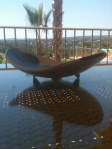
belatrova, musing by a pool in the heat of Sotogrande, with a distant view of the Rock of Gibraltar, discovered that Andalusia has some of the hottest areas in Europe, sometimes averaging above 36 C in summer, with daytime highs of over 40 C. This explains the landscape of Holly and Cork Oak and the Pinsapo Fir trees that do well here, as do the olive trees that are grown all over the area.

Andalusia certainly knows its olives: Manzanilla, Arbequina, Empeltre, Sevillano, Picual, Hojiblanca, Picolimon, Verdial are just some of the estimated 260 different varieties of olive in Spain, which, as we all know, always look their best when offered to guests in a belatrova bowl.

olives in belatrova bowl

the only way to eat olives

But we digress. After being controlled by Carthaginians, Romans, Vandals and Visigoths, for half a millennium “Al-Andalus” was part of a Muslim caliphate, from the moment in 711 a Berber called Tariq ibn Ziyad landed his troops on the coast at a place that would become “Jabel alTariq” (the mountain of Tariq), now pronounced “Gibraltar”. Then came the Catholic Kings, and so on, until Spain became a member of the European Community. How about that for a quick outline of Spanish history?

drawing of Malaga port

Malaga port

Before arriving in Sotogrande belatrova had spent a short time in Malaga, port city of misty mornings and birthplace of the greatest artists of the 20th Century*, and paid a visit to the Museo Picasso de Malaga to have a peek at the great man’s ceramics and paintings on display. A small but fine collection that will satisfy anyone interested in art and ceramics.

Porcelain figure by Picasso

Insect – ceramic figure at Museo Picasso en Malaga


After 90 minutes of leaving Malaga and driving south belatrova suddenly saw the strange presence of the large rock that is part of Britain. It is surprising that there is this tiny enclave with red telephone boxes, bobbies and pubs in the southernmost tip of Spain. But we stayed in Sotogrande and enjoyed the calm of this beautiful location.

belatrova bowl by pool

belatrova by the pool in Sotogrande


bowl with landscape in background

…on the veranda

bowl by Buhdda bust

…meditating


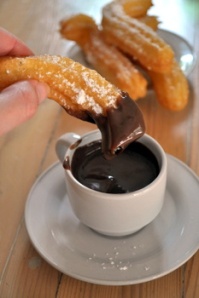
Next stop was a few days near Ronda in a small town called Arriate. Early in the mornings, before the sun clears the horizon and bakes everything in its path, a quick walk into Arriate will reward you with a breakfast of “Churros con chocolate” before returning and finding a shady area in the house or by the pool. belatrovians have already met Thelonius the Pugmill (blog November 2013).
image of pugmill

Thelonius Pugmill in action

pugmill

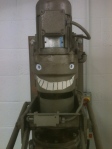
Though it may upset Thelonius, the churro-making machine is basically the same idea. Stuff goes in one end and is squeezed out the other, though in the former’s case it cannot be eaten with chocolate:

churro machine

churro-making machine

churro mix extruded by machine

churro extruded

ring of cooked churro

churro ready


churro with hot chocolate

churros con chocolate


brick pottery chimney

abandoned pottery in Arriate with stork’s nest on the top, seen when wandering into the village for breakfast


As for Ronda, it is a buzzing and welcoming town whose most well-known feature is the gorge that divides it and the bridge that crosses it, both made famous by the series of brilliant oil paintings David Bomberg made when he lived there in the 1930s.

bridge at Ronda

Ronda


painting of Ronda bridge by Bomberg

Bomberg’s Ronda


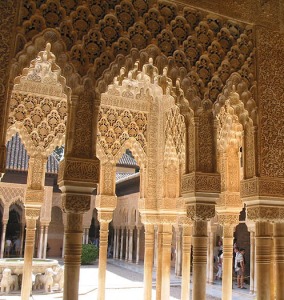
Next stop was Granada, at the foot of the Sierra Nevada, home of the poet Federico García Lorca and of the Alhambra, Moorish citadel and palace, and the most renowned building of the Andalusian Islamic legacy. Any lover of mosaic and tiles would love its interior, but frankly anybody with an ounce of romance and fantasy would fall for it.

view of Alhambra

The Alhambra in Granada


the courtyard of the lions, Alhambra

inside the Alhambra

Saturation of visual sensation means you will end up agreeing with the poet Franciscio de Icaza who wrote “Give him alms, woman, for there is nothing sadder in life than being blind in Granada.” (“Dale limosna mujer, que no hay en la vida nada como la pena de ser ciego en Granada.”)


Walking along the narrow streets of the Albaicín district is also enthralling. Lots of shops selling pots and ceramics of all kind.

ceramic street sign

street sign in Granada


Even the street names are made of ceramic.


A visit to the Moorish Baths was a cool break from the sun and heat outside: looking up at the ceiling from the gloomy depths of the 11th Century building, the shapes cut out originally to allow steam to escape let in the daylight and shine like stars.
ceiling of old Moorish baths in Granada

11th Century baths in Granada

All a distant memory. Now back at the workshop at No 9, belatrova is busy preparing for h.Art events which will be from 6th – 14th September and to which you are all most welcome. We will be open from 10.00 to 17.30. Remember to follow the bright red h.Art signs.

picture of the Studio Gallery launch

tHe Studio Gallery opening in Ross on Wye


And if you are near Ross-on-Wye, please drop in at the Studio Gallery which had a very successful launch some days ago and has an excellent display of belatrova ceramics.


* any belatrovian agreeing or disagreeing with this statement is invited to leave a comment. Comments will be awarded points, and points mean prizes … and, much as we would like to give the winner a Picasso bowl, you could win yourself a belatrova Valencia three legged ceramic instead.

Pope to belatrova

belatrovians will know that we at No 9 Bankside are hard working and industrious and that we subsequently reward ourselves at the end of the week with a deliciously cold Dry Martini lovingly prepared by the Alcomeister hours in advance so as to reap the most from this sublime Emperor of Cocktails. We have also more than hinted at the excellent qualities of the Negroni in a previous blog. But today we will sing the praises of an altogether different drink and toast a man whose standing should be far better appreciated than perhaps it is. How does all this relate to art, design and craft?

image of Ross on Wye

Ross on Wye

Ross on Wye is a charming town on the northern edge of the Forest of Dean and perhaps the birthplace of British tourism when in 1745 the rector Dr John Egerton started taking friends on boat trips down the valley to appreciate the river scenery, its castles and abbeys, its precipices and its altogether picturesque environment. By the 1850s the Wye Tour established the area as a tourist attraction. The town is known for its independent shops, narrow streets and market square with its market hall. Opposite the church, the Prospect is a public garden offering a view of the famous horseshoe bend in the River Wye, as well as views of the distant Black Mountains in Wales.

John Kyrle

The Man of Ross

The Prospect was created by one John Kyrle. He is without doubt the town’s most famous son (and we say this in the full knowledge that two of the founding members of Mott the Hoople were from Ross). He devoted his life to philanthropic works, introducing a public water supply to the town and
laying out the Prospect Gardens. He also reconstructed and added pinnacles to the unsafe 14th century spire of the Church of St.
Mary and gave it a magnificent tenor bell. He sponsored the causeway to the nearby Witton Bridge and set up funds for needy local
children to attend school. Kyrle lived modestly as a bachelor on an income, it is said, of £500 per year. Apart from Kyrle’s charitable works and deeds, he also settled disputes, supported the schools, tended the sick
and helped the poor. His public-mindedness also extended to beautifying the town and its surrounding landscape.

18C painting of baby

lisping babe


His life and good works were celebrated by the poet Alexander Pope in his Moral Essays written in 1732 and called him the ‘Man of Ross’, the name by which he has been known ever since:

“…Who taught that heav’n directed Spire to rise? 
    

          The Man of Ross, each lisping babe replies.”  


Now, Pope, though an interesting poet, was also a hugely influential landscape gardener and as the perfect representative of Augustan poetry he uses the same principles when it comes to landscape gardening. The Augustan style takes its inspiration from ancient Rome and Greece, emphasizing elegance, harmony, balance, formal strictness and simplicity. We are not just talking Geometry here but surely you’ll agree that it is one easy step from Pope’s harmony to the perfect balance of Mondrian‘s paintings (and to his New York connections) and thus to belatrova’s Manhattan range of ceramics and tables.

Mondrian painting

Mondrian


ceramic collection by belatrova

manhattan collection

And to celebrate these 18th Century geniuses why not raise a cocktail to them? Your 18th Century taste buds were likelier to go for the sweet rather than the dry, so, in keeping with the general theme, we thought the Manhattan hit the spot:


2 ounces whiskey (rye preferable)

1/2 ounce sweet vermouth

2-3 dashes Angostura bitters Maraschino cherry for garnish

Preparation:

Pour the ingredients into a mixing glass with ice cubes.

Stir well.

Strain into a chilled cocktail glass.

Garnish with the cherry.


Ladies and gentlemen, raise your glasses to the Man of Ross, and consider this: the pursuit of all that is excellent in design and harmony continues in Ross on Wye with the launch of a new gallery in the town centre. The Studio Gallery, open from the 16th August, is exhibiting ceramics, painting and high quality craft, and would love to see you. So would belatrova, whose work is on show there.

Valencia range in ceramics by belatrova

what you might see at the Studio Gallery

“Hope springs eternal in a young man’s breast: Man never is, but always to be blest.”

Alexander Pope

Azure, sky blue, ultramarine and cobalt – who says Britain is the land of rain?

photo of blue sky over Tresco island

a view from Tresco

We live in a land of contrasts in the UK – there is so much diversity. Take the Lake District and Berkshire Downs, the Scottish Highlands and the Norfolk Broads, the wild Jurassic coast of Southern England and the sedimentary London basin, Fingal’s Cave, Salisbury Plain, Cheddar Gorge, and yes, there is even a touch of the Caribbean to be found 30 miles from the Cornish mainland. You don’t believe us?

image of ferry to Isle of Scilly

ferry

Lucky belatrova took a boat from Penzance and went to a very small place in a beautiful archipelago. Tresco is a small island measuring about two and a half miles long by a mile wide, and it is one of the five inhabited islands which, together with 200 or so islands, islets and rocks, form the Isles of Scilly.

Augustus Smith

Augustus

In 1834, the Duchy of Cornwall leased the Isles of Scilly to a liberal-minded squire, Augustus Smith, who became the Lord Proprietor of the

Sub tropical plants at Tresco Gardens

Tresco Abbey Gardens

islands. He built his home, Tresco Abbey, alongside the ruins of an old priory and set about creating a garden containing plants from all over the world. Tresco Abbey Garden is internationally renowned as having one of the finest sub-tropical flora and fauna collections in the Northern Hemisphere. The family still run the business as the Tresco Estate, and own Tresco island.

seagull

angry bird

As there are no predators or grey squirrels, the red squirrel was introduced recently and there is now a thriving colony of about 30. One was spotted in the Abbey Gardens, a flash of dark red moving amongst the Echium and Pelargonium. And being a birdwatcher of sorts, Mr b got very excited and spotted Oyster Catchers, Grey Heron, Terns, Ibis, Egrets and Godwits. He was also mobbed by angry sea gulls.

plate full of cooked shrimps

shrimps from Ruin Beach

Later that evening with the tide slowly rising a shrimping party netted a generous catch which was cooked and then eaten at a picnic overlooking the harbour. As you can see, there are no half measures here: one carries tables and chairs to the top of a hill to get the most out of an occasion like this.

table and chairs set out for picnic

picnic


image of sailboat

tacking

A sailing trip to the smaller island of Samson was a symphony of azure and greens, gentle wavesand distant bird cries, white sand and clear water. What an experience it was, tacking back to Tresco harbour – a commemorative ceramic is called for, and here it is, just out of the kiln:

rectangular ceramic dish

belatresco dish

Back at the workshop after this idyllic break, the sun, sea and clean air, combined with the walking, cycling and (ahem) swimming, meant that cobwebs were swept away and a desire to use Tresco blues came surging out of the belatrovian brush and onto one of our coffee tables.

coffee table with blue brush marks

Tresco-inspired coffee table


low coffee table with blue colours

coffee table

Of course, like everywhere else in the UK, Tresco can be grey, battered and windy, but it was hard to imagine while we were there.

seawater off Tresco

water off Samson Flats


Khaneh Takani – is it a compulsion or a tradition?

disorganised clutter in confined space

clutter – but not belatrova’s

Spring cleaning: why do we do it? Iranians call it khaneh takani (“shaking the house”) – and it may be good for you, after all a cluttered space does not just look a mess, it may also affect your peace of mind. “Where’s the thingymebob I need for the whatsit, I could swear I left it on the table right here while I was molding the clay on the thingy. It should be next to the whoojemaflips…oh, they’re gone too.”

rubber kidney used in pottery

yes, a potter’s kidney.

Yes, clutter is the enemy of productivity, and, as you may have noticed, it also challenges one’s ability to master the terminology of the ceramicist’s workshop. Well, do you know what a kidney, a natch, a whirler, a slip trailer or a toggle is?

But those of us who are disorganised or untidy by nature need not worry. It only becomes a problem when the person is not just messy but impaired by the clutter, when significant portions of, say, a workshop cannot be used for the purpose intended or when you find yourself working cheek by jowl with a pug mill at your back, hemmed in by stacks of clay on one side and shelving on another.

We are not saying that belatrova ever allowed this to happen – it would be an exaggeration – but the time seemed right for a radical reorganisation of space.

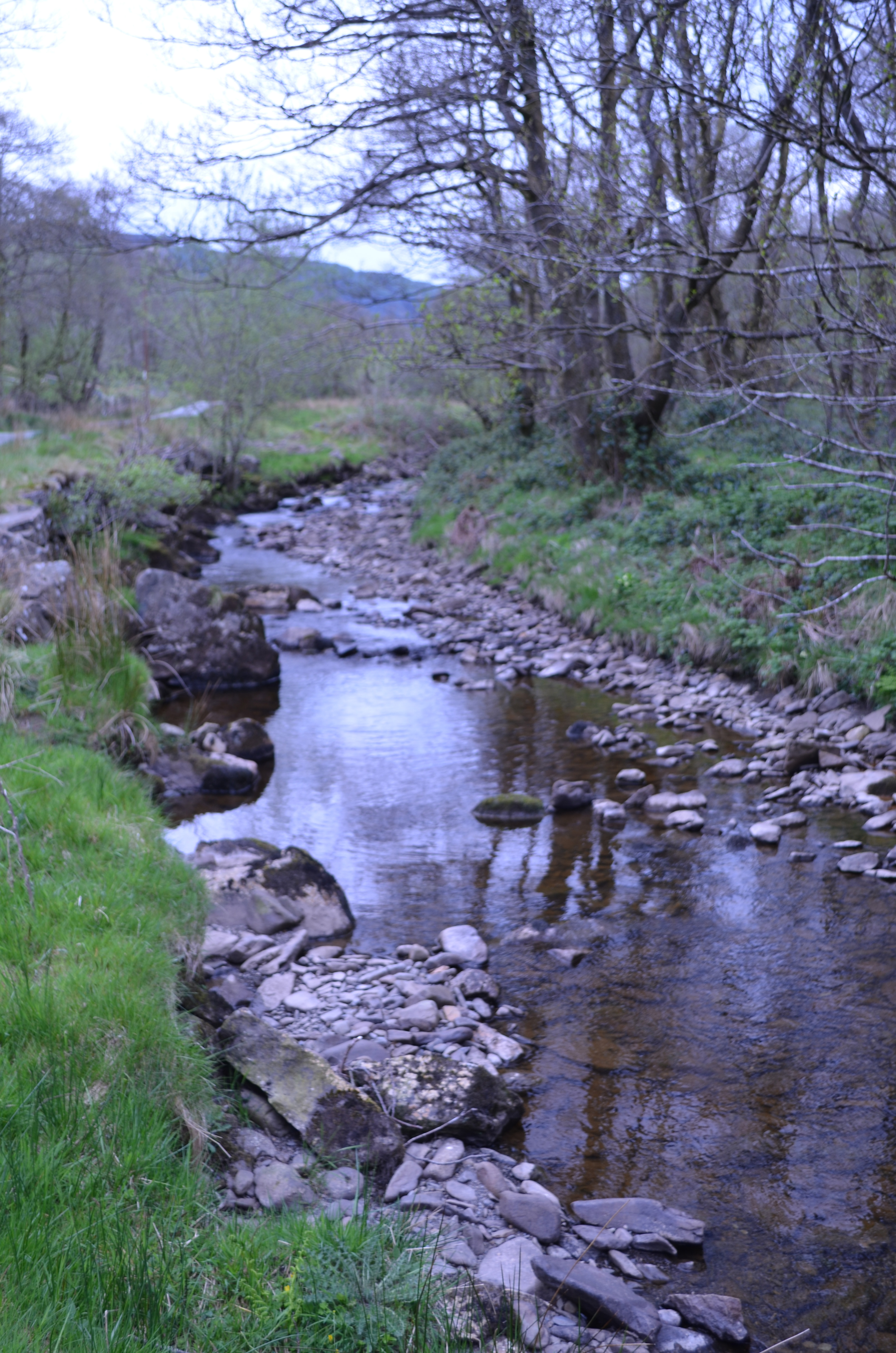
river near Llanbrynmair

River Cleggy in Wales

This compulsion came over us after coming back from the Welsh countryside where grandparental duties involving children and a horse had meant open air walks and an appreciation of the wide open landscape.

drawing of Shetland pony

a complex personality

An irrelevant aside: Shetland ponies are strange little things – their whole posture speaks of world weariness and fatalism, but their actual characters can be quite complex; crafty, sensitive, single-minded and self-possessed are just some of the adjectives that come to mind. This one is called Tinkerbell, sometimes known as Stinkerbell.

Walking back into the workshop after the Welsh break led to a general rolling up of sleeves and shifting of shelves, racks and slab rollers to create more space for showing our wares as well as a more suitable area for belatrovian productivity.

belatrova showroom

the new showroom

Result: belatrova is even more of a beehive, with some new and interesting stuff coming out of the kilns, and not just in our four ranges. This long three-legged scooped bowl has something of the 1950s about it.

ceramic bowl on belatrova coffee table

Do drop in and have a look at the rest – the showroom space we now have looks good, and we’ll offer you tea or coffee (remember that Dry Martinis are only on Friday afternoons). There is usually someone in all day but it is best to give us a call beforehand just in case we are out delivering or at a meeting.

newly organised worspace

a cavernous new space created

ceramic display by workshop entrance

the showroom entrance

the great Paul Klee’s never ending reach

a line of hand painted belatrova tables

belatrova conga at the Open Day

So many of you came to our Open Days on Saturday 30th November and Sunday 1st December, that we ran out of coffee, white wine and mince pies.  Although Unit 9 Bankside is a workshop, please feel free to drop by at any time, though a ‘phone call beforehand is a good idea, just in case.

two lines of belatrova coffee tables

belatrova squad

Those of you who came were able to see the exhibition of table  paintings which we set up just for the two days, and this proved very popular. These tabletops are all hand painted, each one a painting in acrylic and then varnished over with a heat resistant lacquer.

With a big space dedicated to the tables only, most viewers took their own time to look at each individual piece and enjoyed the experience of a gallery-like atmosphere and the pleasure of looking down at paintings and walking around them. Try it at home, it’s so much more comfortable than looking up at paintings on walls. And you can put hot mugs of tea on them too.

One or two of you, having been to the Paul Klee exhibition at the Tate Modern, noted a connection between his painting and some of the tables. Well spotted. Klee is a particular hero of belatrova’s and every now and again surfaces in our work. Here are some Klee-like examples:

belatrova paul klee table painting

paul klee table

klee reference on belatrova table

a bit more klee

The Klee exhibition is one of the best to be held anywhere, and even if you are not familiar with his work, belatrova recommends a visit (we’ve been twice already); he was innovative and always trying out new ways to make marks on a surface, and, seventy three years after his death, you can see how much he has influenced artists.

belatrova is not sure that Klee ever made any ceramics, but had he done so the results would have been as engaging as Picasso’s, though gentler. Here are two we made earlier with P.K. in mind:

two pots in the Klee style

two Klee pots by belatrova

yes, you could win a belatrova ceramic

Please have a long look at this close-up of one of our dishes. Allow the colours and shapes to simmer and bubble away in your mind, and then come up with a name for that range. Anything permitted, barring whatever might get us sued.

close up of ceramic platter

name it and win it

Either go to our website and send us an email via contact page or simply add a comment on the blog. If you are successful, not only will the name be forever associated with this particular belatrova style, but you may win a prize: the very ceramic you see in the picture.

The result will be democratically decided (ie much discussed and argued over) by the team on Friday 1st November at No 9 Bankside at 5pm, and announced officially in the next blog.

close up of Valencia range

Valencia

We all know that belatrova makes unique hand-made and painted tables and ceramics. The variety of one-off designs is apparent when you walk into our workshop in Ledbury. Within the multiplicity of colours, brushstrokes and shapes there are a few discernable themes or ranges; one example being the mellow ochre look produced by mixing a little red iron oxide in the glaze into which the painted dish or bowl is dipped before firing. What to call this range? The team scratched its chin and mused one late Friday afternoon as it unwound with a Dry Martini (see blog May, Relocation). Names are important, after all, and after a great deal of discussion we decided that the range in question would be given the name of Valencia. There is something of coastal Mediterranean Spain in the tones.

 Inspired, the team went on to name three other ranges or “looks”. Here they are:

close-up of Manhattan range of ceramics

Manhattan

close-up of brushstroke blues range

Brushstroke Blues

close-up of allegro range

Allegro

We think highly of you and expect to receive some poetic and/or pithy ideas, so please give it a go. There’s a whole lot of biscuited bowls and dishes just waiting for the belatrova touch.

piles of biscuited bowls at belatrova

ready and waiting