Posts

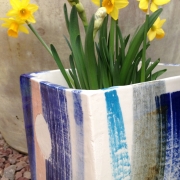
ceramic planter with daffodils

hello Spring

close-up of ceramic brushmarks

painterly close-up

You haven’t heard from us for a while, we admit, but we are coming out of our Winter torpor, just like the snowdrops that every year nose their way out into the light before Spring to gladden the hearts of all lovers of beauty and Nature. And we are here to gladden your homes and gardens, with our handmade ceramic lamps and outdoor tables, our fabulous mirrors and the new range of Jazz pots influenced by our old friend Thelonious Monk and others.

ceramic planter with daffodils

blue and yellow

With your gardens in mind, we’ve been making new Brushstroke Blues planters that will bring to life any corner of a garden or patio, and, because they are mostly blue in colour, they will set off the warmer yellow, orange or ochre hues of the plants. Furthermore, blue is serene and mentally calming, associated with intelligence, communication, trust, efficiency, serenity, duty, logic, coolness, reflection, calm, and thus a nice contrast with yellow and its optimism, confidence, self-esteem, extroversion, emotional strength, friendliness and creativity. All of that in one planter, but then belatrova does like to carry out as much research as possible on behalf of its supporters and customers, and this often reveals things we were not aware of – perse, smalt and watchet, for example, are all associated with blue, as are the better known azure, cobalt, navy, sapphire, cerulean, cyaneous, mazarine, pavonated, perwinkle and ultramarine.

the colour watchet

watchet

the colour smalt

smalt

the colour perse

perse

In all honesty, blue is belatrova’s favourite colour – as you may remember from a previous blog (July 2014).

abstract cewramic table top

ceramic blue abstract table top

Click here and you can hear the inmortal lyrics Nel blu, dipinto di blu from Volare sung by Domenico Modugno (skip the ads). Dean Martin also sang it, but Dino’s version is a “tad slick”, according to one member of the team, though another claims that Domenico’s strange arm-lifting movement reminds him of a policeman stopping traffic. See what you think.

jazz inspired ceramic pot

thelonious corner pot

Edmund de Waal‘s visit to the Ledbury Poetry Festival last year reminded us how pottery and poetry are only differentiated by the one “t”, and looking at the quality of the ceramics produced in the UK any objective observer would have to agree that the state of pottery creativity is at an all time high, possibly aided by the “Great Pottery Throw Down” on TV. The most astonishing shapes, textures, glazes and sizes can be seen in galleries and in excellent magazines such as Ceramic Review, and pieces can express a range of emotions, from the calm of a Japanese influenced pot to the freewheeling hurly burly of glaze upon glaze on a large abstract shape. Inevitable, belatrova looks to see where it fits in and we conclude that for the painterly abstract quality and the treatment of the ceramic surface as a canvas we belong to a very small group. Our customers are very discerning, and many seem to have a disposition for the visual arts; but however discriminating, sharp and perceptive they are (and, of course, they are), with Spring around the corner and the sap rising we know that a Spring Open Weekend is a much anticipated opportunity to make up minds and go for that particular piece that will enhance the dining room, or sitting room, or patio.

three ceramic planters

blue planters

Sometimes the world is a valley of heartaches and tears
And in the hustle and bustle, no sunshine appears
But you and I have our love always there to remind us
There is a way we can leave all the shadows behind us…

Yes, by paying us a visit!

So please pencil in the 22nd and 23rd of April (10 am – 5 pm), when we will be at Bankside Studios in Ledbury along with makers such as Fleen Doran and Wendy Houghton, and others. Otherwise you can always visit the website.

ceramic jazzpot

splash pot waiting to meet you

apple harvest on a table

“Slack ma girdle, Foxwhelp.”

ceramic fruit bowl
Season of mists and mellow fruitfulness!
Close bosom-friend of the maturing sun;
Conspiring with him how to load and bless
With fruit the vines that round the thatch-eaves run...” (John Keats)

image of grapes on a vine

belatrova bunch

At belatrova we started turning our thoughts to Autumn, what with the leaves beginning to turn and that scent of damp and smoke that permeates the countryside near the workshop. We also discovered a taste for perry – surprising given that we seem (from the blog) to be serious cocktail sippers rather than quaffers of fermented fruit juices. We told you how to make the perfect Dry Martini some time ago. Perry is very much an Autumnal drink, and we visited a local small holding to see how it is made.

image of bottle of local perry pear

perry made from blakeney red

Has this anything to do with ceramics or table making? Probably not. The Blakeney Red is a greenish yellow perry pear with a red flush on the sunny side, an old favourite which was even considered a desert pear in the 1600s. which could also be stewed and used to dye soldiers’ khaki uniforms. This popular pear is renowned for perry making and is considered one of the best single perry varieties. The perry we tried was made from this pear.

How does this link in to ceramics, I hear you ask? Well, perry pears had their heyday in the late 17th and early 18th centuries and it is thought that there are at least 120 Perry pear varieties, many so local that they were only ever propagated on 1 or 2 adjacent farms. The heritage of these pears leaves us with some fantastic variety names, including Dead Boy, Mumblehead and Merrylegs. Some cider apple names? Brown Snout, Foxwhelp, Tremlett, Slack-ma-Girdle.

apple harvest on a table

worcester apples

So far we have found no obvious links to ceramics and pottery, however, Stinking Bishop perry pear is local and used by Charles Martel, cheese maker supreme and reviver of Single Gloucester, whose washed-rind cheeses are immersed in the perry for 4 weeks while it matures. It is made from milk of Gloucester cattle, and became famous when it starred in “Wallace & Gromit: the Curse of the Were-Rabbit“. Here is a picture of late Autumn lillies to wave away the scent of cheese:

late autumnal lilly in sunlight

some kind of lilly

Throughout Herefordshire there is a strong tradition of farm cider-making. Farmers produced cider to be drunk by the farm labour force during the following year, especially the busy times of hay-making and harvest. Farmers used to sell cider to local pubs and cider merchants for re-sale in towns. By the way, perry pear trees take much longer to mature than cider apple trees, thus:

Who sets an apple tree may live to see it end,
Who sets a pear tree may set it for a friend
.”

a three legged ceramic fruit bowl with apples

fruit bowl

Like the pear tree, belatrova has also paced its maturity to get to the stage we are now at. So if there is a seasonal change in the air, belatrova too reflects this. We have added two new categories to our website which we would love you to visit – just click on either: Fruit bowls and serving dishes and Ceramic art. Enjoy the visual sipping, get merry on home decor ideas, refresh your taste buds.

three legged spotted bowl

ceramic art? More Fresian than Hereford

cartoon of bishop

an old stinker


apple on ceramic bowl

belatrova – Open Studio Art Week 10 – 18 September

The purest treasure mortal times afford, is spotless reputation; that away, men are but gilded loam or painted clay.” William Shakespeare

apple on ceramic bowl

temptation

belatrova’s reputation may well be gleaming, but we would like you to see it up close and give it a good poke. We are happy for you to pick up any of our bowls and test its weight, or sniff it, or hold its cool surface against your cheek, even lick it. Pottery does this to people.

Clay engages the five senses.

ceramic acoustics

listen

Put a porcelain pot to your ear and flick its surface with your middle finger; what a satisfying “ping” sound comes from it, clear and perfect and proving there are no cracks in it. How horrible it is when we take a piece out of the kiln and the ping is more a “plock” sound – disappointment soon follows as a hairline fracture shows up.

eyes looking at ceramic

look

Touching pots is part of the experience, both when you are making them and when you are choosing one to buy. Do your fingers yearn to feel the rough textured surface of an unglazed vase or do they prefer the smooth milky whiteness of glazed porcelain? And what about plunging them in wet clay and making shapes?

Your eyes can be drawn to certain pots for all sorts of different reasons: colour, glaze, shape. Try holding up a piece of fine porcelain up to the light and wonder at its translucence.

licking porcelain

lick

And eating clay? Well, it is an acquired taste, but some people swear by it. It helps keep toxins from being absorbed into the body, the minerals that make up Bentonite clay work together to absorb heavy metals and other toxins in the gut. And kids seem to love it. “I am so happy that there are other people who love eating clay. I’ve been eating it since my pregnancy 20 years ago. I love the smell of wet earth in my mouth. Yum, yum” Mrs Elvira Fingerhut of Neasden, London, UK.

nose sniffing ceramic

sniff

Finally, smell….mmmm, a bit of a challenge, this one. Sometimes it can smell of rotten eggs. But sometimes it is just damp and musty, like Autumn approaching with all its mellow fruitfulness.

Yes, Herefordshire Art Week is with us from 10 – 18 September, which means that we are one of over 150 makers and artists in Herefordshire who will be open to visitors throughout the nine days.

And for a limited period only we have knocked 10% off the price of everything in stock! Would you like to know how to get your discount? Just click here.

One of the advantages in coming to our venue is that you get to see the work of three other ceramicists who form the Bankside Studios cluster: Fleen Doran, Stuart Houghton and Wendy Houghton.

This annual event draws many people to our workshop, and many are dropping in not just for the excellent cake and tea they are offered; you get to experience an exhibition of contrast and style, with informal demonstrations and the chance to talk to the artists.

Furthermore, there is an irresistible sale of belatrova pieces in one section of the workshop, and wonderful bargains to be found. Do come along, say “hello”, and handle, stroke and pat our pottery.

hand made jug by belatrova

thelonius splash pot

Directions: in Ledbury follow the red h.Art signs from Lower Rd or New St into Little Marcle Rd. Follow signs to studios behind Alfa-Tech Garage. Parking is available. We are open 10 – 5.30 pm.

large blue ceramic jug

big blue

paper cut-out of dog

The Bankside bestiary

p<a href=

It has been busy at the studio this summer, so it was not until recently that we started to take in the seasonal activity outdoors; the (slightly) warmer weather, the greenery, the butterflies, the bees, the birds. The various creatures reminded us that most animals that feature in belatrova have been portrayed or referred to in our blogs, not in “real life”. Should we have a pet at the workshop? We at belatrova do not have an official pet, as such, though we have had many animals on our blogs since 2013, and, just to remind you, we are scattering images of them throughout this blog.


centipede

Ed Millipede

Many claim that pets have a calming effect on our bodies and minds, that they reduce blood pressure and lower stress, that pets at the workplace make employees more creative, productive, and cordial with each other. This would be a good thing.


Jim

Jim

A digital online marketing agency conducted a survey of three thousand office workers, and 16% had an office pet, the top ten pets being fish, dogs, cats, tortoises, birds, rabbits, guinea pigs, geckos, snakes and tarantulas. As many as 55% of those canvassed admitted they would feel more motivated if they did have a pet in the office, though in our case, since one of us is a serious arachnophobe, tarantulas would be at the bottom of the list. This is despite Ziggy the house spider being a past visitor (see Oct blog 2014).


house spider wearing Xmas hat

Ziggy

Indeed, a research undertaken on domestic dogs and human health (published in 2007 in the British Journal of Health Psychology) suggested that pet owners tend to be healthier – dog owners have lower blood pressure, lower cholesterol and are less likely to have minor and serious health problems. We wonder if this also applies to cockerel owners?


cockerel statue at Trafalgar

giant alarm clock

So what is it about dogs? A carnivorous mammal that typically has a long snout, an acute sense of smell, non-retractile claws, and barking, howling, or whining voice, the domestic dog (Canis lupus familiaris) is a domesticated animal selectively bred for various behaviours, sensory capabilities, and physical attributes.


Their long association with people has allowed dogs to be uniquely attuned to human behaviour. We very occasionally get a visit from one of these fearsome creatures, but only with her (so-called) master. Rowan has been selectively bred to sniff out and hunt badgers, but she kindly agreed to having her Brockian search interrupted and posed for us in a belatrova birdbath with great dignity.


And just in case we have digressed a long way from our intended theme, let us show you a few of our ceramic pieces. All totally unrelated to beasties, but it is what we do best:


And so it’s goodbye from him…

medieval bestiary

elephant on the keyboard

With an Open Summer Weekend (Sat 2nd and Sun 3rd July) just around the corner, something happened at the Bankside Studio recently. The ghost of Thelonius Monk made itself known and whispered strange and wonderful things into the ears of belatrova as we were making a batch of three legged bowls. Perhaps “Ruby my Dear” was playing on the cd player, whatever it was it made our hands dance and the unintended clay shapes seemed to be spot on. “What about the three legged bowls?” we hear concerned belatrovians ask. Well, we did make them, though a few days later, after we had returned from Monkland.

ceramic pot
ceramic pot
ceramic pot

belatrova team

Thelonius Pugmill and two friends

Taking a brief trip to Monkland is highly recommended: you will come back refreshed and brimming with more ideas than usual. It is liberating to make pieces without worrying about the end result, and if one piece turns out to be a failure then the next one will be stronger for it. In this we were aided and abetted by our hard working pug mill who, as some of you may remember, is called “Thelonius” and who is by far the hardest working member of the team.

For a ceramicist, going to Monkland means that you accept one condition only – that there is no wrong way to make ceramics. This is how you have to approach the lump of clay, just as Thelonius Monk approached his piano. As he saw it, “The piano ain’t got no wrong notes!” and this explains his unique jazz style, which includes percussive playing, unusual repetitions and dissonant sounds, and a surprising use of silences and hesitations. Click here to listen to “Don’t blame me” where there is a fine example of his style.
ceramic potceramic pot
He also had the habit during performances that while the other musicians in the band continued playing he would stop, stand up from the keyboard, and dance for a few moments before returning to the piano. It was in this spirit that one of our team tried to show his fellow potters how to dance a jig while violently flattening clay with a rolling pin and, at the same time, sipping tea from a mug.
blue ceramic piece
ceramic piece by belatrova
large ceramic pot

A debate followed as to whether this performance was a fine example of syncopation made flesh, since in music, syncopation involves a variety of rhythms which are in some way unexpected, thus making a tune or piece of music off-beat – “a disturbance or interruption of the regular flow of rhythm”. We agreed this was the case, and that it would be incorporated into a piece, which in turn would be entitled: “Thelonius made me do it“, subsequently the title for the whole series.

ceramic blue jug
ceramic piece by belatrova
blue ceramic jug

Many of you will want to see this growing collection of freewheeling pottery, and we would like to show it to you, so make an entry in your diaries for Saturday 2nd and Sunday 3rd of July (10 – 5pm) when we will be opening the workshop for our Summer Weekend.

Philip Larkin

Philip

elephant on the keyboard

Nellie

And we will also be showing our bowls, lamps, tables and birdbaths, as well as our new range of wave bowls and scoop bowls, because not everybody loves Thelonius as much as we do. Philip Larkin, a much better poet than jazz critic, considered Thelonius Monk nothing more than “the elephant on the keyboard”, but Monk is the second most recorded Jazz composer of all time, right after Duke Ellington. So put that in your pipe and smoke it, Philip – and just to rub it in, here is a link to a short video of the Thelonius pots spinning to “‘Round Midnight” arranged for saxophone quartet by Quartetto di Sassofoni Accademia, with no piano or elephant.
Thelonius Monk

PS  belatrova will be under the Ledbury Market House this Saturday and every Saturday in June – if you are in the area drop by and say hello.

PPS. We would like to thank “Botloes” for giving us such a great review on Houzz – we wonder if this mystery personality might reveal herself or himself?

Hasta luego.

close-up of ceramic planter surface

Slabby McSlabface

close-up of ceramic planter surface

Spring ceramic

At belatrova we make things because we like them, and think that you might too. We even make things before we know exactly what to call them. We have been slab rolling and glazing pieces for the outdoors and indoors, and though, strictly speaking, they are “slab pots” we think there is a better name for these ceramic containers, or planters, or plant pot holders, or umbrella stands, or whatever.

They are so flexible, you see, that they can be used in many ways.

However, belatrova will not fall into the mistake made by the UK’s Natural Environment Research Council who asked people on the internet to name its newest research ship. The internet returned with the magnificent, if inappropriate, RRS Boaty McBoatface. So we are not guaranteeing that we will adopt any name suggested by majority response.


It is May, and many will be turning their thoughts to the garden. If you are dreaming of salvia, foxgloves, Sweet William, wallflowers, poppies, nasturtium and scabious, now is the time to sow. You can grow your favourite flowers and vegetables anywhere by planting them in beautiful containers that enhance the setting. “Container gardening” in planters or plant pot-holders allows your imagination to wander all over your garden.

Unlike many planters and holders belatrova’s are colourful and bold, and when placed strategically in the garden or patio, they can brighten the space around them as well as complement the plants inside. They work well in small to medium spaces, or in clusters and groups.

ceramic sweet display

a bonboniere, but you can call it “Fred”

On the other hand, you can use them in entirely different ways indoors – as slab pots, ceramic umbrella stands, bonbonieres (great word) or just plant holders. With indoors in mind, these do not drain because they have no holes at the base, but we can easily make them with drainage holes if commissioned to do so. If you are looking for a bold statement then imagine it as a centrepiece of a side table or counter, or on the floor next to the fireplace, filled with dried sunflowers. The colours really stand out and brighten any space.

We are very aware that most of you do not live in stately homes or manor houses, but just in case one or two of you do, a fine umbrella, whip, or walking stick stand for any hallway or lobby is surely a “must”.

ceramic planter

brushstroke blues for buddha

Try serving a punch or mulled wine out of one. We have previously given you the recipe for deliciously dark and cool Black Velvet (November 2014 blog) – imagine serving that out to your guests with a ladle from this unique tureen (do you see our problem? What can we call this adaptable ceramic?).

We hand make our planters out of four large, rolled ‘slabs’ of clay and it takes two of us to put the larger pieces together. They are glaze fired at 1275 degrees – this is when vitrification takes place, making the ceramic tough and resistant to weather extremes of heat and cold. They will not crack in a frost.

On occasions at the workshop we are overcome by the strange combined influence of our pugmill, Thelonius, and of our favourite jazz pianist, Thelonius Monk. This often happens on a Friday afternoon. We are slowly building a small collection of these inexplicable Thelopots, and we thought you would like a glimpse of one.

three ceramic planters

Thelonius made me do it” series

We are opening our workshop to the public for a Summer Weekend on Saturday 2nd and Sunday 3rd July – please drop in, but if you’d like to come at any other time, just give us a ring – all details on our website: www.peterarscott.co.uk/dev

You can also visit us on Home of Artisans

curved ceramic bowl with fruit

banana

ceramic bowl

banana blue

You will not be surprised to know that we take our research very seriously at belatrova, so that when we talked about a name for a new range of bowls and decided it was to be “banana bowl“, we discovered the revealing fact that the inside of a banana skin can be used to polish shoes.

pair of shoes

banana rub

What else? Well, it can also be used to calm an itchy mosquito bite, and did you know that on average each person in the UK eats about 100 bananas a year?

mosquito

banana scratch

We could go on. And we will.

Bananas are the most popular fruit in the world, and the banana is, in fact, not a tree but a high herb that grows up to 15 metres. It is believed that there are almost 1000 varieties of bananas, the most commonly known banana being the Cavendish variety, which is the one produced for export markets.


Enough. The fact is that our bowls are banana shaped, and thus their name.

We really enjoyed making these bowls. The shape is a whimsical and it truly stands out in any setting, whether it has anything in it or nothing at all. It has enough personality to speak for itself: notice the herring bone motifs in some, all contained by the rich cobalt brush marks.

A unique hand made bowl, unusual but really elegant, and ideal as a way to serve fruit, or snacks, though it really comes into its own when used simply as a table centrepiece. The three legs give it a steady balance and a charming retro look, say we.

banan bowl drying

banana bowl drying

Each piece takes days to make, from flattening the clay and passing it through the slab roller, shaping and cutting and letting it dry for over a week, then biscuit firing it to 1000 degrees. We shape them over a large round cement garden ornament, as you can see in the image above.

If you want to see more images of our banana bowls do visit a new online outlet that belatrova has teamed up with: Home of Artisans, where you will also see some more examples of our wave bowls, which we mentioned in our January blog.

And did you know that the derivation of the word banana is from the Arabic banan, which means finger?

ba

ba

ban

ban

banan

banan

banana

banana


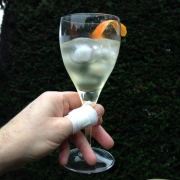
glass of Orange Blossom

all fingers and thumbs

glass of Orange Blossom

Orange Blossom cheer

It was Sir Isaac Newton who stated that, in the absence of any other proof, the thumb alone convinced him of God’s existence. And belatrova, stoically recovering from an injured left thumb after an unfortunate encounter with a kiln door, could not help but think of the usefulness of those five appendages that grow out of each hand – our fingers, or, strictly, our digits, if we include the thumb.

It turns out that our fingertips possess a high concentration of receptors, which means that they are highly sensitive to moisture, pressure, texture and temperature. Fingers are capable of feeling the tiniest, almost invisible, wrinkles on what appears to be a smooth surface, an extraordinary level of sensitivity. Thus we use our fingers as sensory probes to find out about the objects we bump into or are puzzled by, and so they are prone to getting hurt – they get burnt, cut, scratched, squashed and scraped. In belatrova’s case it was an injury due not to sensory probing but to simply forgetting where his thumb was as the kiln lid was being closed.

When not getting them injured, we at belatrova tend to use our fingers to poke clay to see how moist it is, or to smooth down the surface of a bowl before biscuiting, or to trim and cut around a shape, or to test how hot a piece is in the kiln (even if the meter indicates 90 degrees), or to brush on an oxide colour or to sandpaper the oak plinth of a birdbath.

mandarins in bowl

mandarins look better on ceramic

What would we do without our fingers. Think of all the finger gestures we rely on: thumbs up, the OK sign, the V for victory sign, the middle finger sign. And pointing is so useful, and counting, and playing the piano. What about the index to your mouth for “silence”, and snapping your fingers, or just picking your nose? The list is endless.

“…Even now that sweet memory lingers
I was playing my guitar
Lying underneath the stars
Just thanking the Lord
For my fingers
For my fingers” Paul Simon

And you need your fingers to make cocktails. As is customary at Christmas, we like to offer our supporters and friends a new cocktail that has been tried and tested on volunteers at the belatrova workshop. We have shown you how to make the perfect Dry Martini, and a delicious Black Velvet, now we would like you to try an Orange Blossom.

Use a large snifter or brandy glass, or balloon glass.

Fill it with ice – perhaps three generous cubes

shake two drops of Orange Bitters into it (this you can buy online or at some shops now). Do not allow more than two drops – these things really matter.

A small splash of Elderflower Cordial

Fill two thirds of the way up with cold Prosecco (it must be cold)

Curl a thin sliver of orange peel onto the rim

Stir

Drink

ceramic costers

star coasters

We at belatrova wish you all the very best for 2016, and we hope you have a Happy Christmas. As some of you know, we are always in and out of our workshop at No 9, so if any of you want to pay us a visit it is a good idea to give us a call first on 01531 634082, otherwise you can always contact us via our website: www.peterarscott.co.uk/dev or you can have a look at our ETSY site, or even our Pinterest boards.

Cheers! Salut! Salud! Santé! Prost! Salute!

pug mill

Thelonius says “Happy Christmas”


ceramic mural

weekend openings, many visitors

A big thank you to all our visitors who dropped by these last two weekends – it is always good to see new faces as well as the regular ones. Many of you took part in our “mini mural” competition which used an assortment of glazed ceramic pieces to very individual effect. And do they say something about the individual, we wonder?  And here are the best ones (as judged by Thelonius):

Hmmm. Very difficult to choose a winner. Turquoise (or anything with blues and greens) is a favourite of the judge’s (who is given to pondering about life), and he says it denotes  an ability to create emotional balance in your life, to express your hopes and dreams no matter how idealistic they may be and to make your own way in the world under your own terms, so he is awarding  a prize each to Alicia and to Lily.


belatrova’s Tales of the Alhambra

view of Granada from Sacromonte hill

Granada and the Alhambra from the Sacromonte

belatrova has often been drawn to Granada (blog August 2014) in the foothills of the Sierra Nevada, and specially to the Alhambra, the great sprawling hilltop fortress encompassing royal palaces from the Nasrid dynasty, as well as the fountains and orchards of the Generalife gardens.

looking down from the Alcazar

view of the city from the fortress

It first became a palace in the 14th century under Yusuf 1, Sultan of Granada, in the years when southern Spain was in the hands of various Moorish dynasties. It is a spellbinding place, all ceramic tiles, wood and plaster – Islamic art at its peak.

view of Granada through Alhambra Palace window

cool inside, hot out

It stands on its hill overlooking the city and from the cool darkened interiors you can see Granada below, through ornate lattice windows, sweltering in the white light of day. It is an indoor coolness reinforced by the tile work along its walls, the lightness of the intricate plaster ceilings, the presence of water in the courtyards and the calm the architecture seems to bestow on its surroundings.

slender pillars of Alhambra

tree-like

Part of its magic is the way you are constantly made aware of nature, specifically of light and water, no matter where you are standing within the palace; either because you are catching glimpses of the exterior, the patios, the views, the distant trees, the reflecting pools, or because your eyes are absorbing the gentle reflections from the chest-high ceramic surround and the extraordinary organic plasterwork of the domed ceilings and the tree-like colonnades of random columns (they are not, of course, they artfully appear to be scattered).

[one_half]

plasterwork of dome ceiling at the Alhambra

intricate and sublime

[/one_half]

[one_half_last]

more plasterwork in the Alhambra

delicate and voluptious

[/one_half_last]

The adjacent Generalife gardens also manage to maintain this fine balance of nature and architecture; no matter that you are outdoors, trees and hedges enclose you, lines of slender pillars appear and lead you into the welcoming shade of a domed space filled with mosaics. Birdsong and the sound of trickling water are all around you, and from certain vantage points, distant views of the Sierra Nevada, still snow capped, remind you of Washington Irving’s Tales of the Alhambra and the story of how muleteers used to bring ice down to the city in great blocks.

[one_half]

view of Sierra Nevada

distant snow-capped Sierra Nevada

[/one_half]

[one_half_last]

pool in Generalife gardens

toe-dipping allure of the Generalife

[/one_half_last]

Water is an essential ingredient in this manmade landscape, an important factor in the life of a culture shaped in the desserts of North Africa and so its presence is everywhere, even flowing in the stone balustrade that leads down a flight of steps to the gardens, and which allows a descending courtier or Sultan to dip his fingers in it.

[one_fourth]

stone balustrade with water running down the middle

finger-dipping stone balustrade

[/one_fourth]

[one_fourth]

ceramic toiles and plasterwork on wall of the Alhambra

ceramic and plaster

[/one_fourth]

[one_fourth]

intricate plasterwork

laberynthine plasterwork

[/one_fourth]

[one_fourth_last]

tiles on wall at the Alhambra

tiled wall

[/one_fourth_last]

Granada itself is a wonderful blend of medieval streets winding up to the Albaicín, gothic and baroque churches, a commanding cathedral, noisy squares filled with cafes and restaurants, fabulous ice cream parlours, incredibly helpful taxi drivers, shops brimming with blue and white ceramics, and one bar in particular that serves ice cold beer in freezing earthenware vessels (an idea germinating in belatrova’s collective mind – could this be applied to a Dry Martini?).

[one_third]

cold beer in earthenware mug

ice cold in Granada

[/one_third]

[one_third]

close-up of magnolia flower in Generalife

magnolia

[/one_third]

[one_third_last]

sandalled foot resting on table

belatrova resting

[/one_third_last]

The visit coincided with Granada’s Corpus Christi festival – a five day period of celebrations and religious processions. In the Plaza Bib Rambla families roamed around the square sipping drinks and watching a puppet show with their children, their young daughters dressed head to toe in their flamenco outfits.

[one_half]

fountain of the courtyard of the lions

the courtyard of the lions

[/one_half]

[one_half_last]

passion flower

passion flower in the Albaicín

[/one_half_last]

It was an inspirational visit, and made us want to get back to our ceramics, our birdbaths, but mostly to our tiled tables which we will be launching as part of the Bankside Studios Summer Open Weekend on Saturday 11th and Sunday 12th July. Please pay us a visit, and you will also get to see the work of six other makers. Hasta la vista.

open studio