Posts

pottery/ poetry in Wales

landscape vase

Driving through the countryside in Herefordshire and then on to Wales is a captivating experience. Perhaps it is the winding roads and the rising and falling of the horizon as you make your way past meadows, hills and then mountains. Small hamlets, castles in ruins, the occasional farmhouse, all punctuate the drive to Abergavenny and, if you are brave enough to do so on a cold January morning, lowering the window will reward you with a steady blast of the cleanest air garnished every mile or so with a whiff of soggy river bank or wet grass or diesel from a tractor as it turns off into a field.

the mouth of the river of blacksmiths

Yes, Abergavenny was my destination. Aber, from the Welsh for “mouth” (of a river) and gofannon, which is Middle Welsh for “blacksmith” and subsequently the name given to the local river, the Gavenny. The reference to blacksmiths relates to the town’s pre-Roman importance in iron smelting. However, my mind was not concentrating on these facts but rather on the strange fusion of cricket, poetry, Nazism, and, of course, ceramics that this town’s history brings together within its old stone walls.

Poetry allusions are plentiful in beautiful Wales, but this town was where Owen Sheers was born – poet, playwright, novelist and actor, and as I say whenever I get the opportunity, the only difference between “poetry” and “pottery” is the letter “t”. Click here to visit his website, and, if you are interested, I can tell you that he is booked to come to the Ledbury Poetry Festival this July.

Malcolm Nash

From poetry to cricket is an easy jump, given the many poems written about this game. For those of you who do not know the rules I would need a whole blog to explain them but allow me to mention writers like Les Murray, A.E.Housman, Harold Pinter and perhaps the best-known, Henry Newbolt (“There’s a breathless hush in the Close tonight…”). One of the most remembered moments in the game took place on 31st August 1968 when the great left hander Gary Sobers became the first batsman ever to hit six “sixes” in a single over of six consecutive balls in first-class cricket. We all remember Gary, but who thinks about the man who bowled those balls? Step forward Malcolm Nash, born in Abergavenny, and forever Garfield Sobers’ partner in cricket history. “My goodness”, says the commentator of the last ball, “it’s gone all the way to Swansea” – click here to see it.

But I digress. I was in Abergavenny to deliver some pieces to the Art Shop and Chapel. Regular exhibitions of fine and applied arts are held at the Art Shop, where artists’ materials can also be bought, while just down the road at the Chapel readings and performances take place with artists, musicians and poets, and you can eat at the Chapel Kitchen too, all ingredients locally produced – something for everyone, from meat-eater to vegan.

The Chapel – music, poetry and food

The town is small enough to make wandering around in it a pleasure, and if you like your food the place is great for world-class mountain lamb, venison, Y Fenni cheese, pastries, beer and cider – unsurprising since every September it is the stage for Wales’s biggest food festival, set in stunning area surrounded by green hills, including the Sugarloaf that looks down on the town.

Abergavenny Market

But I know what you are thinking. What about the Nazis? Well, OK. On the road to or from Abergavenny you will drive pasty a large stone ruin called Skenfrith, built in 1066 to protect the route from Hereford to Wales and now largely visited by passing tourists. One such was Rudolf Hess, a leading member of the Nazi party of Germany.

Skenfrith

Deputy Fuhrer to Adolph Hitler, he served in this position until 1941, when he flew solo to Scotland in an attempt to negotiate peace with the United Kingdom. He was taken prisoner and eventually convicted of crimes against peace, serving a life sentence until his suicide. They had to keep him somewhere straight after his capture, so he was kept under escort at Maindiff Court Hospital for a while and paraded before the cameras and even allowed out on sightseeing trips – he was apparently known locally as the “Kaiser of Abergavenny”.

You will need a coffee when you are there. Go no further than the Chapel – the coffee is seriously good. The kitchen and cafe make breakfasts, lunch and suppers, starting with fresh soda bread every morning.


Hwyl fawr

a curly tail of two cities

a pier with no equal

Brighton and Hove is an engaging place and I was wandering around in an aimless way when I came across a giant donut surrounded by very happy people, two of whom has just got married, all of whom were drinking champagne, and one of whom offered me a glass. The donut is a huge circular shape cast in bronze and its centre at eye level allows a view of the world through the sculpture. It’s called “Afloat”.

Afloat

Some of you will know that expectant feeling that takes over when a kiln is opened up and the work of weeks is revealed fully glazed– smooth shiny shapes that are pleading to be picked up, weighed and felt for the first time. Stoneware and, occasionally, porcelain is what’s used at the workshop, and recently after my trip to Brighton and Hove, I was thinking about piglets for some unaccountable reason. The brain is a strange and wonderful thing.

whirlpot set

Stay with me on this one. The point of the story is that the donut is sited at the seaward end of the groyne, a word I had never heard of but which turns out to be a man-made barrier designed to trap sand which the waves have moved along the beach and to prevent the sand being moved too far along the coast. Groynes are usually made of wood, or concrete.

porker

If you are like me you will want to know why it is so called. Well, it comes from the Old French groign, which derives from the late Latin grunnire (to grunt) and thus from grunium ( a pig’s snout). I suppose groynes do stick out like porkers’ snorters towards the sea. I was relieved to work out that this was the reason for my porcine daydreaming and pleased to realize that it afforded this blog yet another tenuous link with ceramics.

How? Well, porcelain comes from the Italian porcellana, literally “cowrie shell,” the chinaware so called from resemblance of its lustrous transparency to the shiny surface of the shells. The shell’s name in Italian is from porcella (young sow), the feminine of the Latin porcellus (young pig), diminutive of porcus (pig). The smooth and plump little cowrie does have piggy qualities though some experts point out its resemblance to a pig’s genitalia. You judge

Robin and Kirsty

All this preamble leads me to the reason for my visit. I was there to deliver some recent ceramics to the Cameron Contemporary Arts Gallery run by Robin Cameron and Kirsty Wither. Scattered throughout this page are examples of pieces you can see if you visit the gallery.

leaf vase

The gallery shows a changing programme of high quality established and up and coming British artists, ranging from traditional to modern, figurative to abstract, and each exhibition is accompanied by a selection of sculpture, ceramics and jewellery.

blue/green stoneware vase

The gallery is in the more laid-back Hove half of this twin city, less dense and intense, but because of its Regency buildings, villas and art-deco housing, wide roads and general leafiness, it is as expensive as Brighton but still attracts young families perhaps drawn by the wistful names of the areas there: Poet’s Corner, Wish Park, Palmeira Square, Adelaide.

seagulls go free

Brighton itself is certainly busy and cosmopolitan. I heard the sing song tones of Swedish, the emphatic sounds of Spanish, a lot of French glissando and very loud screeching Seagull. Seagulls own the promenade and perch all over the place in wait for something edible – they stare back at you unblinkingly and with a certain smugness because they are the only ones who do not have to pay to climb to the top of the British Airways i360 tower, from which you can view Brighton and the south coast. Visitors glide up gently to 450ft in the glass viewing pod, designed by the creators of the London Eye.

the Pavilion

Brighton’s famous lanes, narrow and crowded, are home to jewellers and a few restaurants, but a stone’s throw from them is the exotic Brighton Pavilion built for George IV, with its extraordinary exterior, its Chinese decor indoors, and its huge kitchen designed to feed a monarch who became very piggy-like in middle age.

Gorgeous George

As well-known as the stout sovereign’s palace is the Brighton pier, formally called the Brighton Palace Pier with its amusement arcade, rides and attractions, candy floss and Brighton rock. A lot of you may remember visiting it as children, and I still remember the smell of candy floss (does candy floss smell, or is my brain playing tricks again?), the one-armed bandits spitting coins at the ever-hopeful and the money I spent at the Shove Ha’ penny machine trying unsuccessfully to get a pocket knife in the shape of Elvis Presley.

three legged leaf bowl

I do remember going blue with cold after being frogmarched to the beach when we came to visit Granny. Luckily by then there were no professional “dippers”, robust women who plunged bathers vigorously into and out of the water for a small fee when the popularity of sea-bathing grew back in the 1790s. The ‘queen’ of the Brighton dippers was the famous Martha Gunn, a large woman who dipped from around 1750 until she was forced to retire through ill health in about 1814.

Martha at the Brighton Museum

It is hard to believe that before George IV made Brighton the “go to” resort it was a very impoverished town after the decline of the fishing industry resulted in much unemployment. It reached its nadir when the population had fallen to around 2,000 by the mid eighteenth century and great chunks of it were being gobbled up by the sea. Daniel Defoe, never one to mince his words, described Brighton as an old and poor fishing town in imminent danger of being completely swallowed by the sea; the proposed expense of £8,000 on groynes was, in Defoe’s opinion, more than the whole town was worth.

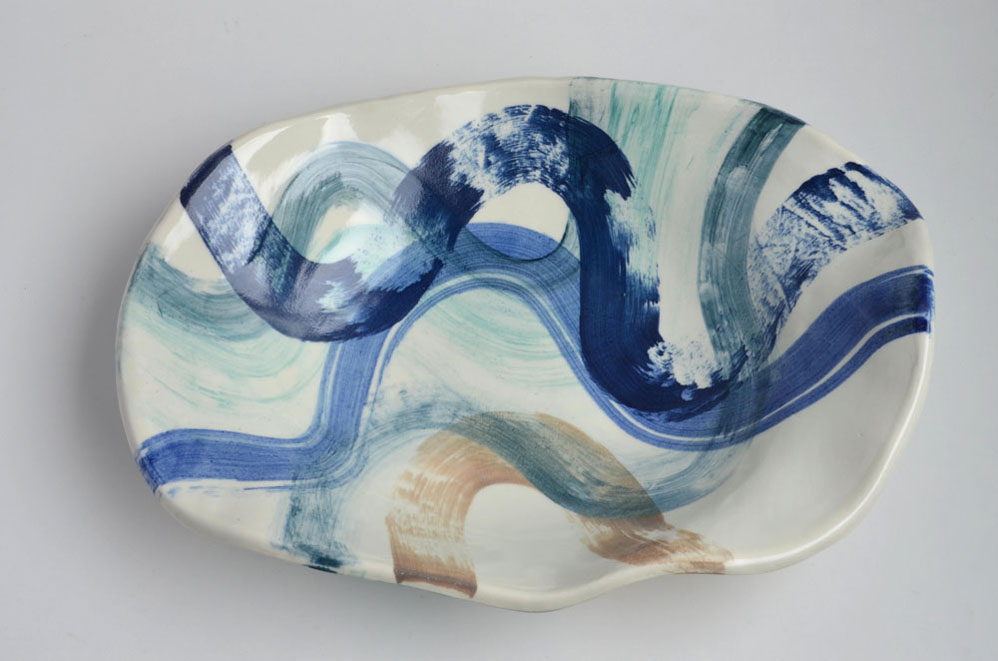
ceramic wave bowl – appropriate for a seaside resort

But it is another story now, and should you want to spend a day or two enjoying the sea, the vista, good restaurants and hotels, fairground rides, serious shopping, sailing, museums and galleries – and all of it an hour’s train ride from London – then this is your place.

Do drop in at Cameron Contemporary, and to see other galleries selling my ceramics click here and it will take you to the Gallery page on the website.

Lastly, I’d like to thank my dear old friend C.D.N. and his lovely Sue for putting me up that night, despite the fact that he was celebrating a significant birthday the next day. I hope the party went off with a bang and that all the wine brought in was consumed. I snuck out very early the next morning and tried to write a thank-you message on a paper napkin, but the tissue soaked up the ink in my pen and all I managed was a wobbly “Tha…” Here’s my present  –  an old song we both like (you’ll be hooked with the first note of the sliding guitar).

Arrivederci

12 hours in London (is like a year in any other place)

derelict Victorian Public Toilets into a cracking little pub.

A quick overnight trip to London was called for, ceramics to be delivered in the morning to the Cecilia Colman Gallery, so arrival was late in the evening – the idea being to spend the night and get up early.

closing time at Pueblito Paisa

London is an extraordinary place, which is why I found myself late that night somewhere in Haringey eating aborrajado (deep-fried stuffed plantains) and empanaditas (meat turnovers) all washed down with cold Colombian beer. The city is ever shifting, neighbourhoods seem to change overnight from the down-at-heel to the slickly bourgeois, and this perpetual construction of flats for the professionals, the foreign “land bankers” and who knows who else seems to be hitting Seven Sisters, so that the little restaurant we were eating at is now in danger, along with its neighbouring businesses, of making way for another redevelopment scheme.

ceviche

Within this large building more than 100 Latin American traders have created a busy complex of cafes, butchers, travel agencies, restaurants, clothes shops and greengrocers all under one roof, and is a fine example of a city that can boast to being the most multicultural place in the planet.

Relocation is promised, but everyone knows that it would never provide the genuine atmosphere that exists when people unselfconsciously transform a place through the need to make a living and make use of their own experiences and backgrounds. It is called Pueblito Paisa, and long may it thrive. Pay it a visit and try the ceviche.

passers-by outside the High Cross pub

We then walked a couple of blocks to a solid Victorian public toilet. This very hospitable place turned out to be a pub, recently converted, and we sat down outside under a cherry tree to drink and watch the night traffic flow by, mostly double deckers and taxis, and pedestrians of all shapes, sizes and diversity, track suits, hijab, business suits, shorts, sauntered past us.

At one point we looked at the shrubbery at the base of the cherry tree and were startled by the untroubled gaze of a fox which gave up on us and turned away.

the canal, early morning

The next morning a visit to Tottenham Hale and the canal that runs alongside the Walthamstow wetlands offered a complete contrast to the urban activity of the night before. Here all was placid and calm, and, if it had not been for the trains, it was easy to imagine you were in the countryside.

Cecilia’s place

And then the trip to St John’s Wood to visit the Cecilia Colman Gallery. Another contrast: spacious Regent’s Park, the London Zoo, the Regent’s Park mosque, Lord’s cricket ground, and St John’s Wood High Street with its cafes and shops – a small world away from edgier Haringey, but cosmopolitan nevertheless.

small three legged bowl at Cecila Colman’s

The Gallery has been in London for forty years having opened in 1977 and is one of the few remaining shops on St John’s Wood High Street which survived the transformation of the area in the last few decades. Cecilia chooses all the pieces and artists herself and is passionate about the work she exhibits. She chose eight recent Arscott ceramic pieces – do drop in to have a look.

large stoneware vase

On another note, we are all very pleased that CUP ceramics project (see previous blog) hit its crowdfunding target with 5 days to spare. Over 90 people pledged contributions, an excellent indication of the support for an open-access studio providing a creative community for all types of ceramicists to share skills and ideas in a relaxed environment

blue vase

Arscott ceramics go to St Ives

on the beach

A trip from Ledbury to St Ives coincided with one of those May days when the sun is hazy, the temperature mild, and the rolling landscape, as you enter Cornwall (or Kernow in Cornish), is sprinkled with mayflower and a roadside flora that does not seem to belong to any other part of the country. When you lower the car window and breathe in the fresh smell of early summer and gaze at the way the blue hills recede into subtle greys and you get your first peek at the sea between clumps of trees and rocks, you could easily bring to mind the painters Ben Nicholson, Peter Lanyon and Terry Frost. On the other hand, a lot of people go to St Ives for its ceramic associations, thanks mainly to Bernard Leach and his Japanese-inspired studio pottery, and visit not only the Tate gallery there, but also the fine independent galleries that exhibit both painting and pottery. There is no doubt too that a lot of people take advantage of what is on offer there and stuff their faces with Cornish pasties, fudge and ice cream. I know I did.

looking down to sea

St Ives Ceramics is on Fish Street, right by the harbour, and was opened by John Bedding back in the 90s. Bedding worked at the Leach Pottery and is now an influential presence in the ceramic world. It was he who introduced us to the idea of a dedicated ceramics gallery that would show work to its best and as primary exhibits. The gallery has since expanded and now shows a range of the best in contemporary studio pottery. The entrance appears small but once inside you realize that it is a treasure trove of ceramic pieces shown in four generous and well-lit spaces. The size of the whole space is a surprise.

treasure trove

I would urge you to drop in when you are in the South West, not least because some of my new ceramics will be on display, but also because you can enjoy the exhibits in a very quiet and cool place, away from the bustle of St Ives, and then consider going onto the Tate St Ives – at this time there was an exhibition of Patrick Heron’s which was inspirational. By the way, it is best to walk – avoid driving in the town and leave your car at one of the car parks further up the hill. Or better, arrive by train.

John Bedding

On the way back to Ledbury my head was full of the possibilities that clay offers us, and of the complex ways it can express moods and feelings depending on the way the material is used. It can do “sombre” and “flippant”, it can invite you to touch or it can repel intimacy, it can sit heavy and unfathomable on a plinth or seem to want to fly away. Most of all it reminded me how much human pleasure is achieved through making.

ceramic wall piece at St Ives Ceramics

Which in turn made me think of CUP, and what follows is another reminder of our open-access ceramics studio situated in Hereford which we aim to open in Autumn 2018. We want to provide a unique and creative community for beginners, intermediate and advanced ceramicists to share ideas, skills and friendships in an inclusive, relaxed and ambient environment. Excellent facilities, storage and expertise can be accessed for an affordable monthly fee allowing time for experimentation and extensive development of skills. CUP Ceramics is a social enterprise, so our profits are committed to providing access to ceramics for all in our local community.

face stuffing

CUP is currently running a crowd funding campaign to show that there is a demand for what we offer in Herefordshire. Here, you can find out more about us and pledge for discounted courses and membership. Or you can simply make any donation, no matter how small, to help make it happen.

Arscott St Ives vase

Please have a look at the new website for Peter Arscott Ceramics.

image of belatrova stall

Arrivederci – everything must go

ceramic bowl with three legs

a belatrova collectable

We admit we haven’t been in touch for some time but belatrova is discarding its old skin and emerging anew like a butterfly from its ceramic chrysalis.

Arscott, Houghton and pugmill

arrivederci from Houghton, Thelonious and Arscott

So is belatrova closing down? Was it inadequate capital, lack of cashflow, poor research, scattergun motivation, a saturated market, big lawsuits pending?

None of the above. After lengthy discussions on the future of belatrova and the path to be taken, it was Thelonious who moved to dissolve the corporation in a pool of margaritas; glasses were then raised to the next stage in this ceramic odyssey.

Each handmade piece will now be sold under Peter Arscott’s name

something new this way cometh

No longer will we be making lamps, birdbaths and coasters. From now on we will concentrate mainly on vases and three legged bowls, painted in a distinctive abstract style, and we will be selling them through various outlets, from St Ives to Edinburgh (details to follow).

ceramic bowl

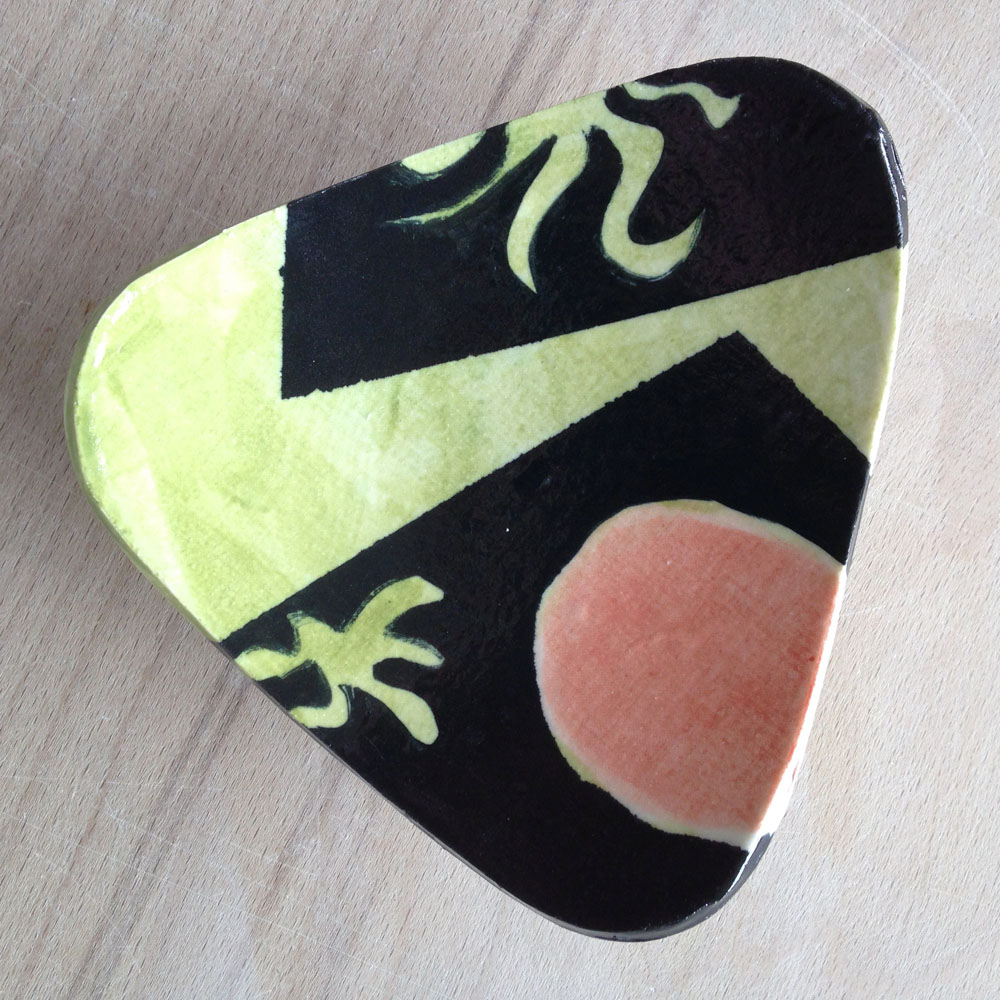
new range of three legged bowls

Our website will be a blog and gallery from now on, where new pieces will be shown and developments and outlets announced.

Ledbury Market House

Ledbury Market House

This means that everything must go and we are offering our belatrova pieces for sale at very low prices. From Saturday 5th May we will be selling belatrova pieces under the Market House in Ledbury from 9am to 4pm every Saturday.

image of belatrova stall

stall

Throughout the month of May customers with any queries or just wishing to visit the new studio workshop can do so by ‘phoning ahead on 07734 678667. Do allow for time as we are occasionally not at the studio throughout the day.

image od Naples residents strolling

Neopolitans strolling

Only just back from Naples, arrivederci is most appropriate since it means until we meet again in Italian. Not that any Neopolitan considers himself or herself Italian but a race apart. The city has an energetic buzz and the volume control is set to “loud”, with groups talking on street corners, under trees, in shops, anywhere convenient where views can be exchanged. Politics, football and gossip reign supreme. When we were there Napoli beat Juventus 1 – 0 and the city around us erupted and citizens spilled out onto the streets to celebrate.

Vesuvius mouth

caldera

We visited the Royal Palace, the Archaeological Museum, the San Martino palace on the hill, and, of course, ate pizza. Pompeii was fascinating and the climb to Vesuvius provided the best scenery available: the whole bay of Naples and the islands of Capri and Ischia. The deep crater, or caldera, still oozes a sulphuric whiff which for some reason was reminiscent of the workshop on a Monday morning.

nocturnal shot of bay of Naples

the Bay of Naples at night

Aglianico, a red grape variety of the area, produces a delicious wine that belatrovians (well known for their excellent taste) may want to try.

Once back in soggy Britain belatrova was involved with the launch of an exciting new ceramic project. CUP Ceramics Community is Herefordshire’s first open access ceramics studio and aims to open its doors in Autumn 2018. CUP provides a unique and creative community for beginners, intermediate and advanced ceramicists to share ideas, skills and friendships in an inclusive, relaxed and ambient environment. Excellent facilities, storage and expertise can be accessed for an affordable monthly fee allowing time for experimentation and extensive development of skills.

CUP is currently running a crowd funding campaign to show that there is a demand for what we offer in Herefordshire. Here, you can find out more about us and pledge for discounted courses and membership: https://www.cupceramics.com/

glass of wine

aglianico

Here’s looking forward to the future, and to seeing you under the Ledbury Market House and elsewhere. We will be keeping in touch.

array of glazed fine art ceramic bowls by belatrova

Far from the Madding Crowd

photo of people swimming in Mallorca

far from the madding crowd

Heat has a strange effect on some humans. When temperatures hit a high, as they did this August in many parts of Europe and the Mediterranean, confusion and dizziness set in, common effects of too much exposure to extreme heat because of increased blood flow to dilated blood vessels and fluid loss through sweating. This sometimes happens to belatrova when the kiln is going full blast and ceramic production is in full flow as we try to feed the insatiable appetite for our products – on the other hand a cold Dry Martini often wards off any lasting effects.

dry landscape of Mallorca

Mallorca inland

This August was an excuse to go abroad for a break before moving into the new workshop in Ledbury (about which more in the next blog).

watercolour of Mallorca

towards the monastery of Sant Salvador

Mallorca is a beautiful island that has lured many foreigners over the years, from Chopin to Robert Graves, and, this year, belatrova. But mass tourism is affecting it much as it is elsewhere. Barcelona, Venice, Edinburgh, Lisbon, Dubrovnik, Skye are all examples of unmanageable jam-packed destinations filled with visitors on holiday. ” Tourist: your luxury trip / my daily misery“, says a placard in the Parque Guell (Barcelona). “Tourists go home. Refugees welcome” was the graffiti that greeted us as we drove to Felanitx for our week in Mallorca.

pool shadow

tourist

And who can blame residents when all anyone can do on the beautiful beaches and calas is to stand waist-deep in the water surrounded on all sides by others similarly engaged in staring at the horizon with arms folded and wondering how to escape – we did find a great spot though, as you can see from the first image.

drawing of tourist on mobile

tourist with mobile

Go inland and the atmosphere changes and the landscape is an engaging mixture of the agricultural and dramatic, from fertile farmland and Aleppo pine forests to the limestone mountains of the Serra de Tramuntana and the summer flowering of oleander, hibiscus, marigolds and orchids.


cacti

away from the tourists

If you really want to get away from any crowds, we recommend a visit to Botanicactus, a cactus sanctuary (though belatrova believes they are quite capable of defending themselves) where the cacti flourish in the dry and sunny climate and the landscape has been specifically designed to protect the plants, with the creation of the artificial lake and raised terraces protecting the plants from the wind. While everyone is at the beach you can wander about in perfect solitude surrounded by these giant prickly beings.


glazed bowl with painting

belatrova’s Miró bowl

Among the many artists associated with the island is Joan Miró, painter, sculptor and ceramicist born in Barcelona, but resident in the latter part of his long life in Palma where he bequeathed a collection that is the basis for his Fundació Joan Miró which we visited one morning.


retro 1950s style bowl

retro bowl (three legs)

It is a purpose-built exhibition space that uses thinly cut alabaster as a source of light into the rooms and has pools of water outside in the gardens that reflect their own light through low cut openings at floor level – and the whole complex stands on a hill overlooking the bay of Palma. We watched white sails racing each other in the distance, the ferry from Barcelona ploughing its way to the docks, and three giant cruise ships blocking part of the harbour architecture as they disgorged their passengers into the city for the day.


fundació Joan Miró

But back to Miró; tiny forms in huge empty spaces, deep blue cerulean sky-like canvases, crescent moons, birds, meandering shapes, his work is captivating and has inevitably inspired belatrova, back in Herefordshire, to make a few ceramics in his style.

array of bowls by belatrova

inspired bowls

If you’d like to see them come and pay us a visit at our old workshop at No9 Bankside Studios during hArt, which runs from Saturday 9th to Sunday 17th (open daily 10 – 5pm), just follow the red hArt signs in Ledbury, or use the postcode: HR8 2DR. You are most welcome. As the hArt website says: “Meet hundreds of individual artists, see an array of artwork across the county in the city and countryside, in fabulous locations such as manor houses, historic barns, farms, churches and beautiful gardens.”

 Finally, belatrova shed a tear on learning of the death of Walter Becker, guitarist and composer, who with Donald Fagen was one half of the unforgettable Steely Dan. We invite you to click here and listen to one of their middle period songs (skip the ad): subtle player that he was, technically dexterous, meticulous master of the instrumental gesture and never a grand-stander, “some of his most intriguing work is embedded in the background – the architectural arpeggios of “Aja,” or the wry, blues-tinged asides that dot the margins of “Hey Nineteen.” (Tom Moon / NPR Music)

Many a bowl was made listening to Walter on his guitar.

When all the dime dancing is through,                                                                                                                              I run to you..

pink pasque roses

Springing Open in April

pink pasque roses

Pasque roses in Spring

Everything is blooming in this part of the world, the sap is rising, winter’s greys are turning into varied shades of green, and cherry and apple blossom are everywhere. April is a month when things turn for the better, it even gets its name from the Latin word “to open”, describing flowers opening at springtime, though Aphrodite the goddess may also be another root for the word. Did you know that April used to be the second month of the year until January and February were invented by the Romans? No, nor did we.

Nor did we know that “April” was the 250th most common name for a baby girl in the UK, or that in the UK it is National Pet Month, or that in the US it is National Pecan Month. And our meticulous research has unearthed the following:

Zebra crossings were introduced in Britain on 4 April 1949, when James Callaghan, then parliamentary secretary to the ministry of transport in the British government, came up with ‘zebra’ as a name for the crossing which it was thought would be easily understood and remembered, particularly by vulnerable groups such as children.

Russian cosmonaut day is April 12, commemorating the astronaut Yuri Gagarin who became the first man in space on April 12, 1961 aboard Vostok 1. He spent 108 minutes in space.

And when, we hear you ask, is National Eggs Benedict Day? Why, it is on April 16th, a day to enjoy eggs with hollandaise sauce, crispy bacon and English muffins. Apparently, a lot of people have never had Eggs Benedict, but we reckon belatrovians are sophisticated and most likely to have enjoyed Eggs Benedict a number of times, and perhaps, on a regular basis. See how many of your friends can tell you how its made, or what’s in it. Or, ask them what hollandaise sauce is.
Celebrate by eating Eggs Benedict – click here to see how to make them (first get a hen).

ceramic planter with elongated corners

belatrova corner planter

All of this is just a preamble to let you know that we are holding our annual Spring Open Weekend on Saturday 22nd and Sunday 23rd April (10 – 5pm) at the Bankside Studios. You are most welcome to drop in and browse, and even though Eggs Benedict will not be on the menu, we will offer you tea, coffee and cake.

ceramic dish with goat head by Picasso

c’est ne pas un chevre

You would be hard pressed to find a spot anywhere that both makes and sells the variety of goods you can find at the Bankside Studios in Ledbury. You can step into the studio to see Fleen Doran, fresh from her successful show at the British Craft Trade Fair at Harrogate, making her salt glaze pots at the wheel, while Wendy Houghton works away at her delicate ceramic sculptures. This is the same workshop where belatrova produce ceramic planters, fruit bowls, mirrors and birdbaths next to the joinery section where Stuart Houghton busily shapes and cuts wood to perfection – at the moment he is whittling a small goat out of myrtle. Upstairs Dan Barker has his photography studio, shared with the textile designer Sunny Todd, and across the road can be found artist blacksmith Dave Preston hammering iron on his anvil – in fine contrast to Bob Evans who can be found in his studio opposite printing images of striking quality on very new and sophisticated printers.

handmade ceramic flower pot with handles

striped splash pot by belatrova

The studios are situated just behind Alfa-Tech on Little Marcle Rd, which is accessed via either Lower Rd or New St. Please follow the signs. There is limited parking on-site (and wheelchair access) and there is additional on-street parking.

large mirror with wide painted frame

large wall mirror with blue frame

The address is: Bankside Industrial Estate, Little Marcle Rd, Ledbury, Herefordshire HR8 2DR. And do please visit the Ledbury Cooperative’s website: https://www.ledburycollective.com/

poster of Spring Open weekend

For those of you who live in or close enough to London we would encourage you to visit the Cecilia Colman Gallery in St John’s Wood. It is right on the High Street and easily reached by underground. Glass is a speciality but among the many excellent pieces on show, ceramics, paintings and jewelry also have pride of place. The gallery is showing some belatrova pieces, including three legged bowls, wave fruit bowls and a large wall mirror.

Cecilia Colman Gallery

Cecilia Colman Gallery

ceramic planter with daffodils

hello Spring

close-up of ceramic brushmarks

painterly close-up

You haven’t heard from us for a while, we admit, but we are coming out of our Winter torpor, just like the snowdrops that every year nose their way out into the light before Spring to gladden the hearts of all lovers of beauty and Nature. And we are here to gladden your homes and gardens, with our handmade ceramic lamps and outdoor tables, our fabulous mirrors and the new range of Jazz pots influenced by our old friend Thelonious Monk and others.

ceramic planter with daffodils

blue and yellow

With your gardens in mind, we’ve been making new Brushstroke Blues planters that will bring to life any corner of a garden or patio, and, because they are mostly blue in colour, they will set off the warmer yellow, orange or ochre hues of the plants. Furthermore, blue is serene and mentally calming, associated with intelligence, communication, trust, efficiency, serenity, duty, logic, coolness, reflection, calm, and thus a nice contrast with yellow and its optimism, confidence, self-esteem, extroversion, emotional strength, friendliness and creativity. All of that in one planter, but then belatrova does like to carry out as much research as possible on behalf of its supporters and customers, and this often reveals things we were not aware of – perse, smalt and watchet, for example, are all associated with blue, as are the better known azure, cobalt, navy, sapphire, cerulean, cyaneous, mazarine, pavonated, perwinkle and ultramarine.

the colour watchet

watchet

the colour smalt

smalt

the colour perse

perse

In all honesty, blue is belatrova’s favourite colour – as you may remember from a previous blog (July 2014).

abstract cewramic table top

ceramic blue abstract table top

Click here and you can hear the inmortal lyrics Nel blu, dipinto di blu from Volare sung by Domenico Modugno (skip the ads). Dean Martin also sang it, but Dino’s version is a “tad slick”, according to one member of the team, though another claims that Domenico’s strange arm-lifting movement reminds him of a policeman stopping traffic. See what you think.

jazz inspired ceramic pot

thelonious corner pot

Edmund de Waal‘s visit to the Ledbury Poetry Festival last year reminded us how pottery and poetry are only differentiated by the one “t”, and looking at the quality of the ceramics produced in the UK any objective observer would have to agree that the state of pottery creativity is at an all time high, possibly aided by the “Great Pottery Throw Down” on TV. The most astonishing shapes, textures, glazes and sizes can be seen in galleries and in excellent magazines such as Ceramic Review, and pieces can express a range of emotions, from the calm of a Japanese influenced pot to the freewheeling hurly burly of glaze upon glaze on a large abstract shape. Inevitable, belatrova looks to see where it fits in and we conclude that for the painterly abstract quality and the treatment of the ceramic surface as a canvas we belong to a very small group. Our customers are very discerning, and many seem to have a disposition for the visual arts; but however discriminating, sharp and perceptive they are (and, of course, they are), with Spring around the corner and the sap rising we know that a Spring Open Weekend is a much anticipated opportunity to make up minds and go for that particular piece that will enhance the dining room, or sitting room, or patio.

three ceramic planters

blue planters

Sometimes the world is a valley of heartaches and tears
And in the hustle and bustle, no sunshine appears
But you and I have our love always there to remind us
There is a way we can leave all the shadows behind us…

Yes, by paying us a visit!

So please pencil in the 22nd and 23rd of April (10 am – 5 pm), when we will be at Bankside Studios in Ledbury along with makers such as Fleen Doran and Wendy Houghton, and others. Otherwise you can always visit the website.

ceramic jazzpot

splash pot waiting to meet you

apple harvest on a table

“Slack ma girdle, Foxwhelp.”

ceramic fruit bowl
Season of mists and mellow fruitfulness!
Close bosom-friend of the maturing sun;
Conspiring with him how to load and bless
With fruit the vines that round the thatch-eaves run...” (John Keats)

image of grapes on a vine

belatrova bunch

At belatrova we started turning our thoughts to Autumn, what with the leaves beginning to turn and that scent of damp and smoke that permeates the countryside near the workshop. We also discovered a taste for perry – surprising given that we seem (from the blog) to be serious cocktail sippers rather than quaffers of fermented fruit juices. We told you how to make the perfect Dry Martini some time ago. Perry is very much an Autumnal drink, and we visited a local small holding to see how it is made.

image of bottle of local perry pear

perry made from blakeney red

Has this anything to do with ceramics or table making? Probably not. The Blakeney Red is a greenish yellow perry pear with a red flush on the sunny side, an old favourite which was even considered a desert pear in the 1600s. which could also be stewed and used to dye soldiers’ khaki uniforms. This popular pear is renowned for perry making and is considered one of the best single perry varieties. The perry we tried was made from this pear.

How does this link in to ceramics, I hear you ask? Well, perry pears had their heyday in the late 17th and early 18th centuries and it is thought that there are at least 120 Perry pear varieties, many so local that they were only ever propagated on 1 or 2 adjacent farms. The heritage of these pears leaves us with some fantastic variety names, including Dead Boy, Mumblehead and Merrylegs. Some cider apple names? Brown Snout, Foxwhelp, Tremlett, Slack-ma-Girdle.

apple harvest on a table

worcester apples

So far we have found no obvious links to ceramics and pottery, however, Stinking Bishop perry pear is local and used by Charles Martel, cheese maker supreme and reviver of Single Gloucester, whose washed-rind cheeses are immersed in the perry for 4 weeks while it matures. It is made from milk of Gloucester cattle, and became famous when it starred in “Wallace & Gromit: the Curse of the Were-Rabbit“. Here is a picture of late Autumn lillies to wave away the scent of cheese:

late autumnal lilly in sunlight

some kind of lilly

Throughout Herefordshire there is a strong tradition of farm cider-making. Farmers produced cider to be drunk by the farm labour force during the following year, especially the busy times of hay-making and harvest. Farmers used to sell cider to local pubs and cider merchants for re-sale in towns. By the way, perry pear trees take much longer to mature than cider apple trees, thus:

Who sets an apple tree may live to see it end,
Who sets a pear tree may set it for a friend
.”

a three legged ceramic fruit bowl with apples

fruit bowl

Like the pear tree, belatrova has also paced its maturity to get to the stage we are now at. So if there is a seasonal change in the air, belatrova too reflects this. We have added two new categories to our website which we would love you to visit – just click on either: Fruit bowls and serving dishes and Ceramic art. Enjoy the visual sipping, get merry on home decor ideas, refresh your taste buds.

three legged spotted bowl

ceramic art? More Fresian than Hereford

cartoon of bishop

an old stinker


apple on ceramic bowl

belatrova – Open Studio Art Week 10 – 18 September

The purest treasure mortal times afford, is spotless reputation; that away, men are but gilded loam or painted clay.” William Shakespeare

apple on ceramic bowl

temptation

belatrova’s reputation may well be gleaming, but we would like you to see it up close and give it a good poke. We are happy for you to pick up any of our bowls and test its weight, or sniff it, or hold its cool surface against your cheek, even lick it. Pottery does this to people.

Clay engages the five senses.

ceramic acoustics

listen

Put a porcelain pot to your ear and flick its surface with your middle finger; what a satisfying “ping” sound comes from it, clear and perfect and proving there are no cracks in it. How horrible it is when we take a piece out of the kiln and the ping is more a “plock” sound – disappointment soon follows as a hairline fracture shows up.

eyes looking at ceramic

look

Touching pots is part of the experience, both when you are making them and when you are choosing one to buy. Do your fingers yearn to feel the rough textured surface of an unglazed vase or do they prefer the smooth milky whiteness of glazed porcelain? And what about plunging them in wet clay and making shapes?

Your eyes can be drawn to certain pots for all sorts of different reasons: colour, glaze, shape. Try holding up a piece of fine porcelain up to the light and wonder at its translucence.

licking porcelain

lick

And eating clay? Well, it is an acquired taste, but some people swear by it. It helps keep toxins from being absorbed into the body, the minerals that make up Bentonite clay work together to absorb heavy metals and other toxins in the gut. And kids seem to love it. “I am so happy that there are other people who love eating clay. I’ve been eating it since my pregnancy 20 years ago. I love the smell of wet earth in my mouth. Yum, yum” Mrs Elvira Fingerhut of Neasden, London, UK.

nose sniffing ceramic

sniff

Finally, smell….mmmm, a bit of a challenge, this one. Sometimes it can smell of rotten eggs. But sometimes it is just damp and musty, like Autumn approaching with all its mellow fruitfulness.

Yes, Herefordshire Art Week is with us from 10 – 18 September, which means that we are one of over 150 makers and artists in Herefordshire who will be open to visitors throughout the nine days.

And for a limited period only we have knocked 10% off the price of everything in stock! Would you like to know how to get your discount? Just click here.

One of the advantages in coming to our venue is that you get to see the work of three other ceramicists who form the Bankside Studios cluster: Fleen Doran, Stuart Houghton and Wendy Houghton.

This annual event draws many people to our workshop, and many are dropping in not just for the excellent cake and tea they are offered; you get to experience an exhibition of contrast and style, with informal demonstrations and the chance to talk to the artists.

Furthermore, there is an irresistible sale of belatrova pieces in one section of the workshop, and wonderful bargains to be found. Do come along, say “hello”, and handle, stroke and pat our pottery.

hand made jug by belatrova

thelonius splash pot

Directions: in Ledbury follow the red h.Art signs from Lower Rd or New St into Little Marcle Rd. Follow signs to studios behind Alfa-Tech Garage. Parking is available. We are open 10 – 5.30 pm.

large blue ceramic jug

big blue