Posts

Sizzle v Sausage

Wave vase

Are you as confused as we are with emojis of giraffes in sunglasses, smiling coiled poos and aubergines? Well, relax. It’s just that the world of our cultural references is becoming increasingly visually based, that’s all. It’s a cliché that a picture tells a thousand stories, but what writing can surpass the photo of the workmen having lunch atop a skyscraper, or of the tank man of Tiananmen Square, or of the sailor kissing the girl in Times Square?

Segment vase

Which leads me to the more mundane issue of imagery and marketing. Images act as storytellers.  You can evoke an emotion by using a high-quality image that can then draw visitors to your website. They will take in the image, and in a split second decide whether the rest of your site is going to be relevant to them.

Eric

Though a long-standing colleague and friend says “it’s the sausage in the frying pan, not the sizzle that counts”, obviously using the image of a nightingale singing, or of Michelangelo’s David with tulips growing out of his head, or of a fat rat called Eric, or of a Hereford cow, or of a fish with an Elvis hairstyle, is not really going to encourage a visitor who is interested in ceramics to keep on clicking. All of which Peter Arscott Ceramics has been guilty of, despite warnings from Spiro, Head of Marketing.

Which explains the images at the top of this blog – visually stunning compositions that have been set up, photographed and edited by someone who knows her craft – click here for a link to her site. Your eyes stay on it that little bit longer, and that extra nano-second may be the difference between leaving or continuing. A post on social media accompanied by an image is ten times likelier to receive engagement.

Willow Pattern Protest Vase at the Oxmarket

It turns out that a big chunk of our brain spends its time in visual processing, in part because images can grab our attention so easily. When you clicked onto this blog, did you immediately start reading or did you look at the photos first? The theory is that our visual senses are the most active because quick processing of visual information would have saved our ancestors from an attack by a predator.

Willow Pattern Protest Vase (verso) at the Oxmarket

A quick visit to Chichester via the M3 and A27 is a real test of anybody’s visual processing: looking out for signs at the spaghetti-like interchanges and dealing with predatory lorries on their way to Southampton docks is a bit like going on a hunting expedition. One of our ceramics has been chosen for exhibition at the Oxmarket Open and had to be delivered to the Oxmarket Gallery, a deconsecrated church formerly St Andrew’s, in the heart of the city, and beautifully redesigned as an Arts centre.  The piece in question is a Willow Pattern Protest Vase – see relevant blog here.

The good news its that the ceramic was chosen as one of the joint winners of the Applied Arts Prize, selected by glass artist Adam Aaronson: an exhibition of ceramics in 2023 awaits. Watch this space. The other winner is Jane Eastell, whose instagram handle is @thepotterycabin_lm.

One of the few things saved from the redundant parish church of St Andrew, Oxmarket, was the memorial to John Cawley, which was moved to the cathedral where you can see it now. He was thrice Mayor of Chichester, and his son William (d. 1666) is also commemorated. William was a philanthropist and a staunch republican, signing Charles I’s death warrant. I think Cawley Senior’s expression is priceless, and probably not one that is meant to convey goggle-eyed confusion, but I can’t help feeling I’ve met him somewhere before..

I’ve resisted the temptation to sign off with a relevant limerick that starts with “there was a young woman from Chichester, who made all the saints in their niches stir…” because Spiro says it is too lewd. Instead, why not visit the cathedral which has a stained glass window by Mark Chagal, a tapestry by John Piper and a painting by Graham Sutherland amongst its collection of art.

But of all the monuments, the Arundel tomb is the best known – the inspiration for Philip Larkin’s poem of that name, and even though he himself said that love isn’t stronger than death just because statues hold hands for six hundred years, we can’t help reading the poem in that way:

… the stone fidelity
They hardly meant has come to be
Their final blazon, and to prove
Our almost-instinct almost true:
What will survive of us is love.

 And drop in to see the Willow Pattern protest vase too.

Disgruntled staff and fundraising

Looking at some of the pieces that have recently come out of the kiln, like the one above, anybody might think that Peter Arscott Ceramics is keen on making work that displays the principles of movement, by showing flowing lines and edges that we find in the natural world. But it is rhythm and pattern in the mark making that is of primary concern and this sometimes leads to this impression of movement – repetition of elements or colours. We are just as keen on placing spots on the surfaces, which achieve the opposite, anchoring a design, like the one below.

Talking of repetition, staff meetings are held regularly at PAC. One was recently held to discuss stock levels. Over coffee, Thelonious (pug mill), Spyridon (marketing), Ziggy (fly control) and I agreed that there is nothing worse than having stock that is uncherished and unseen. Subsequently, we are going to display those pieces that didn’t quite make the grade, those “not quite right” vases, those skewed pieces, those stunted or, frankly, unresolved ceramics that have been lurking in some dark corner of the studio, forgotten and unloved but which will for once have a chance to have others cast their eyes on them and decide their worth.

Spyridon, Thelonious and Ziggy

Because all these stoneware vessels are fired to such a high temperature in the kiln (1270°) they are essentially vitrified and will withstand any temperature out in the garden. They are frost-proof. And you’d be surprised how good the most questionable ceramic can look once it has been strategically placed outdoors among shrubs and bushes, or on terraces, or on a balcony or windowsill with suitable plants in them. You may even like one enough to put on your kitchen table, but what I am saying is that despite their flaws they retain some allure if carefully positioned around or outside the house.

So obviously we are not going to charge you for any of these little ceramic orphans. No. We are going to ask those of you who come to see and take, to leave a donation in a box that will be left outside in the garden near the display. You can leave as much or as little as you like, but it will go to a charitable cause.

Thelonious wanted any money to go to a retirement scrapyard for old pugmills, Spiro pressed for donations to go to a home in Greece for retired goatherds, and Ziggy, despite our best attempts at explaining the idea of “charitable” to him, wanted to invest it all in a large glass maggot-breeding farm and fly dispenser. However, as the boss, I have decided that it should go to towards the Ledbury Poetry Festival Community Projects at the new Poetry House in Ledbury to help cater for the many communal events planned to take place there.

“What’s poetry got to do with pottery?” sneered the sulking Ziggy.

“The only difference is the letter t” I riposted.

“You’ve said that so many times before that it is no longer witty,” murmured Spiro.

“Yes,” added Thelonious, “you are repeating yourself quite often nowadays.”

“Listen, you lot,” I said with rising anger, “this is all a bit rich coming from a cast iron contraption that can only compress used clay! As for you, Spyridon, I haven’t heard you ever say anything witty, possibly because you are a third century goatherd and Bishop of Trimythous, but mainly (I suspect) because you are a figment of my imagination, one to whom I have entrusted this enterprise’s marketing campaign!”

There was a hushed silence in the studio.

“And Ziggy, don’t forget that, as a spider, you are here on sufferance because you keep the fly population under control.”

There followed murmured protests and vague threats of a strike, which (like the present government) I chose to ignore. Then my wife came into the studio with a suspicious look in her eyes and asked me if I’d been talking to myself again, which I denied. Perhaps I have been working on my own too much.

So, if you are interested, please make your way to Oakland House, The Homend, Ledbury, HR8 1AP and park on the road, if you are driving, by the gate, skip up the seven steps into the front garden and have a look. If anything takes your fancy, take it and leave your donation in the nearby box. The images accompanying this blog show some of the ceramics that will be on display. They will be there on Saturday 16th and Sunday 17thJuly, from 10am to 6pm.

For those of you wanting to spend as little as possible (hard times and steeper bills are heading our way, after all) there will also be some small three legged bowls to choose from, mainly from when Peter Arscott Ceramics used to be “belatrova” – you’ll find the “b” mark on those, as opposed to the PAC mark.

Although somebody will be at home , Covid has struck, so nobody contagious will come out to greet you. A forlorn wave from a window is all you might get, though staff, being  a machine, a figment and a spider, are not affected. Finally, and with Ziggy’s woeful attitude in mind, and because this is a ceramics blog, and because we have had a highly successful Ledbury Poetry Festival, I’ll finish with the part of the last stanza of John Keat’s poem, Ode to a Grecian Urn:

When old age shall this generation waste,

Thou shalt remain, in midst of other woe

Than ours, a friend to man, to whom thou say’st,

“Beauty is truth, truth beauty, —that is all

Ye know on earth, and all ye need to know.”

John Keats by William Hilton, National Portrait Gallery

song of the nightingale, buzz of the fly

May view of Ledbury

A celebratory walk was needed after a successful glaze firing. The view from Bradlow Knoll down towards Ledbury this May afternoon was grey and cloudy. You can see in the distance the white shapes of the plastic used in the speeded-up cultivation of strawberries for the voracious soft fruit market, and, nearer, the sheep  which will end up on our dinner plates. Land maintained and exploited for the consumer’s benefit, which has made our landscape what it is today. This applies to Frith Wood as well, where dead trees are removed or left on the ground to encourage wildlife. This tree was 57 years old – I counted the rings.

A well-maintained wood.

It clouded over very quickly and started to rain, so it was dark walking in the wood, and there was little birdsong. However, it was not as dark as a few weeks ago when my daughter and I found ourselves with thirty others tiptoeing through Highnam Woods near Gloucester at midnight.

A walk through the woods at night vase

 It was pitch black. Not a sound could we make, no squeaky shoes allowed, or noisy clothing, no flashlights to be used, only the vague shape of the person in front to guide each of us in single file until we came to a small clearing and very carefully sat down. We had previously gathered around a campfire to eat, drink and listen to the environmentalist Sam Lee, who was leading us into the trees with one purpose only: to listen to a nightingale sing.

Nightingale. Photo: Carlos Delgado

Unlike the continent, the UK is seeing the slow disappearance of the bird, due to farming and land management activity, but primarily to the lack of thoughtfully maintained woods like Highnam, which is owned by the Royal Society for the Protection of Birds, and is a jewel, a remnant of ancient woodland that is carefully managed in order to keep a balance between mature trees and traditional coppice.

Doodle vase just out of the kiln.

Our nightingale sang his heart out, though not for us. Only male birds sing at night, in order to woo the females – if you hear one still singing at the end of Spring, that means he didn’t get the girl and he’ll be a Summer bachelor. Ours was a Pavarotti, with the most amazing technique, and the sound was clean and clear and strangely affecting. Click here to listen, and if you are interested in going on a Nightingale Walk next Spring, have a look at the Nest Collective website here.

Posture vase

From beautiful sounds to irritating ones: is it me, or are the flies out early this year?

They keep zooming into the studio uninvited, hurling themselves against the windowpanes again and again, and buzzing at a particular pitch that keeps you from concentrating. Eventually you spend too much time trying to swat them, unsuccessfully, and getting more and more frenzied and unfocused.

Fl-eye view

Like most people, I know flies have those compound eyes which allow them to see what’s coming towards them no matter at what angle or speed, so that by the time they’ve swerved the blow of a rolled-up newspaper, they’ve had time to read the print. Ok, so flies are important pollinators, second only to the bees, but house flies, commensal with humans all over the world, spread food-borne illnesses. And they are an annoyance especially in some parts of the world where they can occur in large numbers, buzzing and settling on the skin or eyes. Did you know, and I’ve looked this up, that the fly’s taste receptors are in the labium, pharynx, feet, wing margins and female genitalia, thus enabling it to taste your food by walking on it?

Research on your behalf also uncovered this: the Sardinian cheese casu martzu is exposed to flies so that the digestive activities of the fly larvae soften the cheese and modify the aroma as part of the process of maturation. Banned by the European Union, the cheese was hard to find, but the ban has been lifted on the grounds that the cheese is a traditional local product made by traditional methods.  And why not? The sustainable food of the future is the insect.

Swat vase

Do flies, do insects, have much to do with the history and development of ceramics? Not as far as I know, this is just another long and rambling lead-in to my latest batch of vases out of the kiln. I think you’ll agree that the piece above has been influenced by fly-swatting.

Hello vase

From bird song to buzzing to mooing: more PCA ceramics at the Palais des Vaches in Exbury, where you can also see a unique coffee table made with tapering beech legs, the top being sealed, and hand painted with acrylics. Three layers of heat-resistant varnish ensure that hot mugs of coffee will not mark the surface, though coasters are recommended. The surface is easy to clean.  It could be described as a horizontal painting on four legs, and certainly you get a lot of pleasure from simply looking down on it and enjoying the colours

Unique PAC hand-painted table at the Palais des Vaches

Other work at the Palais includes this large sculptural piece:

Porthole vase

And to finish, a poem from childhood:

“Will you walk into my parlour?” said the Spider to the Fly,
“‘Tis the prettiest little parlour that ever you did spy;
The way into my parlour is up a winding stair,
And I have many curious things to show when you are there.”
“Oh no, no,” said the little Fly, “to ask me is in vain,
For who goes up your winding stair can ne’er come down again.” (Mary Howitt)

Ruby my Dear vase at the Coastal Gallery

Well, I couldn’t resist finishing off with John Keats:

“Darkling I listen; and, for many a time
I have been half in love with easeful Death,
Call’d him soft names in many a musèd rhyme,
To take into the air my quiet breath;
Now more than ever seems it rich to die,
To cease upon the midnight with no pain,
While thou art pouring forth thy soul abroad
In such an ecstasy!”

Ceramics – Form or Function

St John’s Wood in London. Most people think of Lord’s Cricket ground and long sunny evenings watching a game and sipping beer, or perhaps a stroll through beautiful Regent’s Park. Others conjure up the image of the Beatles on the now famous zebra crossing  outside Abbey Road studios – those old enough will remember the mystery surrounding the image and  the rumours of Paul’s death; after all, why else would he be barefoot, and doesn’t George represent  the carpenter who made the coffin, John the religious figure conducting the ceremony, Ringo the undertaker?  However, I mention it because like all zebra crossings, it is black and white, and thus a clumsy introduction to my theme. Bear with me.

I still do not know for sure whether those of you who buy Peter Arscott Ceramics (PAC) do so because you want a vase in the house to put flowers in, or whether you just want the piece because it’s a particular colour and shape you find attractive, or eye-catching, its use as a vase thus being secondary. I suspect it is the latter.

Monochrome vase at Cecilia Colman Gallery

All this head-scratching comes from one piece which a lot of people do not like, while others do. For starters it is unlike the typical PAC piece in that it’s black and white, and its shape or form does not seek a harmonious balance in the whole, but rather rejects it. All of which makes it sound like sculpture, which it is not – it’s still a vase.

Monochrome vase, verso.

As you probably already know, at PAC each piece is made by hand, each piece is a unique one-off since nothing is made twice, nor is function strictly observed – the pot or vase is seen as a form you can play with, PAC having moved away from the potter’s wheel to focus on hand-built forms, as this technique allows much more freedom for expression.

Vine vase at Cecilai Colman Gallery

Some of the pieces have a singular lop-sided stance; improvisation takes place either in cutting out the rolled clay shapes, or later when painting oxides onto their surfaces. The approach to clay is that of a painter’s, and the forms arrived at often work as sculptures or as shaped surfaces with paintings. In other words, its function as a vase is secondary when being made.

Frond vase at Cecilia Colman Gallery

Now, if you want something to perform a function, you want it to perform well. If it doesn’t, you’re probably going to stop using it or ask for your money back, no matter how good it looks. This has yet to be a problem at PAC – never has a vase been returned because it hasn’t functioned as a vase. However, if you hate the way a product looks, you’re less likely to buy it in the first place.

Vase 54 at Cecilia Colman Gallerey

The main distinction between art and design is that design must have a purpose. Art can have no other reason for existing other than to be to viewed, say, or experienced (probably contentious, but some of you will let me know). However, design requires a function. If the design is visually striking, then it may also be dipping its toes in the ocean of art, because often art and design overlap. However, without function, it’s just form – it’s not design but art.

Dave as flower pot

Anyway, it doesn’t really matter. Your eyes tell you whether you like it or not – and that is that. So, if you are in London, go to Cecilia Colman’s gallery and test your eyes. Cecilia is showing some PAC ceramics, including the much maligned monochrome piece. See what you think. You could combine it with a visit to Regent’s Park Zoo, or a nice meal out at one of the restaurants on St John’s Wood High Street (nearest underground station is St John’s Wood).

Ming Dynasty, Jiajing: 1522 – 1666

Of course, you will know if a piece is a genuine Peter Arscott Ceramic by the stamp on the bottom of each piece. Stamps are important for dating and authenticating ceramics. The one above belongs to the time of Jiajing’s reign, a man infatuated with women, known to be a cruel emperor who lived in isolation while ignoring state affairs. This eventually led to corruption at all levels of the Ming government, and to a plot by his concubines to assassinate him in 1542, by strangling him while he slept. Sadly, the plot failed and all of the concubines were executed.

Peter Arscott Ceramics, 2022,

The next stamp above is of the early 21st century, probably during the reign of Jon Son, a man who survived many plots, and belongs to a small ceramic workshop based in Herefordshire that produced rare, unique and now much sought-after vases in stoneware.

Cecilia Colman gallery – over 40 years of experience

Having mentioned The Beatles, it is only fair to finish with The Rolling Stones whose 1965 song “Play with Fire” contains the following lyrics:

Your mother she’s an heiress, owns a block in Saint John’s Wood
And your father’d be there with her
If he only could

Click here to hear them sing it.

Spring ceramics

This blog usually begins with a view from Bradlow Knoll looking down towards Ledbury, accompanied by text complaining about the effort required to get to the top. This time, for a change, behold the view looking up towards the Knoll – disappointingly, the hill does not look so challenging  in the photo, but it is a slog. Honest.

Spring vase

This is meant to be a ceramics blog, but I sometimes find myself meandering away from the subject and end up finding out about things I had little or no idea about. Then I feel I have to share it all with you, dear reader. This time I delved into the world of rats because they are so evident outside and inside the house, but before I deal with them, if the following comes across as a Latin lesson, please forgive me:

image Wikipedia

Equinox, the time or date (twice each year) at which the sun crosses the equator, when day and night are of approximately equal length (22 September and 20 March). Either of the two occasions in the year when the centre of the sun is directly above the equator, and day and night are equal in length, thus “equi” (from Latin “aequuus”, meaning equal, and “nox” meaning night). In case you are asking, the solstice is the longest and shortest day of the year.

Persephone – Greek goddess of Spring (photo Wikipedia)

In the northern hemisphere, the vernal equinox marks the first day of spring and occurs when the sun moves north across the equator – “vernal” comes from the Latin word ver, meaning “spring.” Here endeth the lesson. Why am I telling you all this?

Spring vase at Palais des Vaches

Because the Coastal Gallery in Lymington  is collaborating with the Palais des Vaches in Exbury (Hampshire) and putting on a show of paintings, sculptures and ceramics to celebrate the Spring Equinox. The private view is on Friday 18th March, 5 – 8.30pm, and the exhibition continues Saturday 19th – Sunday 20th March, 11am – 4pm. Otherwise it is by appointment only.

Close-up of Spring animals on vase

The pieces commissioned are meant to reflect abundance, green shoots, and Spring in general (thus the images of bunnies, hedgehogs and birds in parts of the vases, don’t know what the teapot is doing there). Do have a look if you live nearby.

Thicket vase at the Palais des Vaches

Ah, Spring. When air temperatures rise, life is primed and ready to go. Sap is rising, supplying the energy needed to grow new shoots and leaves. Animals become active — arising from winter sleep, migrating, breeding.

Tendril vase at the Palais des Vaches

However, rats do not have a real breeding season.  if they are all warm and tucked up in your cellar or attic, that is the perfect setting for continuous breeding. My research shows that a female rat can be ready to re-conceive immediately after giving birth. At home they can be seen running between the yew tree and the cellar, lurking behind raised beds and sometimes climbing up and having a go at the bird food. They can often be heard scratching behind the skirting boards in the sitting room. I say “they” now, because in my naivety I first thought it was just one rat called Eric.

Eric – enormouse

I have an air rifle and I admit I took a shot at Eric, and thought I’d got him, but he soon reappeared, mocking me with his tubby gait and air of nonchalance. Shocked that I could even think of taking a life, even a rat’s, my colleague, the poet Brenda Read-Brown, wrote a poem, as a result of which I have pledged not to shoot Eric:

Making a living (by Brenda Read-Brown)

The shotgun’s missing from its mount.
It’s by his side, he says, ready
to kill the rat. It’s a big one, he says.
And in the basement, a sleek intelligence
plans a raid, sets the alarm
for its nightshift, behaves
like early man, who had to hunt
to live; does what it can
to keep its fur from red spatter,
its guts intact and full,
its family fed.
It only wants the things that matter:
cast-off crumbs of bread;
a roof over its head.
It’s willing to work, to creep,
to hide and run.

The man leaves his post today;
buys his food, takes his car through a wash
crewed by thin-faced strangers
who won’t meet his gaze;
men willing to work, to beg,
to hide and run.
Men who know the meaning
of a gun.

And now a complete change of subject. Scribble is an online venue for flash (very short) and short fiction. This eclectic journal is open to literary fiction and all fiction genres with a literary approach, and has published a short story called Last Outing by yours truly – if you’d like to read it, click here. It’s about an old aunt being taken out for lunch.

Any further developments regarding Eric will be reported. For now, he is just a fortunate rodent unaware of the power of poetry to change lives, even small furry ones.


Eunice done me wrong

Storm brewing over Ledbury

The consequences of humans evolving bipedalism from a body designed to walk on four, not two, legs, include the effort required to climb a hill without running out of puff. This is what walking up to Bradlow Knoll entails – back pain, breathlessness, and aching thighs, but the reward awaits, no matter what the weather: the view down to Ledbury and beyond, though it looked ominous and buffeted by winds.

Final hurdle

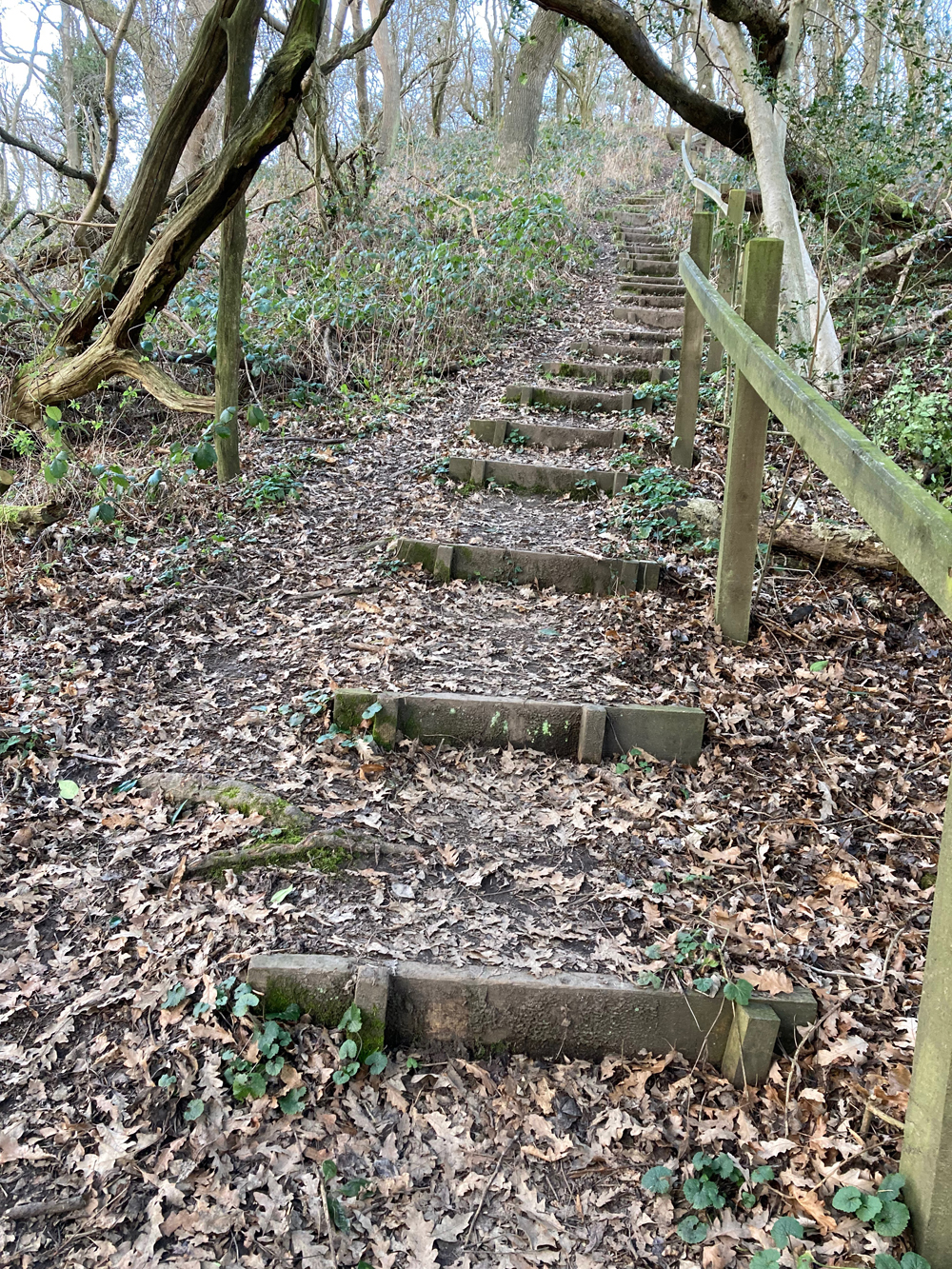
But it would be easier on four legs. The fact that it is a “knoll”, which means low hill or hillock, somehow adds insult to injury. It feels more like a smallish mountain, or at least a steep hill. What’s more, when you make it to the top you are ambushed by the fifty extra steps required once in the wood to get to the very top.

Two legs good

Bipedalism. It seems that thousands of years ago our pelvis shortened, the thighs became longer, the angle of the thigh bone changed to point inwards allowing the knees to come together under our centre of gravity, allowing us to stand for a long period without getting tired. The spine curved into an S-shape helping to support the head and creating balance. Oh, and we lost our body hair.

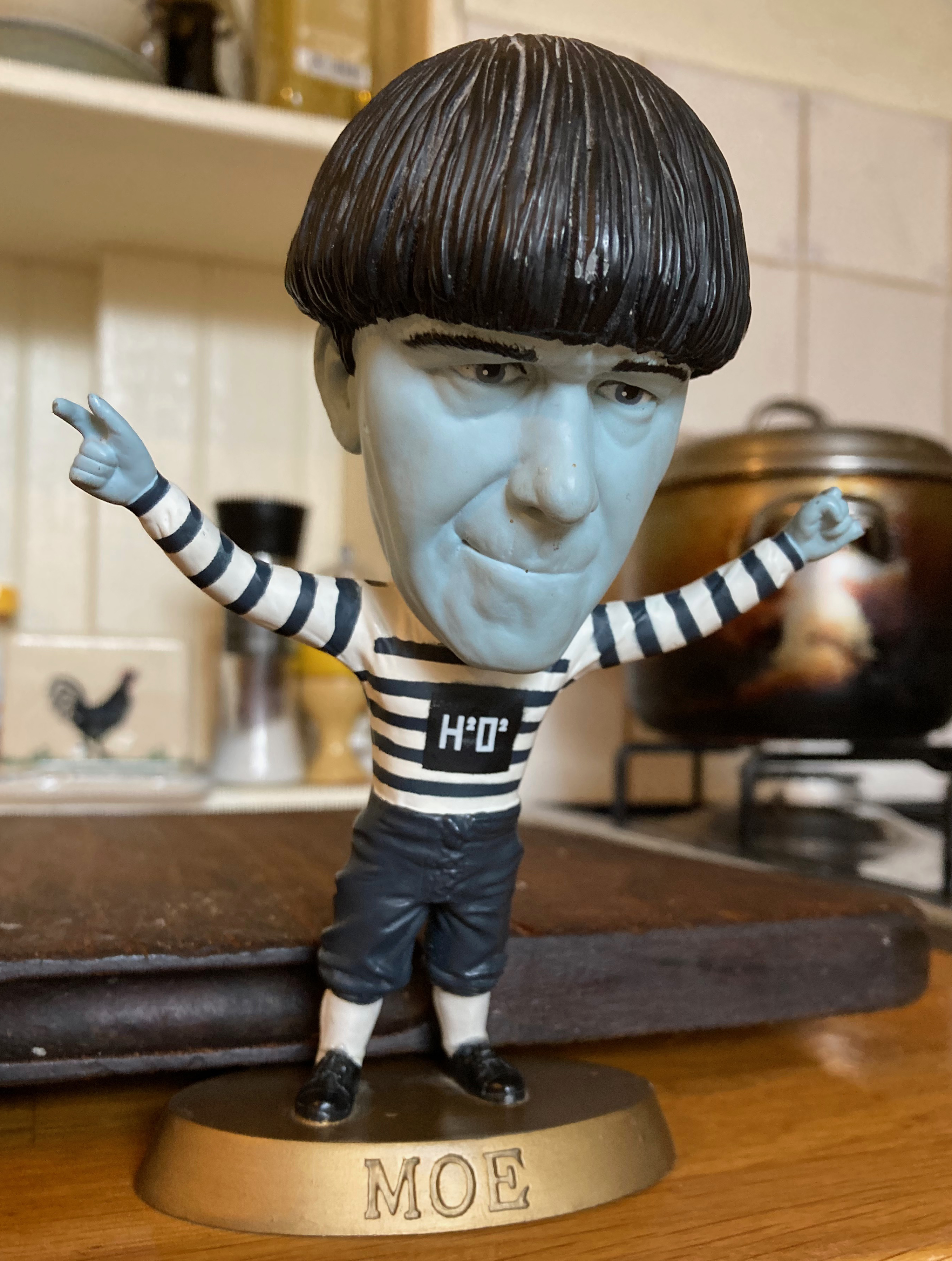
Moe

The disadvantages of standing on two legs?  More pressure put on our spine and on our knees. The vertical position of the spine makes it more prone to back injuries. It’s also much harder on the heart and its vessels to pump blood to the entire body. And the big heavy head our spine has to carry, no wonder we lose our balance and fall when we get older.

Bighead

In the case of Moe, my bedside table mascot, he can only stand upright if his feet are wedged at an angle behind the table, otherwise his head, being too heavy for the design, forces him to collapse. Who is Moe? Those of us of a certain generation may remember Larry, Moe and Curly Joe who had us laughing when we were six or seven. Not sure their vaudeville humour has survived with time, but there is a certain nostalgia seeing them poke each other’s eyes and indulge in slapstick. Click here for The Three Stooges .

Fingers – one of the benefits of bipedalism

On the other hand, walking upright frees the hands for carrying your important tools like your mobile phone, for social display and communication like when you feel the need to welcome or insult somebody, but, most importantly, for making pots out of clay – there’s no doubt that would be difficult on all fours. Having fingers also helps.

Eunice did it

The fragility of the human frame and what it has to put up with (stress, weight, temperatures, balance) leads me, of course, to ceramics. All this was uppermost on the day of the climb to the knoll. It was cold and windy but not yet a storm. That was to come a few days later in the guise of Storm Dudley, very much a milksop of a squall compared with his successor a few days later – Storm Eunice. Presumably the next one will be a male name starting with “F” – Fred, Finnegan, Fernando, Finbar? Well, while writing this, Storm Franklyn blew in and is at the moment playing havoc with the tree in the garden. The news says there’s another on the way, and it’s called Gladys. Dudley, Eunice, Franklyn and Gladys – sounds like a polite tea party at an old people’s home.

Large Block vase


Large Block vase stress fracture

It was Eunice who knocked over a big garden vase, but sometimes it is the potter who is the culprit, as in the case of the large block vase. By not allowing its thick stoneware time to dry slowly and completely, sections of it dried at different times creating stress fractures that only became visible after firing. It is now useless and will be relegated to garden duties.

Big Spring vase

Big Spring vase

Sometimes the fractures are made when the potter is manipulating the clay too much, as when adjusting a handle onto the body of a vase, which is what happened with this Big Spring vase.

Big Spring vase close-up

Still on the subject of bipedalism, cows have four legs, as is well known, but not feet. They have hooves – hard, good for long distances. Good in almost any environment except sharp rocks. Very little maintenance needed. I mention them because Arscott Ceramics will be exhibiting some work at the Palais des Vaches near Southampton opening on 18th March, in collaboration with the Coastal Gallery. More about that in the next blog, but if you are nearby on the day do pencil it in your diary.

Tendril vase at the Palais des Vaches

Why do cows have hooves? Because they lactose.

I wonder if at this rate we’ll get to Storm Zebedia this year? Anyway, keep well and don’t forget to pencil in the Equinox exhibition at the Palais, which is in Hampshire, and as everybody knows, in Hertford, Hereford and Hampshire, hurricanes hardly happen. So you’d be safe from the wind.


December, happy outcomes

wintry

Strange things have been happening at the studio lately. Unexplained disappearances of ceramics, unfamiliar sounds coming from the ceiling, doors being left wide open at night and the kiln not firing on all cylinders. I decided to go for a walk up the hill to Frith Wood to blow away the cobwebs.

Storm Arwen

It was the usual steep climb up to Bradlow Knoll. The view was bathed in a wintry half-light but there was no wind as there had been these last few days with Storms Arwen and Barra which managed to blow a few trees down along the path deep in the wood. Barra (fair-headed) is named by Irish weather forecaster Met Éireann. Arwen is Welsh Celtic for “good”. The next one will be named Corrie, then Dudley, Eunice, Franklin, Gladys, and so on, according to a “name a storm’ project open to the public. What they all have in common is an ability to blow down trees and embarrass the big energy companies.

Fatball Slim

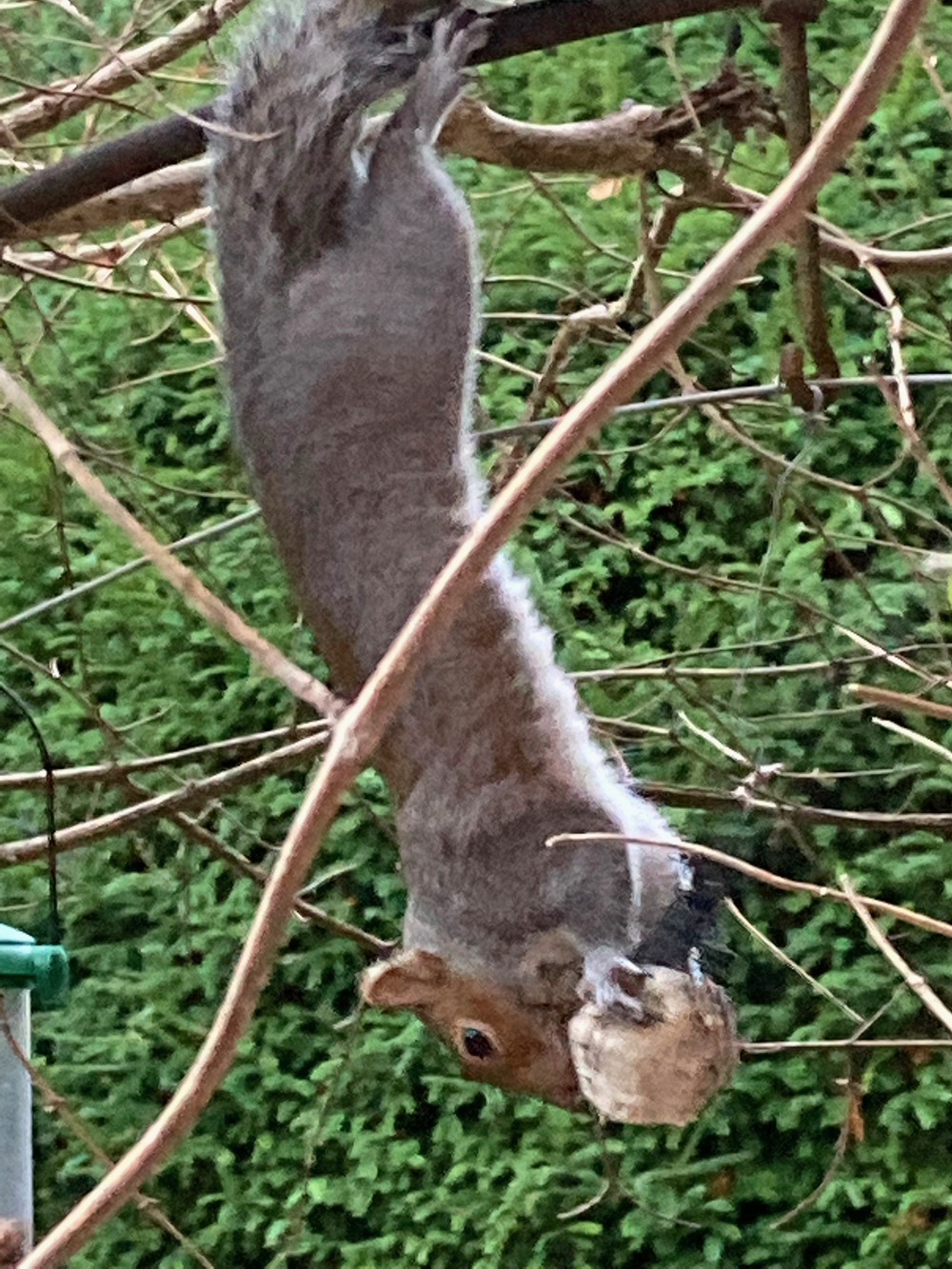
The only noticeable activity in the woods were the squirrels chasing each other up and down trees. One of their cousins lives in our garden and has been caught eating the fatball left out for the bluetits, but here in the Frith they seem to feed mainly on chestnuts. But I was too concerned with the studio to take in the flora and fauna.

I believe that I was so burdened by these thoughts that I went to bed that night and muttered the magical words that all potters do when they seek help; “hydrous aluminium phyllosilicates.” I fell into a deep sleep but awoke when I felt the presence of someone else in the room. It was, of course, St Spyridon, patron saint of potters, former shepherd and Bishop of Trymithous (c. 270 – 348), responsible for marketing at Peter Arscott Ceramics, who you may remember from a previous blog (passim December 2020).

Marketing strategy meeting

I knew it was him from the strange shepherd’s woven straw hat and the smell of sheep.

“This better be good”, he said, “you do realize I’m only for emergencies, don’t you?’

I nodded and told him about my worries. He rolled his eyes in a “seen it all before” way and took a cigarette out of a pouch and lit it, inhaling deeply.

“You don’t mind, do you? I really needed one after what I’ve just been through – a game of poker with Freud, Mohamed Ali and Mother Teresa, and they were fleecing me. Lucky you summoned me.”

Cecilia Colman, London

He blew the smoke up towards the ceiling, and continued:

“All your problems will be sorted by tomorrow. They are of little consequence compared with your pathetic marketing strategy however, which, despite my best advice, I see you have ignored.”

“The blog is still a little text-heavy,” I admitted.

“The more images, the lighter the blog. Vision trumps all senses; the human brain can process entire images in as little as 13 milliseconds.”

Taken aback as ever by the modern approach of this two thousand year-old holy man, I could only shrug and ask:

“So, how are things up in… Heaven, or wherever it you dead go to?”

“Fine, thank you. I’ve joined a club since I last saw you. It’s one for patron saints only, quite exclusive. We meet and swap stories. Why, last time St Blaise was telling us how he became patron saint of those with throat troubles after he cured a child who was choking on a fish bone.”

“Interesting. Anyway, you say the kiln will fire OK tomorrow?”

“Well, you might have to get an electrician for that.”

“Oh, I hoped you’d just snap your fingers and fix it.”

“I’m not a magician, you know, I’m a patron saint.”

“I’m disappointed.”

“I can get St Eligius to recommend one.”

“Who’s he then?”

“St Eligius? He’s the patron saint of electricians.’

“OK. Thank you. By the way, are you coming to the company Christmas party?”

“Er, no, I can’t. I’d be breaking the rules.”

“Covid?”

“No. We can only appear directly to one earthling at a time.’

“Ah,” I said, “but the other two guests will be Thelonious, who is the pottery pugmill, and Ziggy, who is the studio spider in charge of security, so strictly speaking …”

“Sorry, a spider is still an earthling.’

“OK.”

“I must go now. We’re putting on a Christmas panto and there’s a rehearsal.  Socrates will be surprisingly good as Aladdin, you know, and James Dean is playing Wishee Washee and John Wayne is Widow Twankey.”

Before I could ask him what part he was playing, he disappeared.

In the morning I had to face the inevitable accusations from my wife of smoking in bed and allowing sheep into the house, but as I entered the studio, I saw that the squirrel was running along its roof, which explained the unfamiliar sounds coming from the ceiling, and when I turned the handle of the door, I saw the latch was stuck, which explained the door always being open.

lost but now found vase

I went to the shed to get a screwdriver and saw in the shadowy depths along the bottom shelf all the “missing” ceramics that I had stored away and then forgotten during the Covid stockpiling. And when I opened the kiln to see the result of a glaze firing, I saw that everything was back to normal, the clock on my digital radio flashing away telling me that there had been a power cut which had gone unnoticed by me, which is why that previous firing had been a disaster. Good old Spyro – always right, in the end.

Happily just out of the kiln

One of the vases that came out of the kiln has some cheery colours that chime with the seasonal good wishes. By now in a celebratory mood, and in honour of St Spyro, I decided to do some serious research into a cocktail that might do the same.

a St Spyros – save the olive till last

To start with you need a bottle of Mastic Tears, a liqueur made from mastiha trees near Olympoi village, one of the mastic villages, on the island of Chios. It was given to me by my niece’s Greek partner, and I accept that not everyone has a bottle in their cellar. A generous slug in a tumbler, a smaller slug of sugar syrup, ice, some soda, a dash of orange bitters, a sprig of thyme and a black olive. I’m calling it a St Spyros. It’s quite interesting. The olive is particularly good at the end.


Peter Arscott Ceramics wish you all a happy Christmas. And If you live in or near Worcester, London, Chichester, Hove, Lymington or Cambridge and you are looking for that original gift, then why not drop in at the galleries whose names caption the ceramic images scattered throughout this blog?

Thelonious the Pugmill

Ziggy, Head of Security

Cheers. Here’s looking forward to 2022, and hoping it surprises us by bringing pleasure, gladness and delight. After all, the number 22 indicates that your angels have your back and are ready to help you in whatever way they can (apparently it is an “Angel Number”).

kalá Christoúgenna


Welsh jaunt

the glass-like mouth of the Ogwen

I believe fish are craftier than their glass-eyed gaze seems to indicate. Fly fishing is the art of luring a fish onto the hook by making it believe it is a true fly dancing on the surface of the water when in fact you, the fisherman, are the puppet master in control. But this never happened during our week-long stay in Penrhyn on the Menai Strait near the mouth of the Ogwen River. Even during the optimum time when the sea trout fed as the tide rose and entered the river, not one bite was had.

hope over experience

Fish are cleverer than they appear. Fish hold records for the relative brain weights of vertebrates, and most vertebrates have similar brain-to-body mass ratios – except for the bony-eared assfish which has the smallest ratio of all known vertebrates (I’m not kidding, this is its true name and it has endured eons of Piscean teasing as a result). Yes, fish know all about deception, distraction display, false courtship behaviour, death feigning, numeracy (look up the mosquitofish), play, food stocking and fisherman taunting.

the unfortunate assfish

We could see them jumping down river, or if we went down river, we’d see them upriver. At one point a large sea trout jumped right out in front of us, ignoring the lure, checked us out and decided we were harmless enough. We had better luck at the Bangor Seafood Co.

the cool Ogwen

fowl mocking

All unsuccessful fishing activity was witnessed by the many swans which live in the tidal sea by the mouth of the Ogwen. They are joined in the evenings by gulls and other sea birds and together create a chorus of plaintive sounds which are very melancholic but could be interpreted as the local wildlife jeering.

Ceramically, the whole experience is well summed up by the wavy green vase: lots of water but no fish, and the colours reflect those in the landscape, as in the image below.

But back to the Penrhyn area – it had been owned by the Pennant family until death duties forced them to hand over the 40,000 acre estate to the National Trust in the 1950s. The family had owned Jamaican sugar plantations since the middle of the seventeenth century, becoming established as merchants in Liverpool and London, while benefitting from the hundreds of enslaved African people working for them.

bust of Richard Pennant

Richard Pennant (1737–1808), MP for Liverpool, invested the Jamaican profits in his agricultural estates and set up the Penrhyn Slate Quarry and built Port Penrhyn. He also built roads, railways, schools, hotels, workers’ houses, churches and farms, but still campaigned against the abolition of slavery. When slavery was finally abolished, the family received £14,683 compensation for 764 enslaved people on their Jamaican estates.

The real Pennant with his dog Crab, by Henry Thomson

The Penrhyn quarry was the world’s largest slate quarry in the nineteenth century, its main pit being 1 mile long and worked by 300 quarrymen, who went on strike over pay in 1900. There was a massive gap between the wealth of Lord Penrhyn, living in his splendid castle, and the poverty of his workers, who lived in local quarrying communities. The strike lasted 3 years, the biggest in union history, until many returned to work out of hunger; but production was soon overtaken by foreign quarries and the decline set in.

the beach

Nowadays it is home to the fastest zip line in the world, Velocity 2, where you can fly 500m above the bright blue quarry lake, blue because of the dissolved natural minerals – copper sulphate. Other activities undertaken included a visit to a butterfly house on Anglesey where we met a chameleon.

Kevin

And slate lies everywhere in Penrhyn – great slabs on the shore of the straits when the tide is out or washed over by the cool river water of the Ogwen, or used as fencing in fields, or just highlighting the green of the landscape with its dark presence.

groyne

On the tidal beach at Penrhyn the remains of old timber palisades or groynes still stick out of the sand. These groynes were constructed more or less perpendicular to the shoreline to restrict the movement of sediment along the shore but have long ago rotted away and now look like the ribs of some monster.

the path down from Bradlow Knoll

The familiar landscape back in Ledbury was a contrast, with all the varieties of green on display, and trees and meadows at their summer’s peak. Climbing up to CJ’s bench was a slog after the excesses of our Welsh break, but the view was rewarding, as ever, and a remider of how varied the landscapes of this island are.

the eight bells

Another view that required a hard slog up hundreds of steps was a visit to the top of St Michael’s tower in Ledbury, only recently opened to the public after a successful fundraising campaign to repair the eight bells and reinforce the structure.

looking up at the tip of the spire from the bells platform

looking up at the tip of the spire from the bells platform

Ledburians who read this blog, I climbed those steps so that you do not have to, but if you still feel compelled to do so yourselves, then I recommend it, not least for the view you get of the town from the parapet around the base of the spire.

Ledbury from the tower of St Michael’s

Lastly, if you fancy reading another short story of mine, this one was published by Fairlight  Books. Fairlight make all of the stories on their website freely available to readers, their aim is to fight the corner for the short story as a form of literature which is often hidden behind paywalls, and to promote and support the writing of these authors. Just click here.


Hwyl fawr

Rutile

St John’s Wort in rutile vase

Last July I was going on about the names of all the different plants that grow wild in Frith Wood, as well as discussing the benefits of geophagia for some reason (the eating of mud or clay). I also think worms came into it, somehow. Click here if you want to revisit.


meadowsweet

This July, however, I would like to introduce you to Filipendula ulmaria, or meadowsweet. It could be because it was used in the Middle Ages as a sweetener for mead that it gets its name, but take a whiff and it might remind you of something familiar. Its chemical constituents include salicin, which was synthetically altered because it causes less digestive upset than pure salicylic acid used in drugs, and thus aspirin was created. It was Bayer that named it aspirin after meadowsweet’s old botanical name: Spiraea ulmaria.  It does have a whiff of aspirin.

meadowsweet

There is a lot of it now  flourishing on the sides of the roads all over Herefordshire: fluffy, slightly floppy, pale cream bundles framed by the hedges they grow by. I confess that the real reason I mention meadowsweet is to promote the Ledbury Poetry Festival and Edward Thomas’ poem, Adlestrop:


Yes. I remember Adlestrop—

The name, because one afternoon

Of heat the express-train drew up there

Unwontedly. It was late June.

The steam hissed. Someone cleared his throat.

No one left and no one came

On the bare platform. What I saw

Was Adlestrop—only the name

And willows, willow-herb, and grass,

And meadowsweet, and haycocks dry,

No whit less still and lonely fair

Than the high cloudlets in the sky.

And for that minute a blackbird sang

Close by, and round him, mistier,

Farther and farther, all the birds

Of Oxfordshire and Gloucestershire.

The Barrett Browning Institute

The Festival this year is mostly online, though there are some great events held in Ledbury itself over the weekend of 9 – 11 July. Click here for all the available events (online and non-online). The Festival is on until 11th July. The Barrett Browning Institute in the town centre  is the Festival’s headquarters, and if you go in you will find Sally Crabtree.

Sally Crabtree

Her latest installation is a sweetshop of conceptual confectionery which offers each member of the public a small gold coin which they can spend on just one thing at the counter and it explores the notion of choice in our lives-“Choose well. Your choice is brief, and yet endless” as Goethe says. It has the feel of a fairground stall with the excitement that each person goes away with a ‘prize’ so to speak. Of more value perhaps however is that each sweet that they choose comes with its own quirky, philosophical inner layer of meaning which they unwrap, depending on what they choose.

Festival A board

And for children… they can fill a jamboree bag with their own creations inspired by the Sweetshop of Words –  including lyrical lollipops, glass sweets and pop a pop a poem balloons!

stonewarew rutile signal vase

As I said in the last blog, the difference between poetry and pottery is only a “t”, and some new pieces have emerged out of the kiln which, if not poetic, are at least expressive.

Wavy rutile vase

The latest batch of ceramics has seen the rise of an ingredient called rutile.   Rutile is a glaze additive that produces colours ranging from light and dark blue, to tan, gold, yellow, and even purple.  It has a mind of its own, depending on the glaze base and the firing conditions and, because it is a mined colorant, its makeup also depends on the mine source. Many potters test their batches of rutile before committing to a full bucket of glaze – all the result of the mineral’s notorious inconsistency. But when it works, it produces many crystalline, speckling, streaking, and mottling effects in glazes during cooling in the kiln and thus it is highly prized by potters.

Wavy rutile vase verso

Of course, here at Peter Arscott Ceramics, and following in the contrarian, or maybe heedless, tradition, rutile is not used in this way at all but rather mixed as a powder with water and a viscous agent to produce a colourant that can be applied like paint to the bisque surface of the piece, and then dipped in a transparent glaze. In other words, it is not used as a glaze but as a colour that gives the object’s surface an effect halfway between wood and honey. See for yourselves.

rutile close-up

By the way, Brits pronounce it “root ill” and Americans say “root isle”, which I prefer. On the other hand, and digressing wildly, why do Americans say “rowt” when they want to say “route”? Answers please. And since we are on the subject, why do they pronounce “rubbish” as “garbage” and “chips” as “french fries”? I am sure that at least one of the three American readers of this blog will tell me in no uncertain terms.

my friend Edith

I got know a resident sparrow, called Edith, busy looking for anything to feed its chicks in their nest in the roof’s gutter. Luckily they were not flooded out, and I felt so sorry for her that I bought a  bag of mealy worms. She didn’t want to land on my outstretched hand but was OK on the table, where she would occasionally forget herself and leave a calling card. The fledglings have now flown, and she has lost all interest in visiting.  Spurned by a sparrow.

Goodbye, May

rain clouds over Ledbury

When I went for a long walk up to Bradlow Knoll and beyond, the day had decided to let rip and unload all of its stored water down onto Frith Wood and onto the lone walker struggling along its already slimy paths. It meant that all one’s concentration was on not slipping, rather than on looking around at the flora and fauna, so these images were taken towards the end of the trudge, when the clouds parted, and the path was level.

bluebells

It turns out that on Friday 21 May , the UK experienced 91% of its expected rainfall for the entire month, with approximately 63.5mm having already fallen. The wettest May on record was in 1967, when 131.7mm of rain fell across the month.

buttercup

It is not the first time the UK has experienced unusual weather this year. April was the frostiest on record, with an average of 13 days of air frosts reported for the UK, topping the 11 days seen in April 1970. Last year, the UK experienced its sunniest spring and driest May since records began with 626 hours of bright sunshine recorded for the UK, exceeding the previous high (555 hours, set in 1948) by more than 70 hours.

bumblebee and bugle

As May transitions into June, we can only hope for dry sunny weather, though the British are, by and large, wary of getting carried away, and will have nurtured low expectations in order not to let disappointment overwhelm them. Is this why, when we go abroad to guaranteed sunshine, and we know we needn’t harbour any circumspection, we allow our inner buoyancy to bubble up and take over? This would explain the uncontrolled alcohol intake, the flippant balcony jumping, the skin-flaking sunburns, the nudity and cross-dressing, the dread of going back home.

The weather and the Brits. What would we talk about without it? It helps us overcome our social inhibitions, but there are rules when conducting these weather-related conversations. Firstly, the topic will almost always be introduced as a form of question and the person answering must agree, otherwise it is quite a serious breach of etiquette. Go on, try it out next time someone says “Cold, isn’t it?” and you say “No.”

dandelion don’t tell no lies. Click here

As for pottery, weather plays a part too. When freshly-made pieces are drying, the dry part will pull on the wet and crack the pottery prior to firing. The best way to avoid this is to dry everything in the shade, but since a humid or wet climate ensures that the pottery will retain its moisture, even after a week, it is best to give the pottery an extra week or even two – the longer the better.

slow dry

And to make sure it dries evenly during the first few days, a plastic bag over each piece is a good idea, otherwise you find parts that are attached to the main body dry too fast and hairline fractures only become bigger visible cracks after the final firing.  This can be deeply disheartening when you’ve put all your energy into one vase in particular, only to discover the fracture after the final hurdle. I’m sure it explains why so many potters turn to drink.

more bluebells

Going back 107 years to June 1914, I see that the month was cool and unsettled, alternating with dry, warm and sunny conditions. On the 8th the maximum temperature was only 13.4°C., and a severe thunderstorm, with hail, produced over 33mm of rain on the 14th. There were many dry and fairly sunny days during the second half of June, and during the last few days of the month it became increasingly warm, and eventually hot. On the 30th, it was sunny all day and the afternoon temperature reached 29°C.

Edward Thomas photo by Frederick Evans

I mention this because this was precisely the weather the poet Edward Thomas was remembering when he wrote “The sun used to shine”. It was the summer he and Robert Frost spent together in the Ledbury area, one of the great literary friendships which ended with Thomas’s death at Arras in 1917. I like to think they took the same paths along the Frith wood, as many of us here still do – they were great walkers. Despite my best research, they do not seem to have any particular interest in ceramics, even though the only difference between poetry and pottery is a “t”.

“Frost’s footfall” is an essay I have written about the two for The Common, a literary organisation based at Amherst College that publishes writing that embodies particular times and places, and where Robert Frost taught for forty years. Click here to read it.


The Ledbury Poetry Festival has been going for 25 years, and this July (2 – 11) will be offering us digital encounters with poets such as Margaret Atwood, Jorie Graham, Andrew McMillan, Jackie Kay, Fred D’Aguiar, Billy Collins, Fiona Sampson, as well as Mexican, Zimbabwean, Chinese, Slovakian and Belarusian voices, and puppetry, a poetry sweet shop, bingo, an interactive digital poetry trail…. Click here for more details.

betony – the stateliest of small flowers


The sun used to shine while we two walked

Slowly together, paused and started

Again, and sometimes mused, sometimes talked

As either pleased, and cheerfully parted


Each night. We never disagreed

Which gate to rest on. The to be

And the late past we gave small heed.

We turned from men or poetry


To rumours of the war remote

Only till both stood disinclined

For aught but the yellow flavorous coat

Of an apple wasps had undermined;


Or a sentry of dark betonies,

The stateliest of small flowers on earth,

At the forest verge; or crocuses

Pale purple as if they had their birth


In sunless Hades fields. The war

Came back to mind with the moonrise

Which soldiers in the east afar

Beheld then. Nevertheless, our eyes


Could as well imagine the Crusades

Or Caesar’s battles. Everything

To faintness like those rumours fade—

Like the brook’s water glittering


Under the moonlight—like those walks

Now—like us two that took them, and

The fallen apples, all the talks

And silence—like memory’s sand


When the tide covers it late or soon,

And other men through other flowers

In those fields under the same moon

Go talking and have easy hours.


moonpot