ceramic mural

weekend openings, many visitors

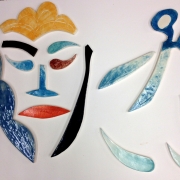
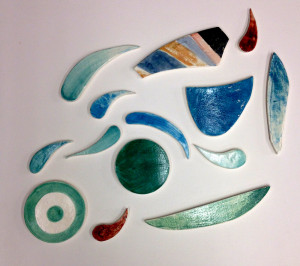
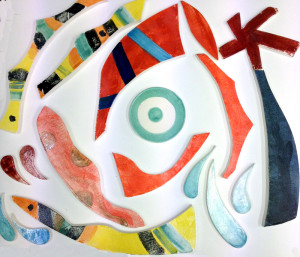
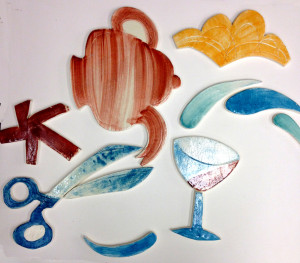
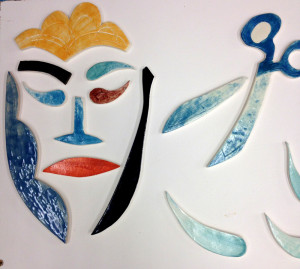
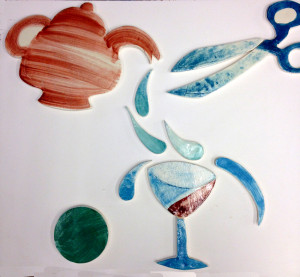
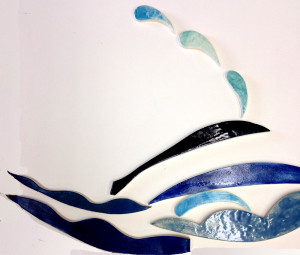
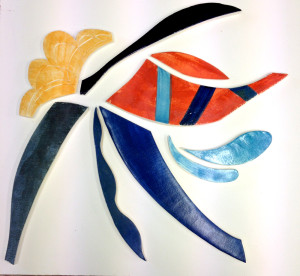
A big thank you to all our visitors who dropped by these last two weekends – it is always good to see new faces as well as the regular ones. Many of you took part in our “mini mural” competition which used an assortment of glazed ceramic pieces to very individual effect. And do they say something about the individual, we wonder?  And here are the best ones (as judged by Thelonius):

Hmmm. Very difficult to choose a winner. Turquoise (or anything with blues and greens) is a favourite of the judge’s (who is given to pondering about life), and he says it denotes  an ability to create emotional balance in your life, to express your hopes and dreams no matter how idealistic they may be and to make your own way in the world under your own terms, so he is awarding  a prize each to Alicia and to Lily.


another close-up of mural

Muralista

complete head-on view of mural

Adaptable as ever, belatrova, as well as designing and making handmade ceramic birdbaths, lamps, bowls and tables, has developed another skill that uses clay to great effect – we also make ceramic murals. A mural, from the Latin murus meaning wall, is any piece of artwork applied directly on a wall, ceiling or other large permanent surface.
view of ceramic mural lo<a href=

This particular mural uses the idea of “juggling” as its departure point; the house in Spain for which it was commissioned is named after an area of southern India, and it is a word that in Spanish is associated with jugglers and juggling. A happy convergence of imagery to get the ball rolling, and which can be seen in the final design with the still central figure at the bottom from which two circular movements flow, one counter clockwise, the other clockwise, co
ntaining the various elements and shapes which are being “juggled” – all presided over by the sun at the very top. Some of the shapes are purely abstract to accentuate the flowing lines, other more recognizable things are there because they are right (even if ultimately inexplicable to most people- cacti, skulls, vases and jugs, ashtrays?).

another close-up of mural


ceramic cactus

The rectangle of space within which the piece was designed measures 2300mm x 3126mm, and each piece is made from grogged stoneware, a clay that contains tiny fragments of molochite to strengthen the material when it has to be shaped and cut, slab rolled and then biscuited to 1000°, after which, as a lot of you may remember from previous blogs, the surfaces are painted with oxides and stains, dipped in a transparent glaze and then fired to 1275° in the belatrova kiln.

view of ceramic mural from ground floor
The challenge was always to produce shapes that stayed flat and did not crack, and there were five “skulls” made before the sixth and final one that you see in the images. Here is a picture of skull No 4, already biscuited, with a fine crack going from eye to jaw. It makes quite a good cheese board, specially when you need to hurry guests away from the table.

close-up of cracked ceramic piece

ceramic skull as cheese board

We were very pleased with the way the two flying legs turned out, considering their awkward shape and length. The belatrova team member who modeled for them wishes to remain anonymous, but we think he has a future with Tommy Hilfiger or Adidas.

ceramic legs in mural

The other challenge facing belatrova was the height of the scaffolding, about three metres off the ground, but, thankfully, any vertigo was kept at bay by our perfect hosts who supplied belatrova with a steady source of cold Spanish beer sothat in the end any lingering acrophobia was gently dispelled.

scaffolding

The first step upon arrival was to measure out the rectangle above the doorway in the hall and then to stick templates of the ceramic pieces (which had previously been cut out in card) onto the wall. When, after a great deal of tweaking, the templates were all blue-tacked in their place, a pencil mark was drawn around the contours and the card templates removed to allow the actual ceramic shapes to be bonded to the wall in their correct positions.

carboard templates of ceramic shapes for mural

Murals do vary from simple tiled works to huge installations by contemporary ceramic artists; depending on context, they can enhance large or small spaces, but belatrova thinks ceramic murals are the perfect solution for those who enjoy sculpture but have no space, or for those who have a large space that needs to resonate more with its surroundings. Murals fulfill the same function as a picture while often being much more dynamic and three-dimensional.

stylized ceramic skull

The technique of slab-rolling and shaping, which was used for this mural, is one also applied to most of belatrova’s production, and if any of you have not already seen our video showing how it is done, please click here.

Lastly, please remember that we have two pre-Christmas Open Weekends: 28 and 29 November, and 6 and 7 December, when we will be open from 10am to 5pm. Do drop in.

belatrova’s Tales of the Alhambra

view of Granada from Sacromonte hill

Granada and the Alhambra from the Sacromonte

belatrova has often been drawn to Granada (blog August 2014) in the foothills of the Sierra Nevada, and specially to the Alhambra, the great sprawling hilltop fortress encompassing royal palaces from the Nasrid dynasty, as well as the fountains and orchards of the Generalife gardens.

looking down from the Alcazar

view of the city from the fortress

It first became a palace in the 14th century under Yusuf 1, Sultan of Granada, in the years when southern Spain was in the hands of various Moorish dynasties. It is a spellbinding place, all ceramic tiles, wood and plaster – Islamic art at its peak.

view of Granada through Alhambra Palace window

cool inside, hot out

It stands on its hill overlooking the city and from the cool darkened interiors you can see Granada below, through ornate lattice windows, sweltering in the white light of day. It is an indoor coolness reinforced by the tile work along its walls, the lightness of the intricate plaster ceilings, the presence of water in the courtyards and the calm the architecture seems to bestow on its surroundings.

slender pillars of Alhambra

tree-like

Part of its magic is the way you are constantly made aware of nature, specifically of light and water, no matter where you are standing within the palace; either because you are catching glimpses of the exterior, the patios, the views, the distant trees, the reflecting pools, or because your eyes are absorbing the gentle reflections from the chest-high ceramic surround and the extraordinary organic plasterwork of the domed ceilings and the tree-like colonnades of random columns (they are not, of course, they artfully appear to be scattered).

[one_half]

plasterwork of dome ceiling at the Alhambra

intricate and sublime

[/one_half]

[one_half_last]

more plasterwork in the Alhambra

delicate and voluptious

[/one_half_last]

The adjacent Generalife gardens also manage to maintain this fine balance of nature and architecture; no matter that you are outdoors, trees and hedges enclose you, lines of slender pillars appear and lead you into the welcoming shade of a domed space filled with mosaics. Birdsong and the sound of trickling water are all around you, and from certain vantage points, distant views of the Sierra Nevada, still snow capped, remind you of Washington Irving’s Tales of the Alhambra and the story of how muleteers used to bring ice down to the city in great blocks.

[one_half]

view of Sierra Nevada

distant snow-capped Sierra Nevada

[/one_half]

[one_half_last]

pool in Generalife gardens

toe-dipping allure of the Generalife

[/one_half_last]

Water is an essential ingredient in this manmade landscape, an important factor in the life of a culture shaped in the desserts of North Africa and so its presence is everywhere, even flowing in the stone balustrade that leads down a flight of steps to the gardens, and which allows a descending courtier or Sultan to dip his fingers in it.

[one_fourth]

stone balustrade with water running down the middle

finger-dipping stone balustrade

[/one_fourth]

[one_fourth]

ceramic toiles and plasterwork on wall of the Alhambra

ceramic and plaster

[/one_fourth]

[one_fourth]

intricate plasterwork

laberynthine plasterwork

[/one_fourth]

[one_fourth_last]

tiles on wall at the Alhambra

tiled wall

[/one_fourth_last]

Granada itself is a wonderful blend of medieval streets winding up to the Albaicín, gothic and baroque churches, a commanding cathedral, noisy squares filled with cafes and restaurants, fabulous ice cream parlours, incredibly helpful taxi drivers, shops brimming with blue and white ceramics, and one bar in particular that serves ice cold beer in freezing earthenware vessels (an idea germinating in belatrova’s collective mind – could this be applied to a Dry Martini?).

[one_third]

cold beer in earthenware mug

ice cold in Granada

[/one_third]

[one_third]

close-up of magnolia flower in Generalife

magnolia

[/one_third]

[one_third_last]

sandalled foot resting on table

belatrova resting

[/one_third_last]

The visit coincided with Granada’s Corpus Christi festival – a five day period of celebrations and religious processions. In the Plaza Bib Rambla families roamed around the square sipping drinks and watching a puppet show with their children, their young daughters dressed head to toe in their flamenco outfits.

[one_half]

fountain of the courtyard of the lions

the courtyard of the lions

[/one_half]

[one_half_last]

passion flower

passion flower in the Albaicín

[/one_half_last]

It was an inspirational visit, and made us want to get back to our ceramics, our birdbaths, but mostly to our tiled tables which we will be launching as part of the Bankside Studios Summer Open Weekend on Saturday 11th and Sunday 12th July. Please pay us a visit, and you will also get to see the work of six other makers. Hasta la vista.

open studio

Art Nouveau, hospital hygiene and ceramic spotlessness

Sant Pau hospital

hospital corridor or ceramic glory

It was not because of excessive drinking and dining that belatrova paid a visit to a hospital only a few blocks from Gaudi’s famous Sagrada Familia cathedral, but as a result of our unquenchable thirst for cultural knowledge and beauty. It is yet another surprise on offer in the city of Barcelona that a masterpiece of Catalan Art Nouveau, built between 1902 and 1930, happens to have played a significant part in the evolution of medicine as well becoming a World Heritage Site.

[one_third]

ceiling at Sant Pau

ribbed ceramic ceiling

[/one_third]
[one_third]

ceramic ceiling with green motifs

looking up from the patient’s trolley

[/one_third]
[one_third_last]

lobby entrance at Sant Pau

main lobby entrance

[/one_third_last]

The Hospital de la Santa Creu i Sant Pau was founded in 1401 with the merging of six hospitals. Santa Creu, the Hospital of the Holy Cross, was right in the centre of the city but by the late nineteenth century, due to the rapid growth of Barcelona’s population and rapid advances in medicine, it became too small and thanks to the bequest of the Catalan banker Pau Gil, the first stone of the new hospital, designed by Lluís Domènech i Montaner, was laid on 15 January 1902. In 2009 it moved to new premises built in the north-east of the precinct and the Art Nouveau site was reopened to the public, after refurbishment, in 2014.

ceramic roofs at Sant Pau

ceramic roofs of pavilion at Sant Pau

This city within a city contains twenty seven pavilions, each one assigned a specific medical speciality and linked to the others by means of underground galleries and tunnels. Muntaner assigned an area of 145 m to each patient, including the landscaped grounds.

ceramic motif on wall

restful motif

What grabbed belatrova’s attention was the care taken in choosing the materials in order to create the best natural surroundings for the patients, primarily ceramics with which to clad domes, roofs, ventilation shafts, the decorative pieces and walls inside and outside the pavilions. Inside, the ceramics serve a hygienic purpose, tiles make disinfection easier, and also function as a therapeutic element. The colours of the many motifs used in the panels and mosaics combine harmoniously and convey a feeling of quiet tranquillity.

ceramic tunnel link to pavilions

ceramic-clad tunnel link

Thanks also to the extremely high thermal stability of ceramics, which belatrovians know can be fired at a temperature of approximately 1280°C, this results in extremely solid products; and the hygienically smooth surface glaze is wear and scratch-resistant and is thus resilient to the abrasive cleaning agents that are frequently used in the sanitary facilities of public areas. Even concentrated hydrochloric acid fails to leave a mark on ceramic, but please do not try that at home.

[one_third]

orange tree in Sant Pau

the garden in Sant Pau

[/one_third]
[one_third]

view of the Sagrada Familia

Sagrada Familia from Sant Pau

[/one_third]
[one_third_last]

main entrance to hospital

clock tower and facade

[/one_third_last]

Ceramic is even resistant to extreme temperatures, both hot and cold, which is why we at belatrova use it for our birdbaths so that, combined with a resilient oak plinth, they can withstand British winters or Mediterranean summers.

belatrova birdbath

resilient but beautiful

Resistant to extreme temperatures, water resistant, easy to keep clean, colourful, ceramic tiles are perfect for outdoor tables.

tiled tabletop

detail of belatrova outdoor tiled table.

To reinforce our message that belatrova products are safe, hygienic, tough and practical here is a picture of a large coiled platter with some gilt headed bream about to be prepared for belatrova’s signature dish: “Besugo al horno con patatas. Click on the left and you will be taken to a video recipe – and you can practice your Spanish at the same time.

Hasta Luego.

fish on platter

bream

three legs good

ceramic three legged bowl

belatrova’s Manhattan three legged bowl

An early morning run or walk can be a way to set oneself up for the day – you are out there with the dawn chorus, a hint of Spring in the air, plans assembling themselves in your mind for the day ahead, perhaps a squirrel just out of hibernation crosses your path, you breathe in the clean air of a new day, and then, an unfamiliar experience, the earth beneath your feet is right in front of your face, greeting you painfully on the nose. You have fallen over. Looking around to make sure nobody has witnessed your collapse, you pick yourself up and limp home with whatever dignity you can muster.

cartoon of legs slipping

bipedalism

Human walking is a unique activity during which the body, step by step, teeters on the edge of catastrophe.” —paleoanthropologist John Napier

Just how do we two-legged creatures manage to stay upright while in motion, or even when standing still? How can we possibly keep our balance on those flippers we call feet? Come to think of it, we are rather top heavy too, so why are we not keeling over all the time? Apparently it is all to do with voluntary and reflexive, neural, muscular, and skeletal systems collectively coordinating so as to allow us to walk without a second thought. But we shall not go into that; we simply bring it up because it leads us to an important belatrovian issue that we propose to resolve here and now.

cow

quadrupedal thing

Within the tightly knit belatrova team, harmony always prevails. No matter what the weather outside, or the music being played, or the occasional badly made cup of coffee, we all beaver away happily and get along. Tea breaks are relaxing opportunities for discussions on topics that range from underwater basket weaving to why on earth men have nipples, from the benefits of taxation in a functioning society to the lingering suspicion that chocolate may actually not be bad for one. Important subjects for debate, we agree.

However, there is one issue that consistently divides the team into two camps: the tripedalists and the quadrupedalists. Dear belatrovians, are three legs better than four? With the spirit of conflict resolution guiding us towards a hoped-for conclusion, research was undertaken and the results are the following:

Try this at home. With your hand slightly cupped, point your thumb, index finger, and middle finger upwards and then place a flat piece of card or paper on top of them. The card will lie on all three points. Now stick a fourth finger into this experiment (perhaps somebody else’s) to add another contact point. It is now a little harder to exactly fit the paper on the plane.

Conclusion – the triangle formed by the three fingertips is stable because no matter where any of the three points of the triangle lie, they will always define a plane. So, a three-legged stool is guaranteed not to wobble, because the ends of its legs always form a plane. Thus a camera tripod; no matter which height each leg is, you will get no wobble. Even on an uneven floor.

It’s much more challenging to make a four legged table whose fourth point of contact is in the same plane as the first three points. Any point that is added to that plane will make it harder for the plane to be stable. On some uneven floors it may be quite impossible for a four legged table to be stable if it gets moved about. Five or six legs would be even worse.

table

a perfectly balanced four legged table by belatrova

Quadrupedalistas, graciously accepting this explanation (despite some sarcastic mutterings about making three legged tables, birdbaths and lamps), have come around to the wisdom and logic of belatrova’s decision to make three legged bowls. Place one on any surface and your olives, peanuts or cheese puffs will not roll off due to wobble. What is more, the bowls carry a certain elegance that is a touch retro – 1950s perhaps?

ceramic three legged bowl

three legged bowl

And talking of retro, MoseyHome are a new London outlet, and they are showing belatrova’s three legged bowls. Pay them a visit if you are in the area. You can also visit our “three legged” Pinterest board.

three legged bowl

stability on legs

As for our monopods, our beautiful birdbaths, lamps and slab pots, they will be appearing in the next few months in Country Living and Garden Illustrated.

With only a month to go, we would like to remind you that we are opening the workshop to the public on the weekend of 25th and 26th April. You are most welcome to visit, and try your hand at making a tripedal bowl. We’ll be there with five other makers for this Open Spring Weekend:

Spring Open Sudios

Spring Open Studios


Here comes the Sun

That huge ball of incandescent plasma at the centre of our solar system that provides all the energy we need for life here on Earth – in the depths of winter, on cold and overcast days, we miss seeing the old sun shining down on us, stimulating our pineal gland deep in the brain, and generally making us feel good. So let’s hear it for big Helios (you could fit 1.3 million planets the size of Earth into the Sun, apparently) and think ahead to Spring and Summer in a practical way – just as everything in the solar system orbits around the Sun, so do belatrova’s ideas revolve around our clientele’s happiness.

image of cross section of brain showing Pineal brain

cross section of belatrova’s brain on a Friday evening showing Pineal gland.

As the days get longer and the promise of heat starts to become a reality it is easier to imagine yourself on your balcony, or terrace, or veranda, or in your garden, glass in hand, as you soak in the rays and relax. What will enhance this experience is something that is associated with warm Mediterranean cultures, something pleasing to the eye and to the touch, something we have seen in palaces, gardens and fountains. Imagine the heat of Cordoba, then imagine stepping into the shade of its courtyards and passing your fingers over the cool surface of the tiles that adorn the inner walls. We would like you to enjoy our tiles in the same way, except that we have incorporated them into a new range of tables that can be used both indoors and out. There is no better surface on which to put that cold gin and tonic, that cup of coffee or that glass of lemon juice.

close-up of tiles

cool belatrova tiles

The advantages of tiles? Well, they are scratch, fire and stain resistant, they will not fade in the sunlight, they are waterproof and easy to clean, and, for the tabletop dancers amongst you, slip resistant. The metal frame and legs make them sturdy enough to support the weight of, say, a large goat. The tiles are grouted and held in place on marine plywood, which, of course, is waterproof.

tiled tabletop

tiled tabletop with metal frame and legs


So if you find yourself oversleeping, gaining weight, craving sweets and starchy foods, lacking in energy and irritable, it could be the beginnings of Seasonal Affective Disorder. However, remember that Spring is around the corner and that belatrova is always here to help. Many of you are gardeners and will be thinking of what needs planting and doing, and being bird lovers (having no doubt fed them throughout Winter) you will be wondering about the springtime needs of our little feathered friends: a good bath, we say. And we do make beautiful birdbaths, a wonderful combination of ceramic and oak. The picture below shows you how the oak turns after four full seasons exposed to the elements.

birdbath in garden

a year ago

ceramic birdbath on oak plinth

one year on


Here is a picture of some snowdrops taken in belatrova’s garden, just to emphasize that Spring is nor far away. Don’t forget to visit our website www.peterarscott.co.uk/dev and if you are on Pinterest have a look at our boards:  https://www.pinterest.com/belatrova/

Give us a ring if you want to drop in: +44 (0) 1531 634082

snowdrops

snowdrops

To a snowdrop (William Wordsworth)

         LONE Flower, hemmed in with snows and white as they

         But hardier far, once more I see thee bend

         Thy forehead, as if fearful to offend,

         Like an unbidden guest. Though day by day,

         Storms, sallying from the mountain-tops, waylay

         The rising sun, and on the plains descend;

         Yet art thou welcome, welcome as a friend

         Whose zeal outruns his promise! Blue-eyed May

         Shall soon behold this border thickly set

         With bright jonquils, their odours lavishing

         On the soft west-wind and his frolic peers;

         Nor will I then thy modest grace forget,

         Chaste Snowdrop, venturous harbinger of Spring,

          And pensive monitor of fleeting years!

belatrova Christmas opening times

brick viaduct in Ledbury

Ledbury viaduct

belatrovians may well want to know what the Ledbury viaduct has in common with our Christmas opening, and the answer is: clay.

Built in 1860, the viaduct was constructed using 5 million bricks made on site from the clay dug out for the foundations; and clay is what brings together a cluster of Ledbury ceramicists.

Wendy Houghton’s delicate abstract sculpture can be seen next to husband Stuart Houghton’s robust hand-thrown tableware, Fleen Doran’s alluring salt-glazed pots next to belatrova’s beautifuly painted slab pots and lamps. It is an exhibition of contrast and style, as well as a chance to buy a unique Christmas gift.

picture of four ceramicists

meet the ceramicists…


Yes, four ceramicists in one venue, and the ideal Christmas present.

Look out for the red h Art signs. Parking is available, as is disabled access.

Tea, coffee and mince pies will be served.

We look forward to seeing you.


Tegestology

ceramic coaster with blue oxide

moon coaster

Coasters, specially ceramic coasters, have become desirable designer acquisitions in recent months, partly in response to the growth in interest for cocktails – something in which we at belatrova have had a hand (you need only go back to earlier blogs to see our recipe for the perfect Dry Martini, and others). Of course, you may not have been aware of all this, which is why belatrova, always in the vanguard of taste and style, thinks it is important to bring this to the notice of all belatrovians and help them solve the annual dilemma faced by so many: “where can I find that special Christmas gift that is both uniquely attractive yet practical?”

hogarth print of revelry

men behaving badly – William Hogarth

Why are they called “coasters“? According to our research, coasters were originally called sliders in the 1700s and were used as a stand to prevent moisture damage to a tabletop and for sliding the bottle of wine along a tabletop from guest to guest after supper when the table cloth was removed and the servants dismissed, leaving the diners (usually men) to fend for themselves. Cue drunk and unseemly male behaviour. These sliders later became known as coasters in allusion to their circulation around the edge of the table. Early ones were made of silver, china or glass, and some were fitted with wheels or with baize-covered wood bases to reduce friction on bare tables.

variety of ceramic coasters

coaster cornucopia


Some coasters are collectible items. Tegestology is a term coined from Latin (teges, a small covering or mat) defined as the practice of collecting beer mats or coasters. Consider, then, becoming a tegestologist by acquiring belatrova’s ceramic coasters and thus simultaneously easing your Christmas shopping experience.


At £5 a coaster belatrova is offering sets of six for the price of five, plus a delivery charge of £5.95, making it a very affordable £30.95. There are three choices: Brushstroke Blues, Valencia or the Selection (a combination of both).

set of ceramic coasters

set of brushstroke blue


six ceramic coasters

set of Valencia cioasters


six different coasters

selection


You can ring us on +44 (0) 1531 634082 and order over the ‘phone.

Or visit us during our Christmas weekend openings (28 – 30 Nov, 5 – 7 Dec)

Or pay us a visit on any day – just ring us beforehand to make sure we are not out delivering.

Or visit the Studio Gallery in Ross-on-Wye

This is how we make our coasters:

biscuited costers

biscuited coaster awaiting oxides


coasters painted with oxides

oxides painted onto coasters

coaster dipped in clear glaze

coaster dipped in glaze


cork adhesive on back of coaster

cork backing


In order to give you some idea of size we have placed a coaster next to a familiar eveyday object:

plastic toy anteater with ceramic coaster

ant eater


plastic toy monster with coaster

Leech Man


We know we are way ahead of ourselves but were thinking of recommending a new cocktail for you to drink on Christmas morning, something called Marmalade Fizz invented by the London Cocktail Club, but in the end decided to be traditional and went for that mellow but elegant drink: Black Velvet. It is guaranteed to get you in the mood for the day


Ingredients: a bottle of cold Champagne, a bottle of cold Guiness

Method: fill a Champagne flute halfway with the Guiness then top it off very gently with

glass of Black Velvet

smooth

Champagne so that it lingers atop the Guiness as a separate layer. Try pouring the Champagne over the back of a spoon to prevent it from plunging straight into the stout. This ephemeral separation is fleeting but satisfying. The drink is smooth and effervescent, just like belatrova.

Cheers!

And finally we would like to announce the winner of the “guess the NSPCC panto auction price of the belatrova table” competition (see previous blog):

L.H of Malvern will be getting a pair of ceramic trivets.

belatrova at the Panto

Leading figures from the world of design and fashion are coming together to raise money for the National Society for the Prevention of Cruelty to Children (NSPCC) by performing in “Peter Pan and the Designers of the Caribbean” at London’s Bloomsbury Theatre, who describe the story as follows:

London is grey and drab. All the interior designers have fled to Never Never Land to escape their client’s bad taste and endless complaints. But with Captain Hook on the loose, how long before the Designers realise they must return colour to London and save the secret to design from Hook’s evil clutches?

If you would like to join Wendy, Tinkerbell and Peter do click here to buy a ticket. You will rub shoulders with leading figures from the world of interior design and see costumes designed by the most illustrious fashion designers in the world: Vivienne Westwood, Anya Hindmarch, Zandra Rhodes, Thomaz Starzewski, Bruce Oldfield and Anna Valentine.

belatrova will also be there having contributed a striking hand painted designer coffee table (750mm diameter) for the auction that will be held there as part of the fund raising appeal for the NSPCC. It was created in our workshop in Ledbury. It is practical – pull it up to the sofa with a book or a cup of tea on it, or it is low enough for children to draw, paint or write on, and easy to wipe clean. And it is beautiful – see it in a different way each day depending on the light outside or else it might be a particular object on the surface itself that sets off a combination of colours (our coasters tend to do that, but more about our coasters in the next blog).

hand painted coffee table by belatrova

hand painted coffee table (roseburgh)


To quote Ziggy the workshop spider (see previous blog) ” Looking at this piece of art from above (the ceiling in my case) is different from having something to admire on the wall. The colours, whether loosely stippled, daubed or brushed on loosely, are all contained within squares, rectangles or triangles, and so invoke architecture rather than nature … in my opinion.”

Thelonius says there is a hint of Paul Klee about it.

Dear belatrovians, we know many of you will not be able to visit the Bloomsbury Theatre in London, so we are offering you the opportunity to win a prize as consolation. Guess the amount the table will raise at the auction before Sunday 6pm and you will win a lovely pair of cutting tiles or trivets in the Brushstroke Blues range. Just post it in the “leave a comment” section of the blog and we’ll get in touch. Or if you would rather, send an email to info@belatrova.co.uk

blue tile by belatrova

belatrova cutting tile

Toodle – loo.