Posts

November news

Potter Pete’s foggy day

Sitting on CJ’s bench and looking down at Ledbury from Bradlow Knoll was an autumnal experience in that it was misty, mellow and mushroomy, and there were no sheep bleating and no birds singing – everything was wrapped in a dull light that seemed to smother any sound, as well as the view. It is pleasing to see how a well-worn path has established itself and forked off the main path towards the bench – obviously it is well used, and the many backsides will add a patina of polish to the wood as time goes by.

fly agaric

November is a little late for mushrooms but there are still a few hanging around in the woods daring you to pick them, and there is that strange damp, rotten-wood mushroom whiff that appears at this time of the year. The one that stood out was a Fly Agaric that had had its edges nibbled by something – strangely, since they are somewhat poisonous, specially to insects. In northern European countries it was used to keep flies off the milk, thus the name, and it can induce psychedelic episodes in those shamans and hippies who ingest it.

Old Man’s Beard

Lots of ‘Old Man’s Beard’ along the path, named after the fluffy seed heads that can be found in the autumn and early winter, it’s a wild clematis that produces a mass of scented, white flowers in late summer and is pollinated by bees and hoverflies. Owing to the fact that the dry stems draw well and do not burst into flame, cigar lengths were smoked and hence it is also called Smoking Cane. But it is best known as Traveller’s Joy.

The main gallery at the Oxmarket, Chichester

And thus, dear reader, this seamlessly leads us on to the joy of travelling along the south coast on the A27 delivering my ceramics to some wonderful galleries, two of which we have visited before in this blog. However, Chichester provides a new outlet in the wonderful Oxmarket Gallery, a medieval deconsecrated church which has existed since the 13th century and was used as a church continuously until the mid-20th century, when wartime damage forced its closure.

Kilter vase at the Oxmarket

It was restored and converted into an arts centre opening as Chichester Centre of Arts, later renamed Oxmarket Centre of Arts. It’s right in the middle of Chichester, with a large car park conveniently next door, and an exhibition space that is airy and light.

Flower vase at the Oxmarket

Yes, Chichester, medieval town of narrow streets and birthplace of Tim Peake, British astronaut, and of William Huskinsson MP, whose statue stands by the river Thames in Pimlico Gardens, London, opposite the old Battersea power station – a nineteenth century politician and statesman, an eminent financier, Corn Law reformist and parliamentary reformer.

William Huskinsson, National Portrait Gallery

He was struck by George Stephenson’s Rocket at the opening of the Liverpool and Manchester line, and thus one of the first casualties of the railway age. It turns out he was born a few miles from the studio, in Birtsmorton Court at the foot of the Malvern hills.

Klee vase at the Coastal Gallery

On my way to the Coastal Gallery in Lymington, I stopped off at Arundel for the first time and had a close look at the castle and Catholic cathedral which are so striking when seen from the main coastal road. The Coastal gallery now have a partnership with the Palais des Vaches gallery in Exbury, Hampshire, and are showing work there too.

The stuff one learns on one’s travels. Did you know that Arundel’s river Arun is full of mullet, which is why its residents are known locally as mullets? I am referring to the fish, of course, and not the hair style so popular in the 1970s – those of you old enough will remember that finest of all mullets, which sat on the head of footballer Kevin Keegan and no doubt added some aerodynamism to his famously speedy runs up the pitches of the UK and Europe.

Garden vase at Cameron Contemporary

Back along the A27 and to the tranquil, upmarket town of Hove to deliver ceramics to the Cameron Contemporary gallery meant driving through a crowd protesting outside a secondary school at Covid vaccinations being given to children. Many banners, much shouting and a leaflet was handed through the car window. Still thinking of my visit to Arundel, I said I’d mullet over.

Chinese willow pattern protest vase 2

Back in the studio in Ledbury, and with protests in mind, I decided to make a bigger Willow Pattern Protest Vase with the conventional images on one side and the subversive ones on the other (I made an earlier version, see March blog). The firing went well and there was hardly any warping in the arms of the vase, those thinner more exposed parts tend to be affected by the heat than the main body of a work, so it was pleasing when it came out unscathed.

Willow pattern protest vase 2 – detail

You might want to see pearl mullet swimming upstream to spawn, Admirable little creatures, bless ’em – they don’t deserve having a bad hair style named after them.

Meandering

The Leadon, which gives its name to Ledbury.

It was a clear, bright September morning, perfect weather for a long walk, but the thought of trudging up Bradlow Hill for a view of Ledbury overcame any remaining willpower and my feet took the easier option, leading me in the opposite direction, across the bypass and along the (flat) Leadon River walk to the east of the town.

Leadon – Celtic word for ‘broad stream.’

Maybe I would spot a kingfisher, or see fish jumping, or some riverbank fauna. Perhaps it was the lack of recent rainfall, and it could simply be seasonal, but the Leadon was a trickle of its usual self, and looked muddy and, frankly, dead. There was no life in it, no fish, no birdlife, and I wondered if it had suffered another watercourse pollution incident like the one in 2016 which killed more than 15,200 fish after 100 tonnes of digestate had been pumped onto a field and had flowed into the Preston Brook, which in turn flows into the river Leadon.

A tributary to the Severn river

There have been efforts in recent years to help the Leadon thrive as a salmon river. In 2009, thousands of salmon were released, and two small weirs were installed near Ledbury, which were designed with salmon in mind to overcome barriers to migration. Also, roach, chub, and dace were added to the mix. Most fish recently re-stocked into the Leadon have been non-migratory species, commonly called ‘coarse fish’

fish vase – if only the Leadon were like this

So, I wonder if there is a problem, or whether my observations are not accurate, but I would have been very happy to spot any fish, even a ‘coarse’ one. I will return later to see if this is just a seasonal issue.

Three legged ‘Coarse’ fish bowl at the Bevere Gallery, nr Worcester

A tiny bridge leads onto a footpath which meanders away from the river and town, towards Little Marcle, with a distant view of the viaduct to the north. Five million bricks were used to build the thirty round-headed arches on their piers in 1859. It was built for the Worcester and Hereford Railway Co, the bricks made on site from the clay dug out for the foundations by a local company owned by Robert Ballard. Seeing the builders hanging by ropes as the structure went up, locals referred to the camp where the men lived (near what is now Beggar’s Ash) as Monkey Island.

5 million bricks = 30 houses

A Mrs Richards, who was meant to perform the opening ceremony in 1860, was left behind by the special train that was meant to bring her to the event. She did get there eventually and laid the final brick using a silver trowel – I wonder if she was allowed to keep it?

the foaming top of the Heineken fermenter

The footpath leads through Haygrove Farm where land has been turned over to vineyards, as well as to the traditionally grown local fruit, and then onto the Little Marcle Road which you can take back into Ledbury, passing on your right the huge Heineken plant which gives off a heady scent of old cider. In fact, I noticed that one of the giant containers was spewing froth from its open top, no doubt all part of the process, but looking like a colossal tankard of foaming beer. The robust fencing prevented me from tasting the foam on your behalf.

large warped vase

As you may remember from previous blogs, not everything that comes out of the kiln is perfect, and mentioning beer and cider brings to mind one recent large piece in particular that emerged meandering and twisted like the Leadon, looking as if it had spent too long in the pub and looking for a fight. If you saw the vase in the image above side on, you would see what I mean. On the other hand, the next one came out of the kiln looking good:

Green vase

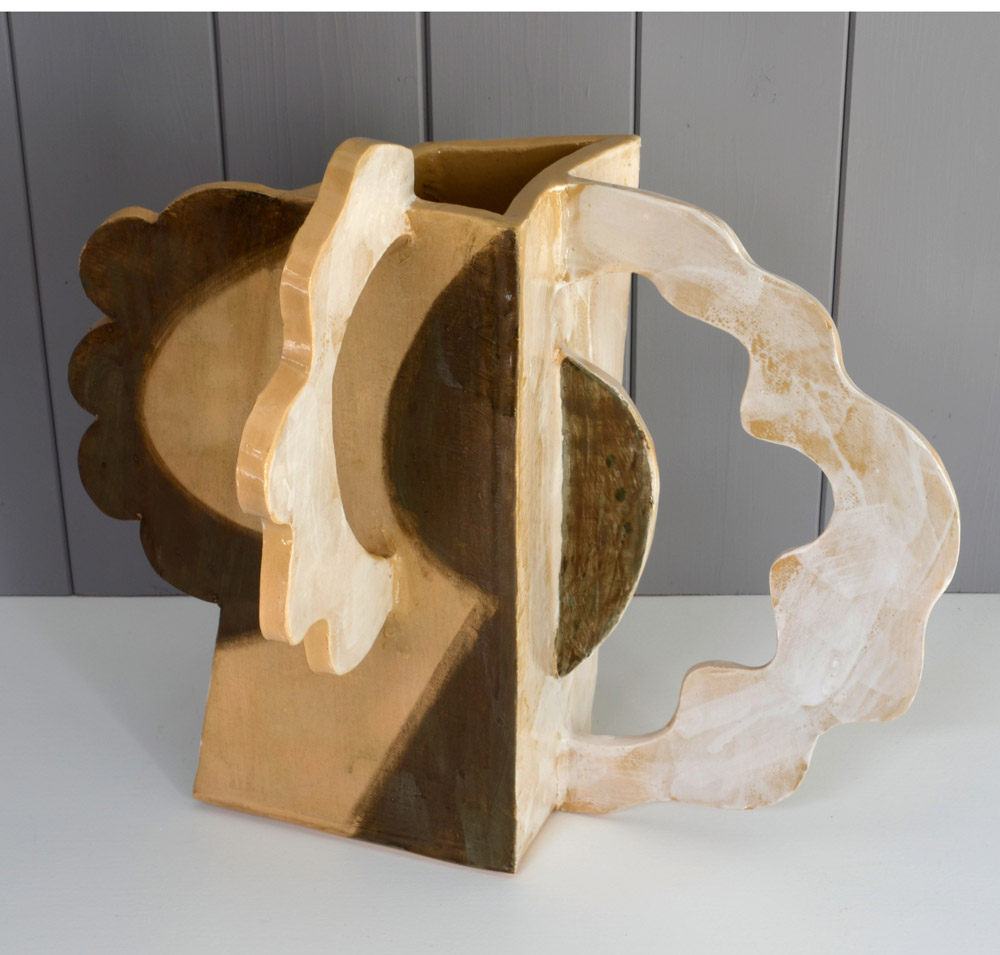
These pieces are not necessarily practical but fun and visually interesting – eye-catching in the way the conventional shape of the vessels has been altered before they reach the kiln. Here are some early examples:

Ruby my dear

People might look at these objects and consider whether they could use them or not, or whether they just go for them because they are sculptures that fill a space in an interesting way.

Striped splash pot

People take them home, sometimes placing them in a particular place in a room, say a mantelpiece or a shelf, or putting flowers in them and changing their position every now again. The work swings between functionality and abstraction – this is what gives it its allure. It’s playful.

Jumble vase

A man walks into a seafood shack cradling a salmon and asks, “Do you make fish cakes?”
“Yes, of course,” the server replies.
“Great,” says the man, “It’s his birthday!”

Rutile

St John’s Wort in rutile vase

Last July I was going on about the names of all the different plants that grow wild in Frith Wood, as well as discussing the benefits of geophagia for some reason (the eating of mud or clay). I also think worms came into it, somehow. Click here if you want to revisit.


meadowsweet

This July, however, I would like to introduce you to Filipendula ulmaria, or meadowsweet. It could be because it was used in the Middle Ages as a sweetener for mead that it gets its name, but take a whiff and it might remind you of something familiar. Its chemical constituents include salicin, which was synthetically altered because it causes less digestive upset than pure salicylic acid used in drugs, and thus aspirin was created. It was Bayer that named it aspirin after meadowsweet’s old botanical name: Spiraea ulmaria.  It does have a whiff of aspirin.

meadowsweet

There is a lot of it now  flourishing on the sides of the roads all over Herefordshire: fluffy, slightly floppy, pale cream bundles framed by the hedges they grow by. I confess that the real reason I mention meadowsweet is to promote the Ledbury Poetry Festival and Edward Thomas’ poem, Adlestrop:


Yes. I remember Adlestrop—

The name, because one afternoon

Of heat the express-train drew up there

Unwontedly. It was late June.

The steam hissed. Someone cleared his throat.

No one left and no one came

On the bare platform. What I saw

Was Adlestrop—only the name

And willows, willow-herb, and grass,

And meadowsweet, and haycocks dry,

No whit less still and lonely fair

Than the high cloudlets in the sky.

And for that minute a blackbird sang

Close by, and round him, mistier,

Farther and farther, all the birds

Of Oxfordshire and Gloucestershire.

The Barrett Browning Institute

The Festival this year is mostly online, though there are some great events held in Ledbury itself over the weekend of 9 – 11 July. Click here for all the available events (online and non-online). The Festival is on until 11th July. The Barrett Browning Institute in the town centre  is the Festival’s headquarters, and if you go in you will find Sally Crabtree.

Sally Crabtree

Her latest installation is a sweetshop of conceptual confectionery which offers each member of the public a small gold coin which they can spend on just one thing at the counter and it explores the notion of choice in our lives-“Choose well. Your choice is brief, and yet endless” as Goethe says. It has the feel of a fairground stall with the excitement that each person goes away with a ‘prize’ so to speak. Of more value perhaps however is that each sweet that they choose comes with its own quirky, philosophical inner layer of meaning which they unwrap, depending on what they choose.

Festival A board

And for children… they can fill a jamboree bag with their own creations inspired by the Sweetshop of Words –  including lyrical lollipops, glass sweets and pop a pop a poem balloons!

stonewarew rutile signal vase

As I said in the last blog, the difference between poetry and pottery is only a “t”, and some new pieces have emerged out of the kiln which, if not poetic, are at least expressive.

Wavy rutile vase

The latest batch of ceramics has seen the rise of an ingredient called rutile.   Rutile is a glaze additive that produces colours ranging from light and dark blue, to tan, gold, yellow, and even purple.  It has a mind of its own, depending on the glaze base and the firing conditions and, because it is a mined colorant, its makeup also depends on the mine source. Many potters test their batches of rutile before committing to a full bucket of glaze – all the result of the mineral’s notorious inconsistency. But when it works, it produces many crystalline, speckling, streaking, and mottling effects in glazes during cooling in the kiln and thus it is highly prized by potters.

Wavy rutile vase verso

Of course, here at Peter Arscott Ceramics, and following in the contrarian, or maybe heedless, tradition, rutile is not used in this way at all but rather mixed as a powder with water and a viscous agent to produce a colourant that can be applied like paint to the bisque surface of the piece, and then dipped in a transparent glaze. In other words, it is not used as a glaze but as a colour that gives the object’s surface an effect halfway between wood and honey. See for yourselves.

rutile close-up

By the way, Brits pronounce it “root ill” and Americans say “root isle”, which I prefer. On the other hand, and digressing wildly, why do Americans say “rowt” when they want to say “route”? Answers please. And since we are on the subject, why do they pronounce “rubbish” as “garbage” and “chips” as “french fries”? I am sure that at least one of the three American readers of this blog will tell me in no uncertain terms.

my friend Edith

I got know a resident sparrow, called Edith, busy looking for anything to feed its chicks in their nest in the roof’s gutter. Luckily they were not flooded out, and I felt so sorry for her that I bought a  bag of mealy worms. She didn’t want to land on my outstretched hand but was OK on the table, where she would occasionally forget herself and leave a calling card. The fledglings have now flown, and she has lost all interest in visiting.  Spurned by a sparrow.

ceramics, olives, squirrels

the view from Úbeda towards the Sierra de Cazorla

A long time ago, arriving anywhere in Spain meant being greeted by the smell of tobacco and coffee. Nowadays, with smoking restrictions in place, it is just the coffee you can just about whiff as you get out of Málaga airport and walk into the dry heat of Andalucía. The drive from Málaga to our destination, the city of Úbeda in Jaén, was a trip through a dry but varied landscape of mountains, valleys and great stretches of olive groves as far as the eye can see. This is the region that produces the most olive oil in the world, alone producing more than the second world producer of oil, Italy. Something like 20% of world production comes from here. There are about 60 million olive trees in this fertile land, and a squirrel could travel happily across the whole province without once touching soil (they claim). Anyway, the photograph above was taken from the hill of Úbeda looking down and across towards the Sierra de Cazorla. The next image is of a squirrel.

The cultivation of olive trees goes back centuries in the different Mediterranean cultures, and includes the Greek, the Phoenician and the Assyrian – even the Bible mentions it over 400 times, since it was used not only as food but as a light source. Of course, the oil had to be stored, and what better way to contain it than the ceramic amphora or jug.

amphora jug of oil, aren’t you?

olives in a three-legged bowl

In Spanish a potter is known as an alfarero, a word that comes from the Arabic “alfahar” meaning “ceramic” and “ero” denoting a profession, and without doubt the best known alfarero in Úbeda is Tito. And pottery has been made in Ubeda for over a thousand years; there have been many influences and styles that have left their mark, and at Tito’s ceramic workshop you can experience absolute fidelity to traditional forms as well as a decorative eclecticism that incorporates and recreates the contributions of each historical period, from Iberian geometries to colourful Baroque via Arab greens and the blues of the Renaissance.

Inside Tito’s workshop

From the cool oasis of Tito’s you can walk to one of the most striking Renaissance collection of buildings in Spain – the Vázquez de Molina square where you can visit the Palacio de las Cadenas (so named after the decorative chains which once hung from the façade), the chapel of El Salvador and the Basílica de Santa María. The interior of the chapel is stunning, built as a burial place for the local nobility in 1536, it is a Spanish architectural jewel with a main altar that forces one to sit down and contemplate.

interior of El Salvador chapel

The town lends its name to a common figure of speech in Spanish, andar por los cerros de Úbeda (literally ‘to walk around the hills of Úbeda’), meaning ‘to go off at a tangent’, which yours truly did by succumbing to a mild case of shingles. Luckily the local chemist is very helpful so no doctor was required, but it did mean that any consumption of local delicacies such as perdiz en escabeche (partridge), andrajos (a stew made with flour, oil, tomato, pepper and rabbit) and paté de aceituna (olive paté) had to be postponed, as did any drinking of the local Torreperogil wine.

Écija – the Frying Pan of Spain

This small sacrifice was soon forgotten with the next stage of the trip. The drive to Jerez de la Frontera meant a brief stop at Écija, the Frying Pan of Spain, and though it turned out be hot enough, the temperature was not as high as in the UK at the time. Something of the dryness of the Spanish landscape and its underlying human endeavour and activity inspired a set of pots once back at the workshop – an abstract interpretation with a marked personality. What do you think?

landscape pots

However, back on the road, the landscape changed gradually the further West we drove, and by the time we were nearing Jerez the fields were white. Albariza is a chalky soil that retains moisture within while forming a dry pale crust above that prevents any drying. This is ideal for the growing of the Palomino grape used in the production of sherry and brandy. The result is a stripy landscape of green and white, grape and soil.

Barbadillo’s cathedral-like warehouse of soleras

A tour of the Barbadillo sherry makers in the port of Sanlucar de Barrameda taught us that manzanilla is made there whereas fino is made in Jerez. Because of the sea breeze that enters the giant bodegas where the maturing takes place, manzanilla has a slightly salty tang. Manzanilla is camomile, which is another aroma typically found in this type of sherry, and where better to sample some than at a bar in the centre of the city. After admiring the cathedral-like building that houses the hundreds of soleras (oak barrels) of manzanilla we headed back to Jerez.

Bar Juanito

Bar Juanito is a cool and airy space clad inside and out with locally-made ceramic tiles where they serve all the sherries along with their specialities, artichoke and deep-fried whitebait. As with most towns and cities in Andalucía tiles are used to decorate buildings on the outside, such as the tower of the church of San Miguel, and to help keep interiors at a lower temperature, for example in the courtyards and patios of houses, and in public and domestic rooms.

the tile-clad tower of San Miguel, Jerez

But if you are feeling the heat then go to the beach. The one at Santa Maria del Puerto is wide and clean and, despite the fact that it is the Atlantic, easy to swim in. The view across the bay allows you a glimpse of Cadiz in the distance.

Cadiz in the distance

In a further attempt to link ceramics, however tenuously, with this blog and the trip to Spain, here is an image of a large pot made two or three years ago which was inspired by the movements of a flamenco dance. It is called Flamenco Pot.

Flamenco pot

Should you want to meet any of the ceramics face to face, keep in mind that other than the workshop in Ledbury there are outlets too in St Ives, Worcester, Cambridge and London – addresses and contact details on the website. Click here to go to the website.

Leaf pot

Hasta luego, amigos.