Posts

Swimming, eating, drinking.

Cala Aigua Xellida

Apologies to those of you expecting the usual image of Ledbury from Bradlow Hill. We’ve been away, you see. A gathering of the clan took place this month in the small town of Tamariu on the Costa Brava. The nearest anyone got to trudging up Bradlow Hill was getting down to Cala Xellida and back, which was done by car anyway – it was a holiday after all. It consisted of swimming early in the morning in this beautiful little bay, consorting with octopuses and watching cormorants diving alongside, or simply floating on your back (like a pale plump starfish on an azure sea) mindful of not brushing up against a sea urchin – one of their sharp needles in a vulnerable spot would spoil the day. I thought the sea urchin was a friend, but it was anemone.

Paracentrotus livides profil. Photo Frédéric Ducarme

The name Tamariu derives from the tamarisk trees along the promenade, which separates the beach from the narrow streets and whitewashed buildings of the town. It was, like most settlements along the Costa Brava, a small fishing village, and fishing boats are still to be seen up on the beach. Nowadays there are a few hotels, along with seafood restaurants, cafes and bars. It is set amongst rugged pine-covered cliffs flanking the sea.

View from the coastal path flanking Tamariu.

A few days beforehand, we had stayed with friends in a small village outside Vic, the ancient capital of the region of Osona. Set among lush green hills, from here you can see in the distance the highest peaks of the Pyrenees that border with France. The main square, where most of the town’s social and cultural life takes place, is a large square area surrounded on all sides by beautiful old buildings, some dating from the late 14th century.

Plaza Mayor, Vic.

Whilst there, a trip uphill to the hermitage of Sant Sebastiá, long abandoned. It stands as a reminder of Albion’s perfidy and of the ongoing struggle for Catalan independence because it was here that the decision was taken to send an emissary to the British, which led to an agreement of support in 1705 during the war of Spanish Succession. Alas, Britain let them down by signing the Treaty of Utrech in 1713. Long story, with little obvious link to ceramics, but complex and interesting. Great views of the valley below.

View of Vic valley from Sant Sebastiá.

Catalans and ceramics? Yes. The best-known source of pottery is La Bisbal which has been producing pots for centuries, and uses the typical blue, red and yellow tones associated with it in the numerous artisan studios along the town’s main drag. But pottery here is also associated with the great names of Catalan art: Gaudí, Miró, Dalí and, though born in Malaga, Picasso.

Ceramic seating in Parc Guell – Antoni Gaudí

Of the four, Gaudí did not actually make any ceramics, rather he smashed them up and incorporated it into his facades and rounded architecture, as can be seen on the benches in Parc Guell where one can sit and look down on the city of Barcelona.

Suite Catalan – Salvador Dalí

In 1976 Dali was seeking a buyer for a collection of tiles known as the Suite Catalan that he had produced in Spain two decades previously. From the original run of 100,000 tiles 60,000 remained. A German lawyer bought them all. The remaining tiles from the original run have sold in private sales and auctions over the years, fetching as much as $2,300 for a set of six, and over €500 for just one.

Earthenware dish with bird – Picasso

Picasso and Miró are better known than the other two for their ceramic work and made extraordinary pieces which nowadays are seen in museums around the world. Picasso moved to Barcelona with his family at 13, in 1895, when the city was full of political and artistic ferment. It was politics that turned his visits to Paris into permanent French exile, but before that, his artistic early artistic formation developed in Barcelona. His Blue Period is Catalan.

Oiseau (Solar) bird – Fundació Joan Miró

Peter Arscott Ceramics would like to emulate them one day and, in a fit of creativity, inspiration has nudged this piece out of the studio.

Doodle vase by PAC

These few days on the Mediterranean were not only about swimming, eating, and drinking. Oh no. There was a quick cultural visit to Gerona.  We wanted to see the cathedral’s interior, which includes the widest Gothic nave in the world, with a width of 23 metres (75 ft), and the second widest of any church after that of St Peter’s Basilica. When we finally made it, the huge West door was being shut to visitors by a stern-faced porter.

Closing time at Gerona cathedral

Defeated in our cultural pursuits, we could only drown our sorrows with more food and drink. Here is a picture of tapas: anchovies and olives.

Tapas

In deference to the octopus we met daily at Aigua Xellida (there may have been two, but if so, they were hard to tell apart; they were i-tentacle), we tried not to eat any cephalopods. But we did eat fish, and many sausages along with barbecued red peppers and aubergines, and a lot of cheese and ham eaten on local bread rubbed with tomato. And more sausages. They know their food, those Catalans.

Salchichón de Vic

Back home, and the call of the clay was loud and enticing, tempting hands into making new shapes and forms, and perhaps influenced by the happy use of colour in the pots and dishes seen in La Bisbal, an orange-red tone crept into one of the more devilish vases that popped out of the kiln today.

Imp vase

Enjoy the rest of Summer.

Someone to watch over me


Do you ever get that feeling that someone is behind you, staring? A sort of ghostly or alien presence nearby, that you slowly become aware of and makes the hairs on the back of your neck stand up and your spine tingle? This happens at the studio very now and then, and probably as a result of the loneliness of the long-distance potter (see blog May), but more likely the result of having a ceramic custodian placed in the workshop high on a shelf, and then forgetting that it is there.

Norma

Our custodian is called Norma. She is imperiously “above it all”, dispassionate and detached, somewhat poker-faced, but commanding and reassuring as she protects the studio from any malevolent spirits. She is not a conversationalist. St Spyridon, or Spiro as we call him, the patron saint of potters, is no good at warding off the malignant because he is too busy with the marketing, and in any case considers such practices as beneath his dignity. However, unlike Norma, he does like to chat.

Frank

It’s natural to assume someone behind us is staring, but I think that feeling we get is a self-fulfilling because when we turn around, our action makes the other person look at us, and when they meet our eyes, they give us the impression that they’ve been staring the whole time. Norma – she is inscrutably mute and thus easily forgotten, until, for no particular reason, you become aware of her presence.

Hugo

In the garden, once Spring arrives and everything starts growing and covering every inch of space with leaves, blossom, buds, stalks, and branches, you forget what was standing visibly throughout the bare Winter months. Indulging in a bit of pruning, you uncover a patch that reveals an old garden sentinel that stares back at you – something familiar that takes you by surprise. In this case Hugo and Frank, who are stylised skulls made as part of a mural commissioned years ago and who were rejected on account of flaws detected – cracks, I think. They still look at one forlornly, even accusingly.

Forsaken

In fact, the garden is full of forsaken ceramics. They peek out at me or make sarcastic comments as I go by: “Call yourself a potter? Didn’t you know that stoneware contains (among other silicates) feldspar, and that this majestic mineral is by far the most abundant in the Earth’s crust, making up about 50% of all rocks? I contain eternity, I’m as old as the planet, and yet…and yet…you cast me out and abandon me in this squalor, surrounded by weeds, mud and (ugh) ants that crawl over me. Have you no respect?

Forlorn

Tables, on the other hand, being made of wood, suffer from no illusions and stand squarely on the earth’s surface, four-legged and robust, and in the case of these two that are now at the Palais des Vaches, looking quite elegant. Their hand-painted tops are varnished with a heat-resistant resin, so that hot cups of tea or coffee can be placed on them directly without the need for a coaster. Their tapering “sputnik” legs give them a fifties look.

Fifties vibe – handmade table at the Palais des Vaches

These tables are not for the outdoors, but for the house. And in the house, we have another sentinel that watches over us. He is tucked up in a corner of the kitchen ceiling and has been there uncomplaining for over thirty years, though he has been with the family for forty.  Three-fingered and four-toed, he is made of plaster and is named Garrel because the kids could not pronounce the word “gargoyle”, though strictly speaking gargoyles are meant to stand on roofs and act as waterspouts, as well as warding off evil spirits.

Garrel

Derivation of the word “gargoyle”? From Middle English: from Old French gargouille ‘throat’, also ‘gargoyle’ (because of the water passing through the throat and mouth of the figure); related to Greek gargarizein ‘to gargle’ (imitating the sounds made in the throat).

Jug vase

Spiro says that’s enough wittering on my part and reminds me that this is a ceramics blog, not some etymology lesson, and that I should at least show something recently made. So here it is – above is a large stoneware vase that looks like a jug from a certain angle. And here’s another table…

Do you want to listen to the incomparable Ella Fitzgerald singing Gershwin’s “Someone to watch over me“? Click here.

There’s a somebody I’m longin’ to seeI hope that he turns out to beSomeone who’ll watch over me

Sorry, I couldn’t resist this one:

A man goes into a bar with his small pet newt called Tiny. “A pint for me and a half for Tiny, please,” he says to the landlord.
The landlord asks, “Why do you name him Tiny?”
The man replies, “Because he’s my newt.”

Adeus, Astrud.

In what has become customary in this blog, I was yet again talking to a fruit the other day – this time an avocado. And, yes, it IS a fruit. They are considered so because they fit all of the botanical criteria for a berry. They have a fleshy pulp and a seed. This particular avocado was in mourning over the passing away of one of its fellow South Americans, the dreamy-voiced bossa nova singer Astrud Gilberto.

What has bossa nova got to do with ceramics? Not much. It’s just that her voice, for those of us who were around then, played such a defining part of the mid-sixties. At the time of her recording of the “Girl from Ipanema”, although she had little time to prepare (she had never sung professionally before), her detached but sultry vocals perfectly captured the spirit of a “tall and tan and young and lovely” girl who turns the heads of everyone she passes. Her husband, the guitarist Joao Gilberto, was recording with the jazz saxophonist Stan Getz when they decided they needed someone to sing the song in English, and since Joao spoke not a word, she volunteered.

Astrud Gilberto – Kroon, Ron / Anefo photo

She wasn’t credited on the track (which was released under the name Stan Getz and João Gilberto) and she only received the standard $120 session fee for her performance, whereas Stan went on to buy a 23-bed mansion outside New York. But her career took off and she sang with the likes of Antonio Carlos Jobim, Frank Sinatra, George Michael, and Chet Baker. We like listening to her cool-as-a-cucumber, slightly diffident voice here in the studio – her singing entwining with Stan Getz’s smooth saxophone calms the atmosphere. Adeus, Astrud. Click here to hear her sing How Insensitive (Insensatez)– she is slightly hesitant, even insecure, in her delivery, probably because of her limited English, but it makes the song all the sadder.

Avocados (persea americana) are popular with ceramicists who enjoy playing with the colours and the shape to create bowls for tableware, and it was the hippest shade of green for your ceramic bathrooms in the 1970s.

Something else that is becoming popular with some ceramicists is the Japanese art of Kintsugi (Golden joinery), whereby broken pottery is mended with lacquer dusted with powdered gold or silver, treating the breakage as part of the history of an object, rather than disguising it. Nowadays potters can buy tubes of ready-made golden glue that hardens at 300F, and no doubt many have pounced on it as a way of salvaging work that might still be sellable.

Kintsugi hoot vase. Notice the vertical golden crack in the green/blue area.

Yours truly is no exception, and the large piece that cracked in the kiln as described in May’s blog was brought out and repaired. However, there were too many cracks to make it watertight, and though it looks good with its golden fissure unashamedly exhibited to all eyes, it sounds dull when you tap the vase with your knuckles. A horrible sound to all potters, and a death knell to a pot. It certainly can’t be sold and will probably live outside in the garden where it might scare away the mice, though the resident barn owl might get confused. I think I will call it Astrud, which means “energetic, courageous and determined”. I made another similar one, which came out of the kiln in perfect condition.

“Call of the Nightingale recorded over eighty-six seconds” 145 x 180 cms. Nicky Arscott 2023.

Owls are not the only nocturnal birds, of course. So is the nightingale, which sings its heart out in the dead of night to attract passing females migrating back to Britain. Last year I told you about our midnight walk with Sam Lee in a wood near Gloucester and I remember him telling us that if you hear one still singing at the end of Spring, that means he didn’t get the girl and he’ll be a summer bachelor. Sam will be reading from his book “Nightingale” and singing (he is a Mercury award-winning singer) at the Ledbury Poetry Festival on Sunday 2 July, so if you’d like to buy a ticket please click here.

Detail of “Nightingale..” by Nicky Arscott.

I am sure I’ve told you before that all the PAC pieces are stoneware, and that they are glaze-fired to 1200°C. Until now, every piece is dipped in a tub of liquid glaze, or, if too big, has the glaze poured over it. This means you don’t get uniform coverage but inevitable thicker and thinner areas of glaze on the surfaces – which is attractive and accentuates the “handmade” aspect of production.

However, using an air compressor and a recently purchased spray gun, goggles, a mask, and a rickety spray booth made out of a large cardboard box on an abandoned garden table, and finally a coverall that was disappointingly tight around middle, two pieces were glaze-sprayed and came out of the kiln with a lovely sheen. Breathing in glaze is strictly to be avoided, you see – thus all the safety preliminaries.

nice sheen

All this is just another example of how far we go to make things pleasing to others. It’s only a few steps away from exerting a pull by creating something irresistible and beautiful like the nightingale desperately attracting a mate, or Astrud singing about regret, or even an owl hooting in the night. Even potters do it, albeit subliminally.

two hoots

Potters and solitude

The view from Bradlow Knoll

Trudging up Bradlow Hill I noticed that the mayflower was in full bloom. What we call “mayflower” is actually hawthorn, a pagan symbol of fertility with ancient associations with May Day, and its blossoming marks the point at which spring turns into summer. This was a cheering thought, as a large vase destined for a gallery had cracked in the kiln the day before and one’s mind needed some distraction.

Mayflower

In the studio, the radio is always on, in part to accompany the ongoing work and to fend off any feelings of aloneness, though there is nothing wrong with a bit of solitude when making vases. As regular readers of this blog know, my team consists of Ziggy (a spider), Thelonious (a pugmill) and Saint Spyridon, (third century Bishop of Trimythous in charge of marketing) – all of them, possibly, not real.

Leaf vase

An important factor in converting aloneness into solitude is that it is voluntary, instead of imposed. As such, it becomes a creative and productive state. It helps concentration, but sometimes it can get to people. For example, a researcher at a station in Antarctica stabbed a colleague (non-fatally), though this may have happened because the victim was giving away the endings of books the attacker was reading.

Antartica. Photo Giuseppe Zibardi

This information is being given out freely by Peter Arscott Ceramics (PAC) because only the other day, seated alone at the workspace and eating a banana, a small unhappy voice was heard in the studio. Looking down at the banana in hand I noticed that it was looking up at me. Don’t tell me that’s not the saddest little world-weary face you’ve seen in a while.

Unhappy

“You shouldn’t be eating me, you know.”

“Is that why you look so sad?”

“No. It’s just that the monoculture production methods used to grow us can destroy entire ecosystems.  I bet you didn’t realize that the banana industry consumes more agrochemicals than any other in the world, except cotton.’

“Well I never.”

“And the low prices paid by supermarkets and the cost cutting by fruit companies as they relocate in search of cheaper labour, and the harsh conditions in plantations…’

“Oh, I’m sorry to hear that.”

“Yes, and none of the other fruit in the fruit bowl talk to me.”

Wormery

Despite feelings of guilt, I finished off the banana, then chopped up the skin and fed it to the inhabitants of the PAC wormery alongside the studio. At least they don’t talk to me, and the skin was put to good use.

Green wobble vase

Back on Bradlow Hill, my mind filled with images of cracked pots, Puritans on the Mayflower, talking bananas and Antarctic research stations, these gradually faded away as the birdsong in the wood took over. I recorded some for you – the loudest is probably a robin, some blackbirds and a chiff chaff, as well as a distant ambulance on its way to Worcester Hospital. You’ll need full volume to get all that.

Click here: birdsong

The bluebells were past their pomp, but the stitchwort was flecking the undergrowth with white, and there was a lot of campion in the hedgerows.

Stitchwort

In parts of Africa the campion is used by Xhosa diviners: the roots are ground, mixed with water, and beaten to a froth, which is consumed by novice diviners during the full moon to influence their dreams.

Campion

Given that this type of campion cannot be found in Herefordshire, PAC recommends buying a good bottle of Ribera del Duero instead. The better the wine, the sweeter the dream. Perhaps the resulting pot, a very impractical and possibly useless wine decanter, is the result.

Droop decanter

Still on the subject of wine, over-consumption of the grape, even if it’s the Queen of Grapes, Tempranillo, can lead to moments of euphoria to be followed the next day by terrible remorse and anguish. In an unusual attempt at public information and to highlight the issue of the seductive lure of alcohol and its consequences, PAC would like to introduce the following piece:

Saturday night, Sunday morning vase

Psychoceramics is the study of crackpot ideas about human behaviour – get it? “Crack pots”?  (Also, Psycho Ceramics were a range of novelty ceramics made by US-based Kreiss company and manufactured in Japan between the 1960s and 1970s). However, PAC would like to associate the word with the more subtle art of depicting the mind or mental processes – psykho, (Greek) meaning “the soul, mind, spirit, or invisible animating entity which occupies the physical body”. PAC would like to think that the above is an example of psychoceramics, as is the next one:

Why? Perhaps because it is a “personality”. Whereas other pieces may highlight a particular colour to effect, or hint at landscape, or get across the idea of spring, or even jazz music, others have their own particular and less easily described temperament which is a bit more than just the sum of its shape, colours and brushstrokes. For example, we like the following piece because it’s a gentle play on a grid and geometrical shapes – it’s attractive enough, but what it offers is essentially decorative:

What do you think, dear reader? Is PAC barking up the wrong tree? Is it all too subjective for a theory? Have we been talking to fruit too often? Can bananas ever look happy? Did you know that the Latin name for banana is musa sapientum, which translates as fruit of the wise men? Please send us your thoughts.

psychoceramic or articeramic?

Going anywhere near Chichester?


Hello all. Apologies for the brevity of this blog (though some of you might be relieved to be spared the usual ramblings). Oxmarket Contemporary is hosting its first of the Open Winners’ Exhibitions on 14th – 25th February.  The Open offered five categories of submission including the applied arts (craft), drawing and illustration, painting, print and photography and sculpture. This exhibition features the winners from the Drawing and Illustration and Applied Arts Categories. It includes yours truly.

Chris Shaw Hughes won the Drawing and Illustration prize, he creates photo realistic drawings that document pivotal moments of history in specific places.

Jane Eastell one of the joint winners of the Applied Arts prize works with a variety of clay bodies, either hand building or using a potter’s wheel. Jane experiments with different glazes and decoration techniques and produces beautiful work.

Peter Arscott (yes, that’s me) the other joint winner of the Applied Arts prize uses grogged stoneware, which lends itself to modelling and shaping. Peter makes one-off pieces, he sees the pot or vase as a form you can play with.

Oxmarket Contemporary will be open 10.00am – 4.30pm, Tuesday, Wednesday, Thursday, Friday, Saturday and Sunday. the gallery is in St. Andrew’s Court, off East Street, Chichester, West Sussex PO19 1YH.

The Madding Crowds

Photo by Rob Curran on Unsplash

Peter Arscott Ceramics paid a quick visit to London a few weeks ago, in order to go to some exhibitions. Walking from gallery to gallery was as demanding as climbing Bradlow Hill, not because of any steep incline but because of the number of people out and about in the capital. – wall-to-wall human flesh, where even on the pavements one had to stop and queue simply to keep going along the same trajectory.

Far from the madding crowd’s ignoble strife, Their sober wishes never learned to stray; Along the cool sequestered vale of life They kept the noiseless tenor of their way.” Thomas Gray. The view from Bradlow Knoll on Boxing Day

A walk along the South Bank to Borough Market for a bit of street food was a marathon, and once in the market area, the queues in front of each little kiosk (the paella queue being the longest) snaked and coiled around each other and made progress almost impossible. This is not a complaint, by the way, simply an observation – everybody was very relaxed and easy-going, and the atmosphere in the city was memorably positive and friendly.

The first exhibition was Strange Clay: Ceramics in Contemporary Art at the Hayward Gallery (until 8th January, so hurry), featuring artists working across recent decades, and examining the plasticity and the possibilities of ceramics, often in a defamiliarized way. Weird and wonderful, ranging from small abstract works to large-scale installations that make you wonder how the artists managed to accomplish their work. If you ever wonder what clay can do, this is for you.

Architeuthis by Zinc Yi

David Zink Yi (Lima, Peru) has somehow created a giant squid (5 metres) lying in a pool of its own ink. To achieve the slick-looking flesh he has glazed the piece with a mix of different oxides. An animal we only ever encounter dead on our shores, there is something impressive but sad about this Architeuthis on the gallery floor. Insider info: the “ink” was made by mixing maple syrup with black ink, and acts as a barrier – somebody kicked and broke one of its legs at a previous exhibition, and this is the clever solution.

Brie Ruais

Brie Ruais (USA) draws inspiration for her large wall pieces from the desert landscapes of the Southwest of the United States. She sees similarities between the body and the land since they both bear scars as a record of trauma, the latter as a result of human intervention and extraction in the region.

Betty Woodman

Betty Woodman’s wall piece (USA, d. 2018) made of many separate ingredients that come together to create movement, colour, and space, is typical of her. Many years ago, she started to create an untroubled and friendly world for ceramics that had never previously existed, and her pieces were often set out in the lobby of galleries with flowers in them, offering visitors a warm welcome. She would throw her pieces on the wheel, but played with them afterwards, twisting, stretching, and cutting shapes, I think, without much forward planning, which gives her work such freshness.

Woody de Othello

Woody de Othello makes vases and jugs that incorporate human body parts such as arms, hands, lips and feet. The exaggerated proportions and the vivid hues of his sculptures reflect his Haitian ancestry and Yoruba culture. They are quite funny too.

Grayson Perry

Of course, Grayson Perry (now a “Sir”) is there with his beautifully made vases – he is a coiler par excellence – and so are many more artists proving the flexibility of clay as an art material.

A walk to the Tate Modern followed, and a visit to the Cezanne exhibition (fabulous collection of his work on show), and also Maria Bartuszová work which is based on plaster casting using gravitational pull or her own breath to make serenely white and delicate works.

Twins (1909) by Marianne Werefkin

Then off to the Royal Academy for a look at “Making Modernism” (on until 12 February) which brings together the work of seven German women artists active in the early twentieth century.

Mother cradling dead child (charcoal) by Käthe Kolwitz

Kathe Kollwitz is the best known, but the others, who achieved success in their day, are, until now, largely forgotten thanks to the Kinder, Küche, Kirche philosophy coming back to the fore.

Portrait of a boy (Willi Blab) by Gabriele Münter

Peter Arscott Ceramics will be included in an exhibition of Oxmarket Open winners in Chichester from 14th to 26th of February. If you pay it a visit, the town has plenty to offer – click here for a previous blog about it.

As you have undoubtedly picked up, 14th February is St Valentine’s, patron saint of beekeepers, asthmatics, and lovers, though St Spyridon (Patron saint of potters and in charge of Marketing at PAC) claims he is a fabrication, “like St Philomena, and St Veronica, and St Eustice”, he says dismissively.

And thanks to those of you who got in touch with your reactions to my story in Litro magazine in the last blog. It’s good to hear your thoughts, mostly positive and some constructively critical, and I appreciate them all. Here is another one called Cornelius Radhopper, which is published in Azure, a Journal of Literary Thought. It specializes in other-worldly realism, a genre that represents the known, often mundane, world in an elevated or defamiliarising way. To read it, click here.

Kiln Kat Kalamity

It may have been a cold early December afternoon, but a walk was needed up to CJ’s bench on Bradlow Hill, in part to clear the cobwebs, but mainly to meditate on the day’s disruptions and to put things in perspective. Kiln firings do sometimes go wrong – it’s not the end of the world. After a blissful state of Nirvana was attained, earthly feelings like suffering and desire disappeared, and the walk downhill was easy.

the remains of the clay

The main reason that pottery explodes in the kiln is residual moisture left in the clay body. Even when it appears bone dry.  Once the kiln gets really hot, the moisture starts to turn into steam, and the steam expands very rapidly into any small air pockets in the clay and shatters the pottery. Kerblam! Though actually it’s usually no more than a loud pop.

exploding pussy

This explosion was only discovered after a previous incident had taken place in the studio. This was announced by the layer of blue smoke that hung in space on entering the room, and which could be seen coiling up from the control panel behind the kiln. There was no panic, though Ziggy and Spiro were nowhere to be seen, and Thelonious offered little, if any, help.

Corroded terminals

Once everything had been turned off and the panel cover removed, the reasons were obvious: of the twelve terminals that connect up to the ends of the heating coils, three were sloppily connected and had corroded badly, deciding that they’d had quite enough, and the time had come to surrender.

Bottomless cat

Opening the kiln top then revealed that a ceramic cat had allowed its bottom to explode. This was just coincidence and had nothing to do with the terminals, though disappointing to my daughter-in-law, who made it. The original, successful, ceramic cat is modelled on Otto – here is a picture of Otto with his ceramic doppelganger Potto. They both live in London.

Ottio and Potto

 Otto himself has visited Ledbury and the studio and spent a weekend with the two adult humans for whom he is responsible. No rats were caught, he is too sedate for that, but the arrival of a third baby human may have complicated his ordered life, since for years cats have been unwittingly exploiting humans into taking care of them, by replicating the sound of a baby’s cry when they meow. They only meow when humans are around, the crafty creatures.

Moche pampas cat, 7 – 11th century AD

And cats have a long pedigree when it comes to ceramics. This beautiful stirrup-spout ceramic vessel was made by potters of Peru’s Moche culture sometime between the 4th – 7thcentury A.D. Moche artists were great observers of the natural world and depicted animals with a keen attention to detail. Here, the ceramicist captured the distinctive coat and leg markings, as well as the bushy tail, of the pampas cat. If you are in New York, you can see it at the Metropolitan Museum of Art.

Potto

Early Egyptians from wealthy families loved their mogs and dressed them in jewels and fed them treats. When the cats died, they were mummified. As a sign of mourning, the cat owners shaved off their eyebrows, and continued to mourn until their eyebrows grew back. Cats were so special that those who killed them, even by accident, were sentenced to death.

Porcello scaber

A piece that does not mention cats however, though woodlice make an appearance, is a story by yours truly in Litro Magazine. This is an online publication that (as it says on the website) “sits at the intersection of technology, the creative arts & literature. It provides a forum for new & experimental writing, whilst nurturing literary development”. It publishes work by first time authors through to Nobel laureates, providing readers with a perfect read for those with busy lives. So, it’s perfect for all of you, and if you want to read the online short story, then please just click here. It’s called Carpet Vandal.

Large stoneware platter 38 cms diam – The Chuffed Store

Christmas is upon us, and we are all having to think of gifts. We’re here to help and to encourage you to buy the “one-off’, that singular piece, the handmade and irrepeatable – in other words, a stoneware vase or dish that catches the eye while at the same time being practical. Such as this large serving platter which you can order through The Chuffed Store.

Or else drop in on one of the galleries that you can find on our website – just click here.

To finish off, why not treat yourself to a full-throated Tom Jones cat song?  The lyrics may not be much, but it’s a belter. Click here for some 70s nostalgia. Why do the girls in the audience scream when he sings that he likes “your pussycat nose”?

Spiro, Thelonious and Ziggy wish you a Happy Christmas

From everyone at Peter Arscott Ceramics, specially from Spiro, Thelonious and Ziggy, have a Happy Christmas and a better new year than we are all expecting.

song of the nightingale, buzz of the fly

May view of Ledbury

A celebratory walk was needed after a successful glaze firing. The view from Bradlow Knoll down towards Ledbury this May afternoon was grey and cloudy. You can see in the distance the white shapes of the plastic used in the speeded-up cultivation of strawberries for the voracious soft fruit market, and, nearer, the sheep  which will end up on our dinner plates. Land maintained and exploited for the consumer’s benefit, which has made our landscape what it is today. This applies to Frith Wood as well, where dead trees are removed or left on the ground to encourage wildlife. This tree was 57 years old – I counted the rings.

A well-maintained wood.

It clouded over very quickly and started to rain, so it was dark walking in the wood, and there was little birdsong. However, it was not as dark as a few weeks ago when my daughter and I found ourselves with thirty others tiptoeing through Highnam Woods near Gloucester at midnight.

A walk through the woods at night vase

 It was pitch black. Not a sound could we make, no squeaky shoes allowed, or noisy clothing, no flashlights to be used, only the vague shape of the person in front to guide each of us in single file until we came to a small clearing and very carefully sat down. We had previously gathered around a campfire to eat, drink and listen to the environmentalist Sam Lee, who was leading us into the trees with one purpose only: to listen to a nightingale sing.

Nightingale. Photo: Carlos Delgado

Unlike the continent, the UK is seeing the slow disappearance of the bird, due to farming and land management activity, but primarily to the lack of thoughtfully maintained woods like Highnam, which is owned by the Royal Society for the Protection of Birds, and is a jewel, a remnant of ancient woodland that is carefully managed in order to keep a balance between mature trees and traditional coppice.

Doodle vase just out of the kiln.

Our nightingale sang his heart out, though not for us. Only male birds sing at night, in order to woo the females – if you hear one still singing at the end of Spring, that means he didn’t get the girl and he’ll be a Summer bachelor. Ours was a Pavarotti, with the most amazing technique, and the sound was clean and clear and strangely affecting. Click here to listen, and if you are interested in going on a Nightingale Walk next Spring, have a look at the Nest Collective website here.

Posture vase

From beautiful sounds to irritating ones: is it me, or are the flies out early this year?

They keep zooming into the studio uninvited, hurling themselves against the windowpanes again and again, and buzzing at a particular pitch that keeps you from concentrating. Eventually you spend too much time trying to swat them, unsuccessfully, and getting more and more frenzied and unfocused.

Fl-eye view

Like most people, I know flies have those compound eyes which allow them to see what’s coming towards them no matter at what angle or speed, so that by the time they’ve swerved the blow of a rolled-up newspaper, they’ve had time to read the print. Ok, so flies are important pollinators, second only to the bees, but house flies, commensal with humans all over the world, spread food-borne illnesses. And they are an annoyance especially in some parts of the world where they can occur in large numbers, buzzing and settling on the skin or eyes. Did you know, and I’ve looked this up, that the fly’s taste receptors are in the labium, pharynx, feet, wing margins and female genitalia, thus enabling it to taste your food by walking on it?

Research on your behalf also uncovered this: the Sardinian cheese casu martzu is exposed to flies so that the digestive activities of the fly larvae soften the cheese and modify the aroma as part of the process of maturation. Banned by the European Union, the cheese was hard to find, but the ban has been lifted on the grounds that the cheese is a traditional local product made by traditional methods.  And why not? The sustainable food of the future is the insect.

Swat vase

Do flies, do insects, have much to do with the history and development of ceramics? Not as far as I know, this is just another long and rambling lead-in to my latest batch of vases out of the kiln. I think you’ll agree that the piece above has been influenced by fly-swatting.

Hello vase

From bird song to buzzing to mooing: more PCA ceramics at the Palais des Vaches in Exbury, where you can also see a unique coffee table made with tapering beech legs, the top being sealed, and hand painted with acrylics. Three layers of heat-resistant varnish ensure that hot mugs of coffee will not mark the surface, though coasters are recommended. The surface is easy to clean.  It could be described as a horizontal painting on four legs, and certainly you get a lot of pleasure from simply looking down on it and enjoying the colours

Unique PAC hand-painted table at the Palais des Vaches

Other work at the Palais includes this large sculptural piece:

Porthole vase

And to finish, a poem from childhood:

“Will you walk into my parlour?” said the Spider to the Fly,
“‘Tis the prettiest little parlour that ever you did spy;
The way into my parlour is up a winding stair,
And I have many curious things to show when you are there.”
“Oh no, no,” said the little Fly, “to ask me is in vain,
For who goes up your winding stair can ne’er come down again.” (Mary Howitt)

Ruby my Dear vase at the Coastal Gallery

Well, I couldn’t resist finishing off with John Keats:

“Darkling I listen; and, for many a time
I have been half in love with easeful Death,
Call’d him soft names in many a musèd rhyme,
To take into the air my quiet breath;
Now more than ever seems it rich to die,
To cease upon the midnight with no pain,
While thou art pouring forth thy soul abroad
In such an ecstasy!”

Ceramics – Form or Function

St John’s Wood in London. Most people think of Lord’s Cricket ground and long sunny evenings watching a game and sipping beer, or perhaps a stroll through beautiful Regent’s Park. Others conjure up the image of the Beatles on the now famous zebra crossing  outside Abbey Road studios – those old enough will remember the mystery surrounding the image and  the rumours of Paul’s death; after all, why else would he be barefoot, and doesn’t George represent  the carpenter who made the coffin, John the religious figure conducting the ceremony, Ringo the undertaker?  However, I mention it because like all zebra crossings, it is black and white, and thus a clumsy introduction to my theme. Bear with me.

I still do not know for sure whether those of you who buy Peter Arscott Ceramics (PAC) do so because you want a vase in the house to put flowers in, or whether you just want the piece because it’s a particular colour and shape you find attractive, or eye-catching, its use as a vase thus being secondary. I suspect it is the latter.

Monochrome vase at Cecilia Colman Gallery

All this head-scratching comes from one piece which a lot of people do not like, while others do. For starters it is unlike the typical PAC piece in that it’s black and white, and its shape or form does not seek a harmonious balance in the whole, but rather rejects it. All of which makes it sound like sculpture, which it is not – it’s still a vase.

Monochrome vase, verso.

As you probably already know, at PAC each piece is made by hand, each piece is a unique one-off since nothing is made twice, nor is function strictly observed – the pot or vase is seen as a form you can play with, PAC having moved away from the potter’s wheel to focus on hand-built forms, as this technique allows much more freedom for expression.

Vine vase at Cecilai Colman Gallery

Some of the pieces have a singular lop-sided stance; improvisation takes place either in cutting out the rolled clay shapes, or later when painting oxides onto their surfaces. The approach to clay is that of a painter’s, and the forms arrived at often work as sculptures or as shaped surfaces with paintings. In other words, its function as a vase is secondary when being made.

Frond vase at Cecilia Colman Gallery

Now, if you want something to perform a function, you want it to perform well. If it doesn’t, you’re probably going to stop using it or ask for your money back, no matter how good it looks. This has yet to be a problem at PAC – never has a vase been returned because it hasn’t functioned as a vase. However, if you hate the way a product looks, you’re less likely to buy it in the first place.

Vase 54 at Cecilia Colman Gallerey

The main distinction between art and design is that design must have a purpose. Art can have no other reason for existing other than to be to viewed, say, or experienced (probably contentious, but some of you will let me know). However, design requires a function. If the design is visually striking, then it may also be dipping its toes in the ocean of art, because often art and design overlap. However, without function, it’s just form – it’s not design but art.

Dave as flower pot

Anyway, it doesn’t really matter. Your eyes tell you whether you like it or not – and that is that. So, if you are in London, go to Cecilia Colman’s gallery and test your eyes. Cecilia is showing some PAC ceramics, including the much maligned monochrome piece. See what you think. You could combine it with a visit to Regent’s Park Zoo, or a nice meal out at one of the restaurants on St John’s Wood High Street (nearest underground station is St John’s Wood).

Ming Dynasty, Jiajing: 1522 – 1666

Of course, you will know if a piece is a genuine Peter Arscott Ceramic by the stamp on the bottom of each piece. Stamps are important for dating and authenticating ceramics. The one above belongs to the time of Jiajing’s reign, a man infatuated with women, known to be a cruel emperor who lived in isolation while ignoring state affairs. This eventually led to corruption at all levels of the Ming government, and to a plot by his concubines to assassinate him in 1542, by strangling him while he slept. Sadly, the plot failed and all of the concubines were executed.

Peter Arscott Ceramics, 2022,

The next stamp above is of the early 21st century, probably during the reign of Jon Son, a man who survived many plots, and belongs to a small ceramic workshop based in Herefordshire that produced rare, unique and now much sought-after vases in stoneware.

Cecilia Colman gallery – over 40 years of experience

Having mentioned The Beatles, it is only fair to finish with The Rolling Stones whose 1965 song “Play with Fire” contains the following lyrics:

Your mother she’s an heiress, owns a block in Saint John’s Wood
And your father’d be there with her
If he only could

Click here to hear them sing it.

December, happy outcomes

wintry

Strange things have been happening at the studio lately. Unexplained disappearances of ceramics, unfamiliar sounds coming from the ceiling, doors being left wide open at night and the kiln not firing on all cylinders. I decided to go for a walk up the hill to Frith Wood to blow away the cobwebs.

Storm Arwen

It was the usual steep climb up to Bradlow Knoll. The view was bathed in a wintry half-light but there was no wind as there had been these last few days with Storms Arwen and Barra which managed to blow a few trees down along the path deep in the wood. Barra (fair-headed) is named by Irish weather forecaster Met Éireann. Arwen is Welsh Celtic for “good”. The next one will be named Corrie, then Dudley, Eunice, Franklin, Gladys, and so on, according to a “name a storm’ project open to the public. What they all have in common is an ability to blow down trees and embarrass the big energy companies.

Fatball Slim

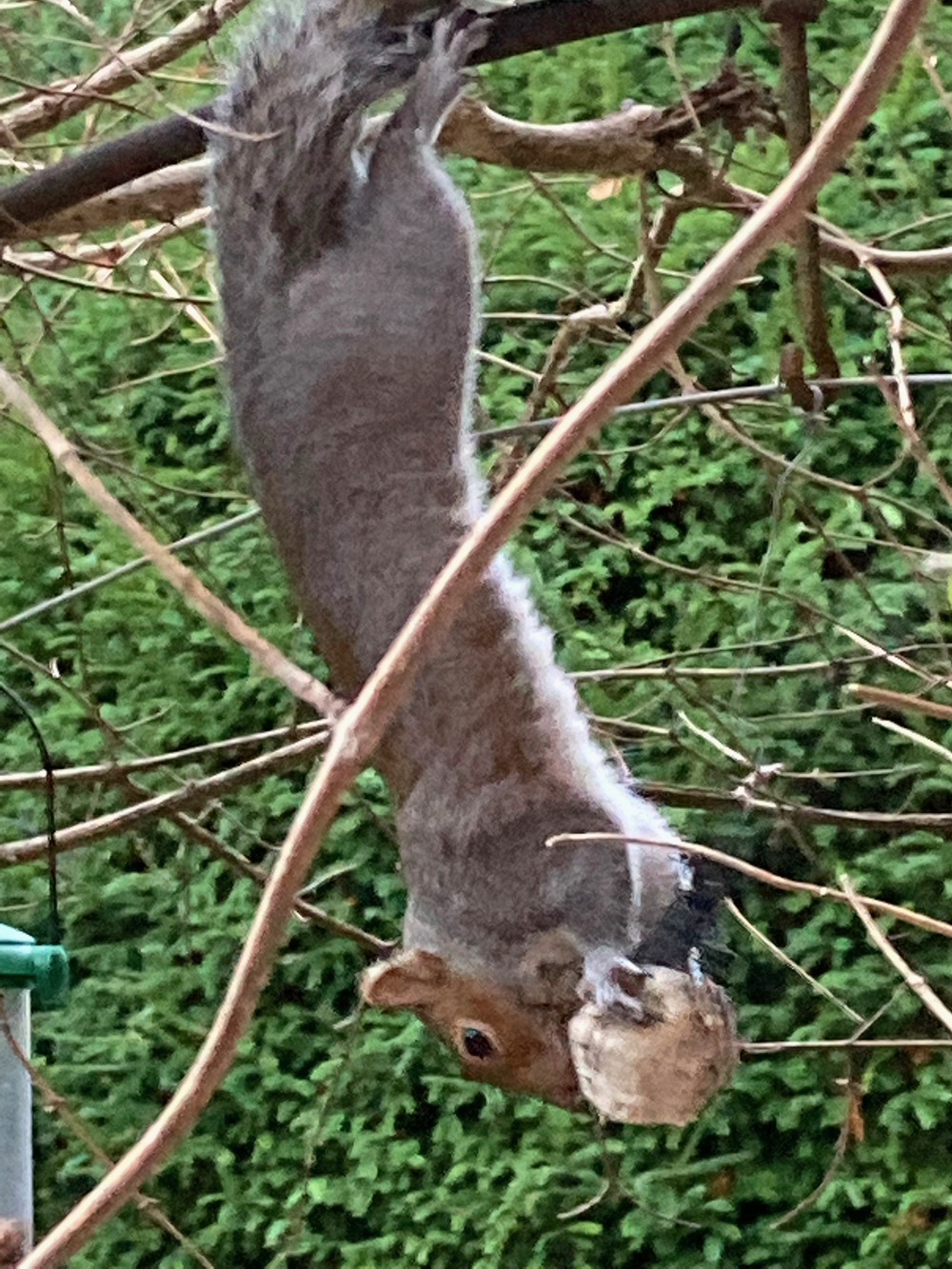
The only noticeable activity in the woods were the squirrels chasing each other up and down trees. One of their cousins lives in our garden and has been caught eating the fatball left out for the bluetits, but here in the Frith they seem to feed mainly on chestnuts. But I was too concerned with the studio to take in the flora and fauna.

I believe that I was so burdened by these thoughts that I went to bed that night and muttered the magical words that all potters do when they seek help; “hydrous aluminium phyllosilicates.” I fell into a deep sleep but awoke when I felt the presence of someone else in the room. It was, of course, St Spyridon, patron saint of potters, former shepherd and Bishop of Trymithous (c. 270 – 348), responsible for marketing at Peter Arscott Ceramics, who you may remember from a previous blog (passim December 2020).

Marketing strategy meeting

I knew it was him from the strange shepherd’s woven straw hat and the smell of sheep.

“This better be good”, he said, “you do realize I’m only for emergencies, don’t you?’

I nodded and told him about my worries. He rolled his eyes in a “seen it all before” way and took a cigarette out of a pouch and lit it, inhaling deeply.

“You don’t mind, do you? I really needed one after what I’ve just been through – a game of poker with Freud, Mohamed Ali and Mother Teresa, and they were fleecing me. Lucky you summoned me.”

Cecilia Colman, London

He blew the smoke up towards the ceiling, and continued:

“All your problems will be sorted by tomorrow. They are of little consequence compared with your pathetic marketing strategy however, which, despite my best advice, I see you have ignored.”

“The blog is still a little text-heavy,” I admitted.

“The more images, the lighter the blog. Vision trumps all senses; the human brain can process entire images in as little as 13 milliseconds.”

Taken aback as ever by the modern approach of this two thousand year-old holy man, I could only shrug and ask:

“So, how are things up in… Heaven, or wherever it you dead go to?”

“Fine, thank you. I’ve joined a club since I last saw you. It’s one for patron saints only, quite exclusive. We meet and swap stories. Why, last time St Blaise was telling us how he became patron saint of those with throat troubles after he cured a child who was choking on a fish bone.”

“Interesting. Anyway, you say the kiln will fire OK tomorrow?”

“Well, you might have to get an electrician for that.”

“Oh, I hoped you’d just snap your fingers and fix it.”

“I’m not a magician, you know, I’m a patron saint.”

“I’m disappointed.”

“I can get St Eligius to recommend one.”

“Who’s he then?”

“St Eligius? He’s the patron saint of electricians.’

“OK. Thank you. By the way, are you coming to the company Christmas party?”

“Er, no, I can’t. I’d be breaking the rules.”

“Covid?”

“No. We can only appear directly to one earthling at a time.’

“Ah,” I said, “but the other two guests will be Thelonious, who is the pottery pugmill, and Ziggy, who is the studio spider in charge of security, so strictly speaking …”

“Sorry, a spider is still an earthling.’

“OK.”

“I must go now. We’re putting on a Christmas panto and there’s a rehearsal.  Socrates will be surprisingly good as Aladdin, you know, and James Dean is playing Wishee Washee and John Wayne is Widow Twankey.”

Before I could ask him what part he was playing, he disappeared.

In the morning I had to face the inevitable accusations from my wife of smoking in bed and allowing sheep into the house, but as I entered the studio, I saw that the squirrel was running along its roof, which explained the unfamiliar sounds coming from the ceiling, and when I turned the handle of the door, I saw the latch was stuck, which explained the door always being open.

lost but now found vase

I went to the shed to get a screwdriver and saw in the shadowy depths along the bottom shelf all the “missing” ceramics that I had stored away and then forgotten during the Covid stockpiling. And when I opened the kiln to see the result of a glaze firing, I saw that everything was back to normal, the clock on my digital radio flashing away telling me that there had been a power cut which had gone unnoticed by me, which is why that previous firing had been a disaster. Good old Spyro – always right, in the end.

Happily just out of the kiln

One of the vases that came out of the kiln has some cheery colours that chime with the seasonal good wishes. By now in a celebratory mood, and in honour of St Spyro, I decided to do some serious research into a cocktail that might do the same.

a St Spyros – save the olive till last

To start with you need a bottle of Mastic Tears, a liqueur made from mastiha trees near Olympoi village, one of the mastic villages, on the island of Chios. It was given to me by my niece’s Greek partner, and I accept that not everyone has a bottle in their cellar. A generous slug in a tumbler, a smaller slug of sugar syrup, ice, some soda, a dash of orange bitters, a sprig of thyme and a black olive. I’m calling it a St Spyros. It’s quite interesting. The olive is particularly good at the end.


Peter Arscott Ceramics wish you all a happy Christmas. And If you live in or near Worcester, London, Chichester, Hove, Lymington or Cambridge and you are looking for that original gift, then why not drop in at the galleries whose names caption the ceramic images scattered throughout this blog?

Thelonious the Pugmill

Ziggy, Head of Security

Cheers. Here’s looking forward to 2022, and hoping it surprises us by bringing pleasure, gladness and delight. After all, the number 22 indicates that your angels have your back and are ready to help you in whatever way they can (apparently it is an “Angel Number”).

kalá Christoúgenna