Posts

Ceramics – Form or Function

St John’s Wood in London. Most people think of Lord’s Cricket ground and long sunny evenings watching a game and sipping beer, or perhaps a stroll through beautiful Regent’s Park. Others conjure up the image of the Beatles on the now famous zebra crossing  outside Abbey Road studios – those old enough will remember the mystery surrounding the image and  the rumours of Paul’s death; after all, why else would he be barefoot, and doesn’t George represent  the carpenter who made the coffin, John the religious figure conducting the ceremony, Ringo the undertaker?  However, I mention it because like all zebra crossings, it is black and white, and thus a clumsy introduction to my theme. Bear with me.

I still do not know for sure whether those of you who buy Peter Arscott Ceramics (PAC) do so because you want a vase in the house to put flowers in, or whether you just want the piece because it’s a particular colour and shape you find attractive, or eye-catching, its use as a vase thus being secondary. I suspect it is the latter.

Monochrome vase at Cecilia Colman Gallery

All this head-scratching comes from one piece which a lot of people do not like, while others do. For starters it is unlike the typical PAC piece in that it’s black and white, and its shape or form does not seek a harmonious balance in the whole, but rather rejects it. All of which makes it sound like sculpture, which it is not – it’s still a vase.

Monochrome vase, verso.

As you probably already know, at PAC each piece is made by hand, each piece is a unique one-off since nothing is made twice, nor is function strictly observed – the pot or vase is seen as a form you can play with, PAC having moved away from the potter’s wheel to focus on hand-built forms, as this technique allows much more freedom for expression.

Vine vase at Cecilai Colman Gallery

Some of the pieces have a singular lop-sided stance; improvisation takes place either in cutting out the rolled clay shapes, or later when painting oxides onto their surfaces. The approach to clay is that of a painter’s, and the forms arrived at often work as sculptures or as shaped surfaces with paintings. In other words, its function as a vase is secondary when being made.

Frond vase at Cecilia Colman Gallery

Now, if you want something to perform a function, you want it to perform well. If it doesn’t, you’re probably going to stop using it or ask for your money back, no matter how good it looks. This has yet to be a problem at PAC – never has a vase been returned because it hasn’t functioned as a vase. However, if you hate the way a product looks, you’re less likely to buy it in the first place.

Vase 54 at Cecilia Colman Gallerey

The main distinction between art and design is that design must have a purpose. Art can have no other reason for existing other than to be to viewed, say, or experienced (probably contentious, but some of you will let me know). However, design requires a function. If the design is visually striking, then it may also be dipping its toes in the ocean of art, because often art and design overlap. However, without function, it’s just form – it’s not design but art.

Dave as flower pot

Anyway, it doesn’t really matter. Your eyes tell you whether you like it or not – and that is that. So, if you are in London, go to Cecilia Colman’s gallery and test your eyes. Cecilia is showing some PAC ceramics, including the much maligned monochrome piece. See what you think. You could combine it with a visit to Regent’s Park Zoo, or a nice meal out at one of the restaurants on St John’s Wood High Street (nearest underground station is St John’s Wood).

Ming Dynasty, Jiajing: 1522 – 1666

Of course, you will know if a piece is a genuine Peter Arscott Ceramic by the stamp on the bottom of each piece. Stamps are important for dating and authenticating ceramics. The one above belongs to the time of Jiajing’s reign, a man infatuated with women, known to be a cruel emperor who lived in isolation while ignoring state affairs. This eventually led to corruption at all levels of the Ming government, and to a plot by his concubines to assassinate him in 1542, by strangling him while he slept. Sadly, the plot failed and all of the concubines were executed.

Peter Arscott Ceramics, 2022,

The next stamp above is of the early 21st century, probably during the reign of Jon Son, a man who survived many plots, and belongs to a small ceramic workshop based in Herefordshire that produced rare, unique and now much sought-after vases in stoneware.

Cecilia Colman gallery – over 40 years of experience

Having mentioned The Beatles, it is only fair to finish with The Rolling Stones whose 1965 song “Play with Fire” contains the following lyrics:

Your mother she’s an heiress, owns a block in Saint John’s Wood
And your father’d be there with her
If he only could

Click here to hear them sing it.

The jumble vases of Mud Month

panoramic view from Bradlow Knoll

Apologies for the brevity of this month’s blog, which like the month of February itself, seems shorter than others and lacking a defined personality. Unfair really. After all, had it retained its original Old English name of Kale-monath it would be forever associated with brassica as Cabbage Month, which we can assume was the daily culinary highlight for the medieval English but must have been an off-putting addition to the domestic winter fug within.

muddy path

The other Old English name was Solmonath, which literally means “mud month.” Whichever way you look at it, February does not come out smelling of roses, until the Romans arrived and thankfully renamed it . So, thank you Romans. They named it after the festival of purification called Februa, during which people were ritually washed.

jumble vase

Three facts about February: in Welsh, February is sometimes known as “y mis bach” which means “little month.” It  is the only month where it’s possible to go the entire time without having a full moon.  February frequently occurs in lists of the most commonly misspelt words in the English language

dinosaur legs

However, Frith Wood. It was a cold day, as you can probably tell by the images, and my powers of observation were subdued. The only thing that drew me out of my reverie was the appearance of two giant dinosaur legs wearing green socks. The “green socks” of moss around the two tree trunks struck me as strange. The moss seems to only grow to a certain height before it applies the brakes and comes to a dead halt: “this far and no more”. Possible explanation? The air within 60 centimetres of the ground is moist because water is constantly evaporating from the ground, so moss, lazy like everybody else, just hunkers down and laps it up. Anybody with a better or more scientific explanation please tell us.

another jumble vase

So, to ceramics (about time, says Spiro). Two larger-than-usual vases came out of the kiln this month, and they do look different. They are part of a series called “jumble vases”, made from stoneware slab-rolled and cut into different shapes which are then applied to each other in such a way that the final piece looks as if it’s made from five or six different vases.

jumble vase showing its decals

After the piece is bisque-fired, each “fragment” is hand painted, then the whole piece is dipped in transparent glaze and fired at the usual 1275 degrees. When it comes out, the areas that have been deliberately left blank then have decals applied. These are fine transparent designs which are soaked in water then carefully placed on the glazed surface. Then the vase goes back into the kiln and fired to 800 degrees.

jumble vase 2

They are sculptural, visually arresting, but also practical, since you can fill them with water and put plants (or other things) in them.

things to put in a jumble vase

Lastly, if you’ve ever heard of flash-fiction (a self-contained story under six hundred words, in this case) and you are interested enough, you can read one of my stories at 365 Tomorrows by clicking here. They are an online site publishing science fiction in all its incarnations, from hard sci-fi to cyberpunk and beyond.

cyberpunk (benign)

Spring is around the corner, snowdrops have appeared, crocuses are out, next the daffs, and then it’s Summer. Antio sas, as Spiro the Greek says.

crocus sativus

Arscott’s ceramic wanderings

cloud vase petulant

I found myself wandering about in the grounds of a ruined castle, somewhere near the Welsh border, probably Skenfrith, or White Castle, when I came upon an open enclosure, the portcullis and dry moat lay ahead and the grassy area was walled in and contained a massive oak tree. But what most intrigued me a very large vase that stood in the middle – it was familiar to me, in fact one of my own pieces called Cloud Vase, but it was huge.

“What are you doing here?” I asked it, I don’t know why.

“I could ask you the same thing”, it answered rather petulantly.

“But what has happened?”  I was very confused.

“Nothing much. What’s up with you?”

“Nothing. What do you mean?”

“Well, look at yourself. You’re stark naked.”

I looked down and saw this was the case. Which is when, thankfully, I woke up.

vine vase in the Welsh hills

This is how reality, or the day to day, elbows its way into your sleep and there’s always some reason behind it. In this case I blame Mr Dale Chihuly. Let me explain.

dream vase at Cecilia Colman’s

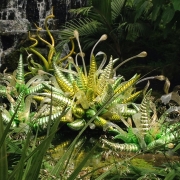
On the way back from leaving some ceramics with the Cecilia Colman Gallery in St John’s Wood (see June 2018 blog), a friend suggested we visit Kew Gardens and look at the exhibition of glass sculpture by Dale Chihuly, Emperor of Blown Glass, whose work he often sites in natural settings, landscape or gardens, and whose technique, as he says himself ( he doesn’t like to use a lot of tools), it is all about fire, gravity and centrifugal force: “It’s these natural elements that make the pieces begin to look like they were made by nature”.

Chehuly’s Persian Column in the Temperate House at Kew

This outdoor exhibition brings together work from the past 50 years, the only site-specific piece being the Persian Column suspended from the roof of the Temperate House.

Lime Chrystal Tower

Main ingredients of glass?  Liquid sand, or rather sand, soda and limestone. melted at around 1320 degrees Celsius. This makes a typical glass which can be formed by blowing by mouth or machine, by casting, by pressing and by drawing.

Glass Hornets in the pond at the Temperate House viewed from the gallery

So, it’s a cousin of stoneware, which is also fired at a high temperature and is essentially a vitreous ceramic made from naturally occurring stoneware clay containing kaolinite, mica and quartz, and is thus water resistant and frost proof – like the pieces I make, only mine are really for a domestic setting, though what if….?

Sapphire Star

How big could a ceramic sculpture be, I wondered? The glass work on view is large, and mainly made out of many hand blown pieces which are carefully slipped onto steel rods that stand out from an inner steel core or tube planted deep into the ground. Like the Summer Sun by the lake, or the Sapphire Star by the Victoria Gate entrance. They are very large and dominating, and impressive. Which is why I ended up dreaming about man made ceramics in outdoor settings.

Summer Sun

If you haven’t been to Kew, you have a treat awaiting. It is a garden that houses the largest and most diverse botanical collections in the world (30,000 different kinds of plants), a World Heritage Centre, 132 hectares of gardens, glasshouses, listed buildings and the fabulous Palm House built in 1848. Parking is challenging unless you go early, otherwise it is best to arrive on the underground, either Kew Station or Richmond. The sandwiches are good.

small vine vase at Cecilia Colman’s

So, back to nocturnal wanderings of the mind, finding yourself in a state of undress in a dream is no big thing, nothing to worry about. Everybody has had one of these dreams, or at least that’s what the giant vase on the hill tells me.

giant vase that tells me things

array of glazed fine art ceramic bowls by belatrova

Far from the Madding Crowd

photo of people swimming in Mallorca

far from the madding crowd

Heat has a strange effect on some humans. When temperatures hit a high, as they did this August in many parts of Europe and the Mediterranean, confusion and dizziness set in, common effects of too much exposure to extreme heat because of increased blood flow to dilated blood vessels and fluid loss through sweating. This sometimes happens to belatrova when the kiln is going full blast and ceramic production is in full flow as we try to feed the insatiable appetite for our products – on the other hand a cold Dry Martini often wards off any lasting effects.

dry landscape of Mallorca

Mallorca inland

This August was an excuse to go abroad for a break before moving into the new workshop in Ledbury (about which more in the next blog).

watercolour of Mallorca

towards the monastery of Sant Salvador

Mallorca is a beautiful island that has lured many foreigners over the years, from Chopin to Robert Graves, and, this year, belatrova. But mass tourism is affecting it much as it is elsewhere. Barcelona, Venice, Edinburgh, Lisbon, Dubrovnik, Skye are all examples of unmanageable jam-packed destinations filled with visitors on holiday. ” Tourist: your luxury trip / my daily misery“, says a placard in the Parque Guell (Barcelona). “Tourists go home. Refugees welcome” was the graffiti that greeted us as we drove to Felanitx for our week in Mallorca.

pool shadow

tourist

And who can blame residents when all anyone can do on the beautiful beaches and calas is to stand waist-deep in the water surrounded on all sides by others similarly engaged in staring at the horizon with arms folded and wondering how to escape – we did find a great spot though, as you can see from the first image.

drawing of tourist on mobile

tourist with mobile

Go inland and the atmosphere changes and the landscape is an engaging mixture of the agricultural and dramatic, from fertile farmland and Aleppo pine forests to the limestone mountains of the Serra de Tramuntana and the summer flowering of oleander, hibiscus, marigolds and orchids.


cacti

away from the tourists

If you really want to get away from any crowds, we recommend a visit to Botanicactus, a cactus sanctuary (though belatrova believes they are quite capable of defending themselves) where the cacti flourish in the dry and sunny climate and the landscape has been specifically designed to protect the plants, with the creation of the artificial lake and raised terraces protecting the plants from the wind. While everyone is at the beach you can wander about in perfect solitude surrounded by these giant prickly beings.


glazed bowl with painting

belatrova’s Miró bowl

Among the many artists associated with the island is Joan Miró, painter, sculptor and ceramicist born in Barcelona, but resident in the latter part of his long life in Palma where he bequeathed a collection that is the basis for his Fundació Joan Miró which we visited one morning.


retro 1950s style bowl

retro bowl (three legs)

It is a purpose-built exhibition space that uses thinly cut alabaster as a source of light into the rooms and has pools of water outside in the gardens that reflect their own light through low cut openings at floor level – and the whole complex stands on a hill overlooking the bay of Palma. We watched white sails racing each other in the distance, the ferry from Barcelona ploughing its way to the docks, and three giant cruise ships blocking part of the harbour architecture as they disgorged their passengers into the city for the day.


fundació Joan Miró

But back to Miró; tiny forms in huge empty spaces, deep blue cerulean sky-like canvases, crescent moons, birds, meandering shapes, his work is captivating and has inevitably inspired belatrova, back in Herefordshire, to make a few ceramics in his style.

array of bowls by belatrova

inspired bowls

If you’d like to see them come and pay us a visit at our old workshop at No9 Bankside Studios during hArt, which runs from Saturday 9th to Sunday 17th (open daily 10 – 5pm), just follow the red hArt signs in Ledbury, or use the postcode: HR8 2DR. You are most welcome. As the hArt website says: “Meet hundreds of individual artists, see an array of artwork across the county in the city and countryside, in fabulous locations such as manor houses, historic barns, farms, churches and beautiful gardens.”

 Finally, belatrova shed a tear on learning of the death of Walter Becker, guitarist and composer, who with Donald Fagen was one half of the unforgettable Steely Dan. We invite you to click here and listen to one of their middle period songs (skip the ad): subtle player that he was, technically dexterous, meticulous master of the instrumental gesture and never a grand-stander, “some of his most intriguing work is embedded in the background – the architectural arpeggios of “Aja,” or the wry, blues-tinged asides that dot the margins of “Hey Nineteen.” (Tom Moon / NPR Music)

Many a bowl was made listening to Walter on his guitar.

When all the dime dancing is through,                                                                                                                              I run to you..

elephant on the keyboard

With an Open Summer Weekend (Sat 2nd and Sun 3rd July) just around the corner, something happened at the Bankside Studio recently. The ghost of Thelonius Monk made itself known and whispered strange and wonderful things into the ears of belatrova as we were making a batch of three legged bowls. Perhaps “Ruby my Dear” was playing on the cd player, whatever it was it made our hands dance and the unintended clay shapes seemed to be spot on. “What about the three legged bowls?” we hear concerned belatrovians ask. Well, we did make them, though a few days later, after we had returned from Monkland.

ceramic pot
ceramic pot
ceramic pot

belatrova team

Thelonius Pugmill and two friends

Taking a brief trip to Monkland is highly recommended: you will come back refreshed and brimming with more ideas than usual. It is liberating to make pieces without worrying about the end result, and if one piece turns out to be a failure then the next one will be stronger for it. In this we were aided and abetted by our hard working pug mill who, as some of you may remember, is called “Thelonius” and who is by far the hardest working member of the team.

For a ceramicist, going to Monkland means that you accept one condition only – that there is no wrong way to make ceramics. This is how you have to approach the lump of clay, just as Thelonius Monk approached his piano. As he saw it, “The piano ain’t got no wrong notes!” and this explains his unique jazz style, which includes percussive playing, unusual repetitions and dissonant sounds, and a surprising use of silences and hesitations. Click here to listen to “Don’t blame me” where there is a fine example of his style.
ceramic potceramic pot
He also had the habit during performances that while the other musicians in the band continued playing he would stop, stand up from the keyboard, and dance for a few moments before returning to the piano. It was in this spirit that one of our team tried to show his fellow potters how to dance a jig while violently flattening clay with a rolling pin and, at the same time, sipping tea from a mug.
blue ceramic piece
ceramic piece by belatrova
large ceramic pot

A debate followed as to whether this performance was a fine example of syncopation made flesh, since in music, syncopation involves a variety of rhythms which are in some way unexpected, thus making a tune or piece of music off-beat – “a disturbance or interruption of the regular flow of rhythm”. We agreed this was the case, and that it would be incorporated into a piece, which in turn would be entitled: “Thelonius made me do it“, subsequently the title for the whole series.

ceramic blue jug
ceramic piece by belatrova
blue ceramic jug

Many of you will want to see this growing collection of freewheeling pottery, and we would like to show it to you, so make an entry in your diaries for Saturday 2nd and Sunday 3rd of July (10 – 5pm) when we will be opening the workshop for our Summer Weekend.

Philip Larkin

Philip

elephant on the keyboard

Nellie

And we will also be showing our bowls, lamps, tables and birdbaths, as well as our new range of wave bowls and scoop bowls, because not everybody loves Thelonius as much as we do. Philip Larkin, a much better poet than jazz critic, considered Thelonius Monk nothing more than “the elephant on the keyboard”, but Monk is the second most recorded Jazz composer of all time, right after Duke Ellington. So put that in your pipe and smoke it, Philip – and just to rub it in, here is a link to a short video of the Thelonius pots spinning to “‘Round Midnight” arranged for saxophone quartet by Quartetto di Sassofoni Accademia, with no piano or elephant.
Thelonius Monk

PS  belatrova will be under the Ledbury Market House this Saturday and every Saturday in June – if you are in the area drop by and say hello.

PPS. We would like to thank “Botloes” for giving us such a great review on Houzz – we wonder if this mystery personality might reveal herself or himself?

Hasta luego.

golfing for muralistas

cave drawings

Chauvet cave – 30,000 year-old mural

Winter is closing in, but thoughts of warm Mediterranean weather have been circulating in the collective mind of belatrova. As well as making lamps and coasters for next year, we have been commissioned to create a ceramic mural for a house in Spain, and have been given a generously open brief.

Conventionally, a mural is any piece of artwork painted or applied directly on a wall, ceiling or other large permanent surface. And ceramic murals are traditionally made from tiles, but strictly speaking belatrova’s work will be a ceramic wall sculpture made from ceramic pieces using the wall space as a canvas and allowing the blank areas of the wall to play their part in the overall composition.

ceramic pieces for wall mural

detail- legging it to Spain


The pieces are of different shapes and sizes, some abstract, some representational, and will be slab rolled as flat as possible without causing them to crack in the kiln – the larger the piece the more likely it is to warp or fracture in the heat, specially if there are stress points in the making which do not show up before biscuiting. Some preliminary tests have taken place, with interesting results. Here is a tantalizing detail of pieces so far that we have glazed (left).

And here below is a piece that nearly made it but cracked during glazing:

ceramic skull

notice the crack between the eyes


The wall space is above a doorway in a hall and measures more than 2 x 3 metres. Foolish members of the team are very keen to accompany the pieces and install them, and have ostentatiously been bringing golf clubs into work to practice their swings because, you see, the house in question is next door to Spain’s best known golf course, Valderrama.

man holdin ceramic mask to face

the ceramicist’s silent scream


engraving of dead stag

Rudolph hit by golf ball

golf ball

ball


belatrova did once play golf, in Richmond Park, and hit a deer with the only ball he managed to get into the air.


However, all this is in the future. What about the present? Well, it is an easy step from ceramic coaster making to tiles, and from tiles to tables with tiled tops. This is our first metal-framed coffee table with a ceramic surface made of nine glazed tiles in the Brushstroke Blues range. There will be more to come.

coffee table with tiled surface

tiled table in Brushstroke Blues

ceramic coaster

coaster


tile

tile


belatrova wishes all its supporters a very happy Christmas and a prosperous New Year. 2015 promises to be an even better year for us and we hope that will be true for all of you too.

holly