Posts

A Stoneware Wolf in a China Shop

towards Paincastle

Delivering ceramics is a way to get to know a country. I found myself in the car, ceramic pieces carefully packed in boxes at the back, on a narrow road in the Welsh countryside of Powys, marooned in a sea of wool as a flock of sheep was driven to an adjacent field by two men and a woman. It was warm enough to have the windows open and as the woman walked by, I asked her what breed they were (the sheep, not the people). Badger Face Welsh Mountain was the reply. I nodded sagely, as if I knew my sheep.

green vs brown

The countryside I was driving through was an upland area above the Wye River and I was on my way to Erwood but had allowed the satnav to dictate terms, so instead of going the direct way, I was doing the “picturesque” route via Paincastle, which meant dealing with slow, winding, single track lanes in an undulating landscape,  but it also presented me with the unexpected opportunity to enjoy a rural backdrop that seems little touched by man…. until you realize that the place owes its personality to the sheep that graze it and the farmers that have shaped it through the ages. On this particular early Spring morning the sky was bright and clear, and the green was taking over from the Winter grey and the brown bracken. Clean air and only a whiff of sheep.

clean air

inside one of the Erwood carriages

Erwood itself is tiny but used to have its own train station until 1962. Nowadays, three railway carriages from the 1880s mark the spot, and form part of the largest privately-run contemporary applied arts gallery in Wales, the Erwood Station Gallery. There’s even a diesel locomotive from 1939 parked outside, a restored Fowler 0-6-0 engine. It is only a few yards from the Wye river, and attracts not only anglers, but also walkers and cyclists.

Fowler 0-6-0

A stone’s throw from Erwood is the village of Crickadarn, which was the remote “East Proctor” in the cult film “An American Werewolf in London”. The gory scenes on the lonely moors with the rampant lycanthrope feasting on Badger Face Welsh were all shot in the nearby Black Mountains, but a Stoneware Wolf (yes, sorry) would undoubtedly calm down at the site of the ceramics on offer at the Erwood Station Gallery. Unless there is a full moon, in which case there would be little chance of protecting the fabulous pieces on show from any lupine loss of control.

Werewolf thrilled at having found an Arscott ceramic

By the way, if you have recently developed a craving for raw meat and a sudden fear of water, have begun ripping your clothes off during a full moon, have a unibrow across your forehead, find yourself screaming with anger when it’s nothing to do with Brexit, then you may well be a werewolf. Click here to see what happens during a full moon – warning: remember it’s all pretend.

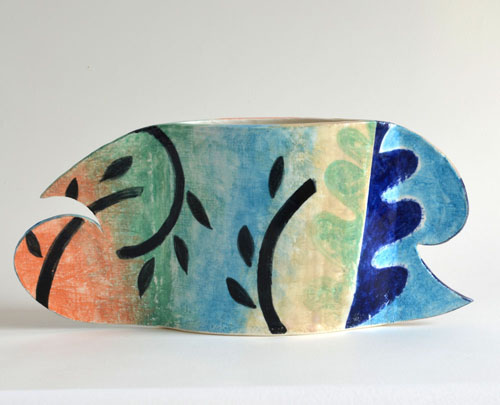
Some of the pieces on view at the gallery:

fish vase

ivy vase

Following your visit to Erwood you may well want to have a meal, in which case Hay-on-Wye is 20 minutes away by car. There you could spend a whole day just browsing in the bookshops for which it is famous, visiting the Erwood sister gallery, the Lion Street gallery, mainly showing the work of Welsh artists, or prowling around the open market (Thursdays only). Or you can hire a canoe and paddle down the Wye – if you are lucky you will catch sight of a flash of brilliant blue and green dropping into the water. A kingfisher.

early morning River Wye

Worcester’s ceramics, swans and sauce.

Arscott at the Bevere Gallery

You would not normally associate the city of Worcester (pronounced Wuster) with the pong of rotting fish and other ingredients, but it is thanks to a certain Lord Sandys in the 1830s that two local chemists, John Wheeley Lea and William Henry Perrins were approached  and paid to come up with an anchovy-based sauce that the former had tasted in India and which he wanted to have made. However, it was deemed to be a disappointing flop and abandoned in a barrel, only to be rediscovered many months later and, to everyone’s surprise, the taste had mellowed into what we know as Worcestershire Sauce. To this day, the ingredients are allowed to ‘mature’ for 18 months before being blended and bottled in Worcester.

Best in a Bloody Mary

Those of you unfamiliar with this dark brown liquid will want to know what you do with it. Well, I like to sprinkle it into the mincemeat when a making Cottage Pie. Or Spaghetti Bolognaise: pour it in to the mince whilst it is simmering away and add a nice big splash just before you serve it up.  The company suggests a splash Worcestershire sauce in your baked beans, or your fish and chips, even in your green salad. They seem to imply that it goes with pretty much anything, but I would personally keep it well away from, say, bananas, or ice cream, or Spotted Dick. Whatever you do, do not sprinkle it into your single malt whisky, but a drop or two in a Bloody Mary is a must. Above is a picture of the sauce; the watch strap is not a Rolex but a cheap one I bought locally. I wouldn’t want you to think that I’m making a fortune out of my ceramics

Worcester Cathedral from the river

I expect you know why I’m going on about Worcester – I was delivering ceramics to the Bevere Gallery, which meant driving on the bridge over the River Severn into the city with the Cathedral sitting impressively over the dark water away to the right. The bright white specks floating about in the almost Worcester Sauce – coloured river are swans, which are always here because for many years the area between the railway viaduct and the Worcester Cathedral Ferry has been designated as a Swan Sanctuary. There is now a large and healthy population of Mute Swans on the water. Fishing in this area is banned and the swans are supported by a number of organisations including the City Council. The local Tourist Board extols “the natural beauty and general friendliness of these swans”. Note the word “general” – in other words, keep away from them or they could turn nasty, like the notorious one in Cambridge called Mr Asbo (Anti-Social Behaviour Order) that had to be deported because it kept attacking people and boats. But, yes, they do look spectacular in the river.

Mr Asbo strikes again

There was no time to stop at the cathedral and say hello to King John who was buried here in 1216 after contracting dysentery in Lynn. John is most famous for agreeing to the Magna Carta, which was a charter of demands made by John’s rebellious barons and the basis for much of our present rights as individuals. When he died he had lost most of his French lands, and was in the midst of a civil war against many of his own barons, though the current consensus is that John was a hard-working administrator, an able man, an able general, albeit with distasteful, even dangerous personality traits, including pettiness, spitefulness and cruelty, which is why he is always the “baddie” in the Robin Hood movies. Anyway, here’s a picture of him getting angry because someone forgot to put the top back on his bottle of Worcester Sauce.

Bad, bad King John

But I digress. I was on my way to the Bevere Gallery, an oasis of ceramic calm on the outskirts of the city, where visitors can really enjoy a high quality and varied selection of pieces on display and then sit down in the café and enjoy what’s on offer (the food is very good). Bevere is the name of an island in the Severn, 2 ½ miles N of Worcester. It is supposed to have been a resort of beavers; was a retreat of the inhabitants of Worcester during the plague of 1637; and is now, they say, a good bathing-place. It commands a fine view of the Abberley and the Malvern hills.

“Interior” vase at Bevere

And talking of ceramics, how could I not mention Royal Worcester porcelain which used to be made here in the 18th century until the Severn Street factory was closed down in 2006? One of its best-sellers was the Evesham Gold series, and samples can be seen at the Museum of Royal Worcester. There were various factories each producing distinctive wares: Flight and Barr, Chamberlain, Hadley and Sons, Kerr and Binns, Grainger and Dr Wall ( Dr John Wall perfected a recipe for porcelain that could withstand boiling water and this discovery led to the fame of the factory).

Evesham Gold

But back to the Bevere Gallery. Informality is an essential element here. You are encouraged to look at, handle and talk freely and openly about what you see – you can be as rude or polite as you like. Stuart and Clare like to engage and talk about the making and creative process. They also hold a Makers’ Lunch, an informal opportunity to talk with ceramicists and artists whose work is exhibited; an unpredictable two hours of conversation with open and frank discourse with the invited maker. They would be very happy to welcome you.

Crouch vase at Bevere

12 hours in London (is like a year in any other place)

derelict Victorian Public Toilets into a cracking little pub.

A quick overnight trip to London was called for, ceramics to be delivered in the morning to the Cecilia Colman Gallery, so arrival was late in the evening – the idea being to spend the night and get up early.

closing time at Pueblito Paisa

London is an extraordinary place, which is why I found myself late that night somewhere in Haringey eating aborrajado (deep-fried stuffed plantains) and empanaditas (meat turnovers) all washed down with cold Colombian beer. The city is ever shifting, neighbourhoods seem to change overnight from the down-at-heel to the slickly bourgeois, and this perpetual construction of flats for the professionals, the foreign “land bankers” and who knows who else seems to be hitting Seven Sisters, so that the little restaurant we were eating at is now in danger, along with its neighbouring businesses, of making way for another redevelopment scheme.

ceviche

Within this large building more than 100 Latin American traders have created a busy complex of cafes, butchers, travel agencies, restaurants, clothes shops and greengrocers all under one roof, and is a fine example of a city that can boast to being the most multicultural place in the planet.

Relocation is promised, but everyone knows that it would never provide the genuine atmosphere that exists when people unselfconsciously transform a place through the need to make a living and make use of their own experiences and backgrounds. It is called Pueblito Paisa, and long may it thrive. Pay it a visit and try the ceviche.

passers-by outside the High Cross pub

We then walked a couple of blocks to a solid Victorian public toilet. This very hospitable place turned out to be a pub, recently converted, and we sat down outside under a cherry tree to drink and watch the night traffic flow by, mostly double deckers and taxis, and pedestrians of all shapes, sizes and diversity, track suits, hijab, business suits, shorts, sauntered past us.

At one point we looked at the shrubbery at the base of the cherry tree and were startled by the untroubled gaze of a fox which gave up on us and turned away.

the canal, early morning

The next morning a visit to Tottenham Hale and the canal that runs alongside the Walthamstow wetlands offered a complete contrast to the urban activity of the night before. Here all was placid and calm, and, if it had not been for the trains, it was easy to imagine you were in the countryside.

Cecilia’s place

And then the trip to St John’s Wood to visit the Cecilia Colman Gallery. Another contrast: spacious Regent’s Park, the London Zoo, the Regent’s Park mosque, Lord’s cricket ground, and St John’s Wood High Street with its cafes and shops – a small world away from edgier Haringey, but cosmopolitan nevertheless.

small three legged bowl at Cecila Colman’s

The Gallery has been in London for forty years having opened in 1977 and is one of the few remaining shops on St John’s Wood High Street which survived the transformation of the area in the last few decades. Cecilia chooses all the pieces and artists herself and is passionate about the work she exhibits. She chose eight recent Arscott ceramic pieces – do drop in to have a look.

large stoneware vase

On another note, we are all very pleased that CUP ceramics project (see previous blog) hit its crowdfunding target with 5 days to spare. Over 90 people pledged contributions, an excellent indication of the support for an open-access studio providing a creative community for all types of ceramicists to share skills and ideas in a relaxed environment

blue vase

array of glazed fine art ceramic bowls by belatrova

Far from the Madding Crowd

photo of people swimming in Mallorca

far from the madding crowd

Heat has a strange effect on some humans. When temperatures hit a high, as they did this August in many parts of Europe and the Mediterranean, confusion and dizziness set in, common effects of too much exposure to extreme heat because of increased blood flow to dilated blood vessels and fluid loss through sweating. This sometimes happens to belatrova when the kiln is going full blast and ceramic production is in full flow as we try to feed the insatiable appetite for our products – on the other hand a cold Dry Martini often wards off any lasting effects.

dry landscape of Mallorca

Mallorca inland

This August was an excuse to go abroad for a break before moving into the new workshop in Ledbury (about which more in the next blog).

watercolour of Mallorca

towards the monastery of Sant Salvador

Mallorca is a beautiful island that has lured many foreigners over the years, from Chopin to Robert Graves, and, this year, belatrova. But mass tourism is affecting it much as it is elsewhere. Barcelona, Venice, Edinburgh, Lisbon, Dubrovnik, Skye are all examples of unmanageable jam-packed destinations filled with visitors on holiday. ” Tourist: your luxury trip / my daily misery“, says a placard in the Parque Guell (Barcelona). “Tourists go home. Refugees welcome” was the graffiti that greeted us as we drove to Felanitx for our week in Mallorca.

pool shadow

tourist

And who can blame residents when all anyone can do on the beautiful beaches and calas is to stand waist-deep in the water surrounded on all sides by others similarly engaged in staring at the horizon with arms folded and wondering how to escape – we did find a great spot though, as you can see from the first image.

drawing of tourist on mobile

tourist with mobile

Go inland and the atmosphere changes and the landscape is an engaging mixture of the agricultural and dramatic, from fertile farmland and Aleppo pine forests to the limestone mountains of the Serra de Tramuntana and the summer flowering of oleander, hibiscus, marigolds and orchids.


cacti

away from the tourists

If you really want to get away from any crowds, we recommend a visit to Botanicactus, a cactus sanctuary (though belatrova believes they are quite capable of defending themselves) where the cacti flourish in the dry and sunny climate and the landscape has been specifically designed to protect the plants, with the creation of the artificial lake and raised terraces protecting the plants from the wind. While everyone is at the beach you can wander about in perfect solitude surrounded by these giant prickly beings.


glazed bowl with painting

belatrova’s Miró bowl

Among the many artists associated with the island is Joan Miró, painter, sculptor and ceramicist born in Barcelona, but resident in the latter part of his long life in Palma where he bequeathed a collection that is the basis for his Fundació Joan Miró which we visited one morning.


retro 1950s style bowl

retro bowl (three legs)

It is a purpose-built exhibition space that uses thinly cut alabaster as a source of light into the rooms and has pools of water outside in the gardens that reflect their own light through low cut openings at floor level – and the whole complex stands on a hill overlooking the bay of Palma. We watched white sails racing each other in the distance, the ferry from Barcelona ploughing its way to the docks, and three giant cruise ships blocking part of the harbour architecture as they disgorged their passengers into the city for the day.


fundació Joan Miró

But back to Miró; tiny forms in huge empty spaces, deep blue cerulean sky-like canvases, crescent moons, birds, meandering shapes, his work is captivating and has inevitably inspired belatrova, back in Herefordshire, to make a few ceramics in his style.

array of bowls by belatrova

inspired bowls

If you’d like to see them come and pay us a visit at our old workshop at No9 Bankside Studios during hArt, which runs from Saturday 9th to Sunday 17th (open daily 10 – 5pm), just follow the red hArt signs in Ledbury, or use the postcode: HR8 2DR. You are most welcome. As the hArt website says: “Meet hundreds of individual artists, see an array of artwork across the county in the city and countryside, in fabulous locations such as manor houses, historic barns, farms, churches and beautiful gardens.”

 Finally, belatrova shed a tear on learning of the death of Walter Becker, guitarist and composer, who with Donald Fagen was one half of the unforgettable Steely Dan. We invite you to click here and listen to one of their middle period songs (skip the ad): subtle player that he was, technically dexterous, meticulous master of the instrumental gesture and never a grand-stander, “some of his most intriguing work is embedded in the background – the architectural arpeggios of “Aja,” or the wry, blues-tinged asides that dot the margins of “Hey Nineteen.” (Tom Moon / NPR Music)

Many a bowl was made listening to Walter on his guitar.

When all the dime dancing is through,                                                                                                                              I run to you..

pink pasque roses

Springing Open in April

pink pasque roses

Pasque roses in Spring

Everything is blooming in this part of the world, the sap is rising, winter’s greys are turning into varied shades of green, and cherry and apple blossom are everywhere. April is a month when things turn for the better, it even gets its name from the Latin word “to open”, describing flowers opening at springtime, though Aphrodite the goddess may also be another root for the word. Did you know that April used to be the second month of the year until January and February were invented by the Romans? No, nor did we.

Nor did we know that “April” was the 250th most common name for a baby girl in the UK, or that in the UK it is National Pet Month, or that in the US it is National Pecan Month. And our meticulous research has unearthed the following:

Zebra crossings were introduced in Britain on 4 April 1949, when James Callaghan, then parliamentary secretary to the ministry of transport in the British government, came up with ‘zebra’ as a name for the crossing which it was thought would be easily understood and remembered, particularly by vulnerable groups such as children.

Russian cosmonaut day is April 12, commemorating the astronaut Yuri Gagarin who became the first man in space on April 12, 1961 aboard Vostok 1. He spent 108 minutes in space.

And when, we hear you ask, is National Eggs Benedict Day? Why, it is on April 16th, a day to enjoy eggs with hollandaise sauce, crispy bacon and English muffins. Apparently, a lot of people have never had Eggs Benedict, but we reckon belatrovians are sophisticated and most likely to have enjoyed Eggs Benedict a number of times, and perhaps, on a regular basis. See how many of your friends can tell you how its made, or what’s in it. Or, ask them what hollandaise sauce is.
Celebrate by eating Eggs Benedict – click here to see how to make them (first get a hen).

ceramic planter with elongated corners

belatrova corner planter

All of this is just a preamble to let you know that we are holding our annual Spring Open Weekend on Saturday 22nd and Sunday 23rd April (10 – 5pm) at the Bankside Studios. You are most welcome to drop in and browse, and even though Eggs Benedict will not be on the menu, we will offer you tea, coffee and cake.

ceramic dish with goat head by Picasso

c’est ne pas un chevre

You would be hard pressed to find a spot anywhere that both makes and sells the variety of goods you can find at the Bankside Studios in Ledbury. You can step into the studio to see Fleen Doran, fresh from her successful show at the British Craft Trade Fair at Harrogate, making her salt glaze pots at the wheel, while Wendy Houghton works away at her delicate ceramic sculptures. This is the same workshop where belatrova produce ceramic planters, fruit bowls, mirrors and birdbaths next to the joinery section where Stuart Houghton busily shapes and cuts wood to perfection – at the moment he is whittling a small goat out of myrtle. Upstairs Dan Barker has his photography studio, shared with the textile designer Sunny Todd, and across the road can be found artist blacksmith Dave Preston hammering iron on his anvil – in fine contrast to Bob Evans who can be found in his studio opposite printing images of striking quality on very new and sophisticated printers.

handmade ceramic flower pot with handles

striped splash pot by belatrova

The studios are situated just behind Alfa-Tech on Little Marcle Rd, which is accessed via either Lower Rd or New St. Please follow the signs. There is limited parking on-site (and wheelchair access) and there is additional on-street parking.

large mirror with wide painted frame

large wall mirror with blue frame

The address is: Bankside Industrial Estate, Little Marcle Rd, Ledbury, Herefordshire HR8 2DR. And do please visit the Ledbury Cooperative’s website: https://www.ledburycollective.com/

poster of Spring Open weekend

For those of you who live in or close enough to London we would encourage you to visit the Cecilia Colman Gallery in St John’s Wood. It is right on the High Street and easily reached by underground. Glass is a speciality but among the many excellent pieces on show, ceramics, paintings and jewelry also have pride of place. The gallery is showing some belatrova pieces, including three legged bowls, wave fruit bowls and a large wall mirror.

Cecilia Colman Gallery

Cecilia Colman Gallery

elephant on the keyboard

With an Open Summer Weekend (Sat 2nd and Sun 3rd July) just around the corner, something happened at the Bankside Studio recently. The ghost of Thelonius Monk made itself known and whispered strange and wonderful things into the ears of belatrova as we were making a batch of three legged bowls. Perhaps “Ruby my Dear” was playing on the cd player, whatever it was it made our hands dance and the unintended clay shapes seemed to be spot on. “What about the three legged bowls?” we hear concerned belatrovians ask. Well, we did make them, though a few days later, after we had returned from Monkland.

ceramic pot
ceramic pot
ceramic pot

belatrova team

Thelonius Pugmill and two friends

Taking a brief trip to Monkland is highly recommended: you will come back refreshed and brimming with more ideas than usual. It is liberating to make pieces without worrying about the end result, and if one piece turns out to be a failure then the next one will be stronger for it. In this we were aided and abetted by our hard working pug mill who, as some of you may remember, is called “Thelonius” and who is by far the hardest working member of the team.

For a ceramicist, going to Monkland means that you accept one condition only – that there is no wrong way to make ceramics. This is how you have to approach the lump of clay, just as Thelonius Monk approached his piano. As he saw it, “The piano ain’t got no wrong notes!” and this explains his unique jazz style, which includes percussive playing, unusual repetitions and dissonant sounds, and a surprising use of silences and hesitations. Click here to listen to “Don’t blame me” where there is a fine example of his style.
ceramic potceramic pot
He also had the habit during performances that while the other musicians in the band continued playing he would stop, stand up from the keyboard, and dance for a few moments before returning to the piano. It was in this spirit that one of our team tried to show his fellow potters how to dance a jig while violently flattening clay with a rolling pin and, at the same time, sipping tea from a mug.
blue ceramic piece
ceramic piece by belatrova
large ceramic pot

A debate followed as to whether this performance was a fine example of syncopation made flesh, since in music, syncopation involves a variety of rhythms which are in some way unexpected, thus making a tune or piece of music off-beat – “a disturbance or interruption of the regular flow of rhythm”. We agreed this was the case, and that it would be incorporated into a piece, which in turn would be entitled: “Thelonius made me do it“, subsequently the title for the whole series.

ceramic blue jug
ceramic piece by belatrova
blue ceramic jug

Many of you will want to see this growing collection of freewheeling pottery, and we would like to show it to you, so make an entry in your diaries for Saturday 2nd and Sunday 3rd of July (10 – 5pm) when we will be opening the workshop for our Summer Weekend.

Philip Larkin

Philip

elephant on the keyboard

Nellie

And we will also be showing our bowls, lamps, tables and birdbaths, as well as our new range of wave bowls and scoop bowls, because not everybody loves Thelonius as much as we do. Philip Larkin, a much better poet than jazz critic, considered Thelonius Monk nothing more than “the elephant on the keyboard”, but Monk is the second most recorded Jazz composer of all time, right after Duke Ellington. So put that in your pipe and smoke it, Philip – and just to rub it in, here is a link to a short video of the Thelonius pots spinning to “‘Round Midnight” arranged for saxophone quartet by Quartetto di Sassofoni Accademia, with no piano or elephant.
Thelonius Monk

PS  belatrova will be under the Ledbury Market House this Saturday and every Saturday in June – if you are in the area drop by and say hello.

PPS. We would like to thank “Botloes” for giving us such a great review on Houzz – we wonder if this mystery personality might reveal herself or himself?

Hasta luego.