photo of shadow in pool

Escape from Boredom

fresco at Pallazzo Schifanoia

August

How has August been for you? Have the August weeks seemed long and interminable? Are you dreading the end of Summer or are you just looking forward to everybody getting back to work and school so that you can get on with things? We all want to avoid boredom – sky diving, snorkelling, eating ice cream, going abroad, or building a palazzo with allegorical frescoes as Duke Borso d’Este did in 1465.

exterior of Palazzo Schifanioa

exterior of the Palazzo Schifanoia in Ferrara

belatrova was in Ferrara and paid the Palazzo Schifanoia a visit. The name “Schifanoia” is originates from “schivar la noia” meaning literally to “escape from boredom” which describes accurately the original intention of the Duke when he had the palazzo built.

Schifanoia fresco March

the March fresco

The highlights of its decorations are the allegorical frescoes lining the Salone dei Mesi (Room of the Months). The Allegory of August (top image) mainly depicts the triumph of Ceres, Goddess of the Harvest, but there are other little everyday details too.

Francesco

Francesco

One of the reasons for the visit was the book by Ali Smith called How to Be Both, which has two interconnected stories, one centred on a teenage girl called George whose mother has just died and the other on the Italian renaissance artist, Francesco del Cossa, responsible for most of the frescoes in the Palazzo. It is an intriguing story and an unusual book, and it led us to the almost empty palazzo on a very hot day this month. A lot of the fresco is damaged beyond repair but what remains is surprisingly bright despite the deliberate gloom of the interior of the hall.

photo of shadow in pool

belatrova selfie

The Duomo Venice

The Duomo in Venice

Part of the Italian genius seems to be based on their ability to take you unawares. So many apparently small and modest churches may spring a Giotto on you, a rectangular blur on a distant hill turns out to be medieval Assisi, you go to Venice and all you remember is the best Dry Martini ever, they drive fast on the road but they drive well, a memorable dish of meat and sage is, of course, called Saltimbocca (Jumps in the Mouth), the waiter who forgets to serve anybody because he wants you to tell him everything about Tate Modern, the Roman taxi driver who pines for Manchester.

belatrova planter

belatrova planter with hint of fresco

A surprise around every corner then, something available to suit any mood. Do you see where I am going?

Grand Canal Venice

Grand Canal

By now you must know of belatrova’s great love of the sublime playing of Thelonius Monk and his piano (see July’s blog), of his ability to hit the right “wrong” note at an unexpected moment yet leave you wanting more – a saltimbocca note.

designer pot

Thelonius pot “Saltimbocca”

And so from Italian culture to jazz to ceramics: belatrova’s Thelonius series of one-off pots which we introduced to you recently continues to develop, and we are open throughout hArt for you to come and see it. We will also be selling our ceramic and oak birdbaths, our ceramic lamps, our three legged bowls and large undulating fruit bowls.

San Marco in Venice

San Marco, Venice

Thelonius pot with attitude

Thelonius pot with attitude

h.Art Week 2016 will take place from 10th to 18th September and we will be open 10 – 5.30 daily. Come and visit us at work in the studio. There will be some great bargains to be had at our belatrova studio clearance.

oak plinth with ceramic birdbath

towering belatrova plinths

There is a surprise for everybody at belatrova, the Schifanoia of the ceramic world.

Cheers!

Assisi toast

Toasting Assisi (in the distance)

paper cut-out of dog

The Bankside bestiary

p<a href=

It has been busy at the studio this summer, so it was not until recently that we started to take in the seasonal activity outdoors; the (slightly) warmer weather, the greenery, the butterflies, the bees, the birds. The various creatures reminded us that most animals that feature in belatrova have been portrayed or referred to in our blogs, not in “real life”. Should we have a pet at the workshop? We at belatrova do not have an official pet, as such, though we have had many animals on our blogs since 2013, and, just to remind you, we are scattering images of them throughout this blog.


centipede

Ed Millipede

Many claim that pets have a calming effect on our bodies and minds, that they reduce blood pressure and lower stress, that pets at the workplace make employees more creative, productive, and cordial with each other. This would be a good thing.


Jim

Jim

A digital online marketing agency conducted a survey of three thousand office workers, and 16% had an office pet, the top ten pets being fish, dogs, cats, tortoises, birds, rabbits, guinea pigs, geckos, snakes and tarantulas. As many as 55% of those canvassed admitted they would feel more motivated if they did have a pet in the office, though in our case, since one of us is a serious arachnophobe, tarantulas would be at the bottom of the list. This is despite Ziggy the house spider being a past visitor (see Oct blog 2014).


house spider wearing Xmas hat

Ziggy

Indeed, a research undertaken on domestic dogs and human health (published in 2007 in the British Journal of Health Psychology) suggested that pet owners tend to be healthier – dog owners have lower blood pressure, lower cholesterol and are less likely to have minor and serious health problems. We wonder if this also applies to cockerel owners?


cockerel statue at Trafalgar

giant alarm clock

So what is it about dogs? A carnivorous mammal that typically has a long snout, an acute sense of smell, non-retractile claws, and barking, howling, or whining voice, the domestic dog (Canis lupus familiaris) is a domesticated animal selectively bred for various behaviours, sensory capabilities, and physical attributes.


Their long association with people has allowed dogs to be uniquely attuned to human behaviour. We very occasionally get a visit from one of these fearsome creatures, but only with her (so-called) master. Rowan has been selectively bred to sniff out and hunt badgers, but she kindly agreed to having her Brockian search interrupted and posed for us in a belatrova birdbath with great dignity.


And just in case we have digressed a long way from our intended theme, let us show you a few of our ceramic pieces. All totally unrelated to beasties, but it is what we do best:


And so it’s goodbye from him…

medieval bestiary

elephant on the keyboard

With an Open Summer Weekend (Sat 2nd and Sun 3rd July) just around the corner, something happened at the Bankside Studio recently. The ghost of Thelonius Monk made itself known and whispered strange and wonderful things into the ears of belatrova as we were making a batch of three legged bowls. Perhaps “Ruby my Dear” was playing on the cd player, whatever it was it made our hands dance and the unintended clay shapes seemed to be spot on. “What about the three legged bowls?” we hear concerned belatrovians ask. Well, we did make them, though a few days later, after we had returned from Monkland.

ceramic pot
ceramic pot
ceramic pot

belatrova team

Thelonius Pugmill and two friends

Taking a brief trip to Monkland is highly recommended: you will come back refreshed and brimming with more ideas than usual. It is liberating to make pieces without worrying about the end result, and if one piece turns out to be a failure then the next one will be stronger for it. In this we were aided and abetted by our hard working pug mill who, as some of you may remember, is called “Thelonius” and who is by far the hardest working member of the team.

For a ceramicist, going to Monkland means that you accept one condition only – that there is no wrong way to make ceramics. This is how you have to approach the lump of clay, just as Thelonius Monk approached his piano. As he saw it, “The piano ain’t got no wrong notes!” and this explains his unique jazz style, which includes percussive playing, unusual repetitions and dissonant sounds, and a surprising use of silences and hesitations. Click here to listen to “Don’t blame me” where there is a fine example of his style.
ceramic potceramic pot
He also had the habit during performances that while the other musicians in the band continued playing he would stop, stand up from the keyboard, and dance for a few moments before returning to the piano. It was in this spirit that one of our team tried to show his fellow potters how to dance a jig while violently flattening clay with a rolling pin and, at the same time, sipping tea from a mug.
blue ceramic piece
ceramic piece by belatrova
large ceramic pot

A debate followed as to whether this performance was a fine example of syncopation made flesh, since in music, syncopation involves a variety of rhythms which are in some way unexpected, thus making a tune or piece of music off-beat – “a disturbance or interruption of the regular flow of rhythm”. We agreed this was the case, and that it would be incorporated into a piece, which in turn would be entitled: “Thelonius made me do it“, subsequently the title for the whole series.

ceramic blue jug
ceramic piece by belatrova
blue ceramic jug

Many of you will want to see this growing collection of freewheeling pottery, and we would like to show it to you, so make an entry in your diaries for Saturday 2nd and Sunday 3rd of July (10 – 5pm) when we will be opening the workshop for our Summer Weekend.

Philip Larkin

Philip

elephant on the keyboard

Nellie

And we will also be showing our bowls, lamps, tables and birdbaths, as well as our new range of wave bowls and scoop bowls, because not everybody loves Thelonius as much as we do. Philip Larkin, a much better poet than jazz critic, considered Thelonius Monk nothing more than “the elephant on the keyboard”, but Monk is the second most recorded Jazz composer of all time, right after Duke Ellington. So put that in your pipe and smoke it, Philip – and just to rub it in, here is a link to a short video of the Thelonius pots spinning to “‘Round Midnight” arranged for saxophone quartet by Quartetto di Sassofoni Accademia, with no piano or elephant.
Thelonius Monk

PS  belatrova will be under the Ledbury Market House this Saturday and every Saturday in June – if you are in the area drop by and say hello.

PPS. We would like to thank “Botloes” for giving us such a great review on Houzz – we wonder if this mystery personality might reveal herself or himself?

Hasta luego.

close-up of ceramic planter surface

Slabby McSlabface

close-up of ceramic planter surface

Spring ceramic

At belatrova we make things because we like them, and think that you might too. We even make things before we know exactly what to call them. We have been slab rolling and glazing pieces for the outdoors and indoors, and though, strictly speaking, they are “slab pots” we think there is a better name for these ceramic containers, or planters, or plant pot holders, or umbrella stands, or whatever.

They are so flexible, you see, that they can be used in many ways.

However, belatrova will not fall into the mistake made by the UK’s Natural Environment Research Council who asked people on the internet to name its newest research ship. The internet returned with the magnificent, if inappropriate, RRS Boaty McBoatface. So we are not guaranteeing that we will adopt any name suggested by majority response.


It is May, and many will be turning their thoughts to the garden. If you are dreaming of salvia, foxgloves, Sweet William, wallflowers, poppies, nasturtium and scabious, now is the time to sow. You can grow your favourite flowers and vegetables anywhere by planting them in beautiful containers that enhance the setting. “Container gardening” in planters or plant pot-holders allows your imagination to wander all over your garden.

Unlike many planters and holders belatrova’s are colourful and bold, and when placed strategically in the garden or patio, they can brighten the space around them as well as complement the plants inside. They work well in small to medium spaces, or in clusters and groups.

ceramic sweet display

a bonboniere, but you can call it “Fred”

On the other hand, you can use them in entirely different ways indoors – as slab pots, ceramic umbrella stands, bonbonieres (great word) or just plant holders. With indoors in mind, these do not drain because they have no holes at the base, but we can easily make them with drainage holes if commissioned to do so. If you are looking for a bold statement then imagine it as a centrepiece of a side table or counter, or on the floor next to the fireplace, filled with dried sunflowers. The colours really stand out and brighten any space.

We are very aware that most of you do not live in stately homes or manor houses, but just in case one or two of you do, a fine umbrella, whip, or walking stick stand for any hallway or lobby is surely a “must”.

ceramic planter

brushstroke blues for buddha

Try serving a punch or mulled wine out of one. We have previously given you the recipe for deliciously dark and cool Black Velvet (November 2014 blog) – imagine serving that out to your guests with a ladle from this unique tureen (do you see our problem? What can we call this adaptable ceramic?).

We hand make our planters out of four large, rolled ‘slabs’ of clay and it takes two of us to put the larger pieces together. They are glaze fired at 1275 degrees – this is when vitrification takes place, making the ceramic tough and resistant to weather extremes of heat and cold. They will not crack in a frost.

On occasions at the workshop we are overcome by the strange combined influence of our pugmill, Thelonius, and of our favourite jazz pianist, Thelonius Monk. This often happens on a Friday afternoon. We are slowly building a small collection of these inexplicable Thelopots, and we thought you would like a glimpse of one.

three ceramic planters

Thelonius made me do it” series

We are opening our workshop to the public for a Summer Weekend on Saturday 2nd and Sunday 3rd July – please drop in, but if you’d like to come at any other time, just give us a ring – all details on our website: www.peterarscott.co.uk/dev

You can also visit us on Home of Artisans

baby asleep in basket on coffee table

Spring Open (or a brief history of the coffee table)

Tomás

T.A.M. and belatrova

A coffee table, also called a cocktail table, is a style of low table designed to be placed in front of a sofa, to support drinks, magazines, books, specially coffee table books, and other small items to be used while sitting, such as babies.

coffee table with soaf in background

knee-high vantage point

Tomás Aventín Martinez is a recently born resident of Barcelona, a small person of exquisite taste who prefers to take his naps at knee height to keep an eye on his parents sitting on the nearby sofa. He also appreciates the stability offered by the four tapering “Sputnik” legs of the belatrova coffee table, but above all else it is the unique quality of the paintwork on the tabletop that most appeals.

coffee table

good on wood

The idea of a table specifically used for serving hot drinks or putting down one’s cup between sips predates the coffee table in Europe by some time. In Britain in the mid 1800s tea drinking was at the height of fashion and there was increasing demand for tea tables. Other forms of tables in use at this time were called occasional tables, end tables, and centre tables.

painted tabletop

looking down on a belatrova coffee table

coffee table top

like going to a gallery


The Egyptians made use of small tables and elevated playing boards, the Chinese created tables in order to write and paint. The Greeks and Romans made more frequent use of tables, notably for eating. And the English?  Well, in England towards the end of the 19th century, when boredom set in after dinner, some upper class Victorians decided to turn their dining room tables into miniature versions of the lawn tennis court. Anything at hand was used: a line of books became the net and rackets were lids from empty cigar boxes. The ball would be either a ball of string or a champagne cork or rubber ball. This is how table tennis was born.

With the increasing availability of television sets from the 1950s onwards coffee tables came into their own since they are low enough, even with stacks of pizza boxes on them, not to obstruct the view of the television.

patio table with green tiles inlaid

robust and elegant

tiled table with bowl of strawberries

Spring – patio table with strawberries


belatrova’s coffee tables are robust enough to take anything, and they are beautiful to look at too. As for our tiled tables for the patio, they can withstand rain and rust, and can take a whole stack of baby baskets (with babies inside) without any bending under the weight.

Bring a baby and try it out this weekend. You will also be able see our new range of wave bowls and planters, as well as the new scooped bowls just out of the kiln.

We are open from 10 to 5 on Saturday 2nd and Sunday 3rd April.

Tea, coffee, cake and feeding bottles available

Bankside Studios, Little Marcle Road, Ledbury, Herefordshire, HR8 2DR

tel: 01531 634082

www.peterarscott.co.uk/dev


glass of Orange Blossom

all fingers and thumbs

glass of Orange Blossom

Orange Blossom cheer

It was Sir Isaac Newton who stated that, in the absence of any other proof, the thumb alone convinced him of God’s existence. And belatrova, stoically recovering from an injured left thumb after an unfortunate encounter with a kiln door, could not help but think of the usefulness of those five appendages that grow out of each hand – our fingers, or, strictly, our digits, if we include the thumb.

It turns out that our fingertips possess a high concentration of receptors, which means that they are highly sensitive to moisture, pressure, texture and temperature. Fingers are capable of feeling the tiniest, almost invisible, wrinkles on what appears to be a smooth surface, an extraordinary level of sensitivity. Thus we use our fingers as sensory probes to find out about the objects we bump into or are puzzled by, and so they are prone to getting hurt – they get burnt, cut, scratched, squashed and scraped. In belatrova’s case it was an injury due not to sensory probing but to simply forgetting where his thumb was as the kiln lid was being closed.

When not getting them injured, we at belatrova tend to use our fingers to poke clay to see how moist it is, or to smooth down the surface of a bowl before biscuiting, or to trim and cut around a shape, or to test how hot a piece is in the kiln (even if the meter indicates 90 degrees), or to brush on an oxide colour or to sandpaper the oak plinth of a birdbath.

mandarins in bowl

mandarins look better on ceramic

What would we do without our fingers. Think of all the finger gestures we rely on: thumbs up, the OK sign, the V for victory sign, the middle finger sign. And pointing is so useful, and counting, and playing the piano. What about the index to your mouth for “silence”, and snapping your fingers, or just picking your nose? The list is endless.

“…Even now that sweet memory lingers
I was playing my guitar
Lying underneath the stars
Just thanking the Lord
For my fingers
For my fingers” Paul Simon

And you need your fingers to make cocktails. As is customary at Christmas, we like to offer our supporters and friends a new cocktail that has been tried and tested on volunteers at the belatrova workshop. We have shown you how to make the perfect Dry Martini, and a delicious Black Velvet, now we would like you to try an Orange Blossom.

Use a large snifter or brandy glass, or balloon glass.

Fill it with ice – perhaps three generous cubes

shake two drops of Orange Bitters into it (this you can buy online or at some shops now). Do not allow more than two drops – these things really matter.

A small splash of Elderflower Cordial

Fill two thirds of the way up with cold Prosecco (it must be cold)

Curl a thin sliver of orange peel onto the rim

Stir

Drink

ceramic costers

star coasters

We at belatrova wish you all the very best for 2016, and we hope you have a Happy Christmas. As some of you know, we are always in and out of our workshop at No 9, so if any of you want to pay us a visit it is a good idea to give us a call first on 01531 634082, otherwise you can always contact us via our website: www.peterarscott.co.uk/dev or you can have a look at our ETSY site, or even our Pinterest boards.

Cheers! Salut! Salud! Santé! Prost! Salute!

pug mill

Thelonius says “Happy Christmas”


ceramic mural

weekend openings, many visitors

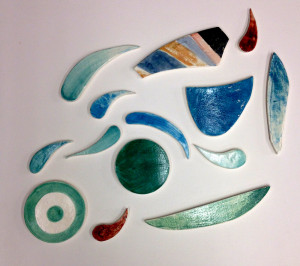
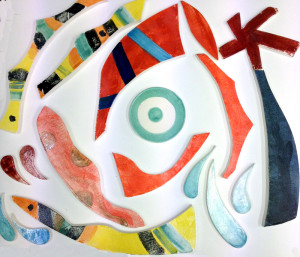
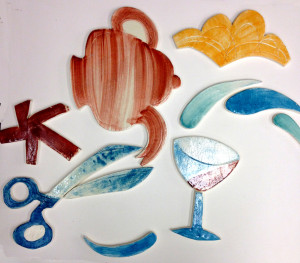
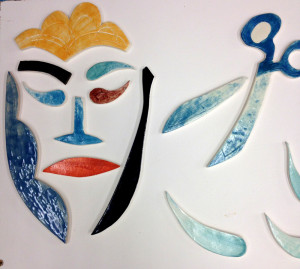
A big thank you to all our visitors who dropped by these last two weekends – it is always good to see new faces as well as the regular ones. Many of you took part in our “mini mural” competition which used an assortment of glazed ceramic pieces to very individual effect. And do they say something about the individual, we wonder?  And here are the best ones (as judged by Thelonius):

Hmmm. Very difficult to choose a winner. Turquoise (or anything with blues and greens) is a favourite of the judge’s (who is given to pondering about life), and he says it denotes  an ability to create emotional balance in your life, to express your hopes and dreams no matter how idealistic they may be and to make your own way in the world under your own terms, so he is awarding  a prize each to Alicia and to Lily.


another close-up of mural

Muralista

complete head-on view of mural

Adaptable as ever, belatrova, as well as designing and making handmade ceramic birdbaths, lamps, bowls and tables, has developed another skill that uses clay to great effect – we also make ceramic murals. A mural, from the Latin murus meaning wall, is any piece of artwork applied directly on a wall, ceiling or other large permanent surface.
view of ceramic mural lo<a href=

This particular mural uses the idea of “juggling” as its departure point; the house in Spain for which it was commissioned is named after an area of southern India, and it is a word that in Spanish is associated with jugglers and juggling. A happy convergence of imagery to get the ball rolling, and which can be seen in the final design with the still central figure at the bottom from which two circular movements flow, one counter clockwise, the other clockwise, co
ntaining the various elements and shapes which are being “juggled” – all presided over by the sun at the very top. Some of the shapes are purely abstract to accentuate the flowing lines, other more recognizable things are there because they are right (even if ultimately inexplicable to most people- cacti, skulls, vases and jugs, ashtrays?).

another close-up of mural


ceramic cactus

The rectangle of space within which the piece was designed measures 2300mm x 3126mm, and each piece is made from grogged stoneware, a clay that contains tiny fragments of molochite to strengthen the material when it has to be shaped and cut, slab rolled and then biscuited to 1000°, after which, as a lot of you may remember from previous blogs, the surfaces are painted with oxides and stains, dipped in a transparent glaze and then fired to 1275° in the belatrova kiln.

view of ceramic mural from ground floor
The challenge was always to produce shapes that stayed flat and did not crack, and there were five “skulls” made before the sixth and final one that you see in the images. Here is a picture of skull No 4, already biscuited, with a fine crack going from eye to jaw. It makes quite a good cheese board, specially when you need to hurry guests away from the table.

close-up of cracked ceramic piece

ceramic skull as cheese board

We were very pleased with the way the two flying legs turned out, considering their awkward shape and length. The belatrova team member who modeled for them wishes to remain anonymous, but we think he has a future with Tommy Hilfiger or Adidas.

ceramic legs in mural

The other challenge facing belatrova was the height of the scaffolding, about three metres off the ground, but, thankfully, any vertigo was kept at bay by our perfect hosts who supplied belatrova with a steady source of cold Spanish beer sothat in the end any lingering acrophobia was gently dispelled.

scaffolding

The first step upon arrival was to measure out the rectangle above the doorway in the hall and then to stick templates of the ceramic pieces (which had previously been cut out in card) onto the wall. When, after a great deal of tweaking, the templates were all blue-tacked in their place, a pencil mark was drawn around the contours and the card templates removed to allow the actual ceramic shapes to be bonded to the wall in their correct positions.

carboard templates of ceramic shapes for mural

Murals do vary from simple tiled works to huge installations by contemporary ceramic artists; depending on context, they can enhance large or small spaces, but belatrova thinks ceramic murals are the perfect solution for those who enjoy sculpture but have no space, or for those who have a large space that needs to resonate more with its surroundings. Murals fulfill the same function as a picture while often being much more dynamic and three-dimensional.

stylized ceramic skull

The technique of slab-rolling and shaping, which was used for this mural, is one also applied to most of belatrova’s production, and if any of you have not already seen our video showing how it is done, please click here.

Lastly, please remember that we have two pre-Christmas Open Weekends: 28 and 29 November, and 6 and 7 December, when we will be open from 10am to 5pm. Do drop in.

pathway in the woods

the belatrova look

pathway in the woods

the way to work

This is a photograph of one of the paths that lead us to work at No9 Bankside. As you can imagine, the colours and environment change considerably throughout the year, and even the birds sound different – hardly a tweet in January but a choir in May. The walk is soothing and helps focus ones thoughts, and amidst the usual deliberations (Is the universe finite or infinite? Are there female leprechauns? Why do old men have hairs in their nostrils? How much deeper would the oceans be without sponges?), what came into mind recently was “How to explain the belatrova look?”


Mid century modern? Vintage 50s? Contemporary retro? Retro contemporary? Not really. It’s just that the belatrova team like bright, bold colours and satisfying forms – it’s age and experience that allow any maker and designer to judge with confidence the fashions and periods she or he has lived through, and to come up with something that looks both familiar and refreshingly new. That’s belatrova.

medieval image of blacksmith

our neighbouring metal worker, on a good day

Add to this a contemporary rural community that provides know-how and support when dealing with different materials and processes – somehow our neighbours, a metal worker, a maker of Japanese screens, a textile artist and a ceramic sculptor, have some intangible influence on things – and if you add the fact that the three business partners are a potter, a painter and a pianist, you have a recipe for a unique creative business.

underside of coffee table

sputnik

What we are saying is that belatrova combines an awareness of contemporary style with the influence from childhoods spent in the era of sputnik legs, Mondrian geometry, rounded shapes and coffee tables, in other words the late fifties and early sixties (yes, last century) – but also bringing a contemporary artist’s touch to domestic design and introducing both fun and fine art painting into the home.

And so, not that you need reminding, distinctive hand made, hand glazed ceramic coasters, lamps, bowls, and large standing pots, contemporary designer coffee tables, and ceramic birdbaths on beautiful oak plinths make up the range of stunning products from belatrova. Here are a few images to whet your appetites:

handpainted coffee tabletop

durden

platter

platter

As most of you know, everything is made at our workshop in Ledbury, Herefordshire, which you are very welcome to visit; just give us a ring on 01531 634082 in case we are out delivering, or on an emergency expedition to buy olives for our Martinis. Warning: the picture below is not of a Martini, but an experiment involving apple juice and gin and other (secret) ingredients.

And by the way, a potter, a painter and a pianist deal respectively with mud, paint and ivory, so we thought at first we would find a name for our enterprise by making an attractive anagram of the three words. Luckily we went for “belatrova” – the only anagrams we came up with were “mad vino purity”, “via nudity romp” and “armpit undo ivy”.

belatrova sign

a bat lover

Toodle pip.


Michaelmas daisies

vulcanology

horse's tail

winter rushes in

There is a saying that “winter comes in on the tail of the last horse home in the St Leger”, one of the oldest classic horse races and held at Doncaster every September.

horse head in stone Parthenon

exhausted horse at the British Museum

On the other hand, we at belatrova would like to banish any winter blues by pointing out that the Romans believed the month of September was looked after by the god Vulcan, so they associated it with fires and volcanic eruptions.

Much as belatrova does, except that we associate the whole year with fire because of our kilns, and with volcanic eruptions because of certain people’s reactions on opening the kilns. Yes, Vulcan presides over No 9 Bankside, reminding us so only a few weeks ago when a large coiled bowl in the Brushstroke Blues style, destined for a BBC programme, exploded in kiln 2.

Michaelmas daisies

September’s flower

Oh, the rage! And then the stoical acceptance. And then the need to soothe the fevered brow. Where better than in a quiet garden at this time of year: cyclamen, daisies, apples and pears, and that flower of the month of September – the Aster, whose name means “star” in ancient Greek and includes the Michaelmas daisy which grows all over the county of Herefordshire. We thought you would like to see them, so here is a snap.

Calm is essential at the workshop, specially at this time of the year because September also means hArt – the Herefordshire Art Week from 12th to 20th, to which you are most welcome. Do come and see us, we are open from 10 to 5 everyday throughout. All three kilns are busy pumping out heat like small volcanoes in readiness for the first day (Saturday), and we shall be exhibiting new birdbaths, lamps and tables.

lounge of Feathers Hotel , Ledbury

inside the Feathers with belatrova

We suggest you make a day of it by visiting other venues open for the week; there are twelve in Ledbury alone, and a total of over ninety countywide. Among the places you could stop at for lunch or supper is the Feathers Hotel, where you could rest in one of their comfortable sofas by the light of a belatrova table lamp, commissioned by the hotel only recently.
ceramic scoop bowl

Come and see us.