April showers bring more than flowers.

The art of walking on sludge requires you to walk bow-legged and on bent knees, leaning forward if going uphill, so that by the time you reach CJ’s bench at the top of Bradlow Hill your thighs ache like a ballerina’s after five consecutive performances of Swan Lake.  By the way, someone has left a nice pair of gloves that are now wedged between the slats waiting for their owner.

England’s sewage system

The rain has been relentless in this part of the world, making the ground as soft as chocolate fondant, delaying planting and seeding by farmers, flooding many areas, reducing oxygen in the soil (think of the poor worms) and forcing water companies to allow sewage into the rivers – this last revolting image the direct result of the privatisation of water and the neglect of any control over “market forces” in the guise of hedge funds. The result is priority for shareholders’ dividends over proper investment in upgrading an outdated system that can no longer cope with the zillion turds we produce daily. Enough moaning.

Bluebells in Frith Wood

Despite the muddy pathway into Frith wood, I ventured in, knowing that you would want proof that at least some things are still as they should be. What with Ukraine, Gaza, climate change, polarized politics, and all the rest of the present gloom fest, it’s good to know that the bluebells are with us, and the wood anemones.

Anemones

On my way out of the woods I passed by a large patch of forget-me-nots. The Greek name Myosotis is a combination of “mus” and “otis” and means “mouse ear”, referring to the shape of the leaves. I’m posting the image because they are beautiful delicate blue flowers with a yellow eye and grey-green velvety leaves, and they are vibrant, heart-warming and make one smile – a reminder of a friend who is no longer with us.

Ceramics: the good news is that the new kiln is now up and running, and a first batch of vases has been glaze-fired successfully.

Big Yoohoo vase just out of the new kiln

The kiln is a Rohde front-loader called Helmut – very efficient and accurate, with a good work ethic.

Introducing Helmut.

He is extremely heavy and here I must give thanks to Steve whose knowledge of cantilevered engineering worked a treat when we moved H into position. He deserves a medal and should any of you be interested in acquiring or finding out about medals of the Great War then Steve, professional military history researcher that he is, is your man. Click here to visit his sight. So far, Helmut seems to get along with the rest of the team – it’s all change here with the introduction of Shinto the Pugmill too.

Thelonious undone.

Spiro and Ziggy are very sad that Thelonious (the old pugmill) is no longer here, and were upset to see him being loaded onto the back of a lorry by a forklift truck to be taken to the (gulp) scrapyard.

Spiro and Ziggy making a scene

It seems that nobody wants anything requiring three-phase power. If anybody is looking for an inverter designed to drive a three-phase induction motor, please get in touch – this one is an IMO iDrive2 XKL.

While writing this blog, news arrived from local MP Jesse Norman that the government has published the River Wye action plan, with up to £35 million in new funding, setting out a wide range of measures to address phosphate pollution and other environmental impacts on the Wye. It has also appointed a new River Champion for the river. All this could lead to a properly funded single collective long-term effort bringing all groups together. That’s a good result and, who knows, it may even be the first step towards the eventual re-nationalization of water.

Back to ceramics.

Stockpiling at PAC.

Here is an architectural piece made from left-overs from the slab roller. It would look better if it were 10ft high.

And before I finally abandon the issue of what can be found bobbing on the surface of our rivers:

  • What is brown and sticky?
  • A stick.

Have a good Spring.

Wet blanket weather

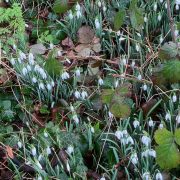
The slog up Bradlow Hill was not as exhausting this time because it had to be done very slowly and carefully to avoid any slippage and loss of dignity. It’s been raining non-stop here and the ground is saturated – so much so that every footstep has to be judged, specially going uphill, if one is to avoid the mud bath fracas of last month (see January blog). Consequently, one’s eyes are always on the ground and there is no time to look around. This meant the walk, which is 4.8 klms long and takes 7800 steps (yes, my new smartphone has the app – more about that later) was tedious, wet, and uninteresting. I did find a patch of snowdrops.

Galanthus

I had so wanted this to be about my trip to Holland to visit the Kröller-Müller Museum located in the Hoge Veluwe National Park in Otterlo and to look around the European Ceramic Workcentre (EKWC) in Oisterwijk, and to bring you lots of fabulous images of the trip. However, in the haste to get off the ferry, the smartphone was left on the car roof and slipped off at some point along the route leading out of the port. Contact with the port authorities has proved fruitless, so if any of you are heading for the Hook of Holland, please keep an eye out for a sad and probably very flat iphone on the tarmac of Prinses Maximaweg, where, according to my Find My app, it is still located, though the area indicated includes the sea, so it could be underwater.

pappekak path

As I trod warily in the mud in Frith Wood I was thinking of Holland, and the word “poppycock” came to mind, no doubt because the consistency of what I was avoiding falling into was indeed soft dung or pappekak. What other words in English derive from Dutch? My research reveals the following: yatch, booze, coleslaw, wildebeest, blunderbuss and hustle.

Wildebeest Photo by Muhammad Mahdi Karim

But then, what with the rainfall and general flooding, I realized that Holland’s relationship with water is special; they have been living below sea level quite comfortably for centuries now and have learned to take advantage of it. Water percolates through the lives of the Dutch, and it runs through the land itself. A fifth of the total surface area of the country consists of water. Nearly a third of the country lies below sea level, and without its landscape of ditches, canals, lakes, rivers, windmills, and dikes, half would be flooded.

wet and bedraggled – Frith Wood

So, no pictures of Holland, though I have used a few that are in the public domain and are not covered by copyright. The trip was enjoyable however, and the Dutch are as polite, direct, but considerate as always, except perhaps when they are driving. Being a small country, the road system too is compact and requires quick decision-making before turning off or getting in the right lane – there isn’t the distance that allows a driver to consider the options, but the Dutch are used to it and zip about with great alacrity. They are also quite tall, in fact, they claim to be the tallest people in the world, and they did invent gin. They eat more liquorice and drink more coffee than any other people …. (that’s enough. How about mentioning ceramics? – Spiro).

Entrance to Kröller-Müller Museum. – photo by Gerardus

The exhibition The Love of Art Comes First. Art & Project at the Kröller-Müller Museum (until 25 February) highlights the significance of Art & Project based on works from the collection by artists such as Barry Flanagan, Richard Long and Nicholas Pope, of this parish, one of whose ceramic pieces stood alone surrounded by the beautiful paintings of Vincent Van Gogh. I wish I had a picture. The museum, founded by art collector Helene Kröller-Müller within the extensive grounds of her and her husband’s former estate (now the national park), opened in 1938. It has the second-largest collection of paintings by Vincent Van Gogh, after the Vincent Van Gogh Museum.

Road with cypress and star. Vincent Van Gogh

What a painter Vincent was. Up close you get to experience the wristy application of paint on canvas that makes his images move and writhe.

Caféterras bij nacht. photo by Paul Hermans

The EKWC in Oisterwijk is housed in a vast warehouse-like building, and is an international artist-in-residence and research centre for ceramics. Artists, designers and architects from all over the world have worked here to experiment with clay. Artists are invited whether they have worked with clay before or not, to participate in their twelve-week residencies. In a year they have about 60 different residencies out of something like 600 applications, and during their time there residents stay in the EKWC accommodation with other artists and share kitchen, studios, facilities, experience and networks. It is a welcoming and friendly set-up, and if you want to find out more, here is the link. The huge walk-in kilns make the new PAC kiln look tiny in comparison. And the coffee in the café is not bad either.

Inside the EKWC

They say you learn a lot about a culture through its humour. Dutch jokes about neighbours are good-natured if crude, because, in practice, neighbours need to get along quite well. The Dutch actually don’t hate the Belgians at all. On the contrary, they find them their most sympathetic neighbours, but nevertheless, ripe for teasing:

Hoe houd je een Belg bezig?

(How do you keep a Belgian busy?)

Zet een man in een ronde kamer en zeg dat er een zak friet in de hoek ligt.

(Put the man in a round room and say there’s a bag of chips in a corner.)

After the rain pot, with tulips from Amsterdam

On the other hand, and for the sake of balance, in the eyes of the Belgians, the Dutch are mean and stingy:

Een Nederlander werd gevraagd voor een donatie voor een verzorgingshuis.

(A Dutchman was asked to make a donation to an old people’s home.)

Hij gaf zijn vader en zijn moeder.

(He gave his father and his mother.)

Moonpot with daffodils

The new kiln is about to be installed, and nothing has been fired now for some time, but Spring should see a renewal of activity and some interesting pieces being made. These images of ceramics are of old pieces which have not been shown for a long time or not at all. The latest news on Thelonious the pug mill is that nobody wants him because he is old and requires a three-phase connection, so sadly he is going to be sold for scrap iron – unless there is a last-minute reprieve . Thank you all, and see you next month.

Someone asked me the other day, “What’s with those clogs you keep wearing?” I replied,”Wooden shoe like to know.”


Anatomy of a fall

The view from Bradlow Knoll at 10 am New Year’s Day

Pottery is just an excuse to play with mud. The material used is really nothing more than soil clay that has been mined. Mud is wet soil. Roll a ball of moist sediment into a thin string – if you can, it’s clay. It’s generally accepted now that playing with mud allows children to connect with the natural world around them, and helps develop tactile skills, boosts creativity and imagination. And it’s fun and therapeutic. And I think this applies to adults too. Using your hands to shape clay into a vessel is an ancient practice that is fulfilling, and whole cultures are identified by their pottery, after all it is one of the oldest and most widespread of artforms. Pots say a lot about people.

New Year’s Day, old moon.

But as you well know, when it’s been raining a lot in the countryside, mud becomes an enemy not a friend, and you have to take it into account when you go for a walk, specially up and down a hill like Bradlow Knoll. In the early morning of the first day of the New Year, the sky was clear after the rainfall of a few days – weighing the pros and cons, and mindful of my duty to my faithful blog readers and seeing a pale waning moon beckoning in a blue sky, I decided the omens were good for a climb up the hill and a first photo of this year’s view.

Walk in the woods vase

However, the problem with walking on claggy mud is that you have to keep your eyes on your feet the whole time. One small lapse of concentration and can send your legs into the air, so you try to step on the least wet bits along the edge of the path, head down and unable to appreciate the surrounding landscape. Which is tiring and frustrating, specially deep into Frith Wood where the dark tree cover keeps everything as damp as possible, though there was a wintry sun low in the sky that you could glimpse through the trees.

I was not really enjoying my New Year’s walk. The mud was not fun and therapeutic, though maybe the worms were enjoying it; in one acre of lands there can be more than a million worms, so I imagined them partying underfoot. There is a stretch towards the end of the walk that is surrounded on both sides by brambles so it’s difficult to use the drier edges of the path. It was here that my concentration strayed because the birdsong was so unexpected and loud. I was trying to identify all the various songs (mainly blackbird, robin and bluetit) when it happened.

Some doctors  believe that one of the biggest benefits of mud baths is that they can provide stress relief. Sitting in warm, soft mud can relax the muscles and soothe the mind. They are also thought to relieve stress, joint pain, rheumatoid arthritis and certain skin ailments. Some people use mud baths simply to chill out. What I found myself in face down was not a warm bath of mud but an unrelaxing cold and slimy one that did nothing for my self-esteem.

It was a slow-motion experience in three stages. First the right foot slid backwards, and I thought I’d land on my right knee (no big deal, I thought, just a muddy knee). Second, because it was slightly downhill, my upper body was leaning forward enough to propel me further, so I stuck out my right hand to stop things getting any worse (no big deal, just a muddy hand, as well as knee). Third, my right hand made contact with the mud and slid forward all the way until the whole right side of my body lay obligingly in the quagmire. This happened in less than a second, but it felt very gradual – it’s amazing what your brain can be doing in such a short time: surprise (this cannot be happening!), anger (I showered and put on clean clothes an hour ago in honour of this New Year, and now look!), indignity (God, I hope nobody’s looking!), curiosity (all the birds have suddenly stopped singing, are they having a quiet laugh? Do birds laugh? I must find out), and finally disappointment and petulance (I was being so careful all the way, it’s just not fair).

I met two dog walkers further on, at a fork in their path, and wondered whether they’d heard my expletives. They looked vaguely concerned at my state, and I had two choices: either I let them go along my path to see if they too slipped in the mud or I recommended the alternative path ahead of them. The Devil in me lost and I told them how to best avoid my fate – it was my first good deed of the year. By the time I got home the sun was out again low in the sky and cast a long shadow, reminding me that we’ve already had our shortest day (22 Dec), and that seemed to put things in proportion, so I blamed my shoes, which have no grip and are inappropriate for walks.

guilty shoes

Somewhere in the Frith Wood is the mud imprint of yours truly. It will last until the next rainfall, then dissolve back to its natural muddiness. Mud is the stuff of creation, used to create Adam, so how come it’s used to tarnish people? Mud is thrown at people in accusation, a name is dragged through it, anything dark and confusing is clear as mud, a person who resists change is a stick in the mud. But we potters know better, which is why I hold nothing against it, other than, occasionally, my body.

architectural pieces drying.

And ceramics? (It’s about time you mentioned them, says Spiro). Well, yes, the new kiln is yet to be connected, so I have been making pieces that have not been bisque fired and sit around waiting in the studio, like the ones in the image above, and the set of Yoohoo vases below.

Yoohoo vases waiting for a bisque firing

Also waiting for kiln connection and bisque firing are various figures and pieces made by visitors to the studio. The lynx pictured is a favourite.

Lynx by Lisa Dearling

And finally, and given that these blogs always seem to refer to woods and trees: a man walks into Frith Wood and tries to cut down a talking tree. “You can’t cut me down,” the tree exclaims, “I’m a talking tree!” The man responds, “You may be a talking tree, but you will dialogue.”

Goodbye 2023

Possibly because it was a cold, grey, miserable day, my walk up Bradlow Hill and into Frith Wood was a lonely one. Not a single walker passed by, nor did I even see a squirrel, and there was no birdsong, except for the distant cawing of the resident raven. It was an unusually silent trudge along the woodland track, the whole atmosphere was brooding, possibly reinforced by the inactivity in the ceramics studio due to delays in connecting the new kiln – creative juices with no outlet can make a person very gloomy – and by the realization that the familiar whiff in our sitting room indicates a dead rat in the skirting boards. The smell is faint now, but building up to its peak for Christmas day.

Crouch vase at Cecilia Colman Gallery, London

Feeling uninspired, I turned a rock over with my foot to find what I expected to see: bugs scuttling away, mainly woodlice. “Aha!” I thought to myself, “here are the true companions of my walk today.” Just because they are not visible and make no sound does not mean they should not be respected as denizens of the wood, as much as the charismatic squirrels, foxes and birds, who have not bothered to make their presence felt; lethargic, pampered and entitled as they lie in their nests, dreys, lairs and setts for the day.

In praise of the woodlouse, the species is found across the UK in almost any habitat. They are flat, oval and grey with a thick exoskeleton and have seven body segments, each with a pair of legs. They are actually crustaceans, related to shrimps and crabs. Like their aquatic relatives they easily dry out, which is why they hide away in cool, damp places during the day and come out at night. To recycle copper in their diet (as their blood is copper based like all marine crustaceans) they eat their own poo, but they also munch away at decaying wood, leaf litter, fungi, fruit, dead animals, as well as other animals’ poo. By the way, eating your own poo is not recommended – do not do it at home.

Granny grunter

If you collect a few woodlice and keep them in a jar, try sniffing it after a while. They excrete ammonia through their exoskeletons, so it’s unpleasant, which is why they are called ‘stinky pigs’ in parts of the UK. They are also known as ‘chiggy pig’ (Devon), ‘gramersow’ (Cornwall), ‘sow bug’ and ‘woodpig’.

Flower vase at Cecilia Colman Gallery

They have 250 recorded names in the UK, including Billy Baker, Monkey pea, Parson’s pig, Cheese log, Daddy granfer, Granny grunter, Damper, Slate cutter, Hardy back, Penny sow, Cheesy bug and Nut bug. Probably names given by children, who are after all the ones closest to these things that crawl around on the ground, it’s children who find them under stones and under sticks, and who play with them.

Segment vase at Cecilia Colman Gallery, London

One insect I did not see was the mythical caterpillar, a beast so rare that only my granddaughter knows about it. It is half caterpillar and half cat – notice the sharp claws at the end of its many feet, the long tail and the feline head.

Cat/erpillar. Erin Arscott Richards

In an effort to be as fair as possible about bugs in general, I include images of two studio residents, a spider and a slug. Both are ceramic portraits, the spider a very accurate one of Ziggy, who as regular readers of this blog know, is in charge of fly-catching in the studio.

Ceramic portrait of Ziggy

Vases have been made in the studio, but they are not even bisque fired yet, until the new kiln is set up. Until then, pieces are available at various outlets, the most recent delivery being at the Cecilia Colman Gallery in London, where you can see the ceramics displayed here on the blog (At last, says Spiro, at least a gesture towards marketing).

Sam Slug

We wish you all a happy Christmas and a prosperous 2024. Here’s hoping it’s a better year for humanity than ’23. Celebrate properly, don’t waste time making mulled wine and other aberrations, go for the classic Dry Martini: Put your martini glass in the freezer, pour a good gin into a shaker, add a drop of Dry Vermouth (only a drop!) and put it in the freezer. After at least 3 hours you can take it out and pour it into the frozen glass and add an olive. The first sip is the best, hold it by the stem so your fingers won’t warm it up. Here endeth the lesson.

Blue dot vase at Cecilia Colman Gallery

A man and his pet slug walk into a bar. They start drinking beer, then as the night goes on they move to cocktails, and then to brandy.  Finally, the bartender says: “Last orders.” So, the man says, “One more for me… and one more for my slug.” The bartender sets them up and they gulp them down. Suddenly the slug falls over dead. The man puts on his coat and starts to leave. The bartender says angrily: “Hey, you can’t just leave that lyin’ there.” The man replies: “That’s not a lion, that’s a slug.

Cheers, and a Happy 2024

Want to know what Nasocarpia is?

November view

Sometimes, when having to make a great physical effort, it helps to have a mantra echoing in your head. Rutile is a good word to pronounce, like, say, elbow or helicopter. The sort of word that comes into your head for no apparent reason when you’re trudging up Bradlow Hill. Anything to take your mind off the increasingly challenging gradient and the pain in your lungs.

Shallow roots

When I finally made it into Frith Wood I saw a fallen tree. I was surprised at how shallow its roots seemed. I suspected that this is due to the trees being tightly packed in a small area and thus competing for light by concentrating on shooting up as high as possible and not wasting time with root depth. But a little research showed that when life gets tough, the roots take the easy option, staying close to the surface and spreading out a long way from the tree. A common misconception is that the root system is a mirror image of the trunk and branches. It turns out a tree’s root system is surprisingly shallow, dominated by long, lateral roots spreading out close to the soil surface and outwards and beyond the branch spread. So, trees are much like us – given to taking the easy option.

Oyster mushroom

The trunks of older trees were hosts to all sorts of fungi, and here’s an image of an oyster mushroom. Mushrooms do not have roots; they have mycelium— a root system that is a mass of filaments called hyphae. I expect you know that. These web-like structures spread into the substrate the fungus is growing on – wood, soil, dead squirrels or compost, and the purpose of the mycelium is to find food sources and collect nutrients for the final creation of its bloom or flower: the mushroom.

Large rutile serving dish (50 cms diam)

There was a reason for the word rutile popping into my head during the hill climb. Rutile (its name is derived from the Latin rutilus meaning “shining, golden-red”) is an oxide mineral composed of titanium dioxide which produces many surprising effects in glazes during cooling in the kiln and is used to enhance the surface character of ceramics.

Rutile spot vase

In other words, you do not know exactly what you’re going to get when you open the kiln, specially if you pour an iron oxide glaze over a bisque surface that has been painted with rutile – it’s all in the lap of the God of Pottery, Khnum, who was depicted by the ancient Egyptians with a ram’s head. He was the creator of the bodies of human children which he made at a potter’s wheel, from clay, and placed in their mothers’ womb. His title was the “Divine Potter”.

Small rutile signal vase

Back to the subject of roots and uprooting, it’s sad saying goodbye to an old friend, specially one that has worked hard in the studio over the years, but the advantages of the new style of pugmill outweigh Thelonious’s steady workhorse qualities and he is shortly going to make way for his replacement.

Thelonious – uprooted

Needless to say, it was difficult breaking the news to him and he is refusing to speak to me (as are Ziggy and Spiro) and goes around the studio with a deeply hurt look. “You’re certainly no Divine Potter”, I heard him mutter under his breath. The indignity of being sold on Ebay was also mentioned. Even the promise of a farewell party has been shrugged off with a sigh, despite the complexities involved in finding exactly the right delicacies for my strange little team: goat yoghurt, spiders and engine oil. I suspect Shimpo, the new pugmill, will be just as fastidious and will only contemplate cheeseburgers (he was born in the USA).

Shimpo – the Jimmy Cagney of pugmills

And cheeseburgers were part of the reason I drove all the way to Stoke-on-Trent, cradle of pottery in the UK. I was there to inspect and then buy Shimpo and bring him back, with the reward of a cheeseburger at one of the motorway service stations on the way back. Somehow, they taste better in a car park when you’re sitting in the car listening to the radio – there’s something vaguely illicit about it if you are not a regular burger eater.

Large rutile planter

I shall miss Thelonious and his whimsical nature. Shimpo, I can tell, is more the James Cagney of pugmills – robust, stocky, slightly aggressive, and “no nonsense”.  He just wants to get down to work, with no pussy-footing – I just hope he gets along with the others.

And finally, a plea to you all. Just as a burger is nothing unless it is eaten, a ceramic cup meaningless unless drunk from, or a song unless heard, so a story unless somebody reads it. If you have ten minutes to spare (and the inclination) please read my short story published online.

Illustrator: Evgenia Barsheva

 It is called A Summary of A Brief History of Nasocarpia, the links with Grietta Ingar and the epidemic of 2049. It is published by Lazuli Literary Group who promote otherworld realism: a genre that represents the known, often mundane world in an elevated or defamiliarizing way through the use of linguistic craft, innovative language, or experimental structure. CLICK HERE.

Marmite explained

The view from CJ’s bench on Bradlow Knoll was appropriate for the day, after all it was St Leger’s, the day of the famous horse race (Saturday 16th September) established by Colonel Barry Saint Leger in 1776 and named for him in 1778. An event for three-year-old colts and fillies, it is run annually at Doncaster, Yorkshire. The winner this year was Continuous, the last horse was Alexandroupolis. They say that Winter comes in on the tail of the last St. Leger horse, but global warming may have done for this old adage.

the last horse at the St Leger

The view was grey, misty and damp, and the leaves on the trees have yet to start turning, but the faint mulchy whiff of tired greenery was hinting at Autumn. Somebody had obviously felt the cold recently as they had left traces of a firepit in front of CJ’s bench. Or perhaps it was an impromptu BBQ. Whoever it was had also forgotten his or her disposable vape – I wonder if CJ would’ve approved of the cherry flavour.

BBQ

Given the weather, I don’t believe that a bonfire would have spread and caused a conflagration in Frith Wood. Apart from a few hot days earlier in the week, it’s been mild. Unhappily that’s not been the story in Greece or Libya, or even Canada, and tramping through the cool damp wood seemed so far removed from those weather extremes. However, even in this neck of the woods, manmade calamity lurks in the shape of the River Wye and its slow poisoning by nutrients leaching from livestock manure (about 70%) and sewage treatment works (20%). Most of the agricultural phosphate pollution is from intensive poultry production (from “What’s polluting the Wye?” – Herefordshire Wildlife Trust blog).

Wye pooper

In order to counter any black outlook that may be developing here, may we urge you to join the fight to save the river by subscribing or following Save the Wye on Facebook, Instagram and Twitter. Here is the link: https://savethewye.org/what-can-you-do-to-help/

Large black and white scrawl vase

Spiro is shouting in my ear that this blog is about marketing ceramics. I have pointed out to him that having unwittingly introduced the word “black” in the context of global warming, I will now exploit its presence in the blog in as measured and respectful a way possible, and with none of the in-your-face cynicism that he always advocates.

Black and white juggler vase at there Palais des Vaches

It is hard to believe Spiro is a 3rd century Bishop of Trimythous, as well as the patron saint of potters, and frankly I am not entirely convinced by his marketing skills. Last month he joined the Ledbury Bank Holiday Carnival Parade saying it was an opportunity to sell pots to the hundreds of Ledburians lining the High Street and was deeply insulted by the pennies people were throwing into the pots he held out, unaware that this the traditional way the parade gathers income for local charities. I had to drag him away when he started berating them in his local Archaic Greek dialect, much to everyone’s amusement who thought this was part of a comedy act.

Poseur vase (Vulcan clay)

Ahem, there is an exhibition at the Palais des Vaches Gallery in Exbury from 29th September, and the theme is “Black & White”. In response to this challenge, Peter Arscott Ceramics (PAC) have made a number of pieces for the show, some are black and white glazed stoneware, and some are made from a dark clay called Vulcan stoneware which comes out of the kiln in a rich dark chocolaty black if left unglazed.

My oh my vase (Palais des caches)

One piece in particular cannot be explained, and for some reason is called Buffoon Vase and wears a top in the shape of Napoleon’s hat. It looks even more inexplicable if you remove the top and insert a flower in it (it can only take one flower, and no water, as it has a leaky bottom). It’s a “marmite” piece – some people will simply like it without having to understand its impractical character, others will just think it’s strange.

Buffoon vase

For those of you unfamiliar with marmite, it is a dark brown yeast extract spread, much liked by half the UK population, and much disliked by the other half. It is used as a metaphor for something that is an acquired taste, or something that divides opinion, like, say, Elon Musk or Nigel Farage or morris dancing.

Buffoon vase with flower

In a neat bringing-together of various themes in this blog (fish, ceramics, rivers), a recent visit to Wales included a fly-fishing lesson with Mr Jones on the banks of the beautiful Dyfi river (unpolluted and very clean, thus salmon and sea trout are happy to swim in it).

Fly-fishing lessons on the Dyfi

The result was a brown trout fished from a smaller river nearby, which was cooked and served to fourteen people on a PAC dish. Thank you Mr J.

Sacrifishal?

A man walks into a fish and chip shop with a happy trout under his arm.
“Excuse me, do you sell fish cakes?” he asks.
The owner replies, “Yes, of course we do”
“Great” the man responds, smiling at his trout, “It’s his birthday.”

With apologies for that old chestnut, farewell and goodbye.

Unhappy trout

Swimming, eating, drinking.

Cala Aigua Xellida

Apologies to those of you expecting the usual image of Ledbury from Bradlow Hill. We’ve been away, you see. A gathering of the clan took place this month in the small town of Tamariu on the Costa Brava. The nearest anyone got to trudging up Bradlow Hill was getting down to Cala Xellida and back, which was done by car anyway – it was a holiday after all. It consisted of swimming early in the morning in this beautiful little bay, consorting with octopuses and watching cormorants diving alongside, or simply floating on your back (like a pale plump starfish on an azure sea) mindful of not brushing up against a sea urchin – one of their sharp needles in a vulnerable spot would spoil the day. I thought the sea urchin was a friend, but it was anemone.

Paracentrotus livides profil. Photo Frédéric Ducarme

The name Tamariu derives from the tamarisk trees along the promenade, which separates the beach from the narrow streets and whitewashed buildings of the town. It was, like most settlements along the Costa Brava, a small fishing village, and fishing boats are still to be seen up on the beach. Nowadays there are a few hotels, along with seafood restaurants, cafes and bars. It is set amongst rugged pine-covered cliffs flanking the sea.

View from the coastal path flanking Tamariu.

A few days beforehand, we had stayed with friends in a small village outside Vic, the ancient capital of the region of Osona. Set among lush green hills, from here you can see in the distance the highest peaks of the Pyrenees that border with France. The main square, where most of the town’s social and cultural life takes place, is a large square area surrounded on all sides by beautiful old buildings, some dating from the late 14th century.

Plaza Mayor, Vic.

Whilst there, a trip uphill to the hermitage of Sant Sebastiá, long abandoned. It stands as a reminder of Albion’s perfidy and of the ongoing struggle for Catalan independence because it was here that the decision was taken to send an emissary to the British, which led to an agreement of support in 1705 during the war of Spanish Succession. Alas, Britain let them down by signing the Treaty of Utrech in 1713. Long story, with little obvious link to ceramics, but complex and interesting. Great views of the valley below.

View of Vic valley from Sant Sebastiá.

Catalans and ceramics? Yes. The best-known source of pottery is La Bisbal which has been producing pots for centuries, and uses the typical blue, red and yellow tones associated with it in the numerous artisan studios along the town’s main drag. But pottery here is also associated with the great names of Catalan art: Gaudí, Miró, Dalí and, though born in Malaga, Picasso.

Ceramic seating in Parc Guell – Antoni Gaudí

Of the four, Gaudí did not actually make any ceramics, rather he smashed them up and incorporated it into his facades and rounded architecture, as can be seen on the benches in Parc Guell where one can sit and look down on the city of Barcelona.

Suite Catalan – Salvador Dalí

In 1976 Dali was seeking a buyer for a collection of tiles known as the Suite Catalan that he had produced in Spain two decades previously. From the original run of 100,000 tiles 60,000 remained. A German lawyer bought them all. The remaining tiles from the original run have sold in private sales and auctions over the years, fetching as much as $2,300 for a set of six, and over €500 for just one.

Earthenware dish with bird – Picasso

Picasso and Miró are better known than the other two for their ceramic work and made extraordinary pieces which nowadays are seen in museums around the world. Picasso moved to Barcelona with his family at 13, in 1895, when the city was full of political and artistic ferment. It was politics that turned his visits to Paris into permanent French exile, but before that, his artistic early artistic formation developed in Barcelona. His Blue Period is Catalan.

Oiseau (Solar) bird – Fundació Joan Miró

Peter Arscott Ceramics would like to emulate them one day and, in a fit of creativity, inspiration has nudged this piece out of the studio.

Doodle vase by PAC

These few days on the Mediterranean were not only about swimming, eating, and drinking. Oh no. There was a quick cultural visit to Gerona.  We wanted to see the cathedral’s interior, which includes the widest Gothic nave in the world, with a width of 23 metres (75 ft), and the second widest of any church after that of St Peter’s Basilica. When we finally made it, the huge West door was being shut to visitors by a stern-faced porter.

Closing time at Gerona cathedral

Defeated in our cultural pursuits, we could only drown our sorrows with more food and drink. Here is a picture of tapas: anchovies and olives.

Tapas

In deference to the octopus we met daily at Aigua Xellida (there may have been two, but if so, they were hard to tell apart; they were i-tentacle), we tried not to eat any cephalopods. But we did eat fish, and many sausages along with barbecued red peppers and aubergines, and a lot of cheese and ham eaten on local bread rubbed with tomato. And more sausages. They know their food, those Catalans.

Salchichón de Vic

Back home, and the call of the clay was loud and enticing, tempting hands into making new shapes and forms, and perhaps influenced by the happy use of colour in the pots and dishes seen in La Bisbal, an orange-red tone crept into one of the more devilish vases that popped out of the kiln today.

Imp vase

Enjoy the rest of Summer.

Someone to watch over me


Do you ever get that feeling that someone is behind you, staring? A sort of ghostly or alien presence nearby, that you slowly become aware of and makes the hairs on the back of your neck stand up and your spine tingle? This happens at the studio very now and then, and probably as a result of the loneliness of the long-distance potter (see blog May), but more likely the result of having a ceramic custodian placed in the workshop high on a shelf, and then forgetting that it is there.

Norma

Our custodian is called Norma. She is imperiously “above it all”, dispassionate and detached, somewhat poker-faced, but commanding and reassuring as she protects the studio from any malevolent spirits. She is not a conversationalist. St Spyridon, or Spiro as we call him, the patron saint of potters, is no good at warding off the malignant because he is too busy with the marketing, and in any case considers such practices as beneath his dignity. However, unlike Norma, he does like to chat.

Frank

It’s natural to assume someone behind us is staring, but I think that feeling we get is a self-fulfilling because when we turn around, our action makes the other person look at us, and when they meet our eyes, they give us the impression that they’ve been staring the whole time. Norma – she is inscrutably mute and thus easily forgotten, until, for no particular reason, you become aware of her presence.

Hugo

In the garden, once Spring arrives and everything starts growing and covering every inch of space with leaves, blossom, buds, stalks, and branches, you forget what was standing visibly throughout the bare Winter months. Indulging in a bit of pruning, you uncover a patch that reveals an old garden sentinel that stares back at you – something familiar that takes you by surprise. In this case Hugo and Frank, who are stylised skulls made as part of a mural commissioned years ago and who were rejected on account of flaws detected – cracks, I think. They still look at one forlornly, even accusingly.

Forsaken

In fact, the garden is full of forsaken ceramics. They peek out at me or make sarcastic comments as I go by: “Call yourself a potter? Didn’t you know that stoneware contains (among other silicates) feldspar, and that this majestic mineral is by far the most abundant in the Earth’s crust, making up about 50% of all rocks? I contain eternity, I’m as old as the planet, and yet…and yet…you cast me out and abandon me in this squalor, surrounded by weeds, mud and (ugh) ants that crawl over me. Have you no respect?

Forlorn

Tables, on the other hand, being made of wood, suffer from no illusions and stand squarely on the earth’s surface, four-legged and robust, and in the case of these two that are now at the Palais des Vaches, looking quite elegant. Their hand-painted tops are varnished with a heat-resistant resin, so that hot cups of tea or coffee can be placed on them directly without the need for a coaster. Their tapering “sputnik” legs give them a fifties look.

Fifties vibe – handmade table at the Palais des Vaches

These tables are not for the outdoors, but for the house. And in the house, we have another sentinel that watches over us. He is tucked up in a corner of the kitchen ceiling and has been there uncomplaining for over thirty years, though he has been with the family for forty.  Three-fingered and four-toed, he is made of plaster and is named Garrel because the kids could not pronounce the word “gargoyle”, though strictly speaking gargoyles are meant to stand on roofs and act as waterspouts, as well as warding off evil spirits.

Garrel

Derivation of the word “gargoyle”? From Middle English: from Old French gargouille ‘throat’, also ‘gargoyle’ (because of the water passing through the throat and mouth of the figure); related to Greek gargarizein ‘to gargle’ (imitating the sounds made in the throat).

Jug vase

Spiro says that’s enough wittering on my part and reminds me that this is a ceramics blog, not some etymology lesson, and that I should at least show something recently made. So here it is – above is a large stoneware vase that looks like a jug from a certain angle. And here’s another table…

Do you want to listen to the incomparable Ella Fitzgerald singing Gershwin’s “Someone to watch over me“? Click here.

There’s a somebody I’m longin’ to seeI hope that he turns out to beSomeone who’ll watch over me

Sorry, I couldn’t resist this one:

A man goes into a bar with his small pet newt called Tiny. “A pint for me and a half for Tiny, please,” he says to the landlord.
The landlord asks, “Why do you name him Tiny?”
The man replies, “Because he’s my newt.”

Adeus, Astrud.

In what has become customary in this blog, I was yet again talking to a fruit the other day – this time an avocado. And, yes, it IS a fruit. They are considered so because they fit all of the botanical criteria for a berry. They have a fleshy pulp and a seed. This particular avocado was in mourning over the passing away of one of its fellow South Americans, the dreamy-voiced bossa nova singer Astrud Gilberto.

What has bossa nova got to do with ceramics? Not much. It’s just that her voice, for those of us who were around then, played such a defining part of the mid-sixties. At the time of her recording of the “Girl from Ipanema”, although she had little time to prepare (she had never sung professionally before), her detached but sultry vocals perfectly captured the spirit of a “tall and tan and young and lovely” girl who turns the heads of everyone she passes. Her husband, the guitarist Joao Gilberto, was recording with the jazz saxophonist Stan Getz when they decided they needed someone to sing the song in English, and since Joao spoke not a word, she volunteered.

Astrud Gilberto – Kroon, Ron / Anefo photo

She wasn’t credited on the track (which was released under the name Stan Getz and João Gilberto) and she only received the standard $120 session fee for her performance, whereas Stan went on to buy a 23-bed mansion outside New York. But her career took off and she sang with the likes of Antonio Carlos Jobim, Frank Sinatra, George Michael, and Chet Baker. We like listening to her cool-as-a-cucumber, slightly diffident voice here in the studio – her singing entwining with Stan Getz’s smooth saxophone calms the atmosphere. Adeus, Astrud. Click here to hear her sing How Insensitive (Insensatez)– she is slightly hesitant, even insecure, in her delivery, probably because of her limited English, but it makes the song all the sadder.

Avocados (persea americana) are popular with ceramicists who enjoy playing with the colours and the shape to create bowls for tableware, and it was the hippest shade of green for your ceramic bathrooms in the 1970s.

Something else that is becoming popular with some ceramicists is the Japanese art of Kintsugi (Golden joinery), whereby broken pottery is mended with lacquer dusted with powdered gold or silver, treating the breakage as part of the history of an object, rather than disguising it. Nowadays potters can buy tubes of ready-made golden glue that hardens at 300F, and no doubt many have pounced on it as a way of salvaging work that might still be sellable.

Kintsugi hoot vase. Notice the vertical golden crack in the green/blue area.

Yours truly is no exception, and the large piece that cracked in the kiln as described in May’s blog was brought out and repaired. However, there were too many cracks to make it watertight, and though it looks good with its golden fissure unashamedly exhibited to all eyes, it sounds dull when you tap the vase with your knuckles. A horrible sound to all potters, and a death knell to a pot. It certainly can’t be sold and will probably live outside in the garden where it might scare away the mice, though the resident barn owl might get confused. I think I will call it Astrud, which means “energetic, courageous and determined”. I made another similar one, which came out of the kiln in perfect condition.

“Call of the Nightingale recorded over eighty-six seconds” 145 x 180 cms. Nicky Arscott 2023.

Owls are not the only nocturnal birds, of course. So is the nightingale, which sings its heart out in the dead of night to attract passing females migrating back to Britain. Last year I told you about our midnight walk with Sam Lee in a wood near Gloucester and I remember him telling us that if you hear one still singing at the end of Spring, that means he didn’t get the girl and he’ll be a summer bachelor. Sam will be reading from his book “Nightingale” and singing (he is a Mercury award-winning singer) at the Ledbury Poetry Festival on Sunday 2 July, so if you’d like to buy a ticket please click here.

Detail of “Nightingale..” by Nicky Arscott.

I am sure I’ve told you before that all the PAC pieces are stoneware, and that they are glaze-fired to 1200°C. Until now, every piece is dipped in a tub of liquid glaze, or, if too big, has the glaze poured over it. This means you don’t get uniform coverage but inevitable thicker and thinner areas of glaze on the surfaces – which is attractive and accentuates the “handmade” aspect of production.

However, using an air compressor and a recently purchased spray gun, goggles, a mask, and a rickety spray booth made out of a large cardboard box on an abandoned garden table, and finally a coverall that was disappointingly tight around middle, two pieces were glaze-sprayed and came out of the kiln with a lovely sheen. Breathing in glaze is strictly to be avoided, you see – thus all the safety preliminaries.

nice sheen

All this is just another example of how far we go to make things pleasing to others. It’s only a few steps away from exerting a pull by creating something irresistible and beautiful like the nightingale desperately attracting a mate, or Astrud singing about regret, or even an owl hooting in the night. Even potters do it, albeit subliminally.

two hoots

Potters and solitude

The view from Bradlow Knoll

Trudging up Bradlow Hill I noticed that the mayflower was in full bloom. What we call “mayflower” is actually hawthorn, a pagan symbol of fertility with ancient associations with May Day, and its blossoming marks the point at which spring turns into summer. This was a cheering thought, as a large vase destined for a gallery had cracked in the kiln the day before and one’s mind needed some distraction.

Mayflower

In the studio, the radio is always on, in part to accompany the ongoing work and to fend off any feelings of aloneness, though there is nothing wrong with a bit of solitude when making vases. As regular readers of this blog know, my team consists of Ziggy (a spider), Thelonious (a pugmill) and Saint Spyridon, (third century Bishop of Trimythous in charge of marketing) – all of them, possibly, not real.

Leaf vase

An important factor in converting aloneness into solitude is that it is voluntary, instead of imposed. As such, it becomes a creative and productive state. It helps concentration, but sometimes it can get to people. For example, a researcher at a station in Antarctica stabbed a colleague (non-fatally), though this may have happened because the victim was giving away the endings of books the attacker was reading.

Antartica. Photo Giuseppe Zibardi

This information is being given out freely by Peter Arscott Ceramics (PAC) because only the other day, seated alone at the workspace and eating a banana, a small unhappy voice was heard in the studio. Looking down at the banana in hand I noticed that it was looking up at me. Don’t tell me that’s not the saddest little world-weary face you’ve seen in a while.

Unhappy

“You shouldn’t be eating me, you know.”

“Is that why you look so sad?”

“No. It’s just that the monoculture production methods used to grow us can destroy entire ecosystems.  I bet you didn’t realize that the banana industry consumes more agrochemicals than any other in the world, except cotton.’

“Well I never.”

“And the low prices paid by supermarkets and the cost cutting by fruit companies as they relocate in search of cheaper labour, and the harsh conditions in plantations…’

“Oh, I’m sorry to hear that.”

“Yes, and none of the other fruit in the fruit bowl talk to me.”

Wormery

Despite feelings of guilt, I finished off the banana, then chopped up the skin and fed it to the inhabitants of the PAC wormery alongside the studio. At least they don’t talk to me, and the skin was put to good use.

Green wobble vase

Back on Bradlow Hill, my mind filled with images of cracked pots, Puritans on the Mayflower, talking bananas and Antarctic research stations, these gradually faded away as the birdsong in the wood took over. I recorded some for you – the loudest is probably a robin, some blackbirds and a chiff chaff, as well as a distant ambulance on its way to Worcester Hospital. You’ll need full volume to get all that.

Click here: birdsong

The bluebells were past their pomp, but the stitchwort was flecking the undergrowth with white, and there was a lot of campion in the hedgerows.

Stitchwort

In parts of Africa the campion is used by Xhosa diviners: the roots are ground, mixed with water, and beaten to a froth, which is consumed by novice diviners during the full moon to influence their dreams.

Campion

Given that this type of campion cannot be found in Herefordshire, PAC recommends buying a good bottle of Ribera del Duero instead. The better the wine, the sweeter the dream. Perhaps the resulting pot, a very impractical and possibly useless wine decanter, is the result.

Droop decanter

Still on the subject of wine, over-consumption of the grape, even if it’s the Queen of Grapes, Tempranillo, can lead to moments of euphoria to be followed the next day by terrible remorse and anguish. In an unusual attempt at public information and to highlight the issue of the seductive lure of alcohol and its consequences, PAC would like to introduce the following piece:

Saturday night, Sunday morning vase

Psychoceramics is the study of crackpot ideas about human behaviour – get it? “Crack pots”?  (Also, Psycho Ceramics were a range of novelty ceramics made by US-based Kreiss company and manufactured in Japan between the 1960s and 1970s). However, PAC would like to associate the word with the more subtle art of depicting the mind or mental processes – psykho, (Greek) meaning “the soul, mind, spirit, or invisible animating entity which occupies the physical body”. PAC would like to think that the above is an example of psychoceramics, as is the next one:

Why? Perhaps because it is a “personality”. Whereas other pieces may highlight a particular colour to effect, or hint at landscape, or get across the idea of spring, or even jazz music, others have their own particular and less easily described temperament which is a bit more than just the sum of its shape, colours and brushstrokes. For example, we like the following piece because it’s a gentle play on a grid and geometrical shapes – it’s attractive enough, but what it offers is essentially decorative:

What do you think, dear reader? Is PAC barking up the wrong tree? Is it all too subjective for a theory? Have we been talking to fruit too often? Can bananas ever look happy? Did you know that the Latin name for banana is musa sapientum, which translates as fruit of the wise men? Please send us your thoughts.

psychoceramic or articeramic?