Posts

December squelch

December from Bradlow Knoll

The month of December signals the full emergence of the cold winter season and, as the last month of the year, it promises a new beginning in January – who would not be looking forward to that?

into the woods

On the other hand, we’ve learnt to change our habits so much in 2020 that, as a result, bread-making, chess, virtual wine tasting, online bingo and TV bingeing may be on the up but to the detriment of other activities such as going to your local shop, meeting other humans and playing golf. I do go walking more though.

mud and leaf

Yes, there is always the great outdoors, and on this particular day the sum was out and the day crisp and bright as I made my way into the Frith. There was no point looking for colour other than the general grey-green-brown hues, no plants, no fungi, just the wet mud of the path and Autumn’s fallen leaves, lots of dead bracken and, somewhere high above, a croaking raven.

bracken

Most of the brown areas are the result of bracken. It was traditionally used for animal bedding which later breaks down into a mulch that can be used as fertilizer, and it’s best not eaten, as it contains a carcinogenic compound, though it is used to store freshly made ricotta cheese. Highly invasive, luckily in autumn it turns brown and dies down. Ferns are definitely prettier.

Cameron Contemporary Art Gallery

Walking in squelchy mud is tiring and forces one to use muscles you didn’t realize you had until you clamber into bed, aching and stiff. That night I slept as soon as my head touched the pillow. I dreamt of trees, squirrels, mud snorkeling and giant stoneware vases.


nocturnal advice

At some point, I woke up with a start. There, at the end of my bed, sat an old man with a long white beard. He wore a woven straw hat, so he wasn’t Father Christmas. There was a musky smell of sheep in the air. He looked at me and asked:

“Do you honestly think that they care that bracken was used for animal bedding?”

“Sorry?” I mumbled, “who are you?”

“Remember me?” he asked. “Come on. Your blog of November 2019?”

I searched my memory and suddenly it came to me.

“Ah, yes, of course. St Spyridon, patron saint of potters.”

“Spot on, though you did misspell my name on that blog.”

“How can I help?” I asked politely.

“I believe it’s the other way round. I am here to help you.”

“Oh, how?”

“You’re having trouble with your blog. It’s been preying on your mind, and last night before you fell asleep you muttered the words “hydrous aluminium phyllosilicates”. If these are the last words a potter says before sleep, I am duty-bound to make an appearance.”

“Well. It can’t happen very often then.”

“You’d be surprised how often a disturbed and troubled potter utters the magic words before drifting off.”

I sniffed the air, which was rude of me.

“Oh, I used to tend sheep before I became Bishop of Trymithous. That’s why I wear this shepherd’s hat. Anyway, your blog. You’re finding it increasingly difficult to relate its content to ceramics, when, after all, it’s meant to be a ceramics blog. Is that right?”

“Yes, I admit that.”

The Chuffed Store

“Your blogs tend to be text-heavy, filled with rambling non-sequiturs and partly related images. The last one was all about mushrooms.  I am here to provide a solution. Instead of trying to twist the text towards any ceramic-related narrative, I propose you write about whatever takes your fancy and intersperse that with unrelated images of your work. Each image, when clicked on, will link the viewer with details of the piece, where it can be bought, and for how much. The more images, the lighter the blog. Vision trumps all senses; the human brain can process entire images in as little as 13 milliseconds.”
Jewel Street

“Wow. You’re quite media savvy for a third century Greek monk. I suppose once you get to Heaven you absorb everything past, present and future, and take on a wisdom beyond anything human.”

“Natch. By the way, how many followers do you have?”

“Well, seven that I know of,” I hesitated, then added pathetically “not including my wife and mum, of course.”

Jewel Street

Wanting to change the subject I asked:

“So, who else have you helped in this way?”

“Oh, I gave Josiah Wedgwood a hand with his marketing, Bernard Leach too, Kawai Kanjirō, Pablo Picasso…”

“Gosh, all that knowledge at your fingertips.”

“Yes, but there are limitations. We get given one luxury when we arrive at the Pearly Gates but this is restricted to each person’s contemporary experience and era. So, for example, my friend Albert Schweitzer has a gigantic church organ, Siggy Freud has a gramophone player, Nelson Mandela has a constant supply of Dom Pérignon, and so on. Alas, I could not have any of these because they did not exist in my time.”

“So what did you choose?”

“Goat’s yoghurt. I’ve always had a passion for it, and it was considered the height of indulgence in my day.”

“But presumably you can share things, listen to Freud’s records, sip Nelson’s champagne…?”

“Yes, true. Albert is teaching me the organ, though, of course…… for a fee.”

“You use currency there?”

“No, we exchange things.”

“So how do you pay Mr Schweitzer?”

“In yoghurt.”

Jewel Street

St Spyridon raised a hand and signalled the end of our conversation.

“I will only appear when genuinely needed. It’s no good muttering “hydrous aluminium phyllosilicates” unless you have a real potter’s dilemma, otherwise I’d be forever at the beck and call of potters.”

He stood up and waved, then slowly disappeared through the bedroom wall.
The Chuffed Store

Later my wife woke up and, despite my protestations, accused me of allowing sheep into the house while she was asleep.

Parfum d’Ovine

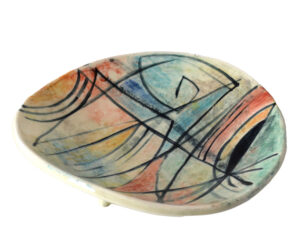
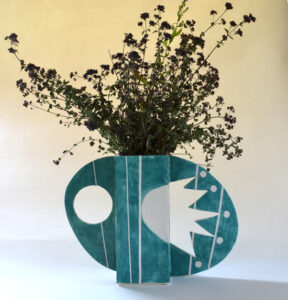
Just click on the images of ceramics to find out more about each piece. Jewel Street is a new outlet you might like to visit, and if you do want to buy a three legged bowl for Christmas the voucher code is PETERARSCOTT10, which will get you a £10 discount. St Spyridon is full of ideas. Meanwhile, back in the workshop, recently made up vases are drying in readiness for their bisque firing in a few days.

waiting for the kiln


αντιο σας

Wanted

back from Gwalia Ceramics

Driving back from the Gwalia* Ceramics gallery in Llangollen, the consequences of this pandemic were apparent. Businesses are having to make difficult decisions, and the ceramics rattling gently in the back of the car were not unwanted but rather a reminder of how vulnerable small enterprises are. The lovely Gwalia Ceramics is having to wind down and I was bringing my unsold pieces home.

The A49 meanders through some beautiful countryside but there are few opportunities to overtake on it. From outside Shrewsbury all the way to Leominster I was stuck behind a food delivery lorry. No doubt with Brexit in mind and in preparation against the invasion of chlorinated chickens from the USA, a large image of a plump roast chicken surrounded by potatoes and veg,  a Union Jack background, and with the slogan “Eat British Chicken” hovered before my eyes for forty miles. By the time it turned off at Leominster I was truly hungry and stopped to gulp down a small pork pie I had bought in Llangollen for supper that night.

Loop vase – dark mossy greens

With the Gwalia ceramics unloaded and stored back on their shelves it is always interesting to see work again after some time. Sometimes you are surprised by a colour achieved and you can’t remember how you did it, or you notice a shape or contour for the first time, which you decide to apply to a new piece. The mossy green on the Loop Vase is a tone I will repeat.

oak canopy in Frith Wood

Talking of which (“green”, that is)  we get spoilt in Spring, what with all the bloom and fresh growth. I set off for a walk in the woods a few afternoons ago. It was hot and sultry, overcast, with a hint of rain in the air, but the trees were not offering any cool shade and the undergrowth looked tired; without a hint of anything flowering it was a dull grey/green carpet. It even smelled different – tacky mud and dried up puddles. I was just about to show my disappointment with Nature by turning back home and watching another episode of “Call my Agent” (it cheers me up) when at last I spotted a pink flower.

Hairy Willowherb

Now, I would be a complete fraud if I claimed to know a lot about plants and flowers. With the recent lockdown and the increased walks I am learning on the trot, but I have recently downloaded an app that helps identify most things in a couple of seconds. This one turned out to be a Hairy Willowherb.

Because its dense and aggressive growth habits can crowd out and destroy other native plants, a sort of rural bullyboy that goes around beating up the feeble pretty ones that tremble and hide behind trees, it is considered a problem, an “unwanted” plant that is difficult to eradicate. Local names include “apple-pie” and “codlins-and-cream”. So, it can’t be all that bad. In fact, the shoots of the willowherb can be boiled and eaten like asparagus. This I can believe, since it seems that any stem or shoot of a non-poisonous plant or veg can be boiled and served cold with mayonnaise as “poor man’s asparagus” – I have eaten beetroot stalks in this way.

Bull Thistle

Anyway, I was struck by the “unwanted”  epithet given to so much that grows in the landscape. Not only willowherb, but also the next one I stumbled on – the Bull Thistle.

It may be considered a noxious weed by some authorities, but it produces a large amount of nectar and attracts pollinators. Its entire bud is featured with stiff spines that make it look like a fierce bull. It is also called a Spear Thistle and is designated an “injurious weed” under the UK Weeds Act 1959 (no, I didn’t know about that either) despite the fact that it feeds butterflies, beetles and small birds. Guess what? Yes, the stems can be peeled and steamed or boiled.

Bitter Doc

The third plant to get my attention was the usually disregarded bitter dock, which  is another unwanted plant apparently growing and spreading out of control, and in such competition with other “wanted” or cultivated plants that it aggressively overpowers them.  But I have always seen it growing in the countryside and to me it seems to happily coexist with nettles (which I expect is yet another “unwanted” plant) and most other unidentified vegetation. Furthermore, the large clusters of shoots which contain small greenish flowers change to a deep reddish brown as they mature and serve as visual punctuation marks in the landscape specially against a greenish background.

watercolour of Malvern Hills – bitter doc, bottom right

The doc’s name variation depends on the leaf – if they are huge it is a broad-leaved dock. Blunt-leaved dock was used to wrap butter in the 19th century. Hence, it is called butter dock. And the bitter dock may be an invasive weed, but It serves as an effective laxative.

fly by Paul Arscott @baguetteboi69

By now I was dreaming up plans to cultivate a Garden of the Unwanted dedicated to all these unappreciated and unloved rural thugs, when I felt something strange on my left arm. Unlike insects which surreptitiously puncture the skin with needle-like organs, female horse flies have specially adapted mouth-parts which they use to rip and/or slice flesh apart. Research later showed that they thrive in hot rainy weather and that “the female horse fly is secretive, with an annoying ability to land without being detected and escaping before the victim begins to experience any pain”, but in this case I most definitely felt it.

horsefly nightmare

I brushed it off and noticed another had landed on my right arm and was already tying its bib around its neck in readiness when I flicked it off. When I felt something land on the back of my neck, I decided I had had enough of Nature for the day and beat a retreat. They can persistently chase you at a flying speed of around 15mph and they did until I crossed paths with a couple walking their dog, who offered my tormentors far tastier fare.

peacock butterflies on buddleia

I am sorry but horseflies are unwanted “unwanted” and will have no place in my Garden – you have to draw the line somewhere. To compensate for the dark shadow cast by these beasts here are two sunny images, one above of peacock butterflies feeding on lilac, and one below of sunflowers in a large vase.

abstract vase with sunflowers

*Gwalia is an archaic Welsh name for Wales. It derives from the Medieval Latin Wallia, which in turn is a Latinisation of the English “Wales”.