Posts

Potter Pete’s foggy day

The view down to Ledbury

This time I groped my way up Bradlow Hill – forget the mud, the rain and the general swampy state of the countryside at present – this was different because I could not see anything in front of me. Fog shrouded everything, as you can see from the picture of the “view” above.

entrance to Frith Wood

Faced with the entrance into Frith Wood, I chickened out of groping any further and blindly banging my head on tree trunks, so turned back and walked along Green Lane in Dog Hill Wood until I reached Ledbury, an easy flat route into town, and the original pack horse trail connecting Worcester to Hereford. There are fragments of  yellowish sandstone on and around the path, formed millennia ago by sand brought by nearby rivers which settled around the tide line in layers (as it does in beaches today) when this area was a coastal stretch.

Green Lane

A great deal of Queen Anne’s Lace and alkanet, unfairly deemed a weed by gardeners, grew along the path, which was, of course, slimy with mud and is specially tricky as it leads downhill into town, but once you are near St Michael’s parish church you are safely back on dry and even surface.

alkanet

A useful angel to have on your side, St Michael the Archangel, patron saint of grocers, soldiers, doctors, mariners, paratroopers and police, and conqueror of Satan.

St Michael’s

Satan is so often depicted as a monstruous three-headed entity, or as a horned beast, half human half goat, or as a squirming dragon, but I believe he is the personification of mud. I promise that this is the last blog where I complain about mud – after all, I am a potter, and it is my source material. By the way, never buy a wig from the Devil, there will be Hell toupee.

And what about ceramics? Well, I have little to show you right now, as the big pieces I am now making take such a long time to dry before they can go into the kiln for bisque firing – and it is no good speeding up the drying process as this will cause the more exposed parts of a piece to dry more quickly that the body, thus creating tension leading to cracks. So, it is always wise to wrap the pieces in plastic to encourage uniform drying, and not to, say, expose it to the sun.

However, here is another experimental piece, not the usual vessel, more an architectural exercise. To remind yourselves of  PAC’s vessel-based work, do visit the website: https://www.peterarscott.co.uk

If you would like to read something that combines waitresses, xenophobia, the Pope and a café, here is a link to a short story of mine called Mysteron (2600 words) on Fiction on the Web. Please read it if you’re in the mood, if it is unread, then it does not exist. Click here.

stumped

On my way up to Bradlow Hill I walked past the tree stumps along Knapp Lane. The trees had been felled as they were a potential danger to traffic. I noticed that each stump had a ring of blue studs inserted evenly around the inside of the edges. What is this? One of you out there will know – please tell us.

Queen Anne’s lace

We often hear mist and fog mentioned alongside each other, but the difference is a simple matter of how far you can see through it. If you can see more than 1,000 metres it’s called mist, but if it is thicker and the visibility drops below 1,000 metres it’s called fog.

What’s a bigamist?

It’s what Italians call a thick fog.

Peter Arscott Ceramics in Ledbury (part 1)

pink ochre vase grogged stoneware

These blogs usually spring from the places and galleries where Peter Arscott ceramics can be seen, places like Worcester, Brighton, London and Cambridge, and despite all this geographical weaving around, until now the actual heart and home of production has never been properly introduced to you: Ledbury, where you can also now see some of the recently made ceramics displayed at John Nash’s in the town centre.

C vase at John Nash

It’s a market town with the ingredients to make its High Street attractive to the eye: a curving length, a slight dip in the middle and buildings on either side that are as tall as the street is wide. Founded in 1123, it has inevitably changed a great deal since then, though the ground plan in Bishop Capella’s rent book shows that it still is the same essential High Street made up of burgages, strips of land 200 ft long and 20ft wide with house frontages onto the street and access via alleyways to the rear where animals were kept. Hard to believe when you look at the shop fronts today; the cafes, pubs, grocers and bookshops hide what is still there – a medieval layout.

Ledbury High St

A saunter down Church Lane and its carefully laid (small) cobbles is a pleasant experience but over a century ago you would have had to deal with petrified kidneys, large sea-worn flint lumps used for paving which caused terrible problems for clog-wearing Ledburians. Today anybody seen having problems walking down Church Lane might well be a local coming out of a pub late at night.

blue scoop bowl

Water used to run down the centre of Church Lane from the hill above town, Dog Hill Wood, and the lake in the grounds of Upper Hall, and gather in the dip in front of the old library, the Barrett Browning Institute, where detritus from nearby tanneries and blood from the Butchers’ Row, a row of 15 shops which originally stood in the middle of the High Street, mingled. The effluvia was blamed for the outbreak of typhoid in 1826 and eventually led to their dismantling after prolonged resistance from the occupants.

whistle, don’t thigh

One shop was saved and rebuilt behind what is now Boots, and later transferred to its present location outside the Burgage Hall – it’s a museum of curiosities: a hurdy-gurdy, pots, breastplates and a Tibetan flute fashioned from a human thigh bone; the femur of a criminal or a person who died a violent death is preferred. Alternatively, the femur of a respected teacher may be used, though I do hope none of the kids from John Masefield High School gets the wrong idea.

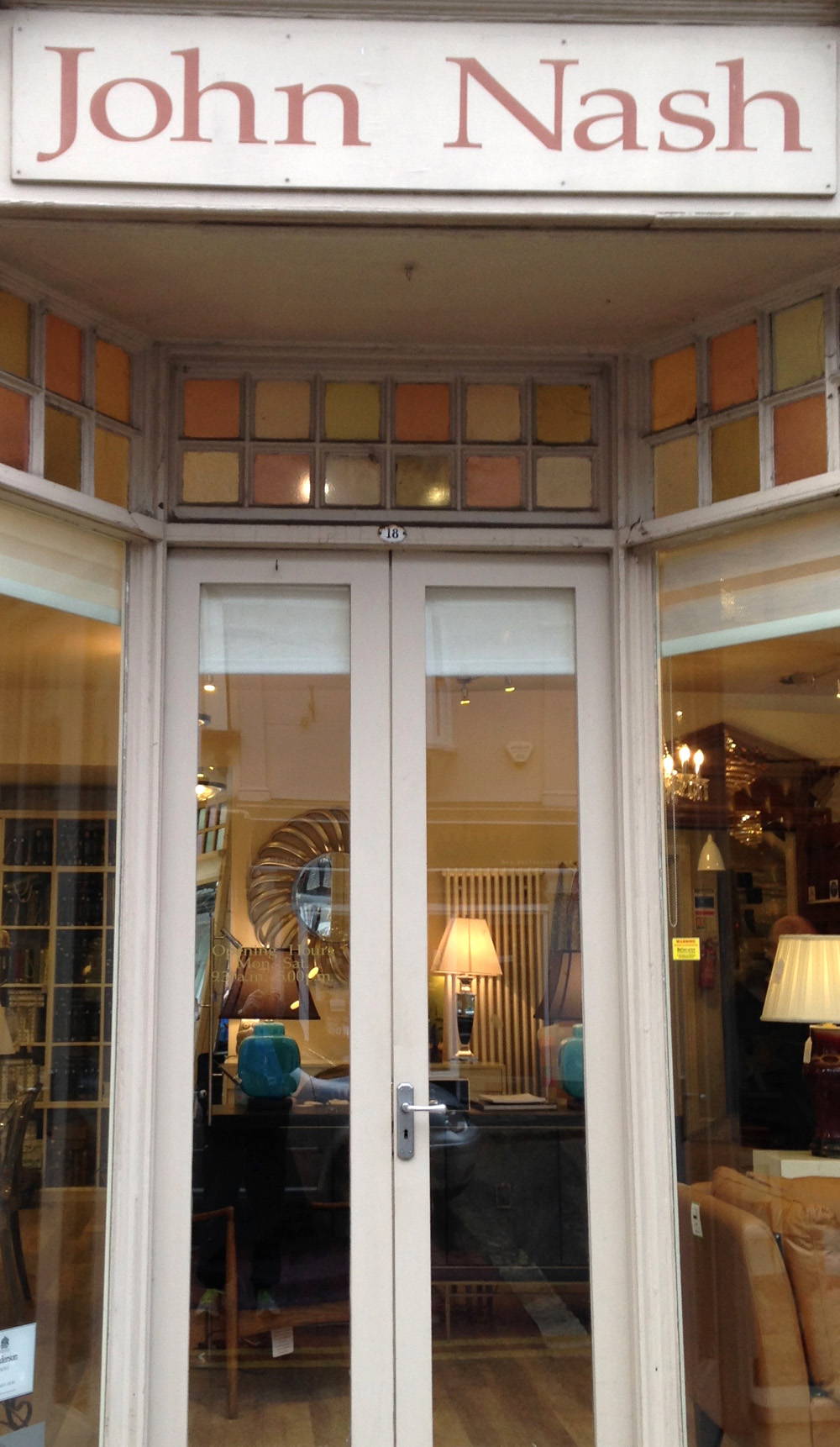
entrance to John Nash Interiors

Next door to the alley entrance is John Nash Interiors, contemporary and period interior design, who are showing various Peter Arscott ceramic pieces with the launch of a new collection of furniture by Andrew Martin.

three legged bowl

The Andrew Martin Interior Designer of the Year Award celebrates the best of design from around the world. Designers from all six continents take part. Every year, a panel of celebrity judges, are charged with the fiendish task of selecting one overall winner. One of this year’s judges was Elizabeth Hurley of this parish (the winner was Ohara Davies-Gaetano Interiors).

retro charger

Do drop in anytime, perhaps combining it with a visit to the Ledbury Gallery next door, and a coffee at one of the town’s seven fine cafes. If you have any time left, nip into St Michaels Church and greet the medieval being halfway up one of the pillars near the choir: the stone Manticore. It has the head of a human, body of a lion and a tail. It eats its victims whole, using its triple rows of teeth, and leaves no bones behind. The Ledbury Manticore, however, looks rather baleful, so just say “hello” and move on.

…………… (to be continued)

sad, sad Manticore