Posts

All the King’s horses

This is going to be a very equine blog. As one gets older, the more challenging the climb up Bradlow Hill becomes, and the more one wishes for a horse. The weather was breezy, and there was a lot of Red Campion about in the wood, having taken over from the Bluebells – the moment when both overlap would have been a month ago: a sea of blue and pink.

Red Campion

Recently I took up the birthday gift by my children of a riding lesson in the Western style, not far from Ledbury, in a place called Ullingswick. It was more fun than expected, given that the last time I sat on an animal was in 1967, and the tolerance of April (my horse) was impressive, as is the fact that I did not fall off. The Western style encourages the rider and horse to become one, with the former using his or her body to guide the horse, who responds to pressure from a knee or a shift in weight.

April carrying a sack of potatoes

April had all the qualities of a ceramicist: patience, perseverance, stoicism, and equanimity (a habit of mind that is only rarely disturbed under great strain). If she had fingers rather than hooves, she would make a good potter.

Juggler vase at Cecilia Colman Gallery

Earlier in the week I was in St John’s Wood to deliver some ceramics to the Cecilia Colman Gallery, which you may remember from a previous blog, has been operating for forty-five years. It’s an established star in the ceramics firmament.

Streaky bacon

Regent’s Park and Zoo are nearby, lots of shops, but also some fine residential buildings built in the late 19th century Streaky Bacon style, or ‘Constructional Polychromy’ – alternating bands of brick and marble, which was popular with British architects. I mention architecture in order to show you a recent piece from the kiln called Construct. There is an affinity between ceramicists and architects in that both vessels and buildings are ways of filling space (discuss).

Construct

I was a little early, so I went to a café. A morning coffee isn’t always accompanied by the unexpected thrill of a seemingly endless column of beautiful chestnut horses clip-clopping their way past the large windows of a London café on its way to Regent’s Park. There must have been over forty, twenty riderless, that passed by with an air of disdainful boredom, as if the gawping pedestrians confirmed all their prejudices about two-legged beings.

All the King’s horses

The barista confirmed that this was a regular occurrence. Based in St Johns Wood, the King’s Troop Royal Horse Artillery is responsible for firing royal and ceremonial salutes as part of the sovereign’s birthday parade in April, the state opening of parliament, state visits and Remembrance Day. The barista was a talented joker. When I said I thought they were beautiful thoroughbreds, he told me he had once I put a bet on a horse that had excellent breeding, and that after it left the starting gate, it stopped and closed it behind him.

Red ochre vase at the Cecilia Colman Gallery

Unable to get horses out of my mind, I inevitably resorted to finding out a bit more about them. So, did you know that horses can sleep both lying down and standing up, thanks to a special locking system in their legs? You’ll like this: when foals are born their hooves are covered with soft tissue which stops their mothers’ birth canal and uterus from being damaged – they are called fairy slippers.

Cuckoo spit

Horses produce 10 gallons of saliva a day – saliva has very important functions because it wets feed material and begins to break it down. It also has an important buffering effect in the stomach, reducing acidity. Since we are talking of these matters, above is a picture I took in Bradlow Knoll of some Cockoo Spit, which has nothing to do with horses’ saliva.  Inside each mass of cuckoo spit is a juvenile yellow-green froghopper.

The adult froghoppers or spittlebugs  are 6mm long and bright green, with large eyes and a blunt-shaped head, but they’re rarely seen because they hop away on their strong back legs at the first sign of danger. We all know people like that – excepting the “bright green” bit, I assume.

Tall pink ochre vase at Cecilia Colman gallery

With the excuse that a froghopper looks like a plump cricket, here in St John’s Wood is the home of the sport. Lord’s  has been  the birthplace of cricket since 1787, but looking at the grounds from outside one has to admit that they’ve moved on with the times, and their roofscape is nice mixture of the old and the new. They say that if cricket wasn’t so difficult to understand, most of its obsessives and followers might never have bothered with it at all. Here are some of the fielding positions players take up: Deep point, Backward point, Deep backward point, Short third, Deep third, Short leg, Square leg, Deep square leg, Backward square leg, Long leg, Short fine leg, Deep fine leg, etc.

Lord’s cricket ground

Most people have some sort of obsession, major or minor, though cricket is not one shared by the team here at Peter Arscott Ceramics (PAC). Spiro (Marketing) has a passion for goat yoghurt, Ziggy (fly-catching) is forever pondering the significance of  Proust’s “A la Recherche du temps Perdu” and Shinto (the pugmill) goes on and on about sushi. In my case it’s Picasso’s Demoiselles d’Avignon that has always bothered me – it’s the elbow sticking out at the top, centre, of the painting, which the vase below always reminds me of.

Demoiselles vase at the Cecilia Colman Gallery

Les Demoiselles d”Avignon by Pablo Picasso

A horse walks into a bar. “Hey,” says the barman. “Yes please,” says the horse.

Sign in Frith Wood

Ceramics – Form or Function

St John’s Wood in London. Most people think of Lord’s Cricket ground and long sunny evenings watching a game and sipping beer, or perhaps a stroll through beautiful Regent’s Park. Others conjure up the image of the Beatles on the now famous zebra crossing  outside Abbey Road studios – those old enough will remember the mystery surrounding the image and  the rumours of Paul’s death; after all, why else would he be barefoot, and doesn’t George represent  the carpenter who made the coffin, John the religious figure conducting the ceremony, Ringo the undertaker?  However, I mention it because like all zebra crossings, it is black and white, and thus a clumsy introduction to my theme. Bear with me.

I still do not know for sure whether those of you who buy Peter Arscott Ceramics (PAC) do so because you want a vase in the house to put flowers in, or whether you just want the piece because it’s a particular colour and shape you find attractive, or eye-catching, its use as a vase thus being secondary. I suspect it is the latter.

Monochrome vase at Cecilia Colman Gallery

All this head-scratching comes from one piece which a lot of people do not like, while others do. For starters it is unlike the typical PAC piece in that it’s black and white, and its shape or form does not seek a harmonious balance in the whole, but rather rejects it. All of which makes it sound like sculpture, which it is not – it’s still a vase.

Monochrome vase, verso.

As you probably already know, at PAC each piece is made by hand, each piece is a unique one-off since nothing is made twice, nor is function strictly observed – the pot or vase is seen as a form you can play with, PAC having moved away from the potter’s wheel to focus on hand-built forms, as this technique allows much more freedom for expression.

Vine vase at Cecilai Colman Gallery

Some of the pieces have a singular lop-sided stance; improvisation takes place either in cutting out the rolled clay shapes, or later when painting oxides onto their surfaces. The approach to clay is that of a painter’s, and the forms arrived at often work as sculptures or as shaped surfaces with paintings. In other words, its function as a vase is secondary when being made.

Frond vase at Cecilia Colman Gallery

Now, if you want something to perform a function, you want it to perform well. If it doesn’t, you’re probably going to stop using it or ask for your money back, no matter how good it looks. This has yet to be a problem at PAC – never has a vase been returned because it hasn’t functioned as a vase. However, if you hate the way a product looks, you’re less likely to buy it in the first place.

Vase 54 at Cecilia Colman Gallerey

The main distinction between art and design is that design must have a purpose. Art can have no other reason for existing other than to be to viewed, say, or experienced (probably contentious, but some of you will let me know). However, design requires a function. If the design is visually striking, then it may also be dipping its toes in the ocean of art, because often art and design overlap. However, without function, it’s just form – it’s not design but art.

Dave as flower pot

Anyway, it doesn’t really matter. Your eyes tell you whether you like it or not – and that is that. So, if you are in London, go to Cecilia Colman’s gallery and test your eyes. Cecilia is showing some PAC ceramics, including the much maligned monochrome piece. See what you think. You could combine it with a visit to Regent’s Park Zoo, or a nice meal out at one of the restaurants on St John’s Wood High Street (nearest underground station is St John’s Wood).

Ming Dynasty, Jiajing: 1522 – 1666

Of course, you will know if a piece is a genuine Peter Arscott Ceramic by the stamp on the bottom of each piece. Stamps are important for dating and authenticating ceramics. The one above belongs to the time of Jiajing’s reign, a man infatuated with women, known to be a cruel emperor who lived in isolation while ignoring state affairs. This eventually led to corruption at all levels of the Ming government, and to a plot by his concubines to assassinate him in 1542, by strangling him while he slept. Sadly, the plot failed and all of the concubines were executed.

Peter Arscott Ceramics, 2022,

The next stamp above is of the early 21st century, probably during the reign of Jon Son, a man who survived many plots, and belongs to a small ceramic workshop based in Herefordshire that produced rare, unique and now much sought-after vases in stoneware.

Cecilia Colman gallery – over 40 years of experience

Having mentioned The Beatles, it is only fair to finish with The Rolling Stones whose 1965 song “Play with Fire” contains the following lyrics:

Your mother she’s an heiress, owns a block in Saint John’s Wood
And your father’d be there with her
If he only could

Click here to hear them sing it.

12 hours in London (is like a year in any other place)

derelict Victorian Public Toilets into a cracking little pub.

A quick overnight trip to London was called for, ceramics to be delivered in the morning to the Cecilia Colman Gallery, so arrival was late in the evening – the idea being to spend the night and get up early.

closing time at Pueblito Paisa

London is an extraordinary place, which is why I found myself late that night somewhere in Haringey eating aborrajado (deep-fried stuffed plantains) and empanaditas (meat turnovers) all washed down with cold Colombian beer. The city is ever shifting, neighbourhoods seem to change overnight from the down-at-heel to the slickly bourgeois, and this perpetual construction of flats for the professionals, the foreign “land bankers” and who knows who else seems to be hitting Seven Sisters, so that the little restaurant we were eating at is now in danger, along with its neighbouring businesses, of making way for another redevelopment scheme.

ceviche

Within this large building more than 100 Latin American traders have created a busy complex of cafes, butchers, travel agencies, restaurants, clothes shops and greengrocers all under one roof, and is a fine example of a city that can boast to being the most multicultural place in the planet.

Relocation is promised, but everyone knows that it would never provide the genuine atmosphere that exists when people unselfconsciously transform a place through the need to make a living and make use of their own experiences and backgrounds. It is called Pueblito Paisa, and long may it thrive. Pay it a visit and try the ceviche.

passers-by outside the High Cross pub

We then walked a couple of blocks to a solid Victorian public toilet. This very hospitable place turned out to be a pub, recently converted, and we sat down outside under a cherry tree to drink and watch the night traffic flow by, mostly double deckers and taxis, and pedestrians of all shapes, sizes and diversity, track suits, hijab, business suits, shorts, sauntered past us.

At one point we looked at the shrubbery at the base of the cherry tree and were startled by the untroubled gaze of a fox which gave up on us and turned away.

the canal, early morning

The next morning a visit to Tottenham Hale and the canal that runs alongside the Walthamstow wetlands offered a complete contrast to the urban activity of the night before. Here all was placid and calm, and, if it had not been for the trains, it was easy to imagine you were in the countryside.

Cecilia’s place

And then the trip to St John’s Wood to visit the Cecilia Colman Gallery. Another contrast: spacious Regent’s Park, the London Zoo, the Regent’s Park mosque, Lord’s cricket ground, and St John’s Wood High Street with its cafes and shops – a small world away from edgier Haringey, but cosmopolitan nevertheless.

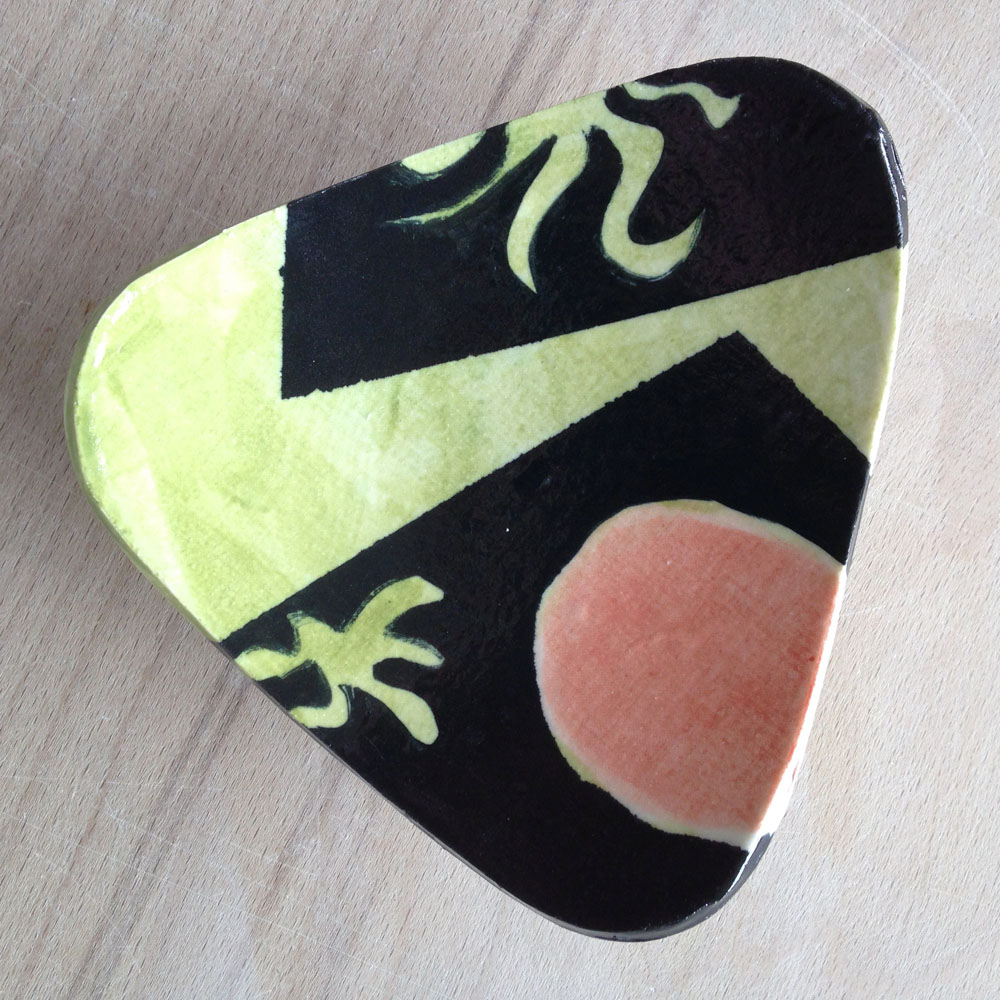
small three legged bowl at Cecila Colman’s

The Gallery has been in London for forty years having opened in 1977 and is one of the few remaining shops on St John’s Wood High Street which survived the transformation of the area in the last few decades. Cecilia chooses all the pieces and artists herself and is passionate about the work she exhibits. She chose eight recent Arscott ceramic pieces – do drop in to have a look.

large stoneware vase

On another note, we are all very pleased that CUP ceramics project (see previous blog) hit its crowdfunding target with 5 days to spare. Over 90 people pledged contributions, an excellent indication of the support for an open-access studio providing a creative community for all types of ceramicists to share skills and ideas in a relaxed environment

blue vase

pink pasque roses

Springing Open in April

pink pasque roses

Pasque roses in Spring

Everything is blooming in this part of the world, the sap is rising, winter’s greys are turning into varied shades of green, and cherry and apple blossom are everywhere. April is a month when things turn for the better, it even gets its name from the Latin word “to open”, describing flowers opening at springtime, though Aphrodite the goddess may also be another root for the word. Did you know that April used to be the second month of the year until January and February were invented by the Romans? No, nor did we.

Nor did we know that “April” was the 250th most common name for a baby girl in the UK, or that in the UK it is National Pet Month, or that in the US it is National Pecan Month. And our meticulous research has unearthed the following:

Zebra crossings were introduced in Britain on 4 April 1949, when James Callaghan, then parliamentary secretary to the ministry of transport in the British government, came up with ‘zebra’ as a name for the crossing which it was thought would be easily understood and remembered, particularly by vulnerable groups such as children.

Russian cosmonaut day is April 12, commemorating the astronaut Yuri Gagarin who became the first man in space on April 12, 1961 aboard Vostok 1. He spent 108 minutes in space.

And when, we hear you ask, is National Eggs Benedict Day? Why, it is on April 16th, a day to enjoy eggs with hollandaise sauce, crispy bacon and English muffins. Apparently, a lot of people have never had Eggs Benedict, but we reckon belatrovians are sophisticated and most likely to have enjoyed Eggs Benedict a number of times, and perhaps, on a regular basis. See how many of your friends can tell you how its made, or what’s in it. Or, ask them what hollandaise sauce is.
Celebrate by eating Eggs Benedict – click here to see how to make them (first get a hen).

ceramic planter with elongated corners

belatrova corner planter

All of this is just a preamble to let you know that we are holding our annual Spring Open Weekend on Saturday 22nd and Sunday 23rd April (10 – 5pm) at the Bankside Studios. You are most welcome to drop in and browse, and even though Eggs Benedict will not be on the menu, we will offer you tea, coffee and cake.

ceramic dish with goat head by Picasso

c’est ne pas un chevre

You would be hard pressed to find a spot anywhere that both makes and sells the variety of goods you can find at the Bankside Studios in Ledbury. You can step into the studio to see Fleen Doran, fresh from her successful show at the British Craft Trade Fair at Harrogate, making her salt glaze pots at the wheel, while Wendy Houghton works away at her delicate ceramic sculptures. This is the same workshop where belatrova produce ceramic planters, fruit bowls, mirrors and birdbaths next to the joinery section where Stuart Houghton busily shapes and cuts wood to perfection – at the moment he is whittling a small goat out of myrtle. Upstairs Dan Barker has his photography studio, shared with the textile designer Sunny Todd, and across the road can be found artist blacksmith Dave Preston hammering iron on his anvil – in fine contrast to Bob Evans who can be found in his studio opposite printing images of striking quality on very new and sophisticated printers.

handmade ceramic flower pot with handles

striped splash pot by belatrova

The studios are situated just behind Alfa-Tech on Little Marcle Rd, which is accessed via either Lower Rd or New St. Please follow the signs. There is limited parking on-site (and wheelchair access) and there is additional on-street parking.

large mirror with wide painted frame

large wall mirror with blue frame

The address is: Bankside Industrial Estate, Little Marcle Rd, Ledbury, Herefordshire HR8 2DR. And do please visit the Ledbury Cooperative’s website: https://www.ledburycollective.com/

poster of Spring Open weekend

For those of you who live in or close enough to London we would encourage you to visit the Cecilia Colman Gallery in St John’s Wood. It is right on the High Street and easily reached by underground. Glass is a speciality but among the many excellent pieces on show, ceramics, paintings and jewelry also have pride of place. The gallery is showing some belatrova pieces, including three legged bowls, wave fruit bowls and a large wall mirror.

Cecilia Colman Gallery

Cecilia Colman Gallery