The call of the cicada

View of the Ter, from the monastery
No slog up to Bradlow Knoll this month. Instead, a walk in the countryside outside Vic in Catalunya, to visit the ancient monastery of Sant Pere de Casserres perched high above a bend in the river Ter. Challenging because of the heat (about 34° centigrade) but rewarding for the view, and for the architecture of this 11th century Benedictine building – plus there’s a café where you can get a drink.

The nave of Sant Pere
Vic itself is an attractive city with a welcoming central square with shops and bars, and a Saturday market that beats most others into a cocked hat. There is a beautifully laid-out museum of medieval art in the old part of the city, with a collection saved from churches and monasteries in the region, including a painting of Christ’s circumcision – a rather concerned Mary looks on, unsure about the priest’s competence, while the infant Jesus seems to be rather laid back about it.

Vic is also famous for its sausages. Of course we were not there for the sausages, though many were eaten. Luckily, we were on holiday in a small coastal town, so the sea was there for cooling off, although, possibly encouraged by the heat, the cicadas were particularly noisy throughout, singing their little hearts out, high up in the pine trees, in the hope that a lady cicada might fall for their tune and, after mating, might deposit her eggs in the bark.

Cicada. Watercolour by Lisa Dearling
Never having seen a cicada before, here is what I found out about them: both male and female cicadas die within a few weeks after emerging from the soil, where they spend most of their lives at depths down to about 2.5 m (8 ft). The “singing” of male cicadas is produced principally using a special structure called a tymbal, a pair of which lies below each side of the abdominal region. The structure is buckled by muscular action and unbuckles rapidly on muscle relaxation, so quickly that to the human ear it is almost one continuous sound. Most cicadas go through a life cycle that lasts 2–5 years. Some species have much longer life cycles, such as the North American cicadas that go through either a 17-year or a 13-year life cycle. But the point is, they must be the loudest insects on the planet and once the sun sets everything seems too quiet.
Click here to listen to the cicadas
So, if you’re looking for “quiet”, then nighttime is good, or very early morning, before the sun hits the trees. Yours truly, in search of oneness with Nature and Zen-like tranquillity, walked down to a small cove at 6.30 in the morning while the cicadas were still snoring and swam accompanied only by a cormorant. Even the iPhone camera’s click seemed intrusive.

Cala Xelida at 6.30 am
Perhaps inspired by the cormorant’s ceaseless search for fish, a drive to nearby Palafrugell’s fish market followed. Once the centre of the Catalan cork industry, it now serves as a summer holiday town for residents of cities such as Barcelona and Girona. Many narrow streets emanate from Plaça Nova – a large square with bars, restaurants and boutiques, and not far is a ceramics gallery called Tejemaneje on Carrer Sant Antoni next to the market.

Tejemaneje entrance
Stepping into its cool and elegant interior is a pleasure. It is run by Jordi Tejedor, designer, artist, ceramicist and businessman, whose work is exhibited along with that of others. His is the large neanderthal figure that greets customers as they walk in, by which I mean the sculpture on display, and not Jordi.

Jumping figure copper oxide on white clay by Jordi Tejedor
.It all seemed a very long way from Peter Arscott Ceramics and the studio with the rest of the team resentful at their exclusion from a holiday in the sun – but then, as I explained to them, getting a heavy Japanese pug machine, a 200 AD Bishop of Tremithus (and patron saint of potters), as well as a spider onto an EasyJet flight would be a challenge. Furthermore, they should pity me, since a machine, a figment and an arachnid can cope with heat, whereas I, a human, am not designed for such temperatures. And the mosquitos would undoubtedly attack me too. As proof here is a drawing of my right leg after a night’s vampiric assault.

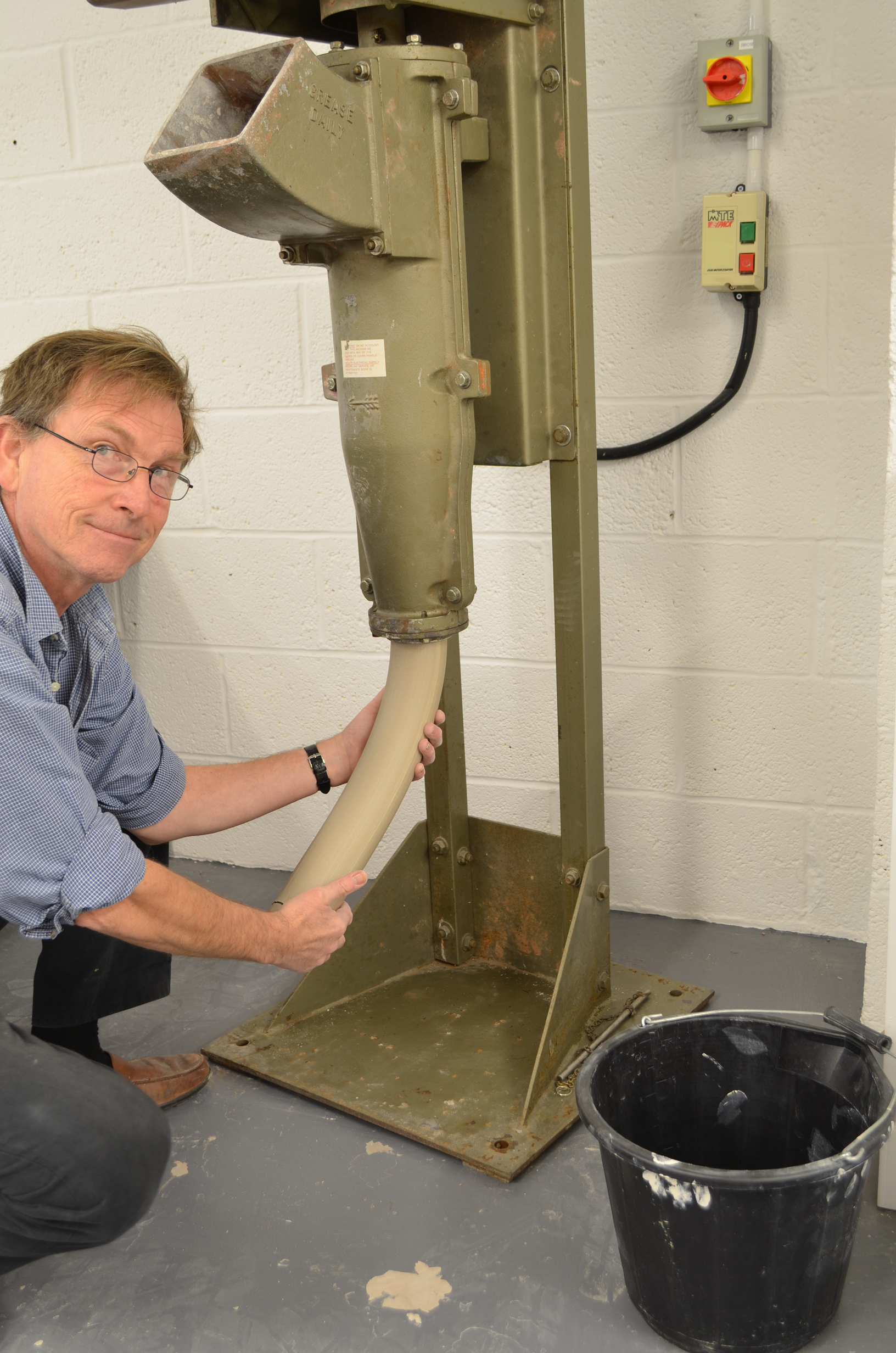
Previous mention of sausages reminds me that a slab potter will find that there is usually a great deal of unused clay or cut-offs when making a piece. To recycle this clay, these lumps are thrown into a large bucket and soaked with water until enough is amassed to lay out on a surface to harden to the right consistency. At this point, as the clay is cut up into sections with a cheese wire, one discovers the wooden sculpting tool and the metal needle tool that disappeared so long ago. The clay cannot be too soft that it squirts out of the mill, or too hard that it impedes the action of wedging and removing any bubbles. When it is extruded as a long sausage, it is ready for use again. Not an ounce of clay is wasted, thanks to Shinto the Pugmill.

waiting to be pugged
Because patience and persistence are necessary for making pottery, given that every stage requires concentration and patience, from preparing the clay (as above) to moulding and finishing it, accepting the occasional flaw may add to the overall authenticity of the piece. It’s important to strike a balance between maintaining control and letting go – sometimes failures and setbacks are not the ends but often occasions for development.

Waving Yoohoo vase
Why am I telling you this? Well, I just want to come clean and show you two examples of what I’m talking about, from the Yoohoo series. The one above shows clearly that there is a gap between the top of the right arm and the body of the vase, caused probably by my allowing the arm to dry more quickly than the body. This was already apparent at bisque stage, but I decided to paint it and glaze fire at 1200℃ and I think the gap adds something to the piece, and gives it more movement.

Saluting Yoohoo vase
The second one (above) has its blue arm dipping away from the rim of the vase at an angle, instead of being perpendicular – probably because its own weight dragged it one way with the extreme heat – but again, it gives the vase a certain quirkiness which makes me think of American sailors’ salutes in those Hollywood movies of the 50s. Anyway, you’re perfectly entitled to tell me I’m wrong and deluded.

Sausages in Oxford market. Photo by Kaihsu Tai
Just as you are with my constant references to sausages. Does every culture have its own sausage? The Spanish have the chorizo, the Catalans their fuet, the Germans their bratwurst, the USA their hotdog, the UK their banger, the boerewors comes from South Africa, the gyulai is Hungarian, the linguiça is Brazilian. Surely this shows that we all have more in common than not, and wouldn’t it be wonderful if the world’s problems were fixed by annual international sausage conventions?

Keep well and stay cool.