
September meander

Exbury Gardens
There is a hint of autumn in the air, but only a hint. Looking down on Ledbury from Bradlow Knoll, the view still offers the usual subtle variation of greens with only a tinge of autumnal orange, though large spiders have started to move into the house and studio, always an indication of colder days ahead, and much to the annoyance of Ziggy, whose insecurities make him prey to anxiety and aggression at the sight of anything he sees as competition in his role as the studio’s “Flycatcher-in-chief”.

Autumn leaf zephyr vase @ Palais des Vaches
Flies are also on the move come autumn. They choose to fly high before the weather gets too cold and enter attics and lofts for the winter. No matter how well the space is sealed, they somehow manage to get in, so that when you visit the loft in spring the whole place is buzzing with blowflies trying to find a way out, presumably having bred throughout Winter. So, all power to the spider, and to anything else that eats them, like fish. Yes, fish, specially trout, are partial to fly, as is the chub – all this came to mind after a walk along the River Leadon.

River Leadon – Chub don’t mind mud
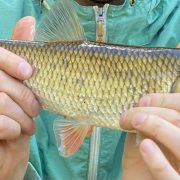
The sad state of the river was highlighted in a blog last September (click here), so it merited another visit. It is good to report an obvious improvement, not least because fish are back, including chub, which can sometimes be seen swimming near the surface of rivers and streams, often in large shoals. One was caught, and then returned – a good indication of better water quality, though there are two outlets pouring into the river that seem to contain some oily substance. As they grow, chub become aggressive predators, eating fish, frogs and even small mammals. Hard to believe when you look at the little chap in the photo.

the predatory chub
He or she must be one of the 90,000 roach, chub, and dace fish that have been added to replace those killed by pollution in 2016, when 100 tonnes of digestate were pumped onto a field and flowed into the Preston Brook, which in turn flows into the river Leadon, and more than 15,200 fish were killed in what was described as “one of the worst watercourse pollution incidents in Herefordshire in recent memory”. The new fish were all hatched and reared at the Environment Agency’s national fish farm at Calverton in Nottinghamshire, which is funded by the proceeds of fishing rod licence sales.

Autumn swirl charger @ Palais des Vaches
There are almost 1500 river systems, comprising over 200,000 km of watercourses in the UK but, in a global context, our rivers are mere streams – being characteristically short, shallow and subject to considerable man-made disturbance, as we know from recent news about water companies releasing sewage and other waste whenever the system is deluged after rainfall (Rain? In the UK? Get away and stap me vitals!).

Autumn vase @ Palais des Vaches
One of these rivers is the Beaulieu River in the New Forest, which rises near Lyndhurst and flows into the Solent, passing through the beautiful gardens at Exbury. More than 100 years in the making, these gardens, designed and curated by the Rothschild family, have a spectacular collection of landscaped woodland, herbaceous, contemporary, formal and wildflower gardens.

Autumn Reds vase
Now, dear reader, as you probably know, a “meander” is a small winding river or stream, and, as a verb, can be used to describe a winding or intricate course suggestive of aimless wandering. Which is what I have done in order to get to this point. The Exbury estate, through which the river passes, also has the Palais des Vaches gallery, a former milking shed now transformed into a strikingly handsome gallery and show area. No thumb-twiddlers, the Rothschilds planned and rebuilt it during the Covid lockdown, and it now has had a further extension added.

interior of the Palais
Autumn Glory is the title of the show opening on Saturday 24th September, and Peter Arscott Ceramics is exhibiting there along with painters, sculptors and textile artists.

Peter Arscott ceramics on show
Possibly as a result of the long hot summer we have had, the apple harvest is early this year in Herefordshire. This means friends and neighbours will be desperately going round offering large bags to anybody they meet, in the hope that this will help with the glut. Other than freezing them, drying them, turning them into puree, or using them to throw at squirrels, any interesting and creative ideas that deal with large supplies of apples will be welcome. Even leaving them on the garden wall for commuters to take before getting to the station makes few inroads.

In keeping with the tenor of this blog, here is a verse from Rupert Brooke’s “Heaven”:
Fish (fly-replete, in depth of June,
Dawdling away their wat’ry noon)
Ponder deep wisdom, dark or clear,
Each secret fishy hope or fear.
Fish say, they have their Stream and Pond;
But is there anything Beyond?….
You can read the rest by clicking here.


