Posts

In praise of tweeting

View from Bradlow Hill, with the town of Ledbury in the distance

View from Bradlow Hill

It struck me while I was walking up Bradlow Hill and into Frith Wood that though I meet people walking in the opposite direction, that is, coming towards me, I wonder if they meet people other than me. Because most people will sensibly choose the way that offers least effort, the one with a slow ascent into the woods and then the downhill walk along Bradlow Hill – I think I’m one of the few who do it the hard way, and that subsequently people get to see my face hoving into view more than others.

A carpet of bluebells amongst the trees in Frith Wood.

Bluebells in the Frith

The reason I do it is for the reward of the view after the exercise, and as an indicator of how the ageing process is coming along. Legs get heavier with age. One of the walkers I met in the wood was a lady from Winchester who used to live in Malvern, but who comes to the Frith once a month to walk and relax. She said it uncluttered her mind and helped her relax – the quiet, the bluebells (see above), the birdsong and the relative wildness (compared to Winchester). Blackbirds, blue tits, black caps, chiff chaffs, a song thrush and a pheasant all contributed to calming the mind on this occasion. Birdsong should certainly be prescribed by doctors to treat mental health conditions, such as certain types of anxiety. Perhaps not the pheasant, they make strange metallic calls – the Pavarottis of the bird world they’re not.

Recently on BBC Radio 4 there was an intriguing programme by Sacha Dench on the plight of one of the world’s most persecuted birds, the vulture. However misunderstood they are (and they are), they shouldn’t be included in the doctors’ prescription: they make raspy, hissing sounds while feeding and fighting, along with grunting noises that can sound like hungry pigs or dogs barking in the distance. Luckily there aren’t any in Frith Wood or the Ledbury area.

Greater Stitchwort – Frith Wood is full of them.

Last week in Wales, on a family visit, I heard a Grasshopper Warbler for the first time. Its high, grasshopper-like song is usually what gives it away. Even when you hear one it can be difficult to locate it because of the way it throws its song. My daughter could hear it clearly, but it took me a while to catch the sound – it turns out that as we get older the first part of the hearing to deteriorate is the exact pitch the grasshopper warbler sings at. Sad to think most of us will stop hearing them at some stage in our lives, so I’m glad it happened. It’s a Red List species, and thus very rare. Click here to see a picture of one.

Cooee vase. Nothing to do with birds.

Here at Peter Arscott Ceramics we have sometimes been asked about birds and ceramics. Specifically, does bird poop affect outdoor ceramics, like birdbaths, for example. The answer is no, the vitrification of the glaze firing protects the ceramic from the acidity of the bird droppings. Research by PCA reveals that birds don’t have the same level of control over their sphincter muscles as humans or other mammals. This means they can’t hold their waste, leading to seemingly random pooping. These are the sort of facts you learn in this blog.

Stoneware vase with upturned handles looking like spindly arms. Painted orange with big green dots.

Polka dot vase

Whilst we’re on the subject, pooping while in flight is a way for birds to lighten their load and conserve energy, especially for longer flights. And they often have preferred areas for pooping, such as where they spend time or find food. They might poop on a garden bench, or near their nest, or, of course, on your head or your car, which is why it’s good there are no vultures in Ledbury.

green, ochre and grey striped vase with skewed handles

Verde vase

Pablo Picasso used birds in his work, from the early paintings of pigeons roosting which can be seen at the Picasso Museum in Barcelona, to the famous dove of peace drawing. He also used them in his ceramics, both sculpturally and as motifs, as on this earthenware dish from the 1950s.

Limited edition of Picasso plate with white adobe bird painted on black background.

Picasso bird

And thus, we finally come to ceramics (“About time”, says Spiro. “And why did you have to mention bird poop?”).

Architectural ceramic piece made up of horizontal and vertical slabs

Construct 1.

PAC’s creative juices are flowing in all directions. Although we are still in love with the basic idea of the vessel, or vase, as the basis for most work, the lure of the sculptural possibilities in ceramics often takes us down different paths. Using grogged stoneware clay, which lends itself to modelling, this large structural piece took shape after careful and deliberate work with weight and balance – remember that once in the kiln and at a temperature of 1200℃, a clay piece can easily flop about and collapse, depending on weight distribution.

Big Hugging vase

On the other hand, and as a contrast (in character it is almost the opposite of the previous piece), this next one (above) was made in one session with no preparation or planning, and turned out in the shape it did, still retaining some practical use – you could possibly wash a small baby in it –  but definitely pulling towards appearance for its own sake.

Swirl vase

We’ve been producing “spontaneous” ceramics for a while – it’s not something new that PAC has stumbled on. The Swirl vase (above) came out of the studio in 2017. The Tutti Frutti jug (below) is from 2018.

Tutti Frutti jug

Going back to the subject of birdsong and tranquility (not again!), the edge of the Frith was flecked with the white bloom of the hawthorn. Its flowers, typically white or pink, bloom in spring, often around May, giving rise to the name “Mayflower”, but its antispasmodic and nerving actions make it suitable for anxiety or nervous tension – it is also sacred to the fairies and is therefore considered unlucky to bring indoors.

image of hawthorn tree in full bloom in May

Mayflower

We do keep a bird indoors in the studio. He is Murphy the Mallard and he’s always quacking jokes: Two vultures were eating a dead comedian. One looks to the other and says, “Does this taste funny to you?”

Ceramic mallard duck made by a child

Murphy says bye


Potters and solitude

The view from Bradlow Knoll

Trudging up Bradlow Hill I noticed that the mayflower was in full bloom. What we call “mayflower” is actually hawthorn, a pagan symbol of fertility with ancient associations with May Day, and its blossoming marks the point at which spring turns into summer. This was a cheering thought, as a large vase destined for a gallery had cracked in the kiln the day before and one’s mind needed some distraction.

Mayflower

In the studio, the radio is always on, in part to accompany the ongoing work and to fend off any feelings of aloneness, though there is nothing wrong with a bit of solitude when making vases. As regular readers of this blog know, my team consists of Ziggy (a spider), Thelonious (a pugmill) and Saint Spyridon, (third century Bishop of Trimythous in charge of marketing) – all of them, possibly, not real.

Leaf vase

An important factor in converting aloneness into solitude is that it is voluntary, instead of imposed. As such, it becomes a creative and productive state. It helps concentration, but sometimes it can get to people. For example, a researcher at a station in Antarctica stabbed a colleague (non-fatally), though this may have happened because the victim was giving away the endings of books the attacker was reading.

Antartica. Photo Giuseppe Zibardi

This information is being given out freely by Peter Arscott Ceramics (PAC) because only the other day, seated alone at the workspace and eating a banana, a small unhappy voice was heard in the studio. Looking down at the banana in hand I noticed that it was looking up at me. Don’t tell me that’s not the saddest little world-weary face you’ve seen in a while.

Unhappy

“You shouldn’t be eating me, you know.”

“Is that why you look so sad?”

“No. It’s just that the monoculture production methods used to grow us can destroy entire ecosystems.  I bet you didn’t realize that the banana industry consumes more agrochemicals than any other in the world, except cotton.’

“Well I never.”

“And the low prices paid by supermarkets and the cost cutting by fruit companies as they relocate in search of cheaper labour, and the harsh conditions in plantations…’

“Oh, I’m sorry to hear that.”

“Yes, and none of the other fruit in the fruit bowl talk to me.”

Wormery

Despite feelings of guilt, I finished off the banana, then chopped up the skin and fed it to the inhabitants of the PAC wormery alongside the studio. At least they don’t talk to me, and the skin was put to good use.

Green wobble vase

Back on Bradlow Hill, my mind filled with images of cracked pots, Puritans on the Mayflower, talking bananas and Antarctic research stations, these gradually faded away as the birdsong in the wood took over. I recorded some for you – the loudest is probably a robin, some blackbirds and a chiff chaff, as well as a distant ambulance on its way to Worcester Hospital. You’ll need full volume to get all that.

Click here: birdsong

The bluebells were past their pomp, but the stitchwort was flecking the undergrowth with white, and there was a lot of campion in the hedgerows.

Stitchwort

In parts of Africa the campion is used by Xhosa diviners: the roots are ground, mixed with water, and beaten to a froth, which is consumed by novice diviners during the full moon to influence their dreams.

Campion

Given that this type of campion cannot be found in Herefordshire, PAC recommends buying a good bottle of Ribera del Duero instead. The better the wine, the sweeter the dream. Perhaps the resulting pot, a very impractical and possibly useless wine decanter, is the result.

Droop decanter

Still on the subject of wine, over-consumption of the grape, even if it’s the Queen of Grapes, Tempranillo, can lead to moments of euphoria to be followed the next day by terrible remorse and anguish. In an unusual attempt at public information and to highlight the issue of the seductive lure of alcohol and its consequences, PAC would like to introduce the following piece:

Saturday night, Sunday morning vase

Psychoceramics is the study of crackpot ideas about human behaviour – get it? “Crack pots”?  (Also, Psycho Ceramics were a range of novelty ceramics made by US-based Kreiss company and manufactured in Japan between the 1960s and 1970s). However, PAC would like to associate the word with the more subtle art of depicting the mind or mental processes – psykho, (Greek) meaning “the soul, mind, spirit, or invisible animating entity which occupies the physical body”. PAC would like to think that the above is an example of psychoceramics, as is the next one:

Why? Perhaps because it is a “personality”. Whereas other pieces may highlight a particular colour to effect, or hint at landscape, or get across the idea of spring, or even jazz music, others have their own particular and less easily described temperament which is a bit more than just the sum of its shape, colours and brushstrokes. For example, we like the following piece because it’s a gentle play on a grid and geometrical shapes – it’s attractive enough, but what it offers is essentially decorative:

What do you think, dear reader? Is PAC barking up the wrong tree? Is it all too subjective for a theory? Have we been talking to fruit too often? Can bananas ever look happy? Did you know that the Latin name for banana is musa sapientum, which translates as fruit of the wise men? Please send us your thoughts.

psychoceramic or articeramic?

Spring clean


early April morning

Early April morning walk up to Frith Wood, clear sky, a little dew in the grass, birds singing – chaffinch, great tit, blackbird and the deep cawing of the “boss”, the raven, the usual lovely view from C.J.’s bench and then the last uphill trudge into the cool of the wood itself. I had the whole place to myself (I thought) until a hair-raising bark from deep in the trees made me jump out of my skin. It came at regular 5 second intervals and I thought I’d recorded it but realized when I got home that I had not pressed the start button. Research online confirmed that it was a barking Roe deer, probably warning others of my approach – it sounds very dog-like.

Here we are in April, with lockdown appearing to recede, and Spring well-established, the blooms are beginning to open up, leaves are unfurling – it is the month of the growing season and thus aptly named: it is derived from the Latin word aperit, which means “to open”.

mayflower in April

Also, and more importantly to some, it’s also Mathematics and Statistics Awareness Month, as well as National Soft Pretzel Month in the USA. And Edible Book Day is celebrated on April 1st – this is not an April Fool’s joke and is taken seriously by that voracious reader, the book worm.

wood anemone

The wood anemone was just beginning to carpet the ground, and the first bluebells were about to unfurl. It was a quiet and relaxing five kilometre walk after the initial “hart”- stopping  moment.

worm moon?

After last month’s Worm Moon, mentioned in last month’s blog and which was largely obscured by cloud, we may have better luck for the next two over the next two months, with a Pink Moon and a Flower Moon on the way. Wolf Moon (January), Snow Moon (February), Sturgeon Moon (August) and Beaver Moon (November) are just four of the monthly moons to look out for. But in order to avoid this blog becoming a lunar calendar, I must try and be as brief as possible and not get carried away (Yes, do try not to – Spiro).

pink moon

The Pink Moon supermoon will be at its peak on Tuesday, April 27 at 4.31am. The Flower Moon supermoon will be at its largest and brightest on Wednesday, May 26 at 12.13pm. The April and May full moons will both appear to loom large as the moon is at its closest points to Earth on its orbit. The Pink Moon, from the pink flowers – phlox – that bloom in the early spring, is also the Sprouting Grass Moon, Fish Moon or Hare Moon. The Old English/Anglo-Saxon name is Egg Moon. It is also known as the Paschal Moon because it is used to calculate the date for Easter. (OK, that’s quite enough – S.).

wavy fruit bowl

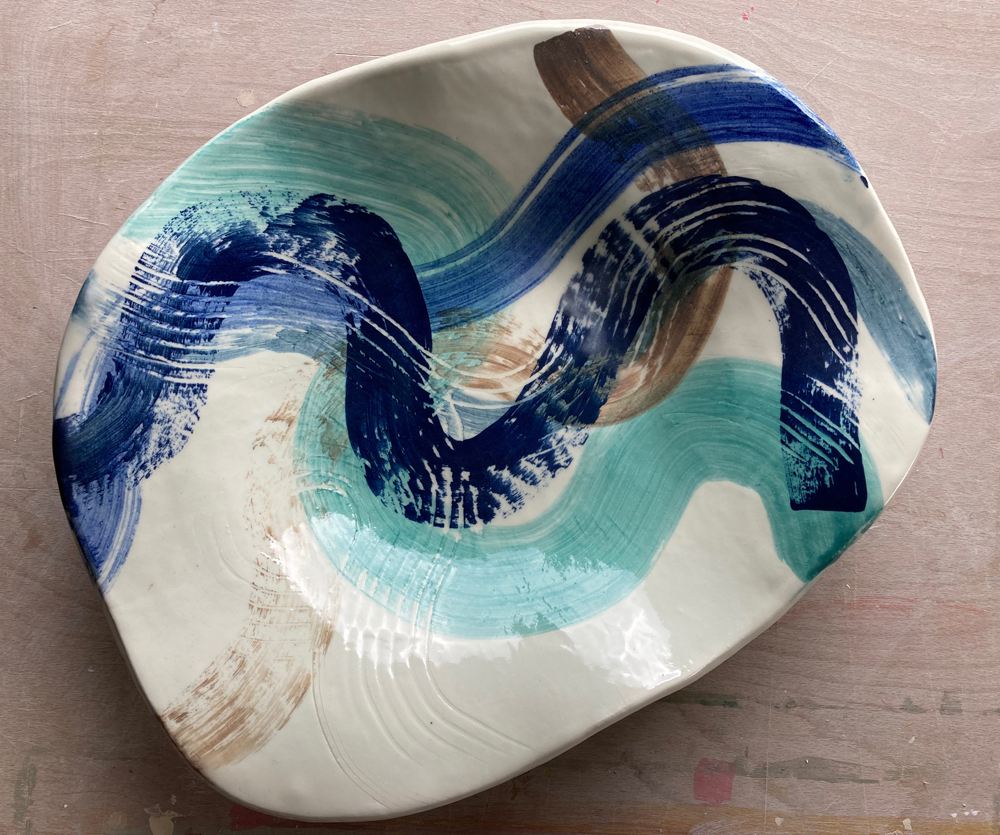
Right. Now the ceramics. Rummaging in the deepest recesses of the storage room is like going back in time. Waiting to see the light of day was a stack of stoneware wave bowls made some years ago and never sold. Spiro ( in charge of Marketing) says it is because they were not properly promoted for their practical use and that customers were perplexed by their description as “wave” bowls. Spiro wants to publicise them as fruit bowls and insists on the following description:

fruity feature

“A really stylish modern ceramic fruit bowl that looks great in any room of the house and can be used in so many ways. This amazing ceramic piece will make a stylish feature on a sideboard, dining room table or kitchen island. It also provides a sense of style to any contemporary space.”

stylish

I suppose I like them for their aesthetic qualities above all and prefer to see them as objects with visual impact, which, I keep telling Spiro, PAC followers do too. He is adamant that function comes before form. Anyway, this is his compromise:

fruit bowl with fruit

“No matter what kind of salad you serve up, this ceramic bowl is sure to make it look scrumptious! This simply designed tableware with its wavy brushstrokes in blue and green depicts a contemporary look with marine associations.  This bowl is perfect for everyday use or special occasions and along with the rest of the range can be used in infinite ways to suit your style. Material: glaze fired porcelain. Dishwasher, oven and microwave safe.”

Edible Book Day

I also found some chargers, or large round serving dishes, so both fruit bowls and chargers need to make room for new stock and will be displayed for sale in the garden at Oakland House, The Homend, Ledbury HR8 1AP from Saturday 18th to Sunday 19th April (10 – 5). They will be spaced out appropriately , but I assume there will not be more than six people together in the garden at any given time. If you want to purchase a bowl, put on a mask and knock on the kitchen door, either Spiro, or Thelonious, or I will serve you. Card or cash accepted. Prices range from £30 to £60.

wave bowl as birdbath

Anyone who’d like a piece but cannot travel, select the one you’d like and just send an email to info@peterarscott.co.uk  Shipping and packaging for UK will add £10.

a. 34 cms max width. 1.7k. £30

b. 42 cms width. 2.4k. £50

c. 42 cms width. 2.7 k. £50

d. 45 cms width. 3.7 k. £65

e. 40 cms width. 1.9 k. £45 Miró

f. 39 cms d. 3k. £40

g. 48 cms d. 4 k. £50

h. 42 cms d. 5 k. £45


i. 48 cms d. 5k. £60

Lastly, I thought you’d enjoy this video of a deer attacking a hunter. Just click on it: