
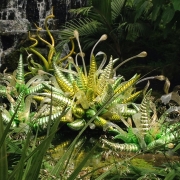
Arscott’s ceramic wanderings

cloud vase petulant
I found myself wandering about in the grounds of a ruined castle, somewhere near the Welsh border, probably Skenfrith, or White Castle, when I came upon an open enclosure, the portcullis and dry moat lay ahead and the grassy area was walled in and contained a massive oak tree. But what most intrigued me a very large vase that stood in the middle – it was familiar to me, in fact one of my own pieces called Cloud Vase, but it was huge.
“What are you doing here?” I asked it, I don’t know why.
“I could ask you the same thing”, it answered rather petulantly.
“But what has happened?” I was very confused.
“Nothing much. What’s up with you?”
“Nothing. What do you mean?”
“Well, look at yourself. You’re stark naked.”
I looked down and saw this was the case. Which is when, thankfully, I woke up.

vine vase in the Welsh hills
This is how reality, or the day to day, elbows its way into your sleep and there’s always some reason behind it. In this case I blame Mr Dale Chihuly. Let me explain.

dream vase at Cecilia Colman’s
On the way back from leaving some ceramics with the Cecilia Colman Gallery in St John’s Wood (see June 2018 blog), a friend suggested we visit Kew Gardens and look at the exhibition of glass sculpture by Dale Chihuly, Emperor of Blown Glass, whose work he often sites in natural settings, landscape or gardens, and whose technique, as he says himself ( he doesn’t like to use a lot of tools), it is all about fire, gravity and centrifugal force: “It’s these natural elements that make the pieces begin to look like they were made by nature”.

Chehuly’s Persian Column in the Temperate House at Kew
This outdoor exhibition brings together work from the past 50 years, the only site-specific piece being the Persian Column suspended from the roof of the Temperate House.

Lime Chrystal Tower
Main ingredients of glass? Liquid sand, or rather sand, soda and limestone. melted at around 1320 degrees Celsius. This makes a typical glass which can be formed by blowing by mouth or machine, by casting, by pressing and by drawing.

Glass Hornets in the pond at the Temperate House viewed from the gallery
So, it’s a cousin of stoneware, which is also fired at a high temperature and is essentially a vitreous ceramic made from naturally occurring stoneware clay containing kaolinite, mica and quartz, and is thus water resistant and frost proof – like the pieces I make, only mine are really for a domestic setting, though what if….?

Sapphire Star
How big could a ceramic sculpture be, I wondered? The glass work on view is large, and mainly made out of many hand blown pieces which are carefully slipped onto steel rods that stand out from an inner steel core or tube planted deep into the ground. Like the Summer Sun by the lake, or the Sapphire Star by the Victoria Gate entrance. They are very large and dominating, and impressive. Which is why I ended up dreaming about man made ceramics in outdoor settings.

Summer Sun
If you haven’t been to Kew, you have a treat awaiting. It is a garden that houses the largest and most diverse botanical collections in the world (30,000 different kinds of plants), a World Heritage Centre, 132 hectares of gardens, glasshouses, listed buildings and the fabulous Palm House built in 1848. Parking is challenging unless you go early, otherwise it is best to arrive on the underground, either Kew Station or Richmond. The sandwiches are good.

small vine vase at Cecilia Colman’s
So, back to nocturnal wanderings of the mind, finding yourself in a state of undress in a dream is no big thing, nothing to worry about. Everybody has had one of these dreams, or at least that’s what the giant vase on the hill tells me.

giant vase that tells me things


