Posts

Marmite explained

The view from CJ’s bench on Bradlow Knoll was appropriate for the day, after all it was St Leger’s, the day of the famous horse race (Saturday 16th September) established by Colonel Barry Saint Leger in 1776 and named for him in 1778. An event for three-year-old colts and fillies, it is run annually at Doncaster, Yorkshire. The winner this year was Continuous, the last horse was Alexandroupolis. They say that Winter comes in on the tail of the last St. Leger horse, but global warming may have done for this old adage.

the last horse at the St Leger

The view was grey, misty and damp, and the leaves on the trees have yet to start turning, but the faint mulchy whiff of tired greenery was hinting at Autumn. Somebody had obviously felt the cold recently as they had left traces of a firepit in front of CJ’s bench. Or perhaps it was an impromptu BBQ. Whoever it was had also forgotten his or her disposable vape – I wonder if CJ would’ve approved of the cherry flavour.

BBQ

Given the weather, I don’t believe that a bonfire would have spread and caused a conflagration in Frith Wood. Apart from a few hot days earlier in the week, it’s been mild. Unhappily that’s not been the story in Greece or Libya, or even Canada, and tramping through the cool damp wood seemed so far removed from those weather extremes. However, even in this neck of the woods, manmade calamity lurks in the shape of the River Wye and its slow poisoning by nutrients leaching from livestock manure (about 70%) and sewage treatment works (20%). Most of the agricultural phosphate pollution is from intensive poultry production (from “What’s polluting the Wye?” – Herefordshire Wildlife Trust blog).

Wye pooper

In order to counter any black outlook that may be developing here, may we urge you to join the fight to save the river by subscribing or following Save the Wye on Facebook, Instagram and Twitter. Here is the link: https://savethewye.org/what-can-you-do-to-help/

Large black and white scrawl vase

Spiro is shouting in my ear that this blog is about marketing ceramics. I have pointed out to him that having unwittingly introduced the word “black” in the context of global warming, I will now exploit its presence in the blog in as measured and respectful a way possible, and with none of the in-your-face cynicism that he always advocates.

Black and white juggler vase at there Palais des Vaches

It is hard to believe Spiro is a 3rd century Bishop of Trimythous, as well as the patron saint of potters, and frankly I am not entirely convinced by his marketing skills. Last month he joined the Ledbury Bank Holiday Carnival Parade saying it was an opportunity to sell pots to the hundreds of Ledburians lining the High Street and was deeply insulted by the pennies people were throwing into the pots he held out, unaware that this the traditional way the parade gathers income for local charities. I had to drag him away when he started berating them in his local Archaic Greek dialect, much to everyone’s amusement who thought this was part of a comedy act.

Poseur vase (Vulcan clay)

Ahem, there is an exhibition at the Palais des Vaches Gallery in Exbury from 29th September, and the theme is “Black & White”. In response to this challenge, Peter Arscott Ceramics (PAC) have made a number of pieces for the show, some are black and white glazed stoneware, and some are made from a dark clay called Vulcan stoneware which comes out of the kiln in a rich dark chocolaty black if left unglazed.

My oh my vase (Palais des caches)

One piece in particular cannot be explained, and for some reason is called Buffoon Vase and wears a top in the shape of Napoleon’s hat. It looks even more inexplicable if you remove the top and insert a flower in it (it can only take one flower, and no water, as it has a leaky bottom). It’s a “marmite” piece – some people will simply like it without having to understand its impractical character, others will just think it’s strange.

Buffoon vase

For those of you unfamiliar with marmite, it is a dark brown yeast extract spread, much liked by half the UK population, and much disliked by the other half. It is used as a metaphor for something that is an acquired taste, or something that divides opinion, like, say, Elon Musk or Nigel Farage or morris dancing.

Buffoon vase with flower

In a neat bringing-together of various themes in this blog (fish, ceramics, rivers), a recent visit to Wales included a fly-fishing lesson with Mr Jones on the banks of the beautiful Dyfi river (unpolluted and very clean, thus salmon and sea trout are happy to swim in it).

Fly-fishing lessons on the Dyfi

The result was a brown trout fished from a smaller river nearby, which was cooked and served to fourteen people on a PAC dish. Thank you Mr J.

Sacrifishal?

A man walks into a fish and chip shop with a happy trout under his arm.
“Excuse me, do you sell fish cakes?” he asks.
The owner replies, “Yes, of course we do”
“Great” the man responds, smiling at his trout, “It’s his birthday.”

With apologies for that old chestnut, farewell and goodbye.

Unhappy trout

a curly tail of two cities

a pier with no equal

Brighton and Hove is an engaging place and I was wandering around in an aimless way when I came across a giant donut surrounded by very happy people, two of whom has just got married, all of whom were drinking champagne, and one of whom offered me a glass. The donut is a huge circular shape cast in bronze and its centre at eye level allows a view of the world through the sculpture. It’s called “Afloat”.

Afloat

Some of you will know that expectant feeling that takes over when a kiln is opened up and the work of weeks is revealed fully glazed– smooth shiny shapes that are pleading to be picked up, weighed and felt for the first time. Stoneware and, occasionally, porcelain is what’s used at the workshop, and recently after my trip to Brighton and Hove, I was thinking about piglets for some unaccountable reason. The brain is a strange and wonderful thing.

whirlpot set

Stay with me on this one. The point of the story is that the donut is sited at the seaward end of the groyne, a word I had never heard of but which turns out to be a man-made barrier designed to trap sand which the waves have moved along the beach and to prevent the sand being moved too far along the coast. Groynes are usually made of wood, or concrete.

porker

If you are like me you will want to know why it is so called. Well, it comes from the Old French groign, which derives from the late Latin grunnire (to grunt) and thus from grunium ( a pig’s snout). I suppose groynes do stick out like porkers’ snorters towards the sea. I was relieved to work out that this was the reason for my porcine daydreaming and pleased to realize that it afforded this blog yet another tenuous link with ceramics.

How? Well, porcelain comes from the Italian porcellana, literally “cowrie shell,” the chinaware so called from resemblance of its lustrous transparency to the shiny surface of the shells. The shell’s name in Italian is from porcella (young sow), the feminine of the Latin porcellus (young pig), diminutive of porcus (pig). The smooth and plump little cowrie does have piggy qualities though some experts point out its resemblance to a pig’s genitalia. You judge

Robin and Kirsty

All this preamble leads me to the reason for my visit. I was there to deliver some recent ceramics to the Cameron Contemporary Arts Gallery run by Robin Cameron and Kirsty Wither. Scattered throughout this page are examples of pieces you can see if you visit the gallery.

leaf vase

The gallery shows a changing programme of high quality established and up and coming British artists, ranging from traditional to modern, figurative to abstract, and each exhibition is accompanied by a selection of sculpture, ceramics and jewellery.

blue/green stoneware vase

The gallery is in the more laid-back Hove half of this twin city, less dense and intense, but because of its Regency buildings, villas and art-deco housing, wide roads and general leafiness, it is as expensive as Brighton but still attracts young families perhaps drawn by the wistful names of the areas there: Poet’s Corner, Wish Park, Palmeira Square, Adelaide.

seagulls go free

Brighton itself is certainly busy and cosmopolitan. I heard the sing song tones of Swedish, the emphatic sounds of Spanish, a lot of French glissando and very loud screeching Seagull. Seagulls own the promenade and perch all over the place in wait for something edible – they stare back at you unblinkingly and with a certain smugness because they are the only ones who do not have to pay to climb to the top of the British Airways i360 tower, from which you can view Brighton and the south coast. Visitors glide up gently to 450ft in the glass viewing pod, designed by the creators of the London Eye.

the Pavilion

Brighton’s famous lanes, narrow and crowded, are home to jewellers and a few restaurants, but a stone’s throw from them is the exotic Brighton Pavilion built for George IV, with its extraordinary exterior, its Chinese decor indoors, and its huge kitchen designed to feed a monarch who became very piggy-like in middle age.

Gorgeous George

As well-known as the stout sovereign’s palace is the Brighton pier, formally called the Brighton Palace Pier with its amusement arcade, rides and attractions, candy floss and Brighton rock. A lot of you may remember visiting it as children, and I still remember the smell of candy floss (does candy floss smell, or is my brain playing tricks again?), the one-armed bandits spitting coins at the ever-hopeful and the money I spent at the Shove Ha’ penny machine trying unsuccessfully to get a pocket knife in the shape of Elvis Presley.

three legged leaf bowl

I do remember going blue with cold after being frogmarched to the beach when we came to visit Granny. Luckily by then there were no professional “dippers”, robust women who plunged bathers vigorously into and out of the water for a small fee when the popularity of sea-bathing grew back in the 1790s. The ‘queen’ of the Brighton dippers was the famous Martha Gunn, a large woman who dipped from around 1750 until she was forced to retire through ill health in about 1814.

Martha at the Brighton Museum

It is hard to believe that before George IV made Brighton the “go to” resort it was a very impoverished town after the decline of the fishing industry resulted in much unemployment. It reached its nadir when the population had fallen to around 2,000 by the mid eighteenth century and great chunks of it were being gobbled up by the sea. Daniel Defoe, never one to mince his words, described Brighton as an old and poor fishing town in imminent danger of being completely swallowed by the sea; the proposed expense of £8,000 on groynes was, in Defoe’s opinion, more than the whole town was worth.

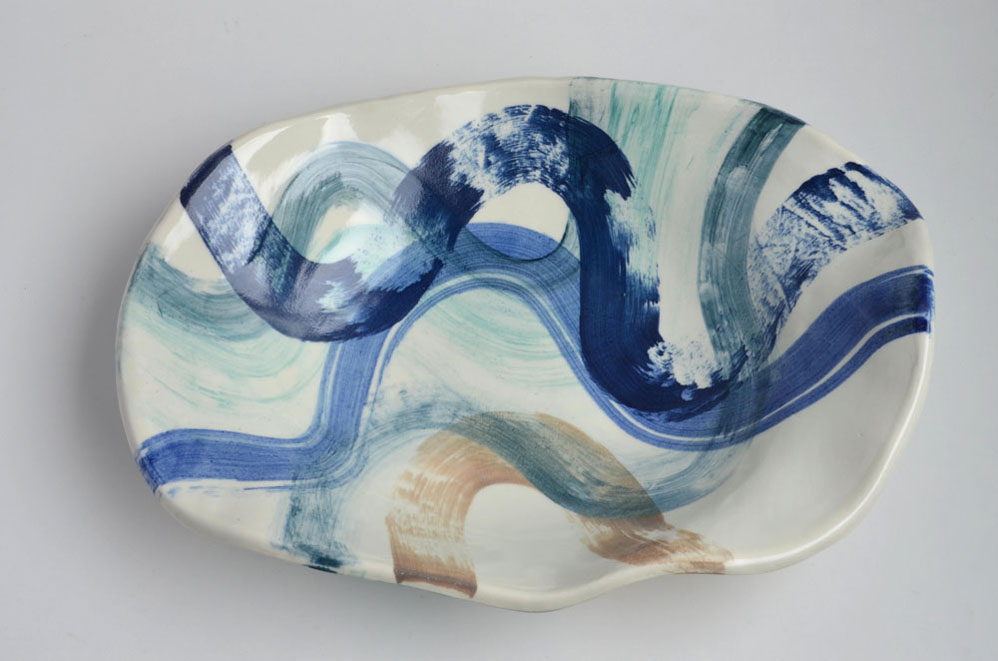
ceramic wave bowl – appropriate for a seaside resort

But it is another story now, and should you want to spend a day or two enjoying the sea, the vista, good restaurants and hotels, fairground rides, serious shopping, sailing, museums and galleries – and all of it an hour’s train ride from London – then this is your place.

Do drop in at Cameron Contemporary, and to see other galleries selling my ceramics click here and it will take you to the Gallery page on the website.

Lastly, I’d like to thank my dear old friend C.D.N. and his lovely Sue for putting me up that night, despite the fact that he was celebrating a significant birthday the next day. I hope the party went off with a bang and that all the wine brought in was consumed. I snuck out very early the next morning and tried to write a thank-you message on a paper napkin, but the tissue soaked up the ink in my pen and all I managed was a wobbly “Tha…” Here’s my present  –  an old song we both like (you’ll be hooked with the first note of the sliding guitar).

Arrivederci