Eunice done me wrong

Storm brewing over Ledbury
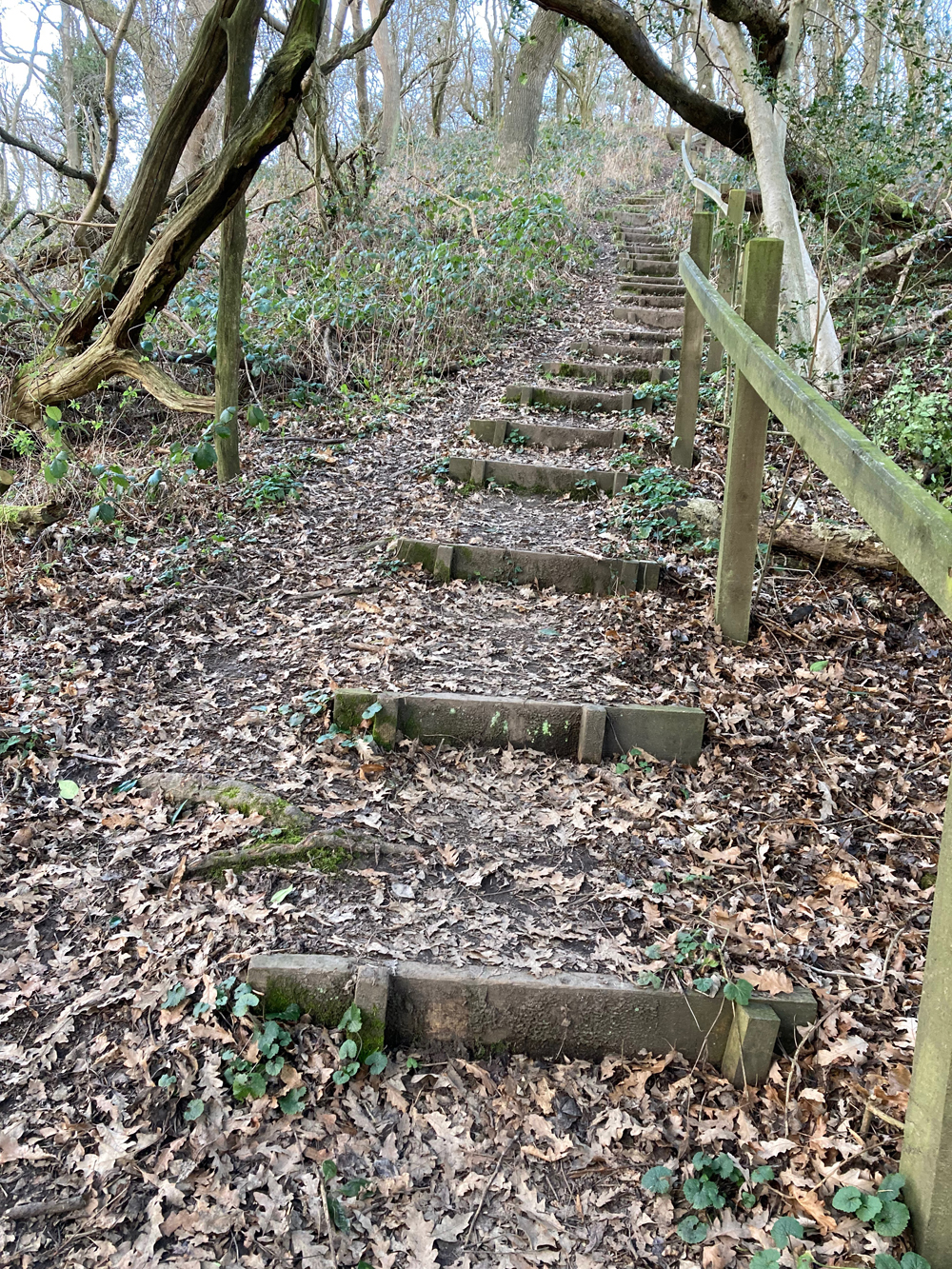
The consequences of humans evolving bipedalism from a body designed to walk on four, not two, legs, include the effort required to climb a hill without running out of puff. This is what walking up to Bradlow Knoll entails – back pain, breathlessness, and aching thighs, but the reward awaits, no matter what the weather: the view down to Ledbury and beyond, though it looked ominous and buffeted by winds.
Final hurdle
But it would be easier on four legs. The fact that it is a “knoll”, which means low hill or hillock, somehow adds insult to injury. It feels more like a smallish mountain, or at least a steep hill. What’s more, when you make it to the top you are ambushed by the fifty extra steps required once in the wood to get to the very top.

Two legs good
Bipedalism. It seems that thousands of years ago our pelvis shortened, the thighs became longer, the angle of the thigh bone changed to point inwards allowing the knees to come together under our centre of gravity, allowing us to stand for a long period without getting tired. The spine curved into an S-shape helping to support the head and creating balance. Oh, and we lost our body hair.
Moe
The disadvantages of standing on two legs? More pressure put on our spine and on our knees. The vertical position of the spine makes it more prone to back injuries. It’s also much harder on the heart and its vessels to pump blood to the entire body. And the big heavy head our spine has to carry, no wonder we lose our balance and fall when we get older.

Bighead
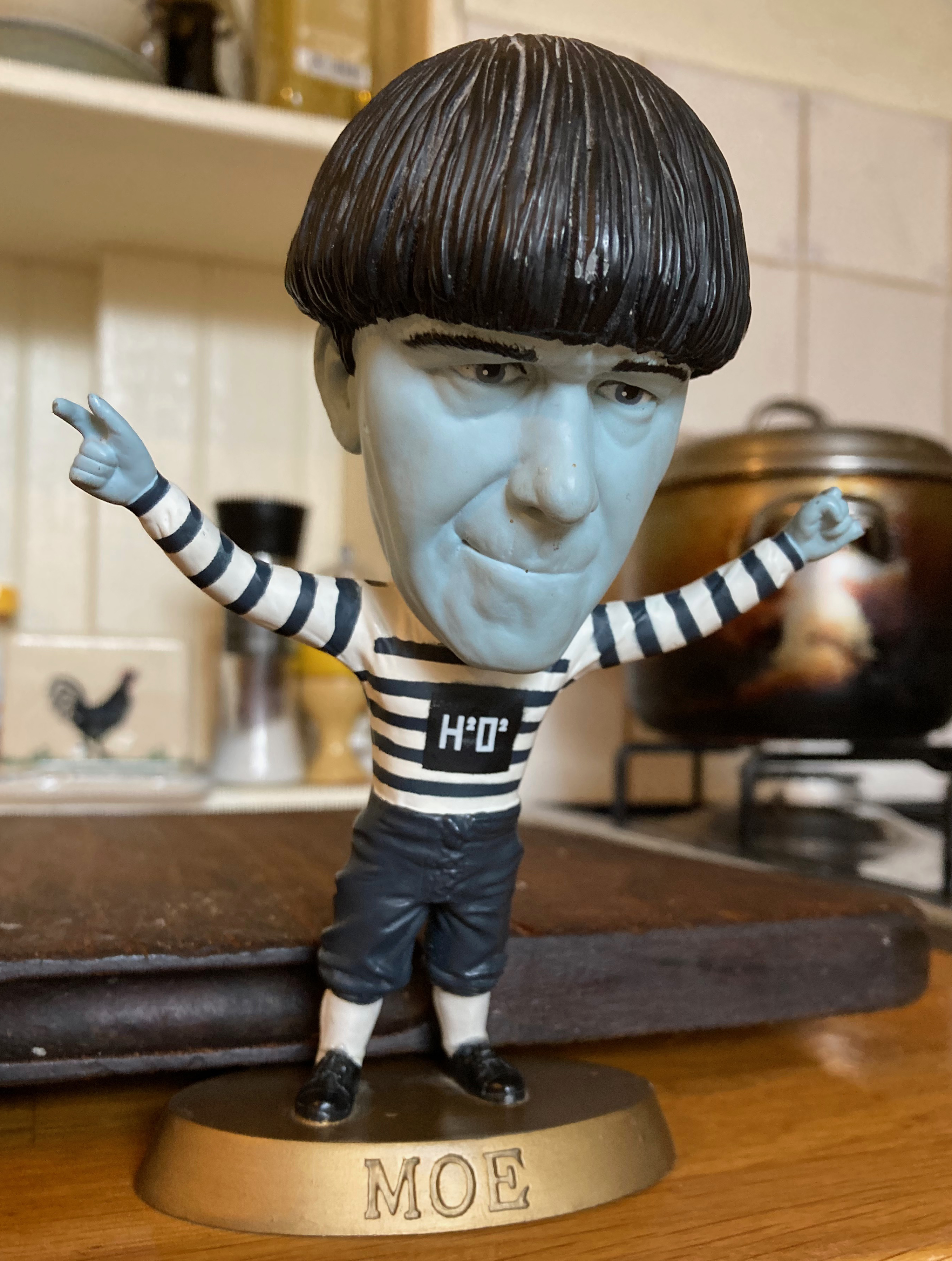
In the case of Moe, my bedside table mascot, he can only stand upright if his feet are wedged at an angle behind the table, otherwise his head, being too heavy for the design, forces him to collapse. Who is Moe? Those of us of a certain generation may remember Larry, Moe and Curly Joe who had us laughing when we were six or seven. Not sure their vaudeville humour has survived with time, but there is a certain nostalgia seeing them poke each other’s eyes and indulge in slapstick. Click here for The Three Stooges .

Fingers – one of the benefits of bipedalism
On the other hand, walking upright frees the hands for carrying your important tools like your mobile phone, for social display and communication like when you feel the need to welcome or insult somebody, but, most importantly, for making pots out of clay – there’s no doubt that would be difficult on all fours. Having fingers also helps.

Eunice did it
The fragility of the human frame and what it has to put up with (stress, weight, temperatures, balance) leads me, of course, to ceramics. All this was uppermost on the day of the climb to the knoll. It was cold and windy but not yet a storm. That was to come a few days later in the guise of Storm Dudley, very much a milksop of a squall compared with his successor a few days later – Storm Eunice. Presumably the next one will be a male name starting with “F” – Fred, Finnegan, Fernando, Finbar? Well, while writing this, Storm Franklyn blew in and is at the moment playing havoc with the tree in the garden. The news says there’s another on the way, and it’s called Gladys. Dudley, Eunice, Franklyn and Gladys – sounds like a polite tea party at an old people’s home.

Large Block vase

Large Block vase stress fracture
It was Eunice who knocked over a big garden vase, but sometimes it is the potter who is the culprit, as in the case of the large block vase. By not allowing its thick stoneware time to dry slowly and completely, sections of it dried at different times creating stress fractures that only became visible after firing. It is now useless and will be relegated to garden duties.

Big Spring vase
Sometimes the fractures are made when the potter is manipulating the clay too much, as when adjusting a handle onto the body of a vase, which is what happened with this Big Spring vase.

Big Spring vase close-up
Still on the subject of bipedalism, cows have four legs, as is well known, but not feet. They have hooves – hard, good for long distances. Good in almost any environment except sharp rocks. Very little maintenance needed. I mention them because Arscott Ceramics will be exhibiting some work at the Palais des Vaches near Southampton opening on 18th March, in collaboration with the Coastal Gallery. More about that in the next blog, but if you are nearby on the day do pencil it in your diary.

Tendril vase at the Palais des Vaches
Why do cows have hooves? Because they lactose.

I wonder if at this rate we’ll get to Storm Zebedia this year? Anyway, keep well and don’t forget to pencil in the Equinox exhibition at the Palais, which is in Hampshire, and as everybody knows, in Hertford, Hereford and Hampshire, hurricanes hardly happen. So you’d be safe from the wind.