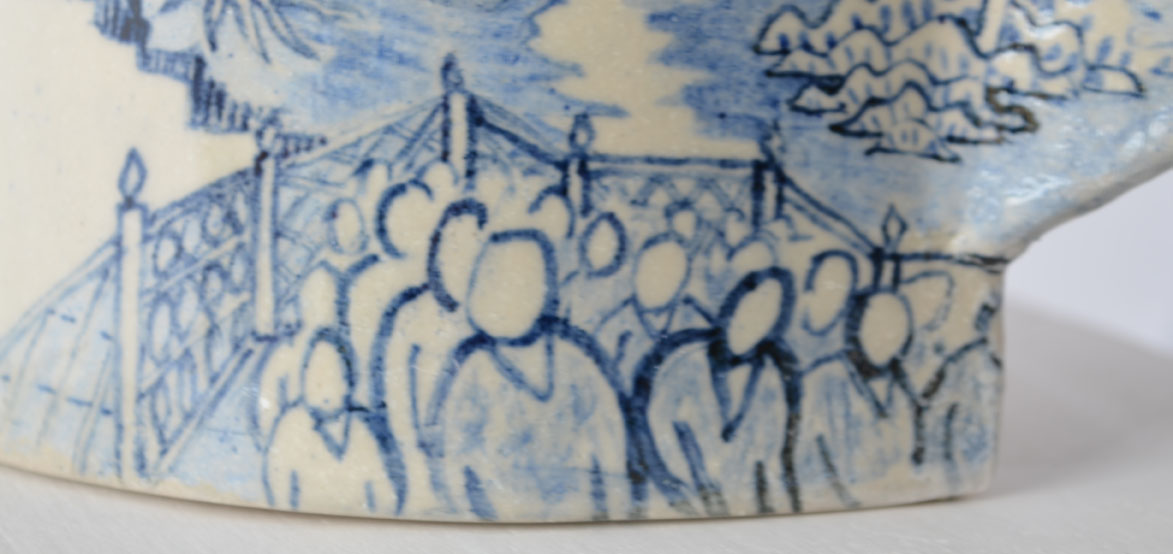
The Madding Crowds

Photo by Rob Curran on Unsplash
Peter Arscott Ceramics paid a quick visit to London a few weeks ago, in order to go to some exhibitions. Walking from gallery to gallery was as demanding as climbing Bradlow Hill, not because of any steep incline but because of the number of people out and about in the capital. – wall-to-wall human flesh, where even on the pavements one had to stop and queue simply to keep going along the same trajectory.

“Far from the madding crowd’s ignoble strife, Their sober wishes never learned to stray; Along the cool sequestered vale of life They kept the noiseless tenor of their way.” Thomas Gray. The view from Bradlow Knoll on Boxing Day
A walk along the South Bank to Borough Market for a bit of street food was a marathon, and once in the market area, the queues in front of each little kiosk (the paella queue being the longest) snaked and coiled around each other and made progress almost impossible. This is not a complaint, by the way, simply an observation – everybody was very relaxed and easy-going, and the atmosphere in the city was memorably positive and friendly.
The first exhibition was Strange Clay: Ceramics in Contemporary Art at the Hayward Gallery (until 8th January, so hurry), featuring artists working across recent decades, and examining the plasticity and the possibilities of ceramics, often in a defamiliarized way. Weird and wonderful, ranging from small abstract works to large-scale installations that make you wonder how the artists managed to accomplish their work. If you ever wonder what clay can do, this is for you.

Architeuthis by Zinc Yi
David Zink Yi (Lima, Peru) has somehow created a giant squid (5 metres) lying in a pool of its own ink. To achieve the slick-looking flesh he has glazed the piece with a mix of different oxides. An animal we only ever encounter dead on our shores, there is something impressive but sad about this Architeuthis on the gallery floor. Insider info: the “ink” was made by mixing maple syrup with black ink, and acts as a barrier – somebody kicked and broke one of its legs at a previous exhibition, and this is the clever solution.

Brie Ruais
Brie Ruais (USA) draws inspiration for her large wall pieces from the desert landscapes of the Southwest of the United States. She sees similarities between the body and the land since they both bear scars as a record of trauma, the latter as a result of human intervention and extraction in the region.

Betty Woodman
Betty Woodman’s wall piece (USA, d. 2018) made of many separate ingredients that come together to create movement, colour, and space, is typical of her. Many years ago, she started to create an untroubled and friendly world for ceramics that had never previously existed, and her pieces were often set out in the lobby of galleries with flowers in them, offering visitors a warm welcome. She would throw her pieces on the wheel, but played with them afterwards, twisting, stretching, and cutting shapes, I think, without much forward planning, which gives her work such freshness.

Woody de Othello
Woody de Othello makes vases and jugs that incorporate human body parts such as arms, hands, lips and feet. The exaggerated proportions and the vivid hues of his sculptures reflect his Haitian ancestry and Yoruba culture. They are quite funny too.

Grayson Perry
Of course, Grayson Perry (now a “Sir”) is there with his beautifully made vases – he is a coiler par excellence – and so are many more artists proving the flexibility of clay as an art material.
A walk to the Tate Modern followed, and a visit to the Cezanne exhibition (fabulous collection of his work on show), and also Maria Bartuszová work which is based on plaster casting using gravitational pull or her own breath to make serenely white and delicate works.

Twins (1909) by Marianne Werefkin
Then off to the Royal Academy for a look at “Making Modernism” (on until 12 February) which brings together the work of seven German women artists active in the early twentieth century.

Mother cradling dead child (charcoal) by Käthe Kolwitz
Kathe Kollwitz is the best known, but the others, who achieved success in their day, are, until now, largely forgotten thanks to the Kinder, Küche, Kirche philosophy coming back to the fore.

Portrait of a boy (Willi Blab) by Gabriele Münter
Peter Arscott Ceramics will be included in an exhibition of Oxmarket Open winners in Chichester from 14th to 26th of February. If you pay it a visit, the town has plenty to offer – click here for a previous blog about it.

As you have undoubtedly picked up, 14th February is St Valentine’s, patron saint of beekeepers, asthmatics, and lovers, though St Spyridon (Patron saint of potters and in charge of Marketing at PAC) claims he is a fabrication, “like St Philomena, and St Veronica, and St Eustice”, he says dismissively.

And thanks to those of you who got in touch with your reactions to my story in Litro magazine in the last blog. It’s good to hear your thoughts, mostly positive and some constructively critical, and I appreciate them all. Here is another one called Cornelius Radhopper, which is published in Azure, a Journal of Literary Thought. It specializes in other-worldly realism, a genre that represents the known, often mundane, world in an elevated or defamiliarising way. To read it, click here.