Posts

December, happy outcomes

wintry

Strange things have been happening at the studio lately. Unexplained disappearances of ceramics, unfamiliar sounds coming from the ceiling, doors being left wide open at night and the kiln not firing on all cylinders. I decided to go for a walk up the hill to Frith Wood to blow away the cobwebs.

Storm Arwen

It was the usual steep climb up to Bradlow Knoll. The view was bathed in a wintry half-light but there was no wind as there had been these last few days with Storms Arwen and Barra which managed to blow a few trees down along the path deep in the wood. Barra (fair-headed) is named by Irish weather forecaster Met Éireann. Arwen is Welsh Celtic for “good”. The next one will be named Corrie, then Dudley, Eunice, Franklin, Gladys, and so on, according to a “name a storm’ project open to the public. What they all have in common is an ability to blow down trees and embarrass the big energy companies.
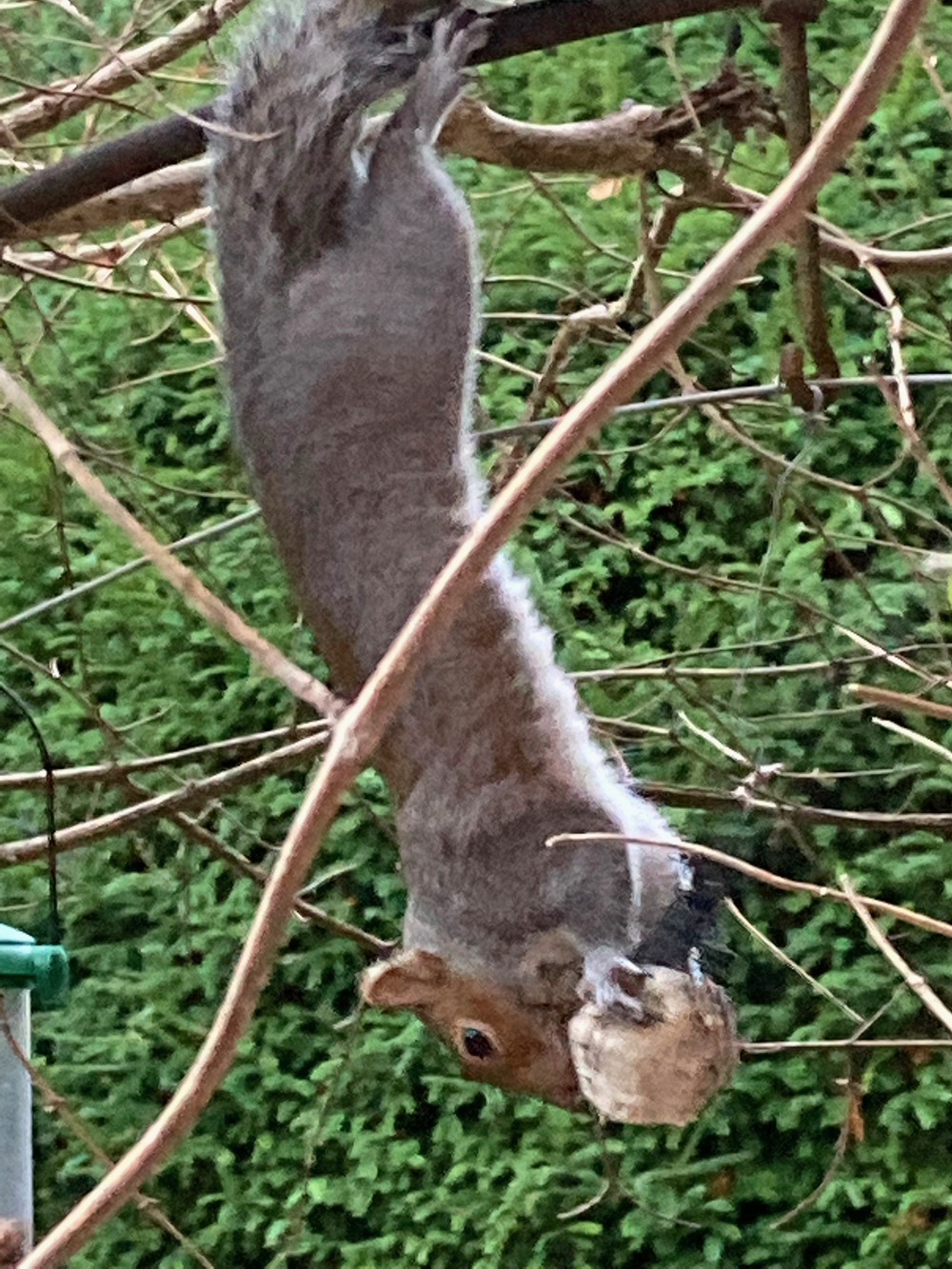
Fatball Slim

The only noticeable activity in the woods were the squirrels chasing each other up and down trees. One of their cousins lives in our garden and has been caught eating the fatball left out for the bluetits, but here in the Frith they seem to feed mainly on chestnuts. But I was too concerned with the studio to take in the flora and fauna.

I believe that I was so burdened by these thoughts that I went to bed that night and muttered the magical words that all potters do when they seek help; “hydrous aluminium phyllosilicates.” I fell into a deep sleep but awoke when I felt the presence of someone else in the room. It was, of course, St Spyridon, patron saint of potters, former shepherd and Bishop of Trymithous (c. 270 – 348), responsible for marketing at Peter Arscott Ceramics, who you may remember from a previous blog (passim December 2020).

Marketing strategy meeting

I knew it was him from the strange shepherd’s woven straw hat and the smell of sheep.

“This better be good”, he said, “you do realize I’m only for emergencies, don’t you?’

I nodded and told him about my worries. He rolled his eyes in a “seen it all before” way and took a cigarette out of a pouch and lit it, inhaling deeply.

“You don’t mind, do you? I really needed one after what I’ve just been through – a game of poker with Freud, Mohamed Ali and Mother Teresa, and they were fleecing me. Lucky you summoned me.”

Cecilia Colman, London

He blew the smoke up towards the ceiling, and continued:

“All your problems will be sorted by tomorrow. They are of little consequence compared with your pathetic marketing strategy however, which, despite my best advice, I see you have ignored.”

“The blog is still a little text-heavy,” I admitted.

“The more images, the lighter the blog. Vision trumps all senses; the human brain can process entire images in as little as 13 milliseconds.”

Taken aback as ever by the modern approach of this two thousand year-old holy man, I could only shrug and ask:

“So, how are things up in… Heaven, or wherever it you dead go to?”

“Fine, thank you. I’ve joined a club since I last saw you. It’s one for patron saints only, quite exclusive. We meet and swap stories. Why, last time St Blaise was telling us how he became patron saint of those with throat troubles after he cured a child who was choking on a fish bone.”

“Interesting. Anyway, you say the kiln will fire OK tomorrow?”

“Well, you might have to get an electrician for that.”

“Oh, I hoped you’d just snap your fingers and fix it.”

“I’m not a magician, you know, I’m a patron saint.”

“I’m disappointed.”

“I can get St Eligius to recommend one.”

“Who’s he then?”

“St Eligius? He’s the patron saint of electricians.’

“OK. Thank you. By the way, are you coming to the company Christmas party?”

“Er, no, I can’t. I’d be breaking the rules.”

“Covid?”

“No. We can only appear directly to one earthling at a time.’

“Ah,” I said, “but the other two guests will be Thelonious, who is the pottery pugmill, and Ziggy, who is the studio spider in charge of security, so strictly speaking …”

“Sorry, a spider is still an earthling.’

“OK.”

“I must go now. We’re putting on a Christmas panto and there’s a rehearsal.  Socrates will be surprisingly good as Aladdin, you know, and James Dean is playing Wishee Washee and John Wayne is Widow Twankey.”

Before I could ask him what part he was playing, he disappeared.

In the morning I had to face the inevitable accusations from my wife of smoking in bed and allowing sheep into the house, but as I entered the studio, I saw that the squirrel was running along its roof, which explained the unfamiliar sounds coming from the ceiling, and when I turned the handle of the door, I saw the latch was stuck, which explained the door always being open.

lost but now found vase

I went to the shed to get a screwdriver and saw in the shadowy depths along the bottom shelf all the “missing” ceramics that I had stored away and then forgotten during the Covid stockpiling. And when I opened the kiln to see the result of a glaze firing, I saw that everything was back to normal, the clock on my digital radio flashing away telling me that there had been a power cut which had gone unnoticed by me, which is why that previous firing had been a disaster. Good old Spyro – always right, in the end.

Happily just out of the kiln

One of the vases that came out of the kiln has some cheery colours that chime with the seasonal good wishes. By now in a celebratory mood, and in honour of St Spyro, I decided to do some serious research into a cocktail that might do the same.

a St Spyros – save the olive till last

To start with you need a bottle of Mastic Tears, a liqueur made from mastiha trees near Olympoi village, one of the mastic villages, on the island of Chios. It was given to me by my niece’s Greek partner, and I accept that not everyone has a bottle in their cellar. A generous slug in a tumbler, a smaller slug of sugar syrup, ice, some soda, a dash of orange bitters, a sprig of thyme and a black olive. I’m calling it a St Spyros. It’s quite interesting. The olive is particularly good at the end.


Peter Arscott Ceramics wish you all a happy Christmas. And If you live in or near Worcester, London, Chichester, Hove, Lymington or Cambridge and you are looking for that original gift, then why not drop in at the galleries whose names caption the ceramic images scattered throughout this blog?

Thelonious the Pugmill

Ziggy, Head of Security

Cheers. Here’s looking forward to 2022, and hoping it surprises us by bringing pleasure, gladness and delight. After all, the number 22 indicates that your angels have your back and are ready to help you in whatever way they can (apparently it is an “Angel Number”).

kalá Christoúgenna


Rutile

St John’s Wort in rutile vase

Last July I was going on about the names of all the different plants that grow wild in Frith Wood, as well as discussing the benefits of geophagia for some reason (the eating of mud or clay). I also think worms came into it, somehow. Click here if you want to revisit.


meadowsweet

This July, however, I would like to introduce you to Filipendula ulmaria, or meadowsweet. It could be because it was used in the Middle Ages as a sweetener for mead that it gets its name, but take a whiff and it might remind you of something familiar. Its chemical constituents include salicin, which was synthetically altered because it causes less digestive upset than pure salicylic acid used in drugs, and thus aspirin was created. It was Bayer that named it aspirin after meadowsweet’s old botanical name: Spiraea ulmaria.  It does have a whiff of aspirin.

meadowsweet

There is a lot of it now  flourishing on the sides of the roads all over Herefordshire: fluffy, slightly floppy, pale cream bundles framed by the hedges they grow by. I confess that the real reason I mention meadowsweet is to promote the Ledbury Poetry Festival and Edward Thomas’ poem, Adlestrop:


Yes. I remember Adlestrop—

The name, because one afternoon

Of heat the express-train drew up there

Unwontedly. It was late June.

The steam hissed. Someone cleared his throat.

No one left and no one came

On the bare platform. What I saw

Was Adlestrop—only the name

And willows, willow-herb, and grass,

And meadowsweet, and haycocks dry,

No whit less still and lonely fair

Than the high cloudlets in the sky.

And for that minute a blackbird sang

Close by, and round him, mistier,

Farther and farther, all the birds

Of Oxfordshire and Gloucestershire.

The Barrett Browning Institute

The Festival this year is mostly online, though there are some great events held in Ledbury itself over the weekend of 9 – 11 July. Click here for all the available events (online and non-online). The Festival is on until 11th July. The Barrett Browning Institute in the town centre  is the Festival’s headquarters, and if you go in you will find Sally Crabtree.

Sally Crabtree

Her latest installation is a sweetshop of conceptual confectionery which offers each member of the public a small gold coin which they can spend on just one thing at the counter and it explores the notion of choice in our lives-“Choose well. Your choice is brief, and yet endless” as Goethe says. It has the feel of a fairground stall with the excitement that each person goes away with a ‘prize’ so to speak. Of more value perhaps however is that each sweet that they choose comes with its own quirky, philosophical inner layer of meaning which they unwrap, depending on what they choose.

Festival A board

And for children… they can fill a jamboree bag with their own creations inspired by the Sweetshop of Words –  including lyrical lollipops, glass sweets and pop a pop a poem balloons!

stonewarew rutile signal vase

As I said in the last blog, the difference between poetry and pottery is only a “t”, and some new pieces have emerged out of the kiln which, if not poetic, are at least expressive.

Wavy rutile vase

The latest batch of ceramics has seen the rise of an ingredient called rutile.   Rutile is a glaze additive that produces colours ranging from light and dark blue, to tan, gold, yellow, and even purple.  It has a mind of its own, depending on the glaze base and the firing conditions and, because it is a mined colorant, its makeup also depends on the mine source. Many potters test their batches of rutile before committing to a full bucket of glaze – all the result of the mineral’s notorious inconsistency. But when it works, it produces many crystalline, speckling, streaking, and mottling effects in glazes during cooling in the kiln and thus it is highly prized by potters.

Wavy rutile vase verso

Of course, here at Peter Arscott Ceramics, and following in the contrarian, or maybe heedless, tradition, rutile is not used in this way at all but rather mixed as a powder with water and a viscous agent to produce a colourant that can be applied like paint to the bisque surface of the piece, and then dipped in a transparent glaze. In other words, it is not used as a glaze but as a colour that gives the object’s surface an effect halfway between wood and honey. See for yourselves.

rutile close-up

By the way, Brits pronounce it “root ill” and Americans say “root isle”, which I prefer. On the other hand, and digressing wildly, why do Americans say “rowt” when they want to say “route”? Answers please. And since we are on the subject, why do they pronounce “rubbish” as “garbage” and “chips” as “french fries”? I am sure that at least one of the three American readers of this blog will tell me in no uncertain terms.

my friend Edith

I got know a resident sparrow, called Edith, busy looking for anything to feed its chicks in their nest in the roof’s gutter. Luckily they were not flooded out, and I felt so sorry for her that I bought a  bag of mealy worms. She didn’t want to land on my outstretched hand but was OK on the table, where she would occasionally forget herself and leave a calling card. The fledglings have now flown, and she has lost all interest in visiting.  Spurned by a sparrow.

Wanted

back from Gwalia Ceramics

Driving back from the Gwalia* Ceramics gallery in Llangollen, the consequences of this pandemic were apparent. Businesses are having to make difficult decisions, and the ceramics rattling gently in the back of the car were not unwanted but rather a reminder of how vulnerable small enterprises are. The lovely Gwalia Ceramics is having to wind down and I was bringing my unsold pieces home.

The A49 meanders through some beautiful countryside but there are few opportunities to overtake on it. From outside Shrewsbury all the way to Leominster I was stuck behind a food delivery lorry. No doubt with Brexit in mind and in preparation against the invasion of chlorinated chickens from the USA, a large image of a plump roast chicken surrounded by potatoes and veg,  a Union Jack background, and with the slogan “Eat British Chicken” hovered before my eyes for forty miles. By the time it turned off at Leominster I was truly hungry and stopped to gulp down a small pork pie I had bought in Llangollen for supper that night.

Loop vase – dark mossy greens

With the Gwalia ceramics unloaded and stored back on their shelves it is always interesting to see work again after some time. Sometimes you are surprised by a colour achieved and you can’t remember how you did it, or you notice a shape or contour for the first time, which you decide to apply to a new piece. The mossy green on the Loop Vase is a tone I will repeat.

oak canopy in Frith Wood

Talking of which (“green”, that is)  we get spoilt in Spring, what with all the bloom and fresh growth. I set off for a walk in the woods a few afternoons ago. It was hot and sultry, overcast, with a hint of rain in the air, but the trees were not offering any cool shade and the undergrowth looked tired; without a hint of anything flowering it was a dull grey/green carpet. It even smelled different – tacky mud and dried up puddles. I was just about to show my disappointment with Nature by turning back home and watching another episode of “Call my Agent” (it cheers me up) when at last I spotted a pink flower.

Hairy Willowherb

Now, I would be a complete fraud if I claimed to know a lot about plants and flowers. With the recent lockdown and the increased walks I am learning on the trot, but I have recently downloaded an app that helps identify most things in a couple of seconds. This one turned out to be a Hairy Willowherb.

Because its dense and aggressive growth habits can crowd out and destroy other native plants, a sort of rural bullyboy that goes around beating up the feeble pretty ones that tremble and hide behind trees, it is considered a problem, an “unwanted” plant that is difficult to eradicate. Local names include “apple-pie” and “codlins-and-cream”. So, it can’t be all that bad. In fact, the shoots of the willowherb can be boiled and eaten like asparagus. This I can believe, since it seems that any stem or shoot of a non-poisonous plant or veg can be boiled and served cold with mayonnaise as “poor man’s asparagus” – I have eaten beetroot stalks in this way.

Bull Thistle

Anyway, I was struck by the “unwanted”  epithet given to so much that grows in the landscape. Not only willowherb, but also the next one I stumbled on – the Bull Thistle.

It may be considered a noxious weed by some authorities, but it produces a large amount of nectar and attracts pollinators. Its entire bud is featured with stiff spines that make it look like a fierce bull. It is also called a Spear Thistle and is designated an “injurious weed” under the UK Weeds Act 1959 (no, I didn’t know about that either) despite the fact that it feeds butterflies, beetles and small birds. Guess what? Yes, the stems can be peeled and steamed or boiled.

Bitter Doc

The third plant to get my attention was the usually disregarded bitter dock, which  is another unwanted plant apparently growing and spreading out of control, and in such competition with other “wanted” or cultivated plants that it aggressively overpowers them.  But I have always seen it growing in the countryside and to me it seems to happily coexist with nettles (which I expect is yet another “unwanted” plant) and most other unidentified vegetation. Furthermore, the large clusters of shoots which contain small greenish flowers change to a deep reddish brown as they mature and serve as visual punctuation marks in the landscape specially against a greenish background.

watercolour of Malvern Hills – bitter doc, bottom right

The doc’s name variation depends on the leaf – if they are huge it is a broad-leaved dock. Blunt-leaved dock was used to wrap butter in the 19th century. Hence, it is called butter dock. And the bitter dock may be an invasive weed, but It serves as an effective laxative.

fly by Paul Arscott @baguetteboi69

By now I was dreaming up plans to cultivate a Garden of the Unwanted dedicated to all these unappreciated and unloved rural thugs, when I felt something strange on my left arm. Unlike insects which surreptitiously puncture the skin with needle-like organs, female horse flies have specially adapted mouth-parts which they use to rip and/or slice flesh apart. Research later showed that they thrive in hot rainy weather and that “the female horse fly is secretive, with an annoying ability to land without being detected and escaping before the victim begins to experience any pain”, but in this case I most definitely felt it.

horsefly nightmare

I brushed it off and noticed another had landed on my right arm and was already tying its bib around its neck in readiness when I flicked it off. When I felt something land on the back of my neck, I decided I had had enough of Nature for the day and beat a retreat. They can persistently chase you at a flying speed of around 15mph and they did until I crossed paths with a couple walking their dog, who offered my tormentors far tastier fare.

peacock butterflies on buddleia

I am sorry but horseflies are unwanted “unwanted” and will have no place in my Garden – you have to draw the line somewhere. To compensate for the dark shadow cast by these beasts here are two sunny images, one above of peacock butterflies feeding on lilac, and one below of sunflowers in a large vase.

abstract vase with sunflowers

*Gwalia is an archaic Welsh name for Wales. It derives from the Medieval Latin Wallia, which in turn is a Latinisation of the English “Wales”.