

Meandering

The Leadon, which gives its name to Ledbury.
It was a clear, bright September morning, perfect weather for a long walk, but the thought of trudging up Bradlow Hill for a view of Ledbury overcame any remaining willpower and my feet took the easier option, leading me in the opposite direction, across the bypass and along the (flat) Leadon River walk to the east of the town.

Leadon – Celtic word for ‘broad stream.’
Maybe I would spot a kingfisher, or see fish jumping, or some riverbank fauna. Perhaps it was the lack of recent rainfall, and it could simply be seasonal, but the Leadon was a trickle of its usual self, and looked muddy and, frankly, dead. There was no life in it, no fish, no birdlife, and I wondered if it had suffered another watercourse pollution incident like the one in 2016 which killed more than 15,200 fish after 100 tonnes of digestate had been pumped onto a field and had flowed into the Preston Brook, which in turn flows into the river Leadon.

A tributary to the Severn river
There have been efforts in recent years to help the Leadon thrive as a salmon river. In 2009, thousands of salmon were released, and two small weirs were installed near Ledbury, which were designed with salmon in mind to overcome barriers to migration. Also, roach, chub, and dace were added to the mix. Most fish recently re-stocked into the Leadon have been non-migratory species, commonly called ‘coarse fish’

fish vase – if only the Leadon were like this
So, I wonder if there is a problem, or whether my observations are not accurate, but I would have been very happy to spot any fish, even a ‘coarse’ one. I will return later to see if this is just a seasonal issue.

Three legged ‘Coarse’ fish bowl at the Bevere Gallery, nr Worcester
A tiny bridge leads onto a footpath which meanders away from the river and town, towards Little Marcle, with a distant view of the viaduct to the north. Five million bricks were used to build the thirty round-headed arches on their piers in 1859. It was built for the Worcester and Hereford Railway Co, the bricks made on site from the clay dug out for the foundations by a local company owned by Robert Ballard. Seeing the builders hanging by ropes as the structure went up, locals referred to the camp where the men lived (near what is now Beggar’s Ash) as Monkey Island.

5 million bricks = 30 houses
A Mrs Richards, who was meant to perform the opening ceremony in 1860, was left behind by the special train that was meant to bring her to the event. She did get there eventually and laid the final brick using a silver trowel – I wonder if she was allowed to keep it?

the foaming top of the Heineken fermenter
The footpath leads through Haygrove Farm where land has been turned over to vineyards, as well as to the traditionally grown local fruit, and then onto the Little Marcle Road which you can take back into Ledbury, passing on your right the huge Heineken plant which gives off a heady scent of old cider. In fact, I noticed that one of the giant containers was spewing froth from its open top, no doubt all part of the process, but looking like a colossal tankard of foaming beer. The robust fencing prevented me from tasting the foam on your behalf.

large warped vase
As you may remember from previous blogs, not everything that comes out of the kiln is perfect, and mentioning beer and cider brings to mind one recent large piece in particular that emerged meandering and twisted like the Leadon, looking as if it had spent too long in the pub and looking for a fight. If you saw the vase in the image above side on, you would see what I mean. On the other hand, the next one came out of the kiln looking good:

Green vase
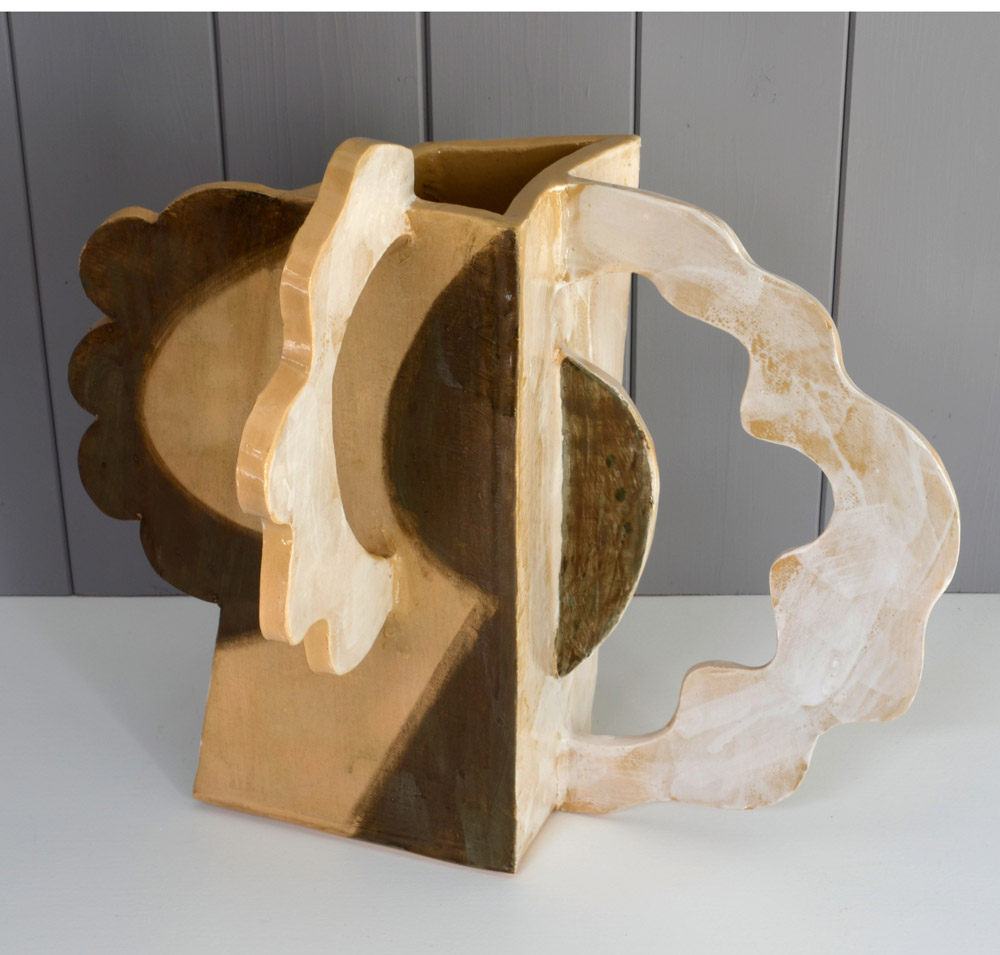
These pieces are not necessarily practical but fun and visually interesting – eye-catching in the way the conventional shape of the vessels has been altered before they reach the kiln. Here are some early examples:
Ruby my dear
People might look at these objects and consider whether they could use them or not, or whether they just go for them because they are sculptures that fill a space in an interesting way.

Striped splash pot
People take them home, sometimes placing them in a particular place in a room, say a mantelpiece or a shelf, or putting flowers in them and changing their position every now again. The work swings between functionality and abstraction – this is what gives it its allure. It’s playful.

Jumble vase
A man walks into a seafood shack cradling a salmon and asks, “Do you make fish cakes?”
“Yes, of course,” the server replies.
“Great,” says the man, “It’s his birthday!”


